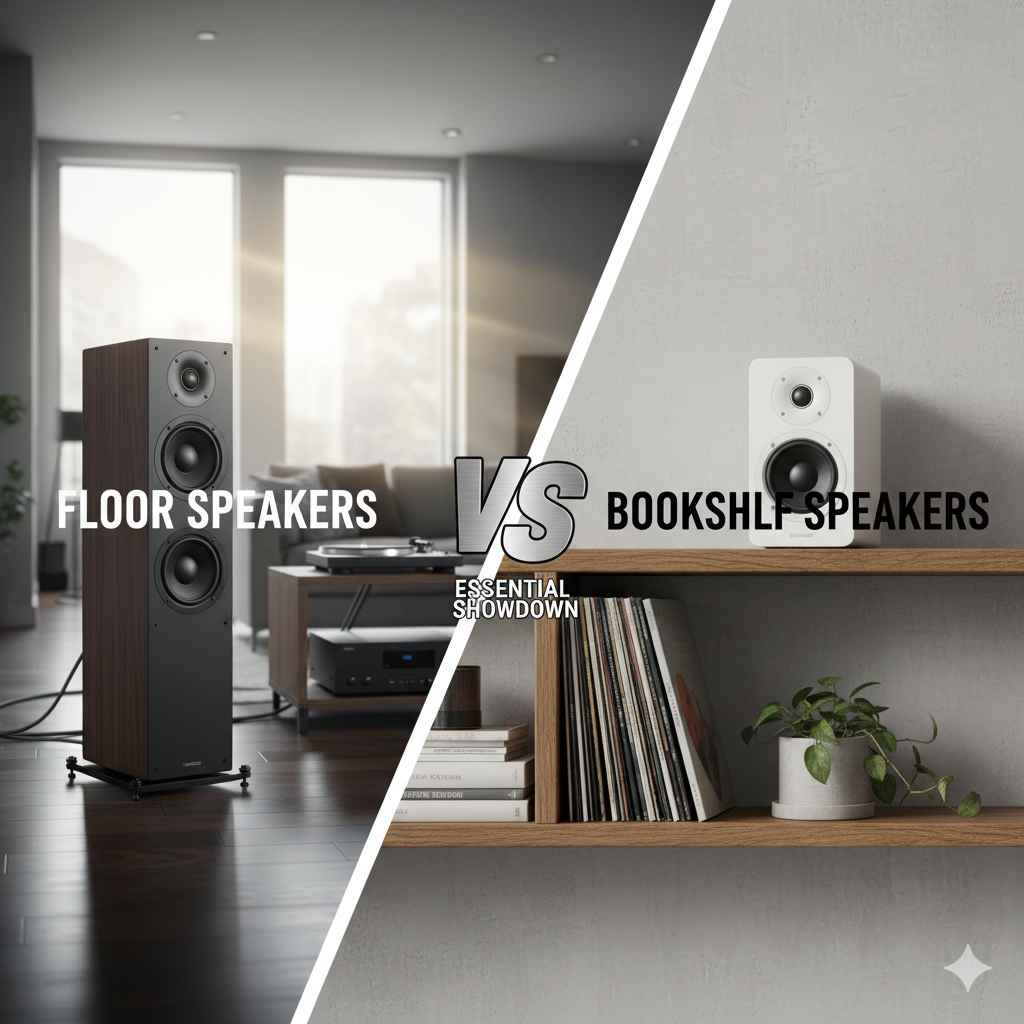
Floor Speakers Vs Bookshelf: Essential Showdown
Floor speakers vs bookshelf speakers boils down to size, space, and sound power. Floor-standing (tower) speakers generally offer deeper bass and fill larger rooms better. Bookshelf speakers are compact, affordable, and excellent for smaller spaces or as rear channels, often requiring stands for optimal performance. Choosing wisely depends on your room size and budget.

PERLESMITH
PERLESMITH Universal Speaker Stands for Surround Sound…
- Wide Compatibility: The PERLESMITH speaker stands feature an adjustable width of 4.5" to 9", making it compatible with most small…
- Customizable Height for Optimal Sound: These floor speaker stands feature an adjustable height range from 33.3" to 45", positionin…
- Two Cable Management Options: The speaker stands pair feature a 1.18" H x 0.59" W cable hole for routing wires through the hollow…
As an Amazon Associate I earn from qualifying purchases.
For a closely related home or decor topic, How To Store Books Without A Bookshelf Creatively gives readers a useful next step.
Picking new home audio equipment can feel like checking the oil for the first time—a bit confusing! You’ve decided you need better sound than your TV provides, but now you face the big choice: big floor speakers or smaller bookshelf models? It’s a common roadblock for anyone setting up a living room system. Don’t worry; this isn’t about needing an engineering degree. We are going to break down the differences simply, focusing on what matters: sound quality, space requirements, and budget. By the end of this guide, you will feel confident grabbing the right speakers for your home setup. Let’s dive into this speaker showdown and get your tunes sounding fantastic!
Understanding the Basics: What Makes Them Different?
When we talk about home audio, speakers come in a few main shapes. Floor-standing speakers and bookshelf speakers are the two heavyweights in the stereo or home theater world. While both aim to deliver sound, their physical size dictates what they can do best.
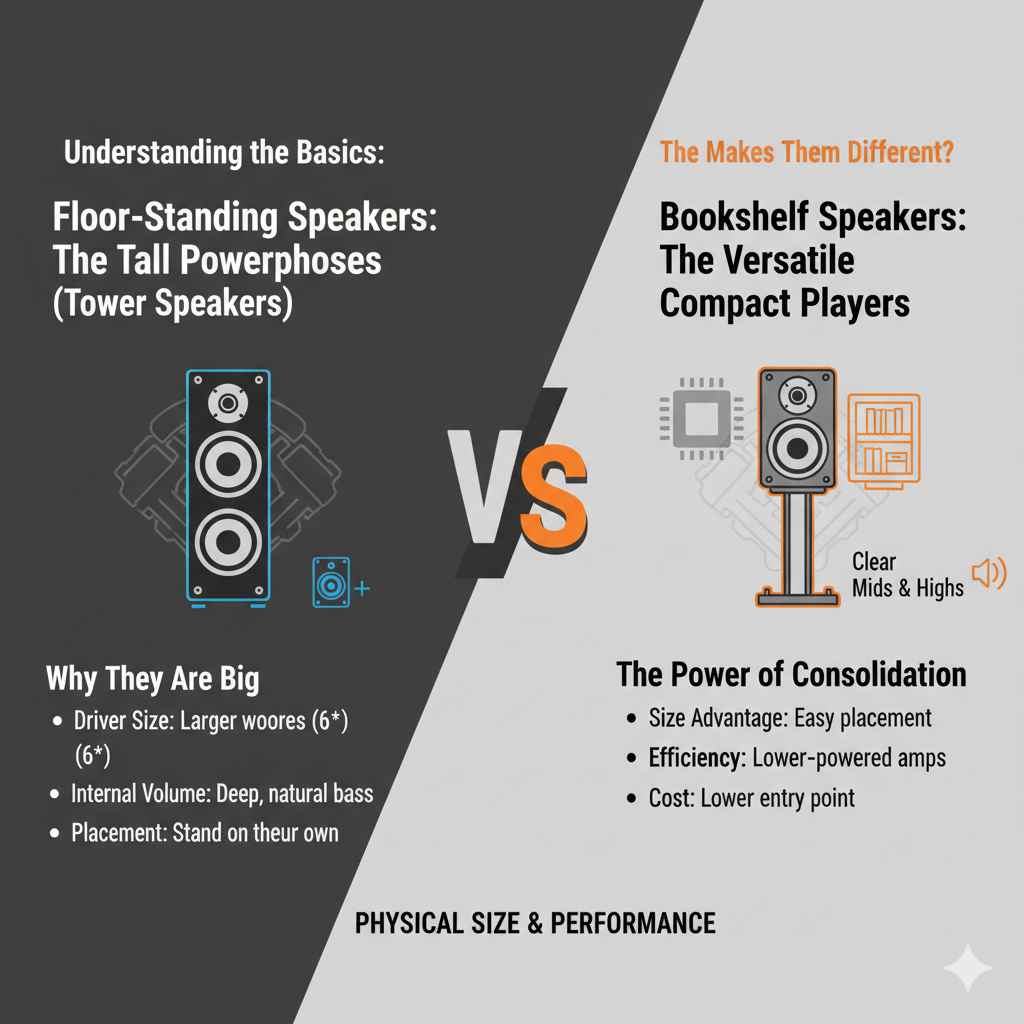
Floor-Standing Speakers: The Tall Powerhouses (Tower Speakers)
Think of floor-standing speakers like the reliable V8 engine of your stereo setup. They are tall, usually resting directly on the floor, and they have the physical space inside their cabinet to house larger components. They are designed to deliver a full range of sound straight out of the box.
Why They Are Big
The size isn’t just for looks. Bigger cabinets mean more air volume, which is crucial for producing natural, deep bass frequencies without needing help from a separate subwoofer (though many people add one anyway!).
- Driver Size: They can fit larger woofers (the drivers that handle low sounds), often 6 inches or larger.
- Internal Volume: More space inside allows the low notes to move and resonate naturally.
- Placement: They stand on their own; no need for extra furniture or stands.
Bookshelf Speakers: The Versatile Compact Players
Bookshelf speakers earned their name because they used to sit neatly on standard home shelving units. Today, while many still use them there, they sound best when placed on sturdy speaker stands, ideally at ear level. They are smaller, making them much easier to position in tight spaces.
The Power of Consolidation
Bookshelf speakers pack two or sometimes three drivers into a small box. They are fantastic for producing clear midrange (voices) and crisp highs (cymbals) very accurately. However, because they are smaller, they often struggle to move air enough to produce deep, rumbling bass on their own.
- Size Advantage: Easy to place in apartments, smaller offices, or as side/rear channels in a surround sound system.
- Efficiency: Often work well with lower-powered amplifiers or smaller receivers.
- Cost: Generally represent a lower entry point into true hi-fi sound.
The Essential Showdown: Floor Speakers vs Bookshelf
When comparing these two, we need to look at four main areas that directly affect your listening experience and your wallet. Think of this comparison like choosing between a dependable sedan and a compact SUV—both get you there, but one handles different terrains better.
1. Sound Quality and Bass Response
This is usually the deciding factor for audiophiles. How low and how loud can they play before the sound gets muddy?
Floor Speakers: The Bass Advantage
Generally, floor-standing speakers win hands down when it comes to raw bass output. Their larger enclosures and bigger woofers can reproduce the lower end of the musical spectrum (below 80 Hz, where you feel the music) with more authority and less strain. This means music sounds fuller even before you turn the volume up high.
For movie watching, this translates to deeper, more impactful explosions and effects, giving you that cinematic rumble that smaller speakers just cannot achieve without an extra subwoofer pairing.
Bookshelf Speakers: The Midrange Focus
Bookshelf speakers usually top out in terms of bass support around 50–60 Hz. While this is perfectly fine for background music or small rooms, you might notice serious music genres like rock, electronic, or action movies missing that foundational low-end punch.
Where they shine is detail. Because the drivers are smaller and work in a smaller box, they can often excel at high-frequency clarity and vocal reproduction. They sometimes sound more “accurate” at lower volumes than larger towers that need more power to really move.
2. Space Requirements and Placement Matters
This is where bookshelf speakers often take the lead for everyday drivers living outside of a dedicated home theater room.
Floor Speakers: Need Elbow Room
Floor speakers require significant space, not just for the speaker itself, but for the sound waves to develop properly. Placing large towers too close to walls or tightly packed into corners can cause bass booms that sound unnatural (this is called “room loading”).
Before buying towers, measure your space. A good rule of thumb is to have at least three feet of clear space behind them and good distance between them.
| Speaker Type | Footprint (Space Used) | Ideal Room Size |
|---|---|---|
| Floor-Standing | Large (Requires dedicated floor space) | Medium to Large Rooms (150 sq. ft. +) |
| Bookshelf | Small (Can sit on surfaces or stands) | Small to Medium Rooms (Under 150 sq. ft.) |
Bookshelf Speakers: Flexible Friends
If you live in an apartment, dorm, or a smaller living room, bookshelf speakers are your best practical friend. They take up very little floor space. The caveat, however, is stands. To get the best sound, you should ideally raise them so the tweeter (the high-frequency driver) is near your ear level when you are sitting down. This means you usually need to budget for speaker stands.
Pro Tip for Placement: According to acoustic design principles, placing speakers at the corners of a room significantly over-emphasizes bass frequencies. You can find excellent resources on speaker placement from university guidelines, like those sometimes shared by engineering departments, to ensure you get the best stereo imaging, regardless of speaker size.
3. Power Requirements (Amplification Match)
Just like your car needs the right fuel octane, your speakers need the right power from your amplifier or receiver. This matching is crucial for safety and sound quality.
Floor Speakers: Power Hogs
Generally, floor-standers are less efficient than their smaller siblings because they have to move larger cones. They often require more wattage (power) from your amplifier to reach the same loudness levels without distortion. If your receiver is older or lower-powered, you might struggle to make large towers sound their best.
Bookshelf Speakers: Easier to Drive
Bookshelf speakers are often rated with higher sensitivity (meaning they produce more volume for the same amount of power). Many quality bookshelf models can sound fantastic even when powered by smaller, entry-level stereo amplifiers or modern, compact Bluetooth receivers.
4. Budget and Overall Cost
Let’s be honest about the sticker shock. Price tags often scale directly with speaker size and the complexity of the engineering required.
Floor Speakers: Higher Initial Investment
You are paying for more materials, larger drivers, and more complex crossovers (the internal wiring that splits the sound frequencies). A quality pair of entry-level floor-standers usually starts where a very high-quality pair of bookshelf speakers might end.
Bookshelf Speakers: Accessible Entry Point
Bookshelf speakers offer a fantastic way to get into high-fidelity audio without breaking the bank. You can get excellent performance for significantly less money. Plus, because they are smaller, you might save money on cables and stands compared to the footprint required for towers.
Deciding Factor Check List: Which Setup is Right For You?
To pull this all together, let’s use a simple checklist. If you answer “Yes” to most questions in a column, that speaker type is likely your best fit.
| Question | Choose Floor-Standing If… | Choose Bookshelf If… |
|---|---|---|
| Room Size | Your room is large (over 300 sq. ft.) or you want deep theater effects. | Your space is small or medium (under 300 sq. ft.). |
| Need for Subwoofer | You want good bass without needing any added subwoofers. | You plan to buy a separate subwoofer later (or listen at modest volumes). |
| Budget | You want the biggest sound for your money and are willing to spend more upfront. | You need great sound quality on a tighter, entry-level budget. |
| Aesthetics/Space | You have plenty of floor space and want a “statement piece.” | Space is a concern, or you need speakers for surrounds or a desktop setup. |
The Role of the Subwoofer in This Showdown
It is impossible to discuss floor speakers vs bookshelf speakers without mentioning the subwoofer. A subwoofer is a dedicated speaker built only to handle the very lowest bass frequencies (LFE or Low-Frequency Effects).
Bookshelf Systems + Subwoofer = Powerful Combo
When you pair quality bookshelf speakers with a well-chosen subwoofer, the system often outperforms basic, all-in-one floor speakers. Why? Because the bookshelf speakers can focus entirely on mids and highs (where they excel), and the subwoofer handles the deep rumble, taking the strain off the smaller drivers.
This “2.1 system” (two bookshelves plus one sub) is often the sweet spot for price, performance, and space efficiency.
Floor Speakers Without a Subwoofer
If you choose large floor-standers, you can often skip the subwoofer initially, especially for music listening. Modern, high-end floor-standers are engineered to deliver satisfying low-end response on their own, giving you a complete soundstage from just two units.
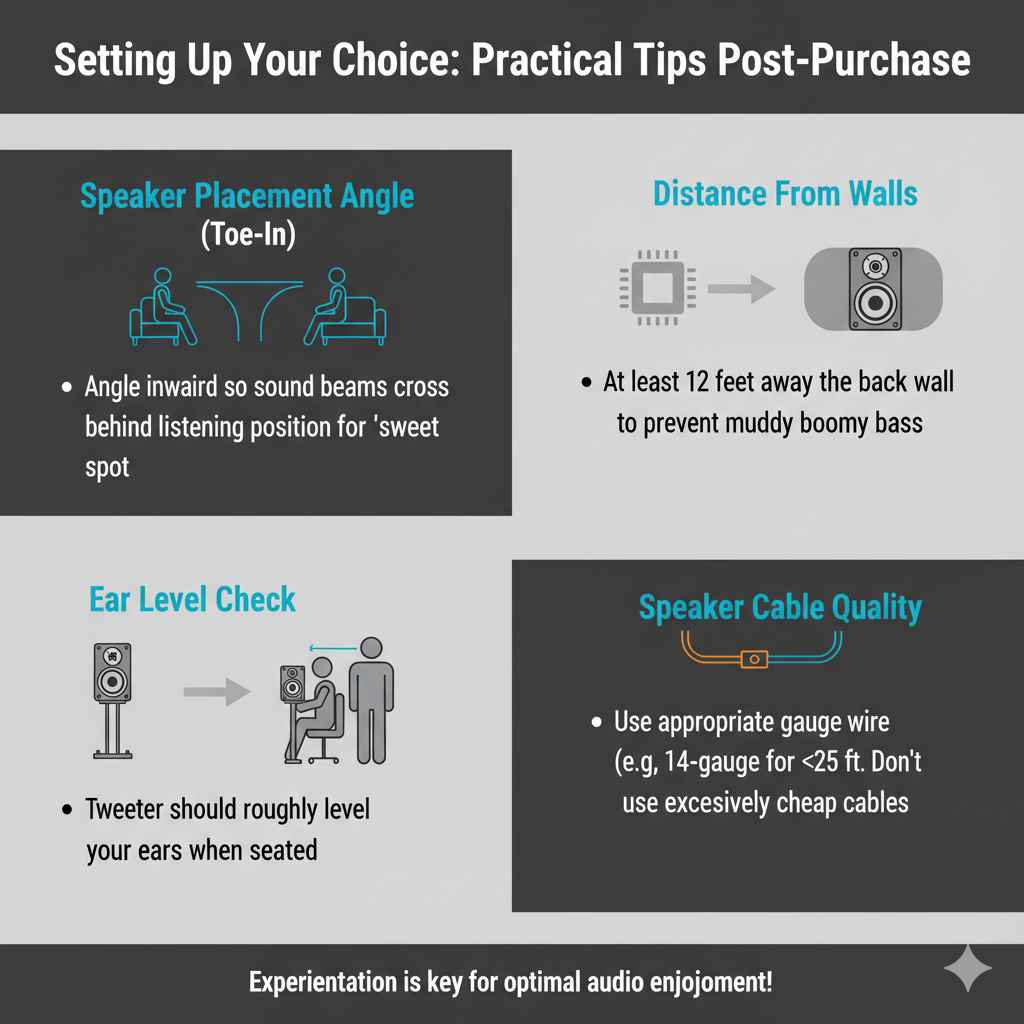
Setting Up Your Choice: Practical Tips Post-Purchase
Once you bring your speakers home, placement is key. Think of this like aligning the wheels on your car—getting it right saves you wear and tear (or, in this case, poor sound quality).
- Speaker Placement Angle (Toe-In): For both types, ensure they are slightly angled inward so that the sound beams cross just behind your main listening position. This creates a focused “sweet spot.”
- Distance From Walls: Pull speakers at least one to two feet away from the back wall. This prevents muddy, boomy bass caused by sound waves reflecting off the wall directly behind the driver—a common beginner mistake.
- Ear Level Check: If using bookshelf speakers on stands, the tweeter should be roughly level with your ears when seated. If using towers, the tweeter is usually designed to be near ear level already.
- Speaker Cable Quality: Don’t cheap out entirely on cables. While you don’t need the most expensive wire, ensure the gauge (thickness) is appropriate for the distance between the speakers and your amplifier. For typical home runs (under 25 feet), 14-gauge wire is usually a safe, solid choice. You can reference guidelines for proper wire sizing to ensure a safe connection.
Remember, whether you have towers towering over your setup or compact bookshelfs tucked neatly, the goal is clear audio enjoyment. Don’t be afraid to experiment—move them around! Sometimes just six inches makes a huge difference.
FAQ: Beginner Questions About Speaker Selection
Q1: Do I need speaker stands for bookshelf speakers?
A: While you can place them on a shelf, stands are highly recommended. Stands lift the speakers to ear level for better imaging and isolate the speaker from furniture, which stops bass vibrations from making other items rattle.
Q2: Can floor-standing speakers sound bad in a small room?
A: Yes, they often can. In small rooms, large speakers tend to over-emphasize bass frequencies, leading to a boomy, uncontrolled sound. Bookshelf speakers usually integrate better into smaller spaces without overpowering the acoustics.
Q3: Are floor speakers better for movies or music?
A: Floor-standing speakers usually excel at both because they offer a fuller frequency range naturally. However, a quality bookshelf system paired with a good subwoofer (a 2.1 setup) can often match or exceed the explosive dynamics of a tower-only setup for movies.
Q4: What is the biggest benefit of starting with bookshelf speakers?
A: The biggest benefit is scalability. You can start with a great pair of bookshelf speakers now, and later, you can use them as surround speakers when you upgrade your main front channels to floor towers, protecting your initial investment.
Q5: How tall should floor-standing speakers be?
A: Most standard floor-standers are between 30 and 45 inches tall. The cabinet height is engineered to work perfectly with the placement of the tweeter and the internal volume required for the woofer.
Q6: If I buy floor speakers, do I still need a subwoofer?
A: For serious home theater use, yes, almost always. For critical music listening, many high-quality floor-standers provide enough bass that a sub is optional. It depends entirely on how much low-end rumble you personally enjoy.
Conclusion: Making the Final Confident Choice
We’ve driven through the landscapes of floor-standing power versus bookshelf versatility. You now have the clear facts needed to bypass the confusion and make a purchase you’ll be happy with for years.
If your goal is massive, room-filling sound right now, you have the space, and your budget allows for it, the floor-standing speaker is your clear winner. They offer immediate, full-range performance that is hard to beat in one package.
However, if you value flexibility, have space constraints, or want to build a truly fantastic, multi-component system over time, start with high-quality bookshelf speakers and add a subwoofer when you are ready. This path is often more budget-friendly initially and surprisingly accurate for critical listening.
No matter which path you choose—towers or books, large or small—remember that the best speaker is the one that fits your space and your listening habits. Trust your ears, do a little tweaking with placement, and enjoy the incredible upgrade in sound quality coming from your setup!
Related pick: Check today's price on Amazon
Products related to this article
Sponsored / affiliate links. As an Amazon Associate I earn from qualifying purchases. I may earn additional commission from eligible campaigns.