Coffee Table Height Chart: Find the Right Fit for Your Sofa
A common rule of thumb is for a coffee table to sit about 1 to 2 inches below the sofa seat, so a 16 to 18 inch table often fits most 17 to 20 inch seat heights. If the table sits too tall or too low, it feels awkward, cuts into legroom, and makes drinks or books harder to reach. This coffee table height chart maps common sofa seat heights to the right table height, plus layout rules for small rooms and everyday use.
Height fit chart


This chart gives a fast starting point for the coffee table height chart shoppers actually need: sofa seat height first, table height second. Use the seat cushion as the baseline, then check whether a fixed top stays below the seat and whether a lift-top design is the better fit for work or eating.
Mismatch checklist: a table is too tall if it sits above the seat line, makes drinks or books hard to reach, or feels visually heavy beside the sofa. It is too low if it forces a long reach or leaves the top lost in the seating group. It is only worth keeping as a lift-top if the closed height fits the sofa and the raised top solves the task.
| Sofa seat height | Recommended coffee table height | Recommended coffee table height | Fit note |
|---|---|---|---|
| 16 in | 14 to 15 in | 35.6 to 38.1 cm | Best for low-profile seating; a fixed-top table should stay below the seat line, while a lift-top can add working height when raised. |
| 17 in | 15 to 16 in | 38.1 to 40.6 cm | A strong match for many apartment sofas; fixed-top tables stay easy to reach, and lift-top tables are useful when you need a higher surface sometimes. |
| 18 in | 16 to 17 in | 40.6 to 43.2 cm | Good for standard family-room sofas; fixed-top tables usually fit well, while lift-top tables are best if you also need eating or laptop use. |
| 19 in | 17 to 18 in | 43.2 to 45.7 cm | Works well when the sofa sits a bit higher off the floor; fixed-top tables should still stay below the seat if possible, and lift-top designs can help when the closed height must stay modest. |
| 20 in | 17 to 18 in | 43.2 to 45.7 cm | Stay below the seat; consider lift-top if you need a higher working surface, because a fixed-top table at this height can read visually heavy and feel hard to reach. |
Quick fit notes for standard, low, and lift-top tables
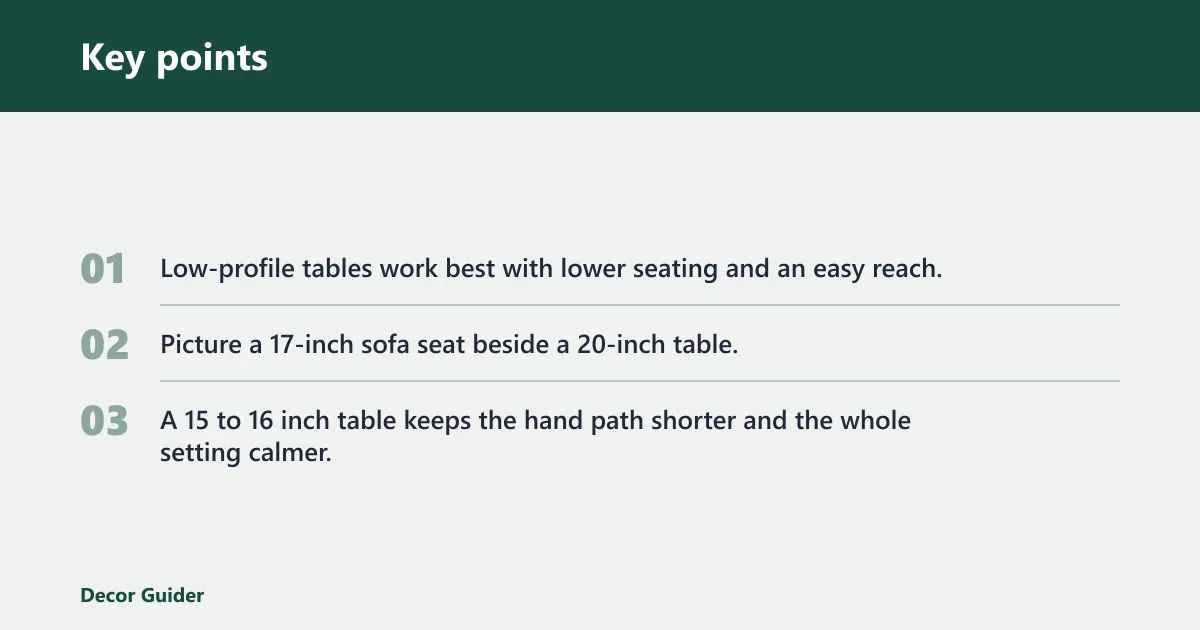
Standard fixed-top coffee tables are commonly reported to sit in the 16 to 18 inch range, which often lines up with many sofa seat heights. Low-profile tables work best with lower seating and an easy reach. Lift-top tables are different: the closed height can follow the chart, while the raised top gives you a higher surface for eating or laptop use.
Picture a 17-inch sofa seat beside a 20-inch table. The top now sits above the cushion, so drinks and books feel harder to reach, and the table can read visually heavy next to the seat. A 15 to 16 inch table keeps the hand path shorter and the whole setting calmer.
What is the right coffee table height?
The right coffee table height is below the sofa seat cushion, with the top easy to reach from a seated position. A common standard range is about 16 to 18 inches. That range suits many sofas because it balances reach, legroom, and visual proportion.
Why sofa seat height matters
Sofa seat height is the baseline because it tells you where your hands naturally land when you reach forward. If the coffee table is too low, you lean farther than you should. If it is too high, your forearms lift and the table can start to feel like a bench or side table instead of a center table.
-
Measure the seat cushion.
Measure from the floor to the top of the compressed seat cushion where you actually sit. Use that number, not the sofa frame, because seat height sets the reach distance you will feel every day.
-
Subtract 1 to 2 inches.
That gives the usual target for the coffee table top. The gap is small on purpose: enough to keep the table easy to use, but low enough to avoid a top-heavy look beside the sofa.
-
Check the arm height.
The coffee table should not sit awkwardly close to the arm height. A table that sits far above the seat line can look crowded beside the sofa, even if the room has enough floor space.
How arm height changes the visual fit
Sofa arm height changes how tall the table looks in the room. If the table is much higher than the seat and near the arm line, it can break the horizontal balance of the seating group. A lower table usually reads as lighter and more open, especially in smaller rooms or with low-profile sectionals.
How high should a coffee table be compared with a sofa?
In most rooms, the coffee table should be 1 to 2 inches lower than the sofa seat cushion. That gap keeps drinks, remotes, and books within easy reach, and it helps the seating group feel balanced. If the sofa sits unusually low or high, adjust the table slightly, but keep it below the seat line when possible.
The best height gap for reach and comfort
The best fit is below the sofa seat cushion. That keeps the table comfortable for placing a mug or resting a tray without stretching. The table should also be short enough that it does not interrupt circulation across the room or block your knees when you lean forward.
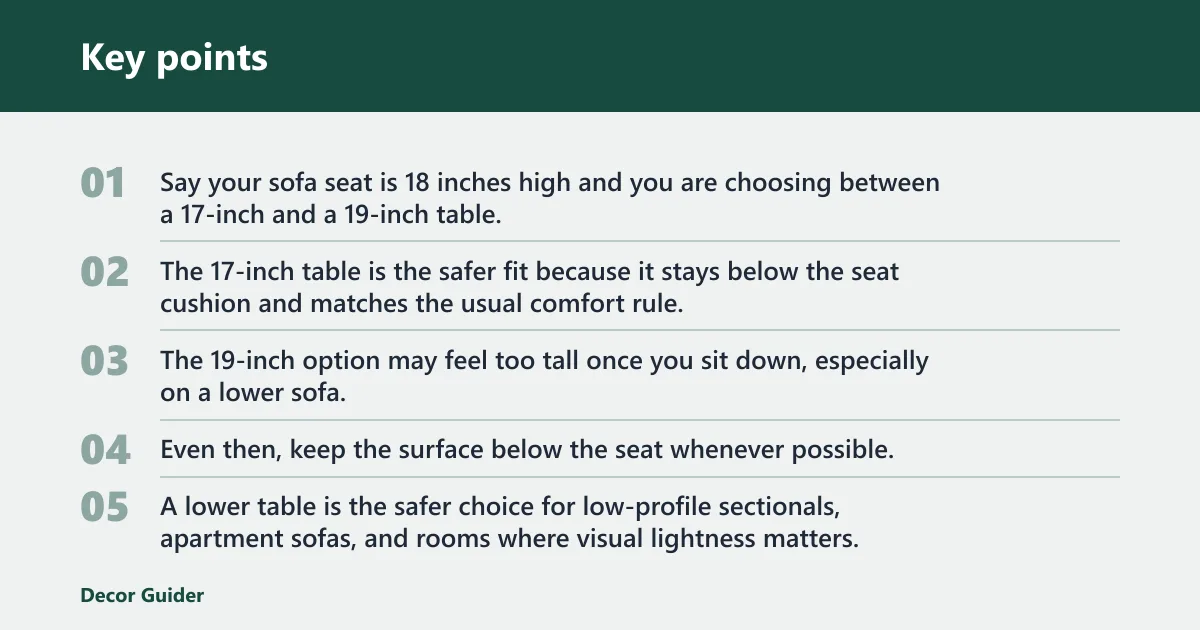
Say your sofa seat is 18 inches high and you are choosing between a 17-inch and a 19-inch table. The 17-inch table is the safer fit because it stays below the seat cushion and matches the usual comfort rule. The 19-inch option may feel too tall once you sit down, especially on a lower sofa.
When a slightly higher table still works
A slightly higher table can still work when the sofa seat is also higher, especially in family rooms with deeper cushions and taller seating. Even then, keep the surface below the seat whenever possible. If the height is close to the seat line, check whether the table still feels easy to reach from the center seat and the ends.
When a lower table is the safer choice
A lower table is the safer choice for low-profile sectionals, apartment sofas, and rooms where visual lightness matters. It also reduces the chance of bumping shins when people move around the seating area. Lower tables suit quiet living rooms where the coffee table is mostly for books, a lamp tray, or a single drink.
Is 20 inches too high?
For many sofas, yes. A 20-inch coffee table can be too high for a low sofa, and it often feels awkward unless the sofa seat is also high. It is generally better to stay below the seat cushion.
Seat-height ranges where 20 inches works
Twenty inches can be acceptable when the sofa seat is tall enough that the table still reads as lower or nearly level with the cushion line. That usually means a higher-seated sofa rather than a low one. Even then, check the arm height and the room layout so the table does not feel oversized or hard to approach.
Seat-height ranges where 20 inches feels high
On sofas around 16 to 18 inches high, a 20-inch table is often considered too tall. That gap makes the reach less comfortable and can make the seating group feel cramped or out of proportion. It is also harder to put your feet up without the table feeling in the way.
When a lift-top is the better answer
If you need a higher surface for eating or laptop use, a lift-top coffee table is the better answer than a fixed 20-inch top. The lower closed height can still fit the sofa, while the raised surface gives you the working height you need. Lift-up designs can also function as living room storage ideas.
Coffee table height by sofa type
Different seating types shift the ideal height a little. The sofa seat height still leads, but apartment sofas, low-profile sectionals, and family-room seating each create different reach and proportion problems. Match the table to the seating style first, then to the room.
Apartment sofas
Apartment sofas often sit a little lower and live in tighter rooms. A lower coffee table usually works best here, especially when the room also needs circulation space. Round or oval shapes are often easier to move around in these smaller layouts, and they soften corners in narrow paths.
Low-profile sectionals
Low-profile sectionals need a coffee table that stays low enough not to overpower the long seat line. A 14 to 17 inch table often looks better than a taller one. If you need extra function, nesting tables or a lift-top design can add use without forcing the main table higher.
Family-room seating
Family-room seating often uses a standard-height sofa and can handle a more traditional table size. Rectangular tables pair well with long sofas, while coffee tables should still remain shorter than the sofa for easier circulation. That keeps the center of the room open enough for daily movement.
Coffee table shape and clearance
Shape matters because height is only part of the fit. The wrong outline can crowd walking paths even when the height is correct. The table should be easy to reach from the sofa, leave room at the ends, and avoid sharp corners where people pass through often.
Rectangular tables for longer sofas
Rectangular coffee tables pair well with long sofas because they echo the sofa’s length and keep the center area balanced. Use this shape when the seating is wide and the room can support a longer piece. Keep enough open space at the ends so the table does not block circulation.
Round and oval tables for tight spaces
Round or oval coffee tables work best in tight spaces because they soften movement around the seating group. They are also kinder in homes with children or busy traffic paths, since there are no hard corners to catch a knee or shin. In a small room, that shape can make the center feel less crowded.
Walking space and corner safety
Leave enough space so you can move around the table without turning sideways. Coffee tables that are too large or too small can make a room feel cramped or out of proportion, so size and clearance matter together. A table should be shorter than the sofa and easy to pass at the ends.
-
Map the walking path.
Trace the route from the sofa to the main doorway or side chair. If the table blocks that route, choose a smaller footprint or a rounder shape.
-
Check the corner risk.
Stand where people usually enter the room and see whether a sharp corner sits in the path. If it does, switch to round, oval, or nesting tables to reduce bump points.
-
Compare table length.
For a long sofa, choose a rectangular table that looks shorter than the sofa, not wider. That keeps the seating group balanced and leaves room to walk at the ends.
Coffee table height for storage and flexibility
Storage and flexible surface space matter most when the room has to do several jobs. In those cases, height is about more than appearance. Lift-top tables help with eating or laptop use, and nesting tables help when you need extra surface area that can tuck away later.
Lift-top tables
A lift-top coffee table is ideal if you want the surface closer for eating or laptop use. The lower closed height can still follow standard sofa fit rules, while the raised top changes the working posture. That makes it useful when the coffee table has to act like a temporary desk or dining surface.
Use lift-top designs when the main need is multi-use support, not just display. They are especially helpful in small homes where one piece has to do more than one job, and where storage inside the base can reduce clutter.
Nesting tables
Nesting tables are useful when you need extra surfaces that tuck away. Pull them out for guests, then push them back to free the center of the room. They are a strong option when the ideal coffee table height varies by activity or when the seating layout changes often.
Small spaces benefit from flexible furniture such as ottomans that double as coffee tables. That kind of piece can work when you want softness, storage, or a lower visual profile without committing to a single fixed top.
When extra surface area matters more than a fixed top
Choose extra surface area over a single fixed top when you entertain often, work from the sofa, or need a quick spot for snacks and laptops. If the table must support several uses, a lift-top or nesting set usually solves the problem better than forcing one fixed height to do everything.
Frequently asked questions
What is coffee table height?
Coffee table height is the distance from the floor to the tabletop. For most sofas, the best height is below the seat cushion, which usually puts the table in a comfortable reach zone. Standard tables often fall in the 16 to 18 inch range.
How high are coffee tables?
Most coffee tables are low enough to sit below the sofa seat line, with many standard models around 16 to 18 inches tall. Low-profile designs can sit lower, while lift-top models keep a lower closed height but rise for eating or laptop use. Height should still suit the sofa and room layout.
What is the standard coffee table height?
The standard coffee table height is below the sofa seat cushion, and many tables fall around 16 to 18 inches. That range works because it keeps drinks within easy reach and avoids a bulky look beside the sofa.
How tall should a coffee table be compared with a sofa?
A coffee table should usually be 1 to 2 inches lower than the sofa seat cushion. That gap keeps the top easy to reach and helps the room feel balanced. If the table rises to the same height as the seat or above it, comfort and proportion usually suffer.
Is 20 inches too high for a coffee table
For many sofas, yes. A 20-inch table is often too high for a low sofa and can feel awkward to reach. It may work better with a taller seat, but most rooms do better with a top below the sofa cushion. A lift-top table is usually the smarter choice if you need extra height only for tasks.
How many inches lower than the sofa seat should a coffee table be?
Use 1 to 2 inches lower as the normal target. That small drop keeps the surface comfortable for everyday reach without making the table look sunk too low. If the sofa has especially low cushions or a low-profile frame, keep the table on the lower end of the range.
What coffee table height works best for a lift-top table
A lift-top table works best when the closed height still follows the usual sofa rule, meaning below the seat cushion. Then the raised top can handle eating or laptop use. That lets you keep a good living-room height when closed and a more usable work height when open.
Products related to this article
Sponsored / affiliate links. As an Amazon Associate I earn from qualifying purchases. I may earn additional commission from eligible campaigns.