Christmas Decor Ideas by Room: Where to Decorate
Editorial note: This room-by-room guide is organized around placement, clearance, flame safety, and scale so readers can decorate without losing function. It uses practical home-decor guidelines together with safety guidance from the National Fire Protection Association (NFPA), the U.S. Consumer Product Safety Commission (CPSC), and UL Solutions on candles and holiday lighting.
Quick-start summary for skimmers: Choose one palette and one light temperature, decorate only the top third of surfaces where possible as a styling guideline, keep about 24 to 36 inches of walking clearance in smaller routes while allowing more space on main paths when you can, and assign one focal point plus one accent to each room. Start with the tree room, then the entryway, then the dining room. In small rooms, move decor to walls, mirrors, windows, shelves, and mantels instead of adding more floor pieces.
Matrix summary: Use the room placement matrix below as a printable room-by-room planning sheet. It shows what to place, where to place it, how large it should be, what safety limit matters there, and what to use if you need a renter-friendly option.
Use a one-third styling rule: decorate only the top third of surfaces where that look makes sense and keep about 24 to 36 inches of walking clearance in tighter areas, with wider circulation preferable on main routes, then assign one focal point and one accent to each room. Skip that balance, and rooms feel cramped, cluttered, and harder to clean, cook, host, or move through safely. This guide maps Christmas decor ideas by room, including what to place where, how much to use, and what to avoid in living rooms, kitchens, bedrooms, baths, entries, mantels, and small spaces.
Whole-home decorating map



A workable Christmas plan starts with placement, not shopping. Decide which rooms get a focal point, which get supporting decor, and which get only a small accent. Then place each item where you will see it without interrupting traffic, storage, power access, or daily tasks.
Choose one palette and repeat it with restraint
Carry one color palette through the house, then change how much of it appears in each room. Put the main color on the tree, repeat it in ribbon, pillows, or runners, and let quieter rooms show only a small hit of that same color on hand towels, candles, or a compact wreath.
For a modern scheme, Trendey notes that Christmas decor can lean monochromatic. That inspiration works especially well if your rooms already have strong finishes, because the holiday layer stays controlled instead of fighting the furniture.
Repeat light temperature and one finish
Choose one indoor light temperature and use it from room to room. Warm white usually reads softer in living rooms, bedrooms, and dining rooms. Cool white can look sharper in modern spaces, but mixed temperatures across adjoining rooms often make a house feel visually broken up.
Repeat one finish as well: matte black, brass, chrome, stained wood, or white-painted wood. That repeated material links a mantel garland to a dining centerpiece and an entry console without forcing every room to match.
Assign anchor, support, and accent rooms
Anchor rooms carry the most visual weight. In most homes, that means the living room and entryway, and often the dining room if guests gather there. Support rooms get a smaller version of the same palette. Accent rooms, such as bathrooms or hallways, get one contained holiday move and stop there.
Trendey suggests homes can use different themes for each room. That can work, but first-time decorators usually get better results by changing scale more than theme. Keep the same palette and light temperature, then vary only the decor type.
Use a function-first rule before placing any decor
Before adding anything, identify what the room must still do. A kitchen still needs prep space. A hallway still needs clear movement. A home office still needs a usable desk and a clean video-call background.
In small homes, the practical takeaway is simple: use fewer decorations, prioritize pieces you really want to see, and keep open space so the decor can stand out. Those points explain why wall, window, shelf, and tabletop decor usually work better than extra floor decor.
What to skip in small rooms
In small rooms, skip wide tree collars, floor lantern clusters, deep console arrangements, extra ottomans used only as decor, and bulky baskets filled with throws. These pieces usually steal walking width faster than they add holiday impact. A slim tree, one wall wreath, one shelf accent, and one soft textile change almost always read cleaner.
Which rooms should you decorate first?
Start with the room that carries the main tree, then decorate the public sightline rooms that connect to it, usually the entryway and dining room. Finish with bedrooms, baths, and pass-through areas last. If time is tight, stop after the first three spaces and repeat only your palette and lighting elsewhere.
First: the main tree room
The living room is usually first because the tree sets scale, color, ornament finish, and lighting temperature for the rest of the home. Christmas.com lists pre-lit trees, unlit trees, and flocked trees among its tree shopping options, which can help you picture how the main tree choice affects every room that follows.
If the room is narrow, a slim or pencil tree helps preserve more usable floor width between seating and walkways. If the room is very tight, a tabletop tree can also make sense. Those options preserve floor area while still giving the home a visual center.
Second: the sightline rooms
Decorate the entryway or foyer next, because it frames the first view into the home. Trendey points to a foyer as the entryway into the home, which is exactly why this space should echo the tree room without competing with it.
Then move to the dining room if it is visible from the living room or entry. Sightline continuity matters more than decorating every room equally.
Last: private and pass-through zones
Bedrooms, bathrooms, hallways, and offices come after the public rooms. They need less volume and more control. In these rooms, one mini tree, one mirror wreath, one candle cluster, or one set of holiday textiles is usually enough.
Three scheduling options
- One afternoon: tree room, entryway, dining table.
- One weekend: add kitchen, staircase or hallway, and main bedroom.
- Full-house setup: finish with bathrooms, office, guest room, and secondary surfaces.
How do you keep Christmas decor cohesive without clutter?
Keep cohesion by repeating color, finish, and light temperature, then limiting each room to one focal point and one supporting accent. Clutter shows up when too many surfaces compete, floor decor narrows circulation, or everyday objects lose their place under seasonal items.
Repeat color in different doses
Use the strongest version of your palette in the anchor room. In support rooms, repeat only one color or material. A red-and-brass living room can become brass candles and a muted red runner in the dining room, then just a brass bell or ribbon in the bedroom.
Move volume upward in small rooms
Wall-hung wreaths, mirror garlands, shelf greenery, and window lights take less functional space than baskets, lanterns, or extra stools. That is why small rooms benefit from decorating vertically rather than across the floor.
Picture a studio apartment with one sofa, a desk, and a dining nook. A floor tree plus two lanterns can eat the path from the kitchen to the entry. A slim tree, window lights, and one shelf garland keep the same holiday signal while protecting circulation.
Use one statement piece per room
Pick one item to lead: the tree, a mantel garland, a dining centerpiece, or a wreath over the bed. Supporting accents should stay quieter in color and height so the room still reads clearly from the doorway.
Keep daily-use surfaces partly open
Leave part of every active surface exposed. On a coffee table, keep room for drinks or remotes. On a kitchen counter, keep prep zones open. On a dresser, do not block drawers with layered decor that has to be moved every morning.
How to style a staircase banister for Christmas
A staircase banister can become a strong holiday focal point when the greenery matches the rail and is attached in a way that stays secure and out of the way. The supporting guide explains how to choose garland by banister shape, how much length to buy, and which fastening method works best for straight, curved, steep, narrow, and high-traffic stairs. It also covers adding ribbon, lights, and accents without making the rail bulky or unsafe.
If you want a practical setup that looks finished and avoids slipping or paint damage, see staircase banister Christmas tips.
How to hang doorway garland without damage
If you want garland on a door without risking paint, residue, or a dropped display, the key is choosing a hanger that matches the door surface and the garland’s weight. The supporting guide breaks down the safest options for painted wood, metal, glass, trim, and rental-friendly frames, and explains when adhesive hooks are enough versus when a mechanical hanger is the better choice. It also covers how doorway traffic and garland weight change the risk of slipping or scratching, so you can place the decoration securely instead of guessing.
For a practical breakdown of methods and fit-by-surface advice, see garland hanging methods.
Room placement matrix

Use this table as a placement map, not a shopping list. Read across each row to match the room with the decor type, where it should sit, how large it should be relative to the room, what safety limit matters there, and what to use if you rent or need a low-damage option.
| Room | Best decor types | Ideal placement | Size/scale rule | Safety note | Renter-friendly alternative |
|---|---|---|---|---|---|
| Entryway or foyer | Wreath, slim garland, console vignette, window lights | Front door, above mirror, along console back edge | Keep decor shallow in narrow spaces; protect 24 to 36 inches of walking clearance | Do not narrow the path or cover switches and outlets near the door | Over-door wreath hook, battery candles, removable hooks on mirror frame |
| Living room | Tree, mantel garland, stockings, coffee-table tray, pillows, throws | Tree near an outlet and away from door swing; garland on mantel; tray centered on table | One focal tree plus one secondary decorated surface | Keep tree base out of main walking routes; keep flames away from stockings and greenery | Tabletop or pencil tree, flameless candles, removable stocking hooks |
| Dining room | Runner, low centerpiece, taper candles, chair ribbon if space allows | Center of table, sideboard, china cabinet shelf | Centerpiece should stay below seated sightlines or be very narrow | Protect serving space and keep candles clear of sleeves, napkins, and greenery | Battery tapers, vase of branches, tray centerpiece that lifts off in one move |
| Kitchen | Mini wreath, windowsill lights, small bowl filler, tea towels | Window, open shelf, breakfast nook, non-prep counter corner | Decorate only unused counter sections; keep most worktop clear | Keep garland and fabric away from burners, steam, and grease zones | Wall-hung decor, clip-on wreath, plug-in lights away from sink |
| Bedroom | Throw blanket, pillows, dresser greenery, mini tree, soft lights | Bed foot, headboard, dresser top, nightstand corner | Limit to one textile swap and one lit accent | Use battery candles near bedding and curtains | Tabletop tree, removable headboard garland ties, LED string lights |
| Bathroom | Hand towels, small candle, mini wreath, tray accent | Mirror, back of toilet only if stable, vanity corner away from splash zone | Use one tiny accent plus one textile change | Choose moisture-safe decor; keep cords away from water | Paper art in frame, faux greenery ring on mirror, flameless votive |
| Hallway or landing | Mirror wreath, wall sconces with ribbon, slim console decor | On wall, mirror, or very shallow table | No freestanding decor in tight corridors | Do not reduce circulation width or block doors | Removable hooks, ribbon-only decor, framed seasonal print |
| Staircase | Garland, ribbon, light strand | On stair rail only, secured at intervals | Keep fullness on the outer side of the rail, not the hand path | Trendey recommends hanging garland on the stair rail; keep the handrail grip usable | Lightweight faux garland with zip ties or removable fasteners |
| Home office | Desk wreath, shelf garland, window lights, small tree | Bookshelf, credenza, background wall, window frame | Keep desktop mostly clear; one decorated background zone is enough | Manage cords so task lighting, chargers, and decor do not tangle | Battery fairy lights, paper honeycomb tree, removable wall hook |
| Guest room or multipurpose room | Mini tree, one throw, one pillow, dresser bowl, framed print | Dresser, side table, window ledge | Decor should not interfere with luggage, folding beds, or storage access | Keep decor away from heaters and temporary sleeping paths | Fold-flat tabletop decor, fabric runner, clip-on wreath |
Christmas decor ideas by checklist
- Walkways between major furniture pieces
- Door swing and closet access
- Windows that still need to open or close
- Outlets needed for lamps, vacuums, chargers, or kitchen appliances
- Light switches and thermostats
- Vents, radiators, and baseboard heaters
- Prep counters, dining serving areas, and bathroom sink edges
- Desk work zones and storage drawers
- Main sightlines across entry, living, and dining spaces
What belongs in the entryway, living room, and dining room?
The entryway needs a first-impression piece, the living room needs the strongest focal point, and the dining room needs low, guest-friendly decor. Connect them with the same palette and lighting, then change the form: wreath in the entry, tree and garland in the living room, centerpiece in the dining room.
Entryway and foyer
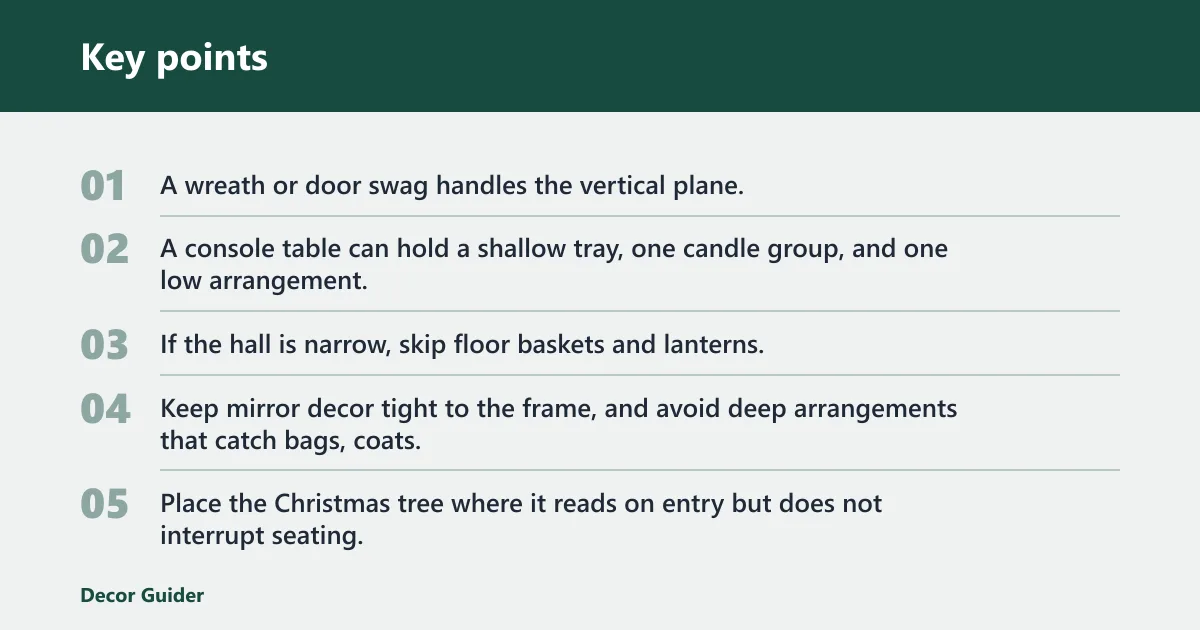
Use the door and console as the main zones. A wreath or door swag handles the vertical plane. A console table can hold a shallow tray, one candle group, and one low arrangement.
If the hall is narrow, skip floor baskets and lanterns. Keep mirror decor tight to the frame, and avoid deep arrangements that catch bags, coats, or sleeves.
Living room
Place the Christmas tree where it reads on entry but does not interrupt seating. A common rule of thumb is to leave enough clearance to move around the tree without turning sideways, and to keep the tree away from door swing and daily paths to the sofa.
Use the mantel as the second zone. Garland can be lighted or unlit. Lighted garland works best when the mantel is the room’s main visual wall and nearby outlets are accessible. Unlit garland works better if the tree already provides most of the sparkle and extra cords would show.
On the coffee table, keep decor contained in a tray. Low candles, a small branch arrangement, or a bowl of ornaments is enough. Leave open space around it.
Throw blankets and pillows should support, not bury, the seating. Add one throw per sofa or chair that actually needs it, and a limited pillow swap in your palette. Too many pillows turn a usable seat into storage.
Mantel-specific placement and safety
A mantel should read as one long composition, not a stack of unrelated objects. Start with one garland or one central mirror or artwork, then layer only two supporting elements: stockings, candles, bells, or a pair of matching objects. If the firebox is active, keep the decor line outside the heat path and do not let garland, ribbon, or stocking toes hang toward the opening.
For visual balance, fuller garland fits wider mantels and taller ceilings, while a slimmer strand suits short mantels, shallow shelves, and small rooms. If the mantel already has a television, use lower-profile greenery and fewer tall accents so the whole wall does not feel top-heavy.
On working fireplaces, follow the fireplace manufacturer’s clearance instructions and avoid placing combustible decor where it can be exposed to heat. NFPA guidance on candles and holiday decor supports the same common-sense rule: keep anything that can burn well away from flames and heat sources. In practice, that means flameless candles are often the better mantel choice if stockings, greenery, or ribbon are nearby.
Dining room
Start with a runner if the table surface is attractive and you want lighter coverage. Use a cloth if the table needs visual softening or the room looks bare. Then add a centerpiece that stays below guest sightlines or is narrow enough that people can still see across it.
Candles belong down the centerline or grouped on a tray. Varying heights helps, but only if the grouping still leaves room for serving dishes, elbows, and conversation.
Suppose your dining table seats six and also serves buffet dishes on Christmas Eve. A wide centerpiece plus tall tapers can force platters to the edge. A narrow runner, one low greenery bowl, and two short candle groups keep the table usable.
How should you decorate bedrooms, bathrooms, and hallways?
Private and pass-through spaces need quieter decorating than public rooms. In bedrooms, swap textiles and add one soft light source. In bathrooms, use moisture-safe accents only. In hallways, keep decor on walls, mirrors, or very shallow surfaces so the path stays fully open.
Bedroom
The easiest bedroom upgrade is textiles. Add one holiday throw at the foot of the bed and one or two pillow covers that pull from the home’s palette. Then stop before the bed starts looking overloaded.
A mini tree on a dresser or one garland on a headboard works well. Use softer lighting here than in public rooms. Battery-operated candles are the safer choice near bedding, curtains, and upholstered benches.
Bathroom
Keep the bathroom restrained. Good options are hand towels, one small tray accent, one mini wreath on the mirror, or one flameless candle. Avoid garland draped where it can collect moisture or interfere with cleaning.
Do not place decor on any surface that gets wet often, and do not route cords near sinks. This room should feel intentional, not crowded.
Hallways and landings
Use vertical decor only unless the hallway is unusually wide. A mirror wreath, ribbon on sconces, or a narrow ledge with one branch arrangement is enough.
If you have stairs, rail garland is the obvious move, but keep the gripping surface clear. Fullness should spill to the outside face of the rail rather than into the hand path.
How do you decorate kitchens and work spaces without losing function?
Decorate kitchens and work spaces only where they will not interrupt tasks. In kitchens, limit decor to windows, shelves, breakfast nooks, and non-prep corners. In offices, decorate the background wall or shelf, not the desk itself, unless the item is small enough to ignore during work.
Kitchen
Use low-footprint decor on counters, and only in corners that never handle chopping, appliances, or dish stacks. Window sills, shelves, and breakfast nooks are usually safer bets than prep zones.
Garland near a range hood can work only if it is clearly away from heat, grease, and steam. In many kitchens, that means skipping the hood entirely and decorating the window or open shelving instead.
Christmas lights belong on windows or shelf edges where cords can reach power without crossing the sink or stovetop. Keep outlets visible. Hidden outlets are one of the easiest ways to make a kitchen setup frustrating later.
CPSC and UL Solutions both emphasize checking seasonal light sets for damage, using products according to their listing and instructions, and avoiding overloaded connections. In a kitchen, that matters even more because cords, heat, and water are already competing for the same limited zones.
Home office and multi-use rooms
Style the camera background, not the whole room. A shelf garland, a small wreath, or a mini tree on a credenza reads clearly on screen and does not compete with papers, chargers, or task lamps.
Desk decor should stay small and movable. If the room doubles as storage, guest room, or homework zone, put holiday items on the one surface least likely to be cleared twice a day.
How do you size the tree, garland, lights, and textiles for each room?
Size decor by room function first and square footage second. The tree should fit the focal wall without crowding doors or seating. Garland should match the length of the surface, lights should follow accessible power routes, and textiles should add comfort without taking over sitting or sleeping space.
Christmas tree placement and ornament density
Place the tree where it can be seen from the doorway and near a power source, but not in front of a door, vent, or regular walking lane. Christmas.com offers both pre-lit and unlit trees, so choose based on whether the room already needs more cords.
For style, a flocked tree reads softer and brighter in sparse rooms, while a green tree often fits homes with more wood tones. Christmas.com lists flocked trees as a tree category, which makes them an easy option if you want a built-in snowy look without adding much else.
Ornament density should scale with room size. In a small room, lighter ornament spacing lets the tree breathe and keeps the whole room from looking dense. In a large living room, a fuller tree can carry more ornaments without feeling heavy.
If you are using a live tree, water level matters as much as placement. Keep live trees watered and away from heat sources because dry needles ignite more easily and shed faster.
Garland fullness, placement, and attachment
Use garland on mantels, stair rails, console tables, doorways, headboards, shelves, and window frames. Mantels and rails can handle fuller layering. Shelves, headboards, and narrow consoles usually look better with a slimmer strand that does not droop into use space.
Choose lighted garland when the surface needs to glow on its own. Choose unlit garland when the room already has strong tree lights or when you want to avoid visible cords.
For attachment, match the fastener to the surface. Use removable hooks on painted walls, over-door hooks on doors, zip ties on railings, ribbon loops on bedposts, and simple tucks or weighted placement on mantels and shelves.
Lights and outlet planning
Warm white creates a softer look in traditional and mixed-style interiors. Cool white fits cleaner, sharper schemes better. The main rule is consistency from room to room.
Frame windows with lights only if the cord can drop cleanly to an outlet without crossing a doorway. Integrate lights into garland when you want one combined element instead of two separate visual layers.
For technical safety, use indoor lights indoors, replace damaged sets, and follow the product instructions for end-to-end connections. That guidance is standard across UL Solutions and CPSC holiday-lighting advice and is more useful than guessing based on how one strand looks in the package.
Throws and pillows
Limit soft goods to what the room can still use easily. On a sofa, one throw and one or two seasonal pillow covers are often enough. On a bed, one folded blanket and one accent pillow in a holiday fabric or color usually reads cleaner than a full bedding overhaul.
Where should you use candles, and where should you skip them?
Use real candles only on stable surfaces away from fabric, greenery, pets, and traffic paths, and switch to battery-operated candles in bedrooms, bathrooms, hallways, and busy family spaces. Candle placement should add glow to a room without creating a flame near anything that moves, brushes past, or dries out.
Where real candles work best
Dining tables, sturdy mantels, and deep console tables are the best candidates, provided the flame has clear space around it. Grouping candles at different heights can add depth, but keep the entire cluster controlled on a tray or in holders.
Where battery-operated candles make more sense
Use battery candles near bedding, in bathrooms, on crowded mantels, near garland, and anywhere children or pets pass closely. They also solve the problem of candlelight in rooms where you do not want to monitor a flame constantly.
What to skip
Skip candles under shelves, near stockings, beside loose ribbon, inside very full greenery, or on tables where guests will be reaching across often. Do not place them where sleeves, bags, or coats might brush the flame.
NFPA candle guidance is clear on the bigger point: candles should stay away from anything that can burn, and they should never be left unattended. That makes flame-free options especially useful in decorated rooms where textiles, greenery, and traffic naturally increase during the holidays.
Frequently asked questions
How do I decorate every room for Christmas without making the house feel cluttered?
Use one focal point and one supporting accent per room, keep floor decor limited, and leave active surfaces partly open. Repeating the same palette and light temperature across rooms does more for cohesion than filling every corner with holiday objects.
Which rooms should I decorate first for Christmas if I only have time for a few spaces?
Decorate the main tree room first, then the entryway, then the dining room if it connects visually. Those three spaces handle most of the home’s holiday impact. Bedrooms, bathrooms, hallways, and offices can wait or get only one small accent each.
What Christmas decorations work best in a living room, dining room, entryway, and bedroom?
Living rooms work best with a tree, mantel garland, and controlled coffee-table decor. Dining rooms need a low centerpiece and candles. Entryways benefit from a wreath and shallow console styling. Bedrooms usually need only textiles, soft lights, and a mini tree or dresser accent.
How do I choose one Christmas color palette for multiple rooms?
Start with one base metal or wood finish and one main color, then repeat them in different amounts. Let the living room carry the strongest version, and scale back in quieter rooms. If the home already has bold finishes, a monochromatic holiday palette can look especially clean.
How do I decorate small rooms for Christmas without taking up floor space?
Move decor upward with mirror wreaths, shelf garland, window lights, and wall-hung accents. In small areas, fewer decorations, open space, tabletop trees, and slim or pencil trees usually work better. That approach keeps the room functional while letting each item stand out.
What should I put on a console table, coffee table, or mantel for Christmas?
Keep each surface contained and partly clear. A console table can hold a tray, candle group, and low greenery. A coffee table needs a shallow tray or bowl that still leaves room for daily use. A mantel can take garland, candles, and stockings if flames stay well away from fabric. If the fireplace is active, use slimmer greenery, keep stockings higher and farther from heat, and consider flameless candles so the mantel remains decorative without adding a fire risk.
Sources
- National Fire Protection Association (NFPA), holiday decorating and candle safety guidance on keeping anything that can burn away from heat sources and open flames
- U.S. Consumer Product Safety Commission (CPSC), seasonal holiday-lighting and decoration safety alerts on damaged light sets, cords, and overloaded connections
- UL Solutions, holiday lights and extension-cord safety guidance on using listed products according to their instructions and connection limits
- Christmas.com, tree shopping category pages referenced for pre-lit, unlit, and flocked tree types
- StoneGable, small-space decorating inspiration referenced for slim, pencil, and tabletop tree ideas
- Trendey, holiday decorating inspiration referenced for monochromatic schemes, foyers, and room-by-room theme variation ideas
Products related to this article
Sponsored / affiliate links. As an Amazon Associate I earn from qualifying purchases. I may earn additional commission from eligible campaigns.