How to Decorate a Small Living Room for Christmas
Decorate a small living room for Christmas by keeping about a 30-inch traffic path, protecting seat access, and placing decor above waist height or in corners. Skip those clearance rules, and the room feels cramped fast, with blocked walkways, awkward seating, and decor that crowds the eye line. This guide shows how to plan zones, choose scaled decor, and layer holiday pieces without sacrificing movement or comfort.
This guide is part of our Christmas Decor Ideas by Room: Where and How to Decorate Every Space series.
What you’ll need
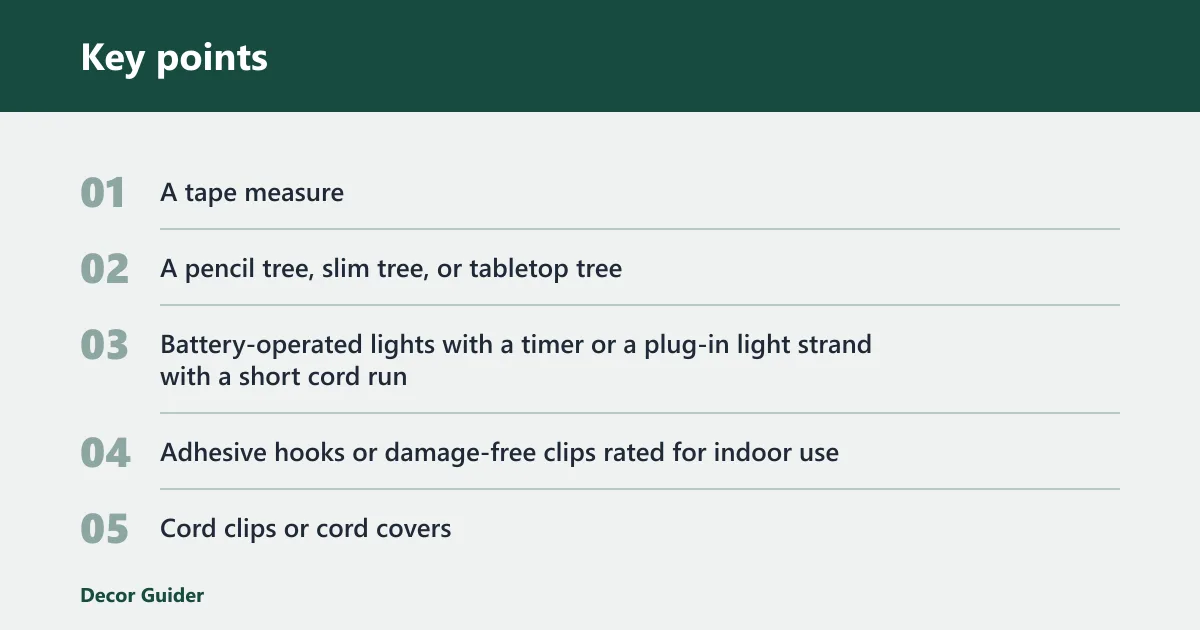


- A tape measure
- A pencil tree, slim tree, or tabletop tree
- Battery-operated lights with a timer or a plug-in light strand with a short cord run
- Adhesive hooks or damage-free clips rated for indoor use
- Cord clips or cord covers
- Garland for a console, shelf, or window ledge
- Throw pillow covers in one tight palette
- A holiday throw blanket in knit, faux fur, or linen texture
- Ornaments in two or three coordinated colors
- A tray or shallow bowl for one small surface accent
Measure the room first
Measure before you buy anything. In a small room, the layout decides what fits, what moves, and what stays out of the way.
- Measure the ceiling height and subtract about a foot to estimate ideal tree height.
- Measure the widest clear tree spot, then keep a floor-space budget for that zone.
- Map the door swing, the path from entry to sofa, and the space in front of the TV.
- Mark outlet locations, radiator zones, and any vent or heater you must keep clear.
- Choose decor only after those clearances are marked on the floor and wall.
Say your room is 8 feet high and the sofa sits across from the TV. A tree that is too wide will steal the passage between them, even if the height is fine. A narrower shape solves more than a taller one.
Which Christmas tree fits best?
The best tree depends on width first, then height. For the tightest corner, a pencil tree gives the smallest footprint. If you have a little more width, a slim tree reads fuller without swallowing the room. If floor space is almost gone, a tabletop tree is the safer move.
Pencil tree
Choose a pencil Christmas tree for the narrowest corners, tight entry paths, or rooms where a chair sits close to the wall. Its slim silhouette keeps movement open and works well near a window or beside a media console.
Slim tree
Pick a slim tree when you have enough width for a little more branch volume but still need a small footprint. It gives a fuller look than a pencil tree without pressing into a walkway.
Tabletop tree
Use a tabletop tree when the room can’t spare floor space at all. It belongs on a console, sideboard, or sturdy shelf, where it can add height without blocking walking paths.
For height, the common rule here is simple: take ceiling height, subtract about a foot, and use that as your target. Pre-lit trees make sense when outlets are awkward or hidden behind furniture. Unlit trees are better if you want more control over bulb color and cord placement.
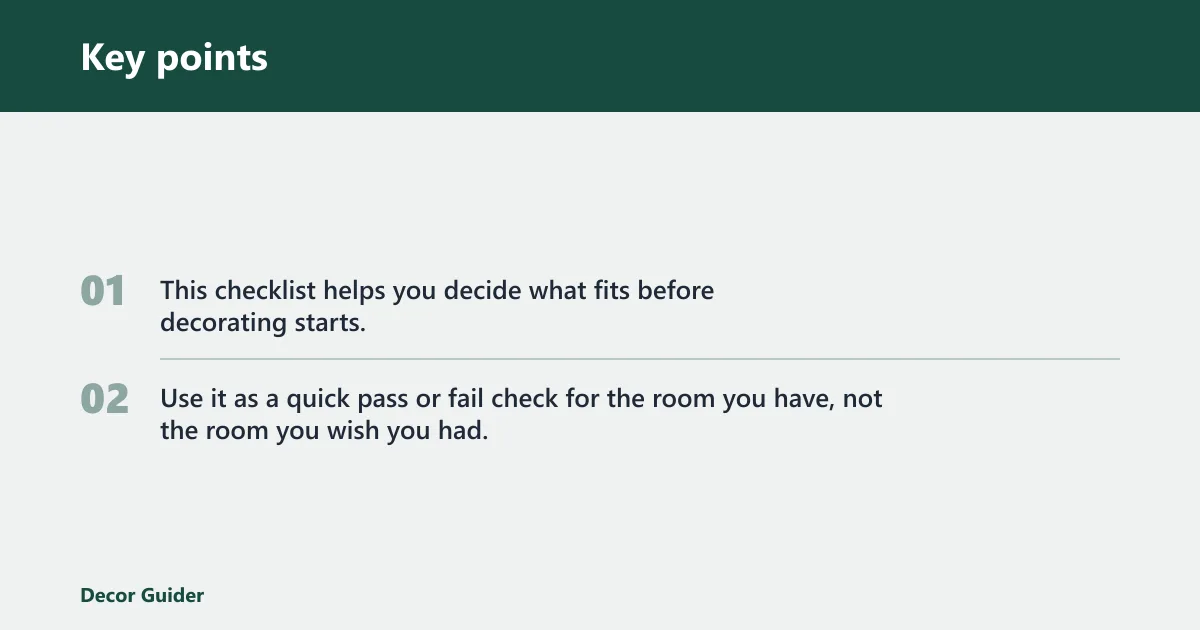
Small living room planning checklist
This checklist helps you decide what fits before decorating starts. Use it as a quick pass or fail check for the room you have, not the room you wish you had.
| Measure or zone | What to check | Practical target | Best fit when space is tight |
|---|---|---|---|
| Ceiling height | Clear vertical room above the tree | Subtract about a foot from ceiling height | Pencil tree or slim tree |
| Tree width allowance | Floor width available at the tree site | Keep the footprint narrow enough to leave a clear path | Pencil tree |
| Sofa-to-tree clearance | Space between seating and branches | Enough space to sit and pass without brushing decor | Slim tree or tabletop tree |
| Walkway width | Path from door to sofa or main seat | Keep the path open, with no pinches at corners | Corner placement or wall decor |
| Outlet locations | Access for lights and timers | Keep cords short and hidden | Pre-lit tree or battery lights |
| Door-swing zones | Door arcs that must stay clear | No decor in the swing path | Wall, shelf, or window decor |
| Corner | Unused vertical space near a wall | Tree or vertical garland | Pencil tree with warm lights |
| Rental | Damage-free hanging needs | Adhesive hooks, clips, battery lights | Window frame and console decor |
| Apartment | Every inch matters | Keep floor items few and narrow | Tabletop tree and one console display |
| TV-centered room | Glare and visual balance | Style the console lightly | Low garland and small accents |
| No-mantel room | Need for a main display surface | Use the media console | Minimal top styling with one focal line |
How should you place decor around the room?
Start with the tree, then the main horizontal surface, then the smaller accents. That order keeps the room readable and prevents decorative clutter from spreading across every flat spot.
Use the corner or window first
Put the tree in a corner when possible, or near a window if the shape of the room makes that safer for traffic flow. Keep it out of the door swing and away from radiators or vents.
Use the media console as the main display
A media console is a natural horizontal decorating line in compact living rooms. If you do not have a fireplace, use the console like a mantel substitute. A nine-foot cedar garland can cover a typical six-foot console with overhang at both ends, and the battery-operated six-hour timer makes it easier to keep the line lit without extra cord clutter.
Keep the top styling minimal. A garland, one or two low objects, and a small light source are enough when a TV sits above it. Too many pieces create glare and visual noise.
Keep shelves and side tables lightly styled
Place one item on a side table or shelf, not a full collection. A small bowl of ornaments, a tiny tree, or a single candle lantern is usually enough in a compact room.
How do you add lights without clutter?
Use lights with a clear job. Warm white works best when you want the room to feel calm and connected. Colored lights can work, but keep them limited to one area so they do not fight the rest of the palette.
Wrap windows carefully
String lights can trace a window frame or sit on a window ledge, but keep the run neat and short. Indoor-safe lights only. Do not drape cords across a walking path or tuck them where heat can build up.
Control cords and layers
Use clips to run cords along the wall edge or behind furniture. Layer lights with one other source, such as the tree lights plus a console strand. More than that often feels busy in a small room.
Picture a rental apartment with one outlet behind the sofa and a narrow window beside the TV. In that case, a pre-lit slim tree and battery garland reduce cord exposure, and the window frame can carry the second light layer without crossing the floor.
Textiles and color plan
Use one tight palette and repeat it across the room. The room reads calmer when the same few colors appear on ornaments, pillows, throws, and garland accents.
Keep the palette narrow
Traditional red, green, white, and gold work well when used sparingly. A neutral winter palette with evergreen, warm gold, and cream is even easier to manage in a small room because it cuts visual noise and keeps the eye from bouncing around.
Use texture, not more color
Choose knit, faux fur, or linen for pillows and throws. Swap in holiday covers rather than adding more pillows than the sofa can handle. One blanket across the arm of the sofa and two matching pillows often add enough seasonal weight.
Keep accent hues to a minimum. If you already have gold ornaments and cream pillows, adding red everywhere can make the room feel full even when the furniture layout is fine.
Common mistakes
Most small-room holiday problems come from scale, not style. If the room feels crowded, something is too wide, too many, or too low to the floor.
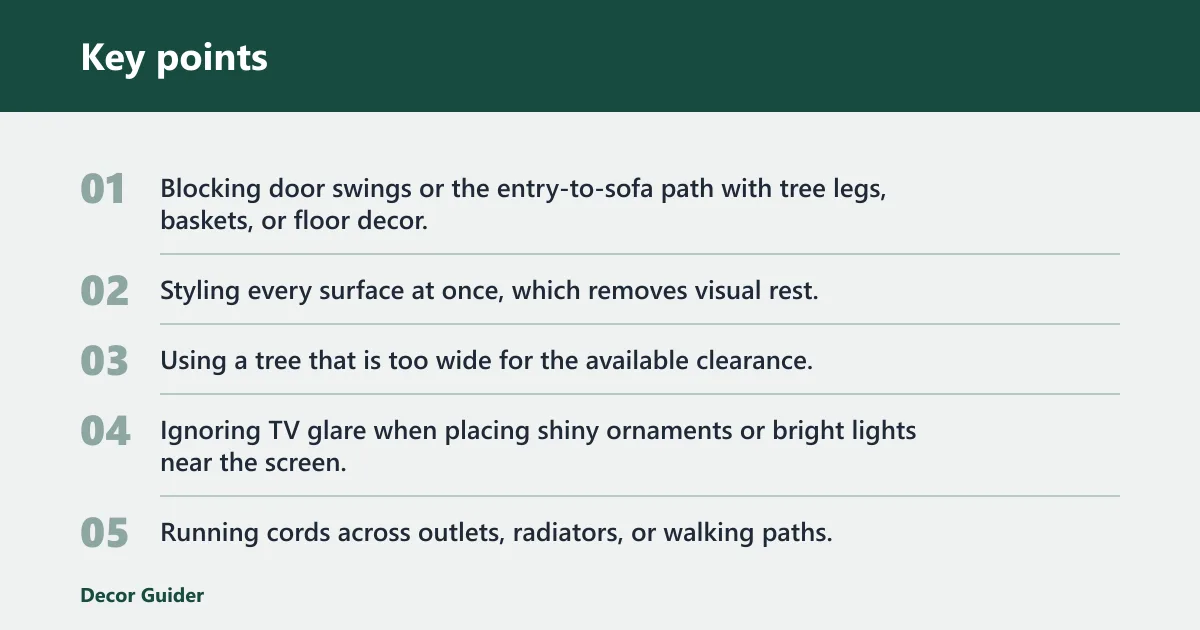
- Blocking door swings or the entry-to-sofa path with tree legs, baskets, or floor decor.
- Styling every surface at once, which removes visual rest.
- Using a tree that is too wide for the available clearance.
- Ignoring TV glare when placing shiny ornaments or bright lights near the screen.
- Running cords across outlets, radiators, or walking paths.
A common first-timer mistake is placing a 36-inch wide tree beside a sofa with only a narrow pass-through. The room feels finished for five minutes, then every trip to the kitchen becomes awkward. A pencil tree or tabletop tree would have solved the path problem first.
If the room still feels crowded
Remove floor pieces first, then duplicate accents, then extra colors. That means taking away baskets, extra presents, and any second throw or pillow set before you touch the tree. If it still feels heavy, cut back to one main light source and one main decorative surface.
- Take away all floor decor that is not essential.
- Remove repeated accents, such as extra candles, bowls, or mini trees.
- Cut the palette to the main two or three colors already in the room.
- Recheck the walkway from the door to the sofa.
- Stop when the room feels open enough to move through without turning sideways.
Begin with the path through the room, then anchor one corner, one horizontal surface, and one soft textile area. That order keeps the room practical and festive. If you decorate every surface at once, the room fills visually before it fills functionally.
Use the tree as the tallest piece, the media console as the main low display, and textiles as the soft finish. Keep the palette limited, repeat it across those zones, and leave the center of the room open.
Frequently asked questions
How do I make a small living room feel festive without clutter?
Keep the palette to two or three colors, repeat them in several places, and limit decor to the edges of the room. Warm lights, a slim tree, and one textile change often feel more festive than scattered accents. Leave negative space on purpose.
What kind of Christmas tree works best in a small living room?
A pencil tree works best in the tightest corners, while a slim tree is better when you have a little more width. If the room can barely spare any floor space, a tabletop tree is the safest option. Match the tree’s footprint to the walkway, not the wish list.
How do I decorate a living room without a fireplace for Christmas?
Use the media console as your main display line and keep the styling low so the TV area stays balanced. Add garland, a few ornaments, and one low light source. That gives you a mantel-like anchor without needing a fireplace at all.
Products related to this article
Sponsored / affiliate links. As an Amazon Associate I earn from qualifying purchases. I may earn additional commission from eligible campaigns.