How to Decorate Floating Shelves for Christmas
Decorate floating shelves for Christmas with three clear layers: a stable base, medium-height focal pieces, and one light accent layer, with open space at the edges. Poor placement makes shelves look crowded, top-heavy, or unstable. This guide shows how to style each layer, balance color and height, and keep decor safe on floating shelves.
This guide is part of our Christmas Decor Ideas by Room: Where and How to Decorate Every Space series.
What to put on floating shelves for Christmas
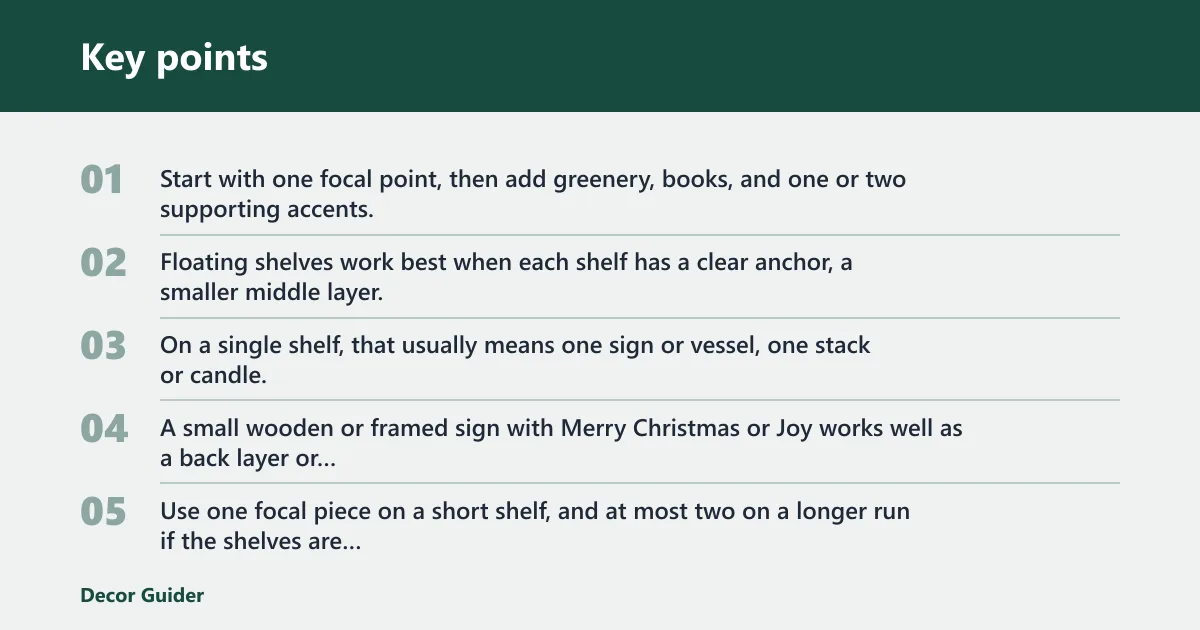


Start with one focal point, then add greenery, books, and one or two supporting accents. Floating shelves work best when each shelf has a clear anchor, a smaller middle layer, and a few light fillers, rather than a line of unrelated objects. On a single shelf, that usually means one sign or vessel, one stack or candle, and a small finish piece.
Start with one focal point
A small wooden or framed sign with Merry Christmas or Joy works well as a back layer or leaner. Use one focal piece on a short shelf, and at most two on a longer run if the shelves are widely spaced. Too many signs crowd the wall and make the display read as flat.
Build around greenery, books, and candles
Christmas greenery does the main work for holiday tone. Use pine, holly, or eucalyptus as garland, sprigs, or stems, then pair it with books stacked horizontally as risers and candles or candleholders for height. White or neutral candles work with most palettes, and battery-operated versions lower fire risk on a crowded shelf.
Use small ornaments only as fillers
Small ornaments and figurines belong in the gaps, not at the center of the plan. Mini trees, houses, gingerbread pieces, orbs, and similar objects work best in odd numbers, such as three or five, because the grouping feels settled without looking stiff. Keep them tied to the same palette as the rest of the shelf.
Choose a Christmas color palette
Use a neutral base with one or two accents, then repeat those colors across every shelf in the same room. That keeps the display tied to the space instead of looking pasted on. A palette of three to four colors is usually enough for Christmas shelf decor, especially when the shelves already sit in a busy room.
Use a neutral base with one or two accents
White, cream, wood tones, black, or soft gray can ground the display. Add one accent like red, green, or metallic gold, then stop there unless the room already uses a broader scheme. If your room leans farmhouse, rustic Christmas decor usually reads better with white, wood, and muted green than with bright, mixed colors.
Match the shelves to the room
Do not invent a new palette that fights the rest of the room. If the space already uses warm woods and black hardware, echo that with neutral books, dark frames, and greenery. If the room is airy and light, keep candleholders, vessels, and signs pale so the shelves feel like part of the wall, not a separate scene.
Repeat colors across the full display
Repeat the same accent in at least two places if you are decorating more than one shelf. For example, a red ornament on the top shelf and a red ribbon or figurine on the lower shelf ties the run together. That repetition matters more than adding extra items. It also helps the eye move smoothly from shelf to shelf.
Floating shelf Christmas styling matrix
Use this matrix to match the layout to the shelf type before you place a single object. The item counts are meant as targets, not a command to fill every inch. Keep the display at about 60 to 70 percent of visible fill, a common rule of thumb, so the shelf can still breathe.
| Shelf type | Recommended item count | Height mix | Palette formula | Do-not-use warning | Common failure case and exact fix |
|---|---|---|---|---|---|
| Single shelf | 5 items | 1 tall, 2 medium, 2 low | Neutral base + 1 accent color + greenery | Do not use more than 1 heavy object or 1 large sign | Top-heavy look: move the tallest piece to one end, lower the front layer, and replace one tall item with a horizontal book stack |
| 2-shelf stack | 8 items total | Top shelf lighter; lower shelf can carry 1 extra medium piece | Neutral base + 1 or 2 accents repeated on both shelves | Do not mirror both shelves exactly | Too symmetrical: change one side’s sign for a vase or basket, and shift the greenery to only one shelf edge |
| Long multi-shelf run | 3 to 5 items per shelf | Alternate tall, medium, and low pieces from shelf to shelf | Neutral base + 2 accents repeated in a loose rhythm | Do not fill every shelf to the same level | Cluttered line: remove one item from every shelf, then leave an empty patch on each run segment for visual rest |
How do you keep Christmas shelves balanced?
Keep balance by building each shelf in three layers: back layer, middle layer, and front layer. Place the largest or flattest item at the back, use a medium-height anchor in the middle, and finish with a smaller object in front. That structure keeps the shelf from looking random or overloaded.
Use the three-layer system
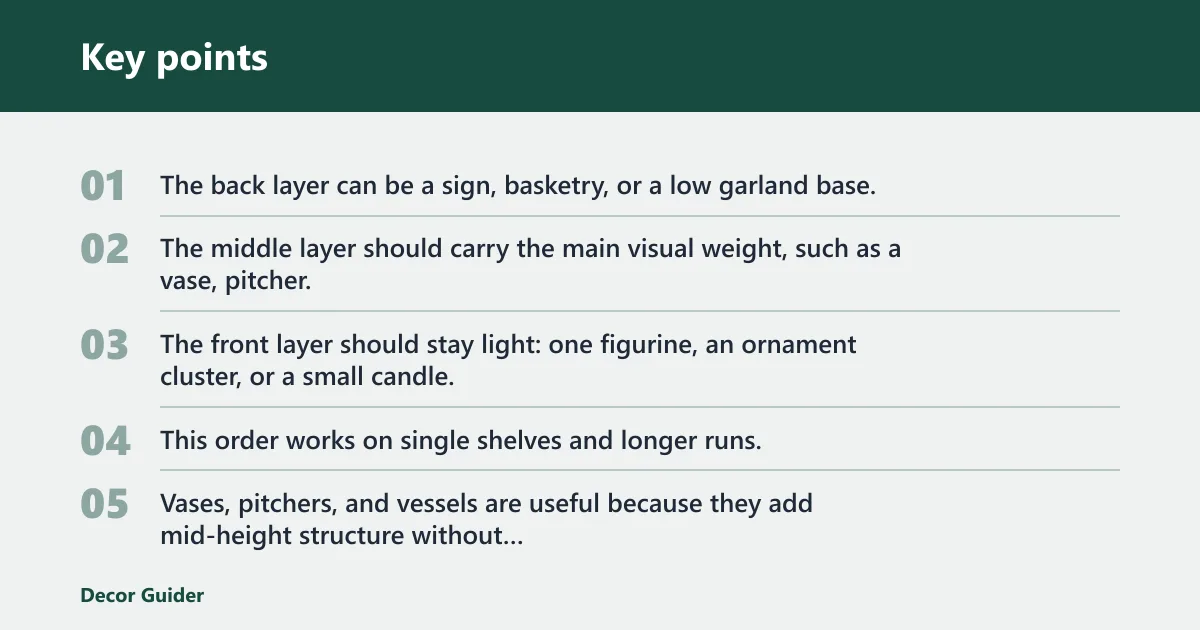
The back layer can be a sign, basketry, or a low garland base. The middle layer should carry the main visual weight, such as a vase, pitcher, candleholder, or book stack. The front layer should stay light: one figurine, an ornament cluster, or a small candle. This order works on single shelves and longer runs.
Mix heights without crowding
Vases, pitchers, and vessels are useful because they add mid-height structure without needing many extra pieces. Choose ceramic, glass, or white pottery, then vary the scale from shelf to shelf. On a short shelf, one tall vessel and one low stack may be enough. On a longer run, repeat the same height family instead of identical objects.
Leave visible negative space
Negative space is not wasted space. Leave blank areas at the ends, between groups, and above lower objects so the display reads as intentional rather than packed. If the shelf looks full from three steps away, it is probably too full. A shelf that is about 60 to 70 percent filled usually looks calmer and easier to read.
Say your 24-inch shelf holds a framed sign, a book stack, a small candleholder, and two mini trees. If the mini trees crowd the front edge, remove one tree and shift the candleholder toward the open side. The shelf will look more deliberate without losing the holiday feel.
Greenery, candles, and warm light
Greenery and candlelight give Christmas shelves their seasonal cue, but the materials matter. Faux and fresh greenery behave differently, and candles need safer placement than casual styling often suggests. Keep flame, heat, and fragile objects apart, especially on wall-mounted hidden-bracket shelves that are only as secure as their installation.
Faux versus fresh greenery
Fresh pine, holly, and eucalyptus add real texture and scent, but they can shed, dry out, and need more attention. Faux greenery lasts longer and creates less mess, which matters on shelves above furniture or electronics. Fresh stems can work for a short holiday window; faux garland or sprigs make more sense for a display that stays up longer.
Choose safe candle options
Tapers, pillars, and tree-shaped candles can all work on floating shelves, but battery-operated versions are generally the safer choice near greenery, signs, and paper-covered books. If you use real candles, keep them away from garland and never place them where a narrow shelf could catch heat or wax drips. White and neutral holders fit nearly every palette.
Place light sources with intention
Light should support the layout, not dominate it. Put candles or battery candles in the middle layer so they add height and a warm glow without stealing the whole shelf. On a run of shelves, vary their positions instead of stacking every light source in the same spot. That keeps the display from feeling repetitive.
How do you style floating shelves in a small space?
In a small space, use fewer, larger pieces and keep the palette tight. Floating shelves are useful in compact rooms because they can hold decor, books, candles, plants, and small objects without taking floor space, but the shelves still need room to breathe. One strong grouping reads better than many tiny holiday pieces.
Choose fewer, larger pieces
A single vase, one book stack, and one sign often work better than six miniature ornaments in a compact room. Small pieces disappear visually and can make the shelf look fussy. Larger objects also help the display read from across the room, which matters when the shelf is above eye level.
Use vertical space instead of extra objects
Let height do the work. A tall stem, a book stack, or a taper candle can create enough variation without adding clutter. If you need more Christmas presence, expand upward with one taller piece rather than adding more front-layer objects. That keeps the shelf from losing its open areas.
Keep the palette tight
In a small room, three colors are often enough: a neutral base, one main accent, and greenery. Match the decor to the wall, trim, and nearby furniture so the shelf blends in. That approach makes the room feel calmer and keeps the holiday styling from overpowering the space.
Avoid clutter and top-heavy displays
Check the shelf itself before you style it. Floating shelves should be mounted securely to the wall, and if they are installed into studs, they need secure mounting there as well. Use a stud finder to locate wall studs, and use a level to make sure the shelves are even. The tutorial also notes there are two ways to hang floating shelves, so follow the hardware instructions for your model.
Watch shelf weight and mounting
Heavy glass, dense books, and thick ceramic pieces can overload weak mounts or thin shelves. If the shelf feels uncertain, do not stack weight toward the front edge. Put heavier items closer to the wall, and keep the lightest pieces in front. That reduces strain and lowers the chance of wobble.
Fix too-symmetrical arrangements
Too much symmetry can make Christmas shelves look stiff. If both ends hold the same object, swap one side for a different shape or move one item off-center. A common first-timer mistake is lining up matching candles, matching signs, and matching ornaments in a straight row. Break that rhythm with one uneven gap.
Edit out pieces that do not help the layout
If an item does not add height, texture, or a color repeat, remove it. Basketry and woven textures can act as grounding pieces, but only when they have enough space to read. The same rule applies to ornaments and figurines: keep the ones that support the grouping, and leave the rest in storage.
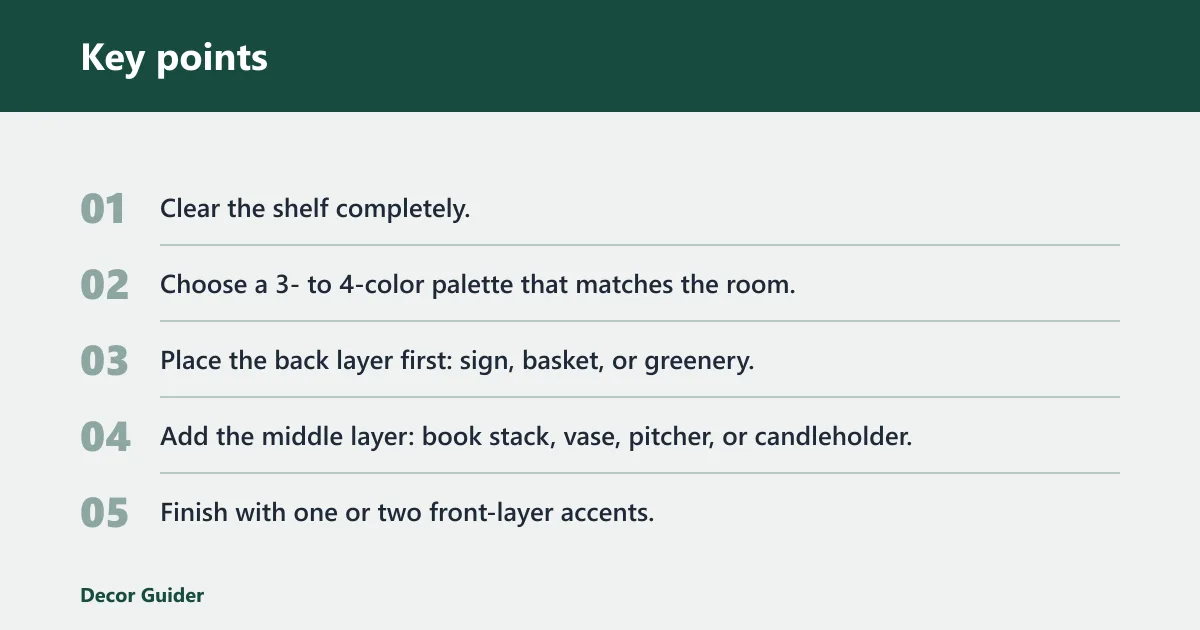
- Clear the shelf completely.
- Choose a 3- to 4-color palette that matches the room.
- Place the back layer first: sign, basket, or greenery.
- Add the middle layer: book stack, vase, pitcher, or candleholder.
- Finish with one or two front-layer accents.
- Step back and remove anything that makes the shelf feel crowded.
Suppose a long shelf run has three narrow shelves and you want a farmhouse look. One shelf can carry a tobacco basket and eucalyptus, the next a book stack with a white pitcher, and the last a candle plus three small houses. Repeating the same white-and-green palette across all three keeps the set connected without making each shelf identical.
Frequently asked questions
How do you decorate floating shelves for Christmas without making them look cluttered?
Use one focal piece, one supporting height element, and one small accent per shelf, then leave open space around them. Keep the display to about 60 to 70 percent fill, and stop adding pieces once the shelf reads clearly from across the room. If an object does not help height or balance, leave it out.
What should I put on floating shelves for Christmas?
Good choices include a small sign, greenery, books, candles or battery candles, a vase or pitcher, woven texture, and a few small ornaments. Floating shelves can hold decor, books, candles, plants, and small objects, but the best results come from mixing only a few of those categories on each shelf.
How many items should go on a Christmas shelf display?
A single shelf often works well with 5 items, while a 2-shelf stack can use about 8 items total. For a long multi-shelf run, aim for 3 to 5 items per shelf and vary the count slightly from one shelf to the next. That prevents the display from feeling too stiff or too packed.
How do you style floating shelves with greenery and lights for Christmas?
Place greenery in the back or middle layer, then add battery candles or other light sources where they can glow without crowding the shelf edge. Faux pine, holly, or eucalyptus lasts longer and makes less mess, while fresh stems need more care. Keep flame-based candles away from garland and paper decor.
What colors work best for Christmas shelf decor?
Use a neutral base and add one or two accent colors, then repeat them across every shelf. White, cream, wood tones, and black pair well with green, red, or muted metallics. The best palette is usually the one that already fits the room, not a brand-new scheme created only for the holidays.
How do you decorate floating shelves in a small space for Christmas?
Choose fewer, larger pieces, keep the color palette tight, and use vertical items instead of many small ones. A book stack, one vessel, one sign, and a little greenery can do more than a crowded row of mini ornaments. Small spaces need breathing room so the shelves do not feel heavier than the room itself.
How do you keep Christmas shelf decor balanced and symmetrical?
Balance does not mean perfect symmetry. Place the tallest item slightly off-center, vary heights from shelf to shelf, and repeat only one or two colors across the set. If both sides look identical, change one object’s shape or scale. That small shift usually gives the shelf a more natural, finished look.
What size and height mix looks best on decorated shelves?
The strongest mix is usually one tall piece, one or two medium pieces, and a few low accents. Use horizontal book stacks to anchor small items, then add a vase, pitcher, or candleholder for mid-height structure. If every item is tall, the shelf feels crowded; if everything is low, it feels flat.
Products related to this article
Sponsored / affiliate links. As an Amazon Associate I earn from qualifying purchases. I may earn additional commission from eligible campaigns.