Best TV Stands for No-Drill Setup (2026): based on specs and reviews
The safest no-drill TV stand is usually a freestanding, low-profile unit with a footprint wider than the TV mount span, a weight rating comfortably above the TV’s weight, and a base suited to your floor. I have seen weak stands tip, shift, and crack flooring. This guide covers fit, stability, and the best renter-friendly picks.
This guide is part of our TV stand guide: types, sizes, setup, and style series.
Quick comparison
| Product | Badge | Best for | Price | ||
|---|---|---|---|---|---|
 |
Rfiver Swivel Floor TV Stand for 32-70 Inch Flat Screen TVsRfiver | Budget pick | 32–65 in · freestanding floor stand | $59.99
Price as of 29 Sep 2026
|
View |
 |
Sylphorium Floating TV Stand, Mid-Century Modern MediaSylphorium | Best match | No-drill drywall bar, fits 12–55 in | $159.00
Price as of 29 Sep 2026
|
View |
 |
No Stud TV Wall Mount, Drywall Studless TV Hanger NoAuoace | Pair with it | $19.99
Price as of 29 Sep 2026
|
View | |
 |
Nathan James Beacon Bohemian TV Stand, TV Wall Unit withNathan James | Pair with it | $1,649.95
Price as of 29 Sep 2026
|
View | |
 |
Perlegear Floor TV Stand with Power Strip for 50–110 inchPerlegear | Also great | 50–110 in · up to 250 lbs · built-in power strip | $189.99
Price as of 29 Sep 2026
|
View |
The safest choices here are the freestanding floor stands, especially when the room has carpet, a slightly uneven floor, or a large TV. Floating and studless wall options can work in rentals, but they are not the same thing as a true floor stand, and they still need careful installation.
How we chose
Base footprint and tipping resistance came first. I have watched a stand look solid and still feel twitchy when the feet were too narrow or the center of gravity sat too high.
Weight rating had to leave a real margin below the TV’s actual weight. Stand width, TV size, and where the mass sits on the base all matter together.
Clear assembly steps and usable cable routing were required. A renter-friendly stand should be easy to reverse at move-out and should not trap cords behind the cabinet.
Floor compatibility and leveling feet were part of every pick. Carpet, tile, laminate, and small bumps in the floor change how much wobble you will see on day one.

Rfiver swivel floor TV stand for 32-70 inch flat screen TVs: best for most renters
This is the safest no-drill pick for most renters because it combines a floor-standing design with a compact base and three height settings. From the spec sheet and owner feedback, it fits smaller rooms where the TV must sit low and steady without wall holes.
It is a strong fit for apartments, temporary setups, and lease-restricted spaces. The 16.7 × 11.8 inch base is narrow, yet still more controlled than a flimsy open-frame stand in a tight corner, and the swivel design helps when seating is off-center.
The drawback is clear: the small base helps in cramped rooms, but it is not the right answer for oversized TVs or heavy center loading. For larger screens, the safe move is a broader steel base with a higher weight rating.
Perlegear floor TV stand with power strip for 50-110 inch TVs up to 250 lbs: best for large TVs

This is the strongest option for very large screens because it is built around a steel frame, a wooden base, and a stated 250 lb capacity. For a heavy TV in a rental, that combination gives more confidence than a lighter stand with decorative legs.
It also suits setups with a soundbar, streaming box, and power needs, since the built-in power strip with USB-C ports cuts cord clutter. That matters in small apartments where the wall outlet is not behind the TV.
The drawback is size. Large no-drill stands take more floor space, and the wider footprint can be awkward in narrow rooms or corner layouts. It is a better match for big panels than for compact living rooms.
Sylphorium floating TV stand, mid-century modern media console, walnut: best for renter-friendly wall use
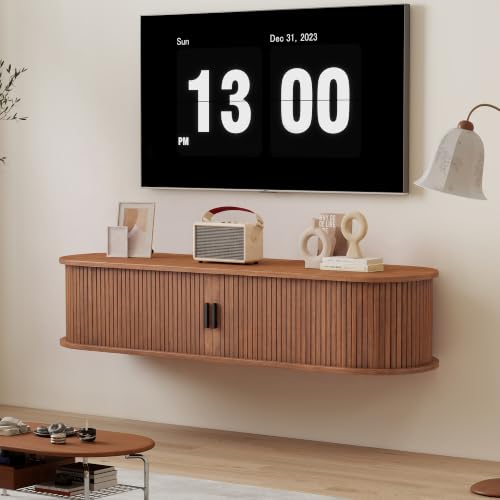
This is the most renter-specific wall option because it is a true no-drill drywall mount rather than a conventional wall unit. It can work well where floor space is tight and the TV stays within the 12–55 inch range.
The cold-formed steel construction and fast installation are the main draw. For a temporary setup, that speed matters, especially when the user wants a clean wall look without drilling into studs.
The drawback is that it still depends on the wall itself. That means it is not the same as a freestanding stand, and it is a poor fit for anyone who wants to avoid wall load entirely.
No stud TV wall mount, drywall studless TV hanger no damage, no drill, non screws, dry wall flat screen TVs easy install bar bracket: best for minimal-wall setups
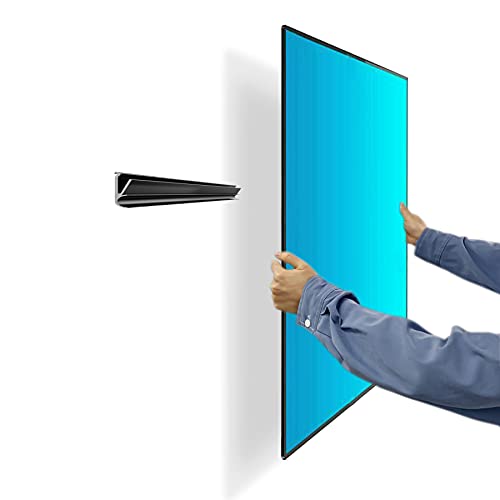
This is a compact no-drill wall hanger for smaller screens up to 55 inches and 99 lbs. It is useful when the goal is to avoid visible furniture under the TV and keep the floor as open as possible.
It makes sense in a lease where wall drilling is forbidden but a light TV still needs to be hung. The included hardware and level help, and the low price may appeal to a short-term renter.
The drawback is that a studless wall hanger is not a freestanding stand. It shifts the safety question from floor stability to wall hold, so it is less forgiving if the drywall condition is poor or the TV is near the upper end of its range.
Nathan James beacon bohemian TV stand, TV wall unit with shelves and accent storage cabinet with solid wood legs and seagrass door fronts, light brown: best for storage-first living rooms
This is the storage-heavy option for someone who wants a furniture piece that can anchor the room and hold more than just the TV. It fits a style-driven living area better than a bare-bones floor stand, and the cabinet layout helps with consoles and media gear.
Solid wood legs add confidence, and the enclosed storage is helpful for hiding accessories. In a larger room, that can be the difference between a tidy media wall and a pile of visible devices.
The drawback is price and footprint. It is far more furniture than a simple no-drill solution, and it is not the easiest choice for a small apartment or a temporary move-out plan.
What is the best TV stand for a no-drill setup?
The best no-drill TV stand is usually a freestanding floor stand with a wide enough base, a weight rating comfortably above the TV’s actual weight, and leveling feet for uneven floors. For most renters, that mix is safer than a decorative cabinet or a wall-mounted workaround.
Start by matching the stand width to the TV and the room layout. A stand that is too narrow, too tall, or too light can wobble even if the finish looks premium.
How do you keep a TV stand from wobbling without drilling into the wall?
Wobble drops when the base is level, the TV mass sits centered, and the feet make full contact with the floor. On carpet, you often need more attention to foot placement, because soft surfaces can hide a small tilt that becomes visible once the TV is on top.
Use the leveling feet first, then recheck the rear clearance and cord tension. A taut HDMI cable or power cord can pull the stand slightly out of square and create a side-to-side shake.
Can a TV stand safely hold a large TV without wall mounting?
Yes, if the stand is rated for the TV’s weight, has a base wide enough for the screen size, and keeps the center of gravity low. Large TVs are safest on steel-framed or heavy-base floor stands that spread weight over a broader footprint.
The real question is not screen size alone. It is how that screen’s weight sits over the base, how far the edges overhang, and whether the room floor stays flat enough to keep the stand from rocking.
What features should I look for in a renter-friendly TV stand?
Look for no-drill setup, move-out reversibility, leveling feet, cable cutouts, and a footprint that suits your room. Renter-friendly also means the stand should not leave wall holes, torn paint, or floor dents after a move.
Hardware retention matters too. Keep every screw, bracket, and spare fastener in a labeled bag, because lease returns are easier when the stand can be disassembled cleanly.
Do no-drill TV stands need anti-tip straps or braces?
For a true freestanding floor stand, anti-tip hardware is still worth using when the TV is tall, the house has children or pets, or the floor is uneven. Wall-anchored straps improve safety, but they are not the same as a no-drill setup.
If wall anchors are not possible, choose a stand with a lower center of gravity, a broader base, and clear load limits. That is safer than assuming a heavy cabinet alone will prevent tip risk.
How much weight can a no-drill TV stand support?
The answer depends on the exact model, but the published pound rating is the number that matters. A smart buyer keeps a safety margin below that maximum, especially for large screens or stands used on carpet or in corner placement.
Do not judge by appearance. A wide-looking frame may still have weak joints, while a compact steel stand may hold more weight because the load sits directly over the base.
Is a freestanding TV stand better than a wall mount for apartments?
For many apartments, yes. A freestanding TV stand avoids wall drilling, is easier to move out later, and fits lease rules better than a fixed wall mount. It is also simpler to reposition when the furniture layout changes.
A wall mount can save floor space, but it asks more of the wall, the installer, and the lease. If reversibility matters more than a flush look, the freestanding choice is usually the safer call.
What height should a TV stand be for comfortable viewing?
The right height puts the center of the screen close to seated eye level. That usually means the TV should not sit so high that the viewer tilts the chin up for long stretches, especially in a sofa-based living room.
If there is a soundbar, leave enough clearance so the bar does not block the bottom of the screen or crowd the shelf. Height is not only about comfort; it also affects stability when the TV sits high on the frame.
Can I use a TV stand with a soundbar and streaming devices?
Yes, but the stand needs usable shelf space, rear cutouts, and a cord path that keeps power bricks from piling up behind the cabinet. A soundbar, console, and surge protector can turn a simple setup into a crowded one fast.
Check device depth before buying. A shelf that fits a streaming box may still be too shallow for a soundbar, and a blocked rear panel can make plugging and unplugging a pain during move-out.
What is the easiest TV stand to assemble without special tools?
The easiest options are usually floor stands that ship with the needed hardware, a single Allen key, and a small number of assembly steps. Clear diagrams matter more than fancy packaging because the wrong bracket orientation can create wobble later.
Before buying, check whether the stand can be built in under an hour and whether the included tools are enough. If the listing suggests extra tools, add that time and effort to the decision.
TV stand stability checklist for no-drill setups
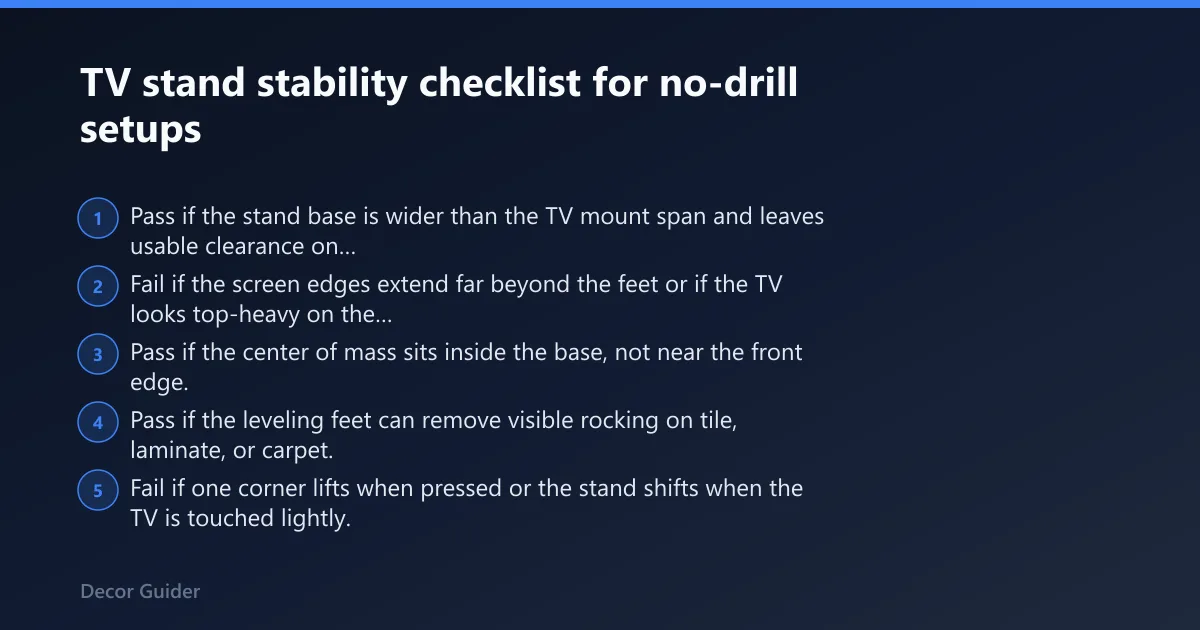
Use this before buying or placing a TV on the stand. It catches the failure points that generic shopping pages usually skip: carpet wobble, overhang, cord pull, and tip risk.
Pass/fail check for base footprint and TV overhang
- Pass if the stand base is wider than the TV mount span and leaves usable clearance on both sides.
- Fail if the screen edges extend far beyond the feet or if the TV looks top-heavy on the frame.
- Pass if the center of mass sits inside the base, not near the front edge.
Pass/fail check for floor type and leveling
- Pass if the leveling feet can remove visible rocking on tile, laminate, or carpet.
- Fail if one corner lifts when pressed or the stand shifts when the TV is touched lightly.
- Pass if the floor protector or foot pad keeps hard floors from scuffing and keeps carpet from bunching.
Pass/fail check for cable routing and accessory placement
- Pass if rear cutouts or cord channels keep HDMI and power cords from pulling sideways.
- Fail if the power strip must hang loose behind the stand or if device cables create tension.
- Pass if the soundbar, console, and streaming box all fit without blocking ventilation.
Pass/fail check for tip risk before first use
- Pass if the stand remains steady when the TV is nudged gently from the side.
- Fail if the stand rocks, slides, or twists when the screen is adjusted.
- Pass if the room layout leaves enough rear clearance to avoid accidental bumps from chairs or foot traffic.
Which one should you buy?
Pick the Rfiver swivel floor TV stand if you want the safest all-around no-drill choice for a typical rental, a smaller room, or a mid-size TV. It is the simplest match when floor space is tight and the TV is not huge.
Pick the Perlegear floor TV stand if the TV is large, heavy, or paired with a soundbar and console. Its higher load rating and built-in power strip make it the strongest choice for bigger setups.
Pick the Sylphorium floating TV stand or the Auoace no-stud wall hanger only if the goal is wall-mounted placement without drilling, and the wall material is suitable. These are useful in rentals, but they are not a substitute for a freestanding stand when the user wants the least wall risk.
Pick the Nathan James Beacon if storage and room furniture matter more than a compact footprint. It is a better fit for a larger living area than for a small apartment.
Products related to this article
Sponsored / affiliate links. As an Amazon Associate I earn from qualifying purchases. I may earn additional commission from eligible campaigns.