IKEA BESTÅ TV Stand Review: Worth It for Your Setup?
IKEA BESTÅ is worth buying for one reason: it gives you a media unit built around your room, without paying a cabinetmaker, but only if the frame size, support method, and TV weight match the layout. Choose the wrong width or mount plan, and the bargain turns into wobble, sag, or awkward cable access fast.
This guide is part of our TV stand guide: types, sizes, setup, and style series.
Verdict
The system makes the most sense for buyers who want closed storage, a cleaner living-room line, and a finish that does not read like plain utility furniture. It fits less well for anyone planning to set a large TV on a long unsupported run and ignore the load plan.
Pros and cons
- Pros: modular layouts that can be open, closed, or mixed
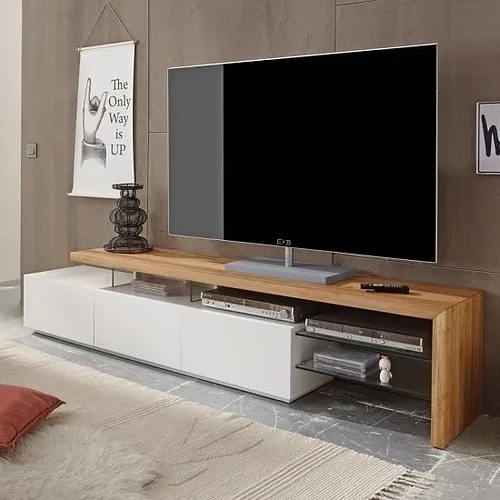
- Pros: a wall-mounted or leg-supported look without custom millwork
- Pros: useful for hiding routers, game consoles, and cables
- Cons: long spans can need center support legs to stay sensible
- Cons: wall mounting takes careful stud and bracket planning
- Cons: doors, drawers, and hardware can push the final bill well past the base bench
📊 The listed price for the TV unit is $90. Source: IKEA BESTÅ TV Unit Review (2026): Owner Reports + Verdict.
Specs at a glance
| Spec | BESTÅ TV bench details |
|---|---|
| System type | Modular storage system sold as a TV bench |
| Featured width | 70 7/8 inches wide |
| Featured dimensions | 70 7/8 in wide, 15 3/4 in deep, and 15 in high |
| Other size options | 120x40x48 cm, 180x40x38 cm, and 240x42x38 cm variants |
| Construction | Particleboard and fiberboard with honeycomb paper filling |
| Warranty | 10-year limited warranty |
| Listed price | $90 for the featured TV unit |
| Typical base bench range on IKEA US listing | Roughly $65 to $90 before doors, drawers, legs, and wall hardware |
| Finish options | Black-brown, white, dark grey, and white stained oak effect |
Price and size reality
The base price is only the opening line. BESTÅ costs more once you add doors, drawer fronts, legs, wall brackets, and the parts needed to make the layout work in a living room.
The 70 7/8-inch frame is the one to watch most closely. It is wide enough to feel useful, but that width is also where support decisions stop being optional.
Who it is for
BESTÅ is for buyers who need adaptable storage and want the front of the room to look planned, not improvised. It suits renters who may move, console owners who want hidden storage, and people who want a wall-mounted look without paying for custom built-ins.
It is less suitable for buyers who want a simple one-box TV stand, a very deep cabinet, or a setup where the TV and console gear are heavy enough that support planning becomes annoying. If the goal is quick assembly and no decisions, this is the wrong cabinet family.
Best for renters who need adaptable storage
Renters usually benefit from BESTÅ when they want a bench that can shift from open shelves to closed fronts later. The key advantage is that the frame can be reconfigured as needs change, while the finish still reads as furniture rather than dorm-room storage.
Best for people hiding consoles and cables
BESTÅ works well for cable boxes, game consoles, and routers when the buyer plans airflow and access from the start. Closed doors hide clutter well, but fully sealed fronts can trap heat and make remote sensors awkward unless one shelf or bay stays open.
Best for buyers who want a floating look
A wall-mounted BESTÅ can look cleaner than legged furniture, especially under a wall-hung TV. It is not the easy path, though. Stud spacing, bracket placement, and cable exits need to be measured before checkout, not after the box is open.
What works
BESTÅ’s strongest point is configuration control. Buyers can build open storage, closed storage, drawer-heavy storage, or a mixed layout that hides the ugly parts and leaves the useful parts accessible.
The finishes help too. Black-brown and dark grey read darker and calmer, white disappears more easily in bright rooms, and white stained oak effect softens the boxy look without turning the unit into a faux rustic piece.
Open storage versus closed storage
Open shelves are the easiest choice for consoles and set-top boxes because they leave ventilation and cable access alone. Closed doors are better when the goal is to hide controllers, discs, or charging bricks, but they demand more planning for heat and remote control signal paths.
Cable and accessory storage when planned well
BESTÅ does well when the back is treated as a utility zone. If the buyer maps where the HDMI runs, power strips, and wall outlet sit before assembly, the unit can look tidy from the front and still be serviceable later.
Finish options that fit real living rooms
Black-brown suits darker floors and black electronics. White is the safest visual choice for bright apartments. Dark grey can sit between the two, while white stained oak effect works best when the room already has warmer woods and softer textiles.
What does not
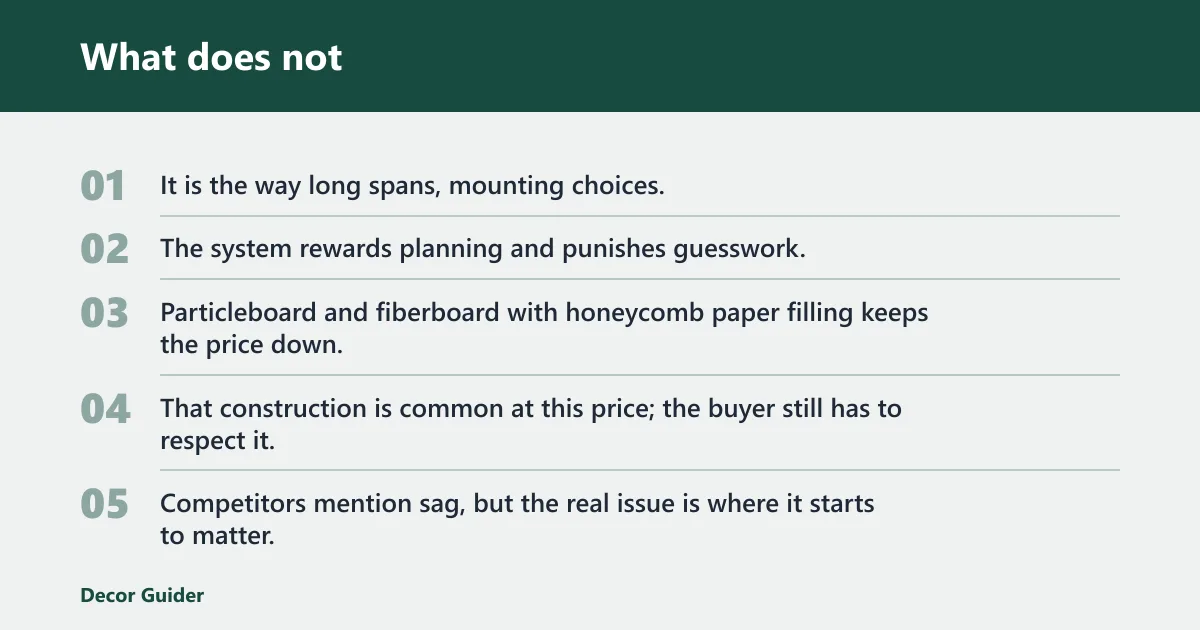
The weak point is not the idea of BESTÅ. It is the way long spans, mounting choices, and access decisions can turn a cheap-looking purchase into an expensive one. The system rewards planning and punishes guesswork.
Particleboard and fiberboard with honeycomb paper filling keeps the price down, but it also means the unit is not the furniture to abuse with careless weight placement or sloppy support decisions. That construction is common at this price; the buyer still has to respect it.
Span and sag concerns on longer builds
Competitors mention sag, but the real issue is where it starts to matter. The roughly 71-inch frame is the one most likely to need a center support leg when a large TV or heavy decor is involved. The longer the run and the lighter the internal support plan, the more the risk rises.
Wall-mount planning and stud spacing
Wall mounting is not a casual last-minute choice. The brackets attach to the frame, but the wall still has to cooperate with stud spacing and outlet placement. A floating install can look sharp, yet it only works cleanly when the wall layout and the cabinet layout are measured together.
Assembly friction and hardware-heavy installs
BESTÅ can feel overbuilt in the wrong way. Once drawers, doors, feet, and brackets are added, the project turns into a parts-managed build. That is manageable, but it is not a five-minute furniture job.
Ventilation and access problems in closed builds
Fully closed fronts are where people get annoyed later. Consoles need airflow. Cable boxes need access. Routers need signal paths. A beautiful closed cabinet can become irritating if the front layout blocks heat escape or forces the user to open doors for routine use.
Do you need center support legs for BESTÅ?
Often, yes, if the build uses a long span or carries a heavier top load. The 70 7/8-inch frame is the clearest case where center support becomes a smart move, especially when the TV sits on top or the middle of the run carries electronics instead of just decor.
For shorter or simpler builds, support legs may not be necessary in the same way, but the buyer still needs to think about load distribution. The mistake is assuming every BESTÅ layout behaves the same. It does not.
When the 70 7/8-inch frame needs help
The wider frame benefits most from a center support leg when the top will carry a TV and when the storage below is mostly open. The more unsupported the middle, the more the long-span issue becomes a design problem rather than a style choice.
Which setups are most at risk
Top-mounted TVs, wide soundbars, and any layout with a lot of empty space under the screen push risk upward. A nearly full cabinet with evenly distributed components is easier on the frame than a long, bare run with one heavy object sitting near the middle.
Mistakes that make a simple build worse
Common errors include choosing the widest frame because it looks balanced, then skipping the support leg; loading the top without checking where the weight lands; and using doors or drawers that reduce access while adding more parts to align. None of those decisions save money in the end.
Can you wall mount an IKEA BESTÅ TV stand?
BESTÅ can be wall mounted, but it calls for careful planning. The brackets attach to the frame, and the wall layout should line up with the cabinet layout, so stud spacing, outlet location, and cable exits are worth checking before ordering anything.
It is a good route for a floating look or for cleaning under the unit, but it is a poor choice when the wall is awkward or when the user expects a quick install. Floating furniture looks simple after the fact; it is rarely simple at the start.
How the brackets attach to the frame
The cabinet is designed to work with wall hardware, but the frame still needs the right attachment points and a sound wall behind it. If the studs do not line up well with the intended position, the buyer may need to rethink the entire room layout.
Stud-spacing and floating-install planning
The safest approach is to measure the wall first, then choose the cabinet width, then map the TV center point and the cable outlet. Reversing that order is how floating installs become frustrating.
When wall mounting is a bad idea
If the wall is fragile, the room is rented with strict rules, or the outlet and studs create a bad mismatch, wall mounting is the wrong move. In those cases, a leg-supported layout is usually easier, cheaper, and less stressful.
Best setups by real-world use case
| Product | Badge | Best for | Price | ||
|---|---|---|---|---|---|
 |
Bestier Modern TV Stand for 65 Inch TV, White EntertainmentBestier | Budget pick | 65 in · LED lighting · 2 drawers | $119.69
Price as of 7 Oct 2026
|
View |
 |
Walker Edison Everette Modern Farmhouse Double Sliding XWalker Edison | Our pick | 58 in · Farmhouse style · Sliding barn doors | $216.99
Price as of 7 Oct 2026
|
View |
| Setup | Exact BESTÅ parts needed | Risk level | Avoidable mistakes |
|---|---|---|---|
| TV on top | 70 7/8-inch BESTÅ frame, support legs if span is long, chosen front type, optional shelf | Medium | Skipping center support, placing the TV too close to the front edge, ignoring cable exit height |
| Wall-mounted TV | BESTÅ frame, wall-mount hardware, level mounting plan, selected doors or drawers if storage is needed | High | Buying before checking stud spacing, forgetting outlet location, assuming the bracket layout will fit the wall as-is |
| Soundbar + console stack | BESTÅ frame, open shelf or open bay, adjustable shelf, doors only on non-gear sections | Medium | Fully closed fronts, poor ventilation, blocking the soundbar with a shelf lip or door panel |
| Renter setup | BESTÅ frame with legs, removable fronts, mixed storage, no wall-mount requirement | Low to medium | Choosing a wall-mounted plan when lease rules or wall quality are uncertain |
| Hidden-storage setup | BESTÅ frame, doors, drawers, adjustable shelves, cable path planning, possibly a mix of open and closed bays | Medium | Sealing everything shut without ventilation, making the remote sensor harder to use, cramming too much into one bay |
TV on top setup
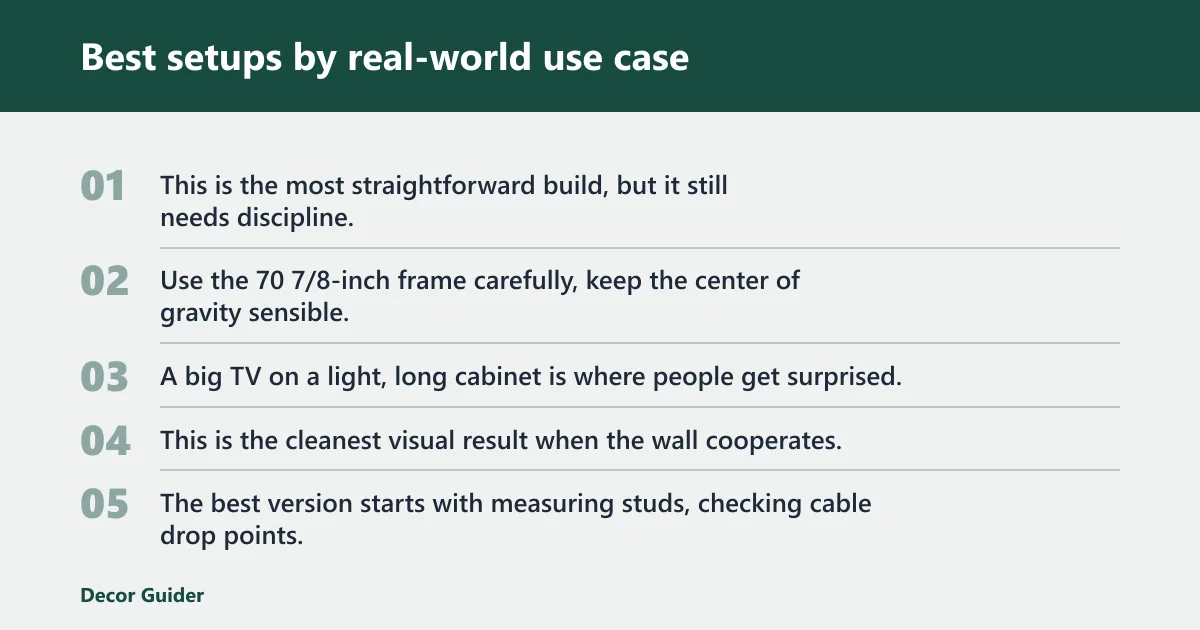
This is the most straightforward build, but it still needs discipline. Use the 70 7/8-inch frame carefully, keep the center of gravity sensible, and add support where the span needs it. A big TV on a light, long cabinet is where people get surprised.
Wall-mounted TV setup
This is the cleanest visual result when the wall cooperates. It is also the most planning-heavy. The best version starts with measuring studs, checking cable drop points, and deciding whether the cabinet sits centered under the screen or aligned to the room.
Soundbar plus console stack
This is one of BESTÅ’s better use cases. The trick is to keep the soundbar in an open bay or on an open section and let the consoles breathe. Put doors on the clutter zones, not on the gear that needs airflow or frequent access.
Renter setup
Renters usually do better with legs than with wall mounts. That keeps the unit movable and avoids wall damage risk. It also makes it easier to take the piece with them if the next place has a different outlet or TV size.
Hidden-storage setup
For hiding remotes, controllers, and cable mess, BESTÅ is strong when the buyer mixes doors and drawers with one open bay. A fully sealed layout often looks good on day one and becomes annoying once something inside needs power or airflow.
Is the IKEA BESTÅ TV stand worth it?
Yes, but only for the right buyer. BESTÅ is worth it when the goal is configurable storage and a tailored look, and when the frame size, support method, and mounting plan are chosen with the TV and gear in mind. If the buyer wants a simple, no-thought stand, it is not the best spend.
The value is real, but so are the hidden ownership tradeoffs. Add the legs, doors, drawers, and mounting parts before judging the price. That is where BESTÅ stops being a cheap base bench and becomes a complete media unit.
Alternatives
- Sliding barn doors for flexible open/closed storage
- 3 adjustable shelves for customizable organization
- Cord management ports to keep cables tidy
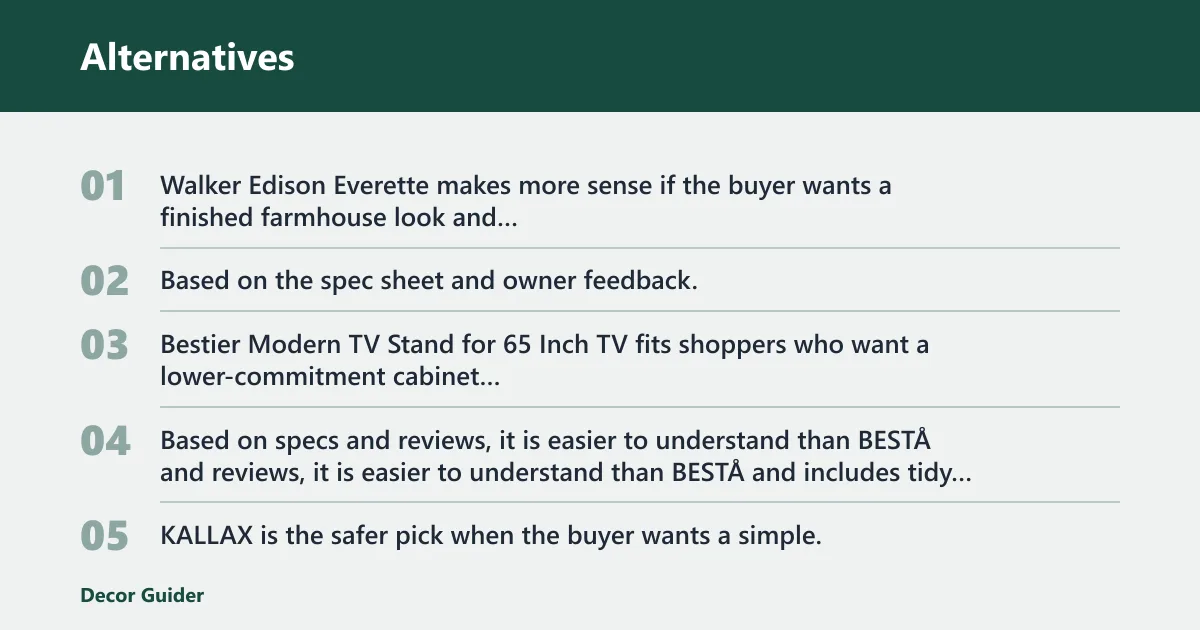
Walker Edison Everette makes more sense if the buyer wants a finished farmhouse look and a TV up to 58 Inches without building a modular plan. Based on the spec sheet and owner feedback, the sliding barn doors and adjustable shelves are useful, but the size ceiling and fixed style make it less flexible than BESTÅ for larger or more tailored living rooms.
- LED lighting with 7 colors and 22 dynamic modes
- Smooth, quiet sliding drawers with premium guides
- Eco-friendly particleboard and MDF construction
Bestier Modern TV Stand for 65 Inch TV fits shoppers who want a lower-commitment cabinet with built-in LED lighting and two drawers. Based on specs and reviews, it is easier to understand than BESTÅ and includes tidy drawer storage, but it gives up the modular flexibility that makes BESTÅ better for changing room layouts.
KALLAX is the safer pick when the buyer wants a simple, low-cost storage unit that can also function as a TV bench. It is shown at €69.99 in the SERP context here, which keeps it on the budget end. It does not offer the same tailored media-unit feel, but it is easier to live with if the buyer does not want to think about spans and mounting.
HEMNES makes more sense for buyers who want a more traditional look and do not mind paying more for it. It is shown at €199 here. Compared with BESTÅ, it is less modular and less targeted at custom media planning, but it can be a better fit when the room leans classic rather than configurable.
LACK is the safer budget pick when the only goal is a very simple, light-duty TV surface. It is not the right choice for hidden storage or serious cable management, and it gives up the more deliberate front and storage planning that BESTÅ can provide. It is the easy option, not the flexible one.
FJÄLLBO suits buyers who want an industrial look and more open construction. STOCKHOLM 2025 and BESTÅ BURS sit in the more design-forward space, where appearance matters as much as storage. Those can be better if style is the top priority, but BESTÅ is usually the more practical system when the room has real cable, console, and door-front needs.
Should you buy it
Buy BESTÅ if you want a media unit you can configure around your room instead of forcing the room to fit a generic stand. It is especially good for renters, console owners, and buyers who want doors or drawers that hide the mess.
Do not buy it if you want a fast, no-planning stand for a large TV on a long top run. In that case, the support decisions, wall-mount questions, and accessory costs can turn an appealing base price into a poor-value project.
Frequently asked questions
Is the IKEA BESTÅ TV stand worth it?
It is worth it for buyers who need modular storage and a tailored look, not for buyers who want a quick, low-thought stand. BESTÅ pays off when the frame size, support method, and front layout fit the TV and the gear. Without that planning, the value slips quickly.
Does the BESTÅ TV bench sag under a large TV?
It can, especially on longer spans and especially when the 70 7/8-inch frame carries a heavy load without center support. Sag risk rises when the middle is left unsupported and the top carries a large TV or other weight. Good support planning matters more than the warranty line.
Can you wall mount an IKEA BESTÅ TV stand?
Yes, but the wall must cooperate. The brackets attach to the frame, yet stud spacing, outlet placement, and cable routing still need to line up. If the wall is awkward or the room is rented with restrictions, a leg-supported setup is usually the safer answer.
Which BESTÅ TV bench size fits a 65-inch TV?
The 70 7/8-inch featured unit is the most obvious fit to consider, but the real decision depends on how much side clearance, storage, and support the buyer wants. A 65-inch TV can look comfortable on a wider bench, yet the frame still needs the right support plan beneath it.
What is the difference between BESTÅ TV unit, bench, console, and cabinet?
In practice, they are the same BESTÅ system used in different layouts and front combinations. The terms change depending on the configuration: open storage, closed storage, wall-mounted, or leg-supported. The buyer should focus less on the label and more on the actual frame size and support method.
Do I need center support legs for BESTÅ?
Often yes on longer builds, especially the 70 7/8-inch frame. Center support helps reduce sag and keeps the middle of the run from behaving like an unsupported bridge. It is most important when the TV sits on top or when the cabinet is mostly open in the center.
Is BESTÅ good for cable box, soundbar, and console storage?
Yes, if the layout leaves space for ventilation and access. Open bays work best for consoles and soundbars, while doors and drawers are better for hiding accessories, discs, and spare controllers. A fully closed build can be neat, but it is only smart if heat and cable routing are planned first.
How much does a BESTÅ TV bench cost?
The featured TV unit is listed at $90, and the base BESTÅ TV benches on IKEA US are roughly $65 to $90 before add-ons. The final total can climb once doors, drawers, legs, and wall hardware are included, so the base price should not be treated as the real budget.
Products related to this article
Sponsored / affiliate links. As an Amazon Associate I earn from qualifying purchases. I may earn additional commission from eligible campaigns.