Bedroom Size Chart: How Much Space You Need Inside
A bedroom should be at least about 2 feet wider and longer than the mattress footprint for basic clearance, and a common guideline is that a truly livable room usually needs about 24 to 36 inches of walking space around the bed. Too little room makes drawers harder to open, door swings awkward, and the space feel cramped fast. This guide gives a bedroom size chart by mattress size, then shows how to judge minimum fit versus comfortable fit.
How to read and use a bedroom size chart
A bedroom size chart is a planning tool, not only a mattress chart. It pairs mattress dimensions with the room footprint needed for basic clearance, then helps you judge whether the bed will work with doors, closets, walk paths, and furniture. For mattress dimensions, this guide uses the standard US sizes commonly listed by mattress makers, and for room planning it relies on the practical clearance guidance already noted here: about 2 feet at minimum, with 24 to 36 inches being more livable.
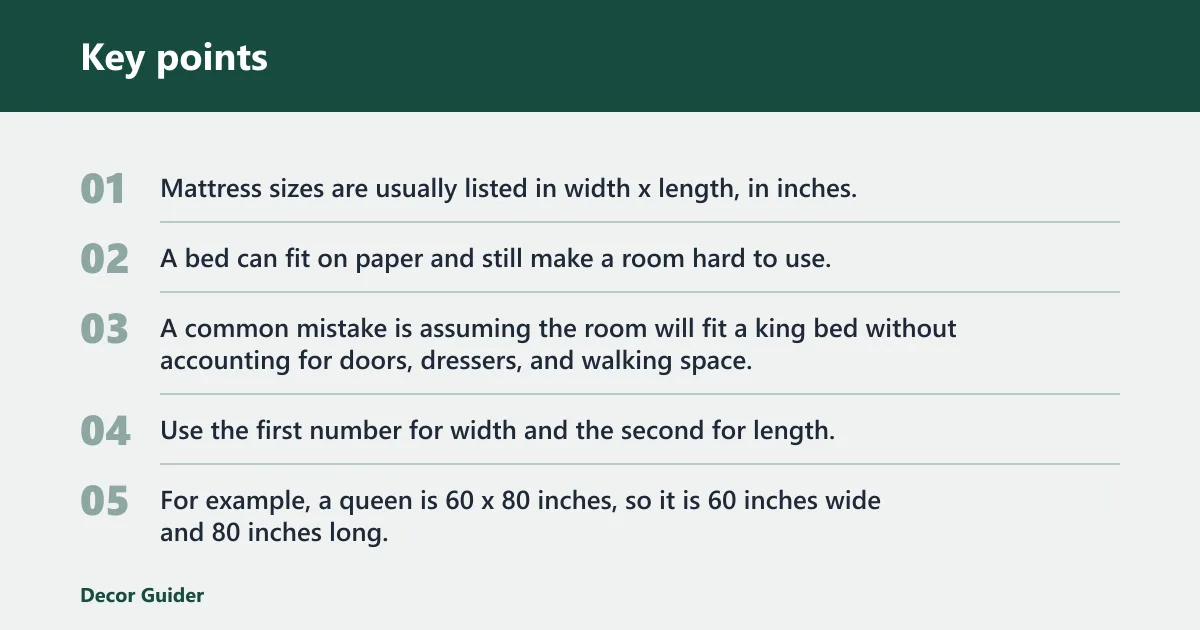
Mattress sizes are usually listed in width x length, in inches. A chart can also convert those dimensions to feet or centimeters for quick comparison, but the room decision should still start with wall-to-wall measurements.
Why room size matters more than mattress size
A bed can fit on paper and still make a room hard to use. The real question is whether you can move around it, open storage, and keep door and closet swings clear without clipping corners or blocking a window.
A common mistake is assuming the room will fit a king bed without accounting for doors, dressers, and walking space. That skips the extra room needed for sheets, a nightstand, and the side you need to walk through every day.
How to read width x length measurements
Use the first number for width and the second for length. For example, a queen is 60 x 80 inches, so it is 60 inches wide and 80 inches long. That format makes room planning easier because you can compare bed footprint against the available wall length and floor depth.
Standard mattress sizes at a glance

The six standard US mattress sizes are Twin, Twin XL, Full, Queen, King, and California King. Their dimensions are usually listed in inches as width x length, and each size solves a different space problem.
| Mattress size | Dimensions | Bare-minimum room size | Better room size | Likely furniture fit |
|---|---|---|---|---|
| Twin | 38 x 75 inches | About 8 x 10 feet | About 9 x 10 feet or larger | One nightstand usually fits; a dresser can be tight |
| Twin XL | 38 x 80 inches | About 8 x 10 feet | About 9 x 10 feet or larger | One nightstand usually fits; length can crowd a doorway |
| Full | 54 x 75 inches | About 10 x 10 feet | About 10 x 12 feet or larger | One nightstand fits; a dresser may fit if the room is simple |
| Queen | 60 x 80 inches | About 10 x 10 feet | About 12 x 12 feet | Two nightstands are possible; dresser space is better in a larger room |
| King | 76 x 80 inches | About 12 x 12 feet | About 12 x 13 feet or larger | One or two nightstands may fit; dresser layout needs care |
| California King | 72 x 84 inches | About 12 x 12 feet | About 12 x 13 feet or larger | One or two nightstands may fit; length is the main constraint |
Twin, twin XL, and Full
Twin mattresses measure 38 x 75 inches and are best for one sleeper. Purple describes a twin as best for children or petite adults, and the size works well in small bedrooms where floor space matters more than bed width.
Twin XL measures 38 x 80 inches. That extra 5 inches of length helps taller sleepers and makes it a common dorm-room choice. Full mattresses measure 54 x 75 inches and are also called double beds; they are roomy for one adult and tighter for two. In practical terms, Twin and Twin XL usually need about 24 inches of side clearance to feel usable, while Full often feels better once the room can support that same clearance without blocking the path at the foot of the bed.
Queen, king, and california king
Queen mattresses measure 60 x 80 inches and are the most popular size in the US, with broad use for couples. King mattresses measure 76 x 80 inches and are the widest standard size, which is why they need a larger bedroom. California King mattresses measure 72 x 84 inches and are the longest standard size, so they suit taller sleepers.
Turmerry recommends about a 10 x 10 foot room for a queen and about a 12 x 12 foot room for a king or Cal king. Those numbers are useful starting points, but the room still has to work with doors, closets, and furniture placement. For a queen, that often means a room can be technically large enough yet still feel tight if both sides need regular access; for a king, the problem is usually circulation, not just mattress width.
Bedroom fit checklist
This checklist is the quickest way to decide whether a room is merely large enough or actually livable. Aim for about 2 feet of open floor around the bed, including both sides and the foot of the bed, then check whether doors, closets, and furniture still work normally.
| Room size | Bed size | Recommended clearances on each side | Door/closet swing risk | Nightstand or dresser fits comfortably? |
|---|---|---|---|---|
| About 8 x 10 feet | Twin | About 24 inches | Low to moderate, depending on door placement | One nightstand usually fits; dresser may feel tight |
| About 8 x 10 feet | Twin XL | About 24 inches | Low to moderate, but length can crowd a doorway | One nightstand usually fits; dresser is often a squeeze |
| About 10 x 10 feet | Full | About 24 inches | Moderate if the closet opens toward the bed | One nightstand fits; a dresser may fit if the room is simple |
| About 10 x 10 feet | Queen | About 24 inches, but often tighter in practice | Moderate to high if the bed is centered | Nightstands are possible; dresser space is often limited |
| About 12 x 12 feet | Queen | About 24 to 30 inches | Moderate, with better door and closet flexibility | Two nightstands and a dresser are often realistic |
| About 12 x 12 feet | King | About 24 inches, sometimes more needed at the foot | Moderate to high if the room has multiple openings | One or two nightstands may fit; dresser layout needs care |
| About 12 x 13 feet or larger | King or California King | About 24 to 36 inches where possible | Lower if openings do not face the bed directly | Nightstands and a dresser fit more comfortably |
How do you measure a bedroom for furniture?
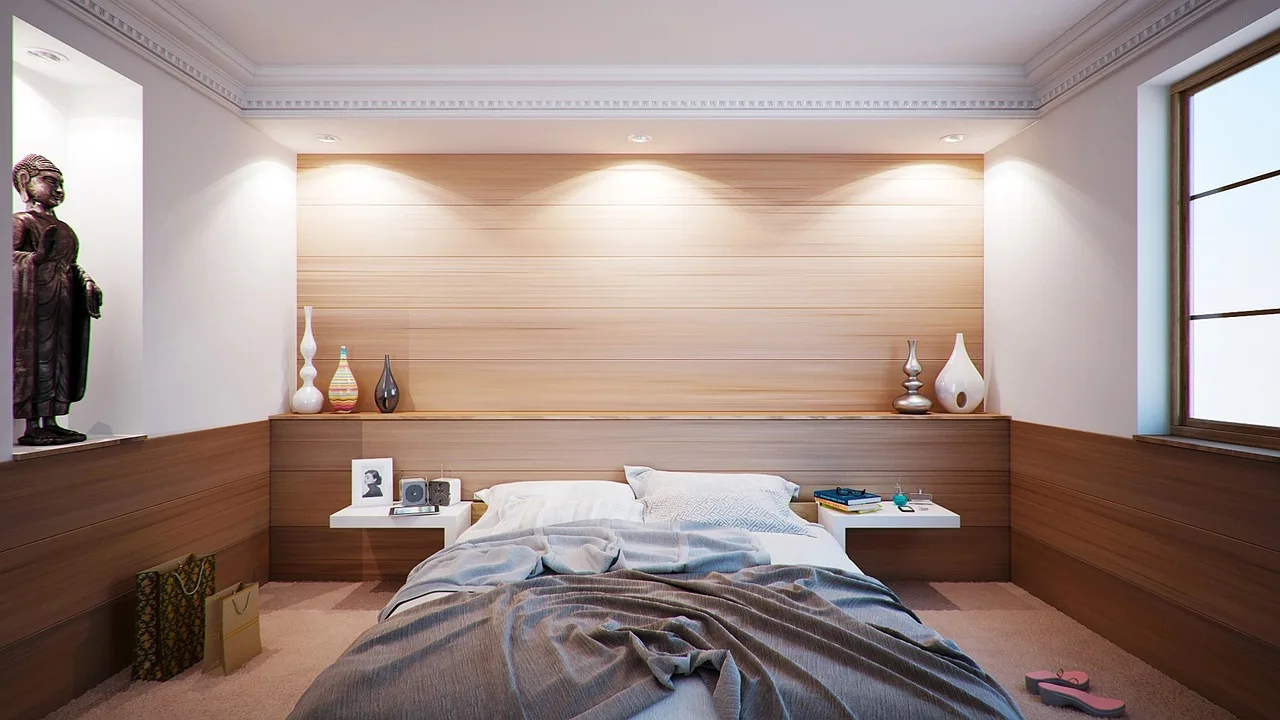
Measure the room wall to wall first, then map the fixed features that eat usable space. Doors, closets, windows, vents, and baseboard heaters can make a room feel much smaller than the raw square footage suggests, especially once you add a bed and storage.
What determines a bedroom’s usable size is the part you can actually move through and place furniture into. A straight wall with no openings is far more flexible than a room with a centered door, a deep closet swing, and a window that blocks the only practical headboard wall.
Common failure cases are easy to miss: a door that swings into the bed zone, a closet that opens into the walking path, a dresser that is too deep for the remaining aisle, a radiator or low window that blocks the headboard wall, and narrow-room layouts where one side of the bed becomes a squeeze rather than a path. Those are the details that turn a technically fit room into a frustrating one.
-
Measure wall to wall.
Record the room’s length and width at floor level. If the room is slightly irregular, take the smallest practical measurements so the bed plan does not depend on an oversized corner.
-
Mark every opening.
Note where doors open, how far closet doors swing, and where windows start and end. These details can remove the one wall you wanted for a headboard or block a nightstand where it seemed obvious to place one.
-
Trace the walking path.
Leave enough room to move from the entry to the closet and from the bed to any dresser. Turmerry’s about 2 feet of open floor around the bed is a practical minimum to start from.
-
Check furniture depth.
Measure the nightstand or dresser depth before assuming it fits. A dresser that technically fits against a wall can still block drawers if the bed leaves too little aisle space in front of it.
Suppose a room is 10 x 10 feet and the queen sits centered on the longest wall. The bed may fit, but a door that swings inward near one corner can steal the exact space needed for a nightstand or for easy access to the closet.
How big should a bedroom be for a queen bed?
A queen bed usually needs about a 10 x 10 foot room at minimum, and a better room is often larger if you want normal traffic flow and usable furniture placement. The same source lists Queen minimum room size as 10 x 10 feet, and that is a useful floor, not a comfort guarantee.
Minimum room size for a queen
A queen measures 60 x 80 inches. In a 10 x 10 foot room, the bed can fit, but the remaining space is limited once you add doors, closets, and furniture depth. The room may be workable, but it can feel tight if the openings are poorly placed.
When a queen feels comfortable instead of cramped
A queen feels comfortable when you can keep about 24 inches of clear space on at least one side and at the foot, with enough room for at least one nightstand. If both sides need daily access, a wider room is much easier to live with. In a room closer to 12 x 12 feet, the bed is less likely to compete with the door swing or the only usable dresser wall, which is why the layout feels more relaxed.
For compact spaces, the same logic applies to small bedroom planning: if the mattress technically fits but the room loses its usable path, the room is too small in practice even if it clears the wall-to-wall measurements.
What bedroom size fits a king bed?
A king bed usually needs about a 12 x 12 foot room as a starting point, and a larger room often works better once you account for circulation and storage. The same source lists King minimum room size as 12 x 12 feet, which matches the reality that a king is the widest standard size.
Minimum room size for a king
A king measures 76 x 80 inches, so the mattress itself uses a large share of the floor. Turmerry also recommends about 2 feet of open floor around the bed. That leaves little margin in a small room once you add doors, closet access, or a dresser. In a square room, the king may technically fit while still limiting the usable side clearance; in a longer room, the same bed leaves more room for movement and storage.
Layouts that leave usable walk space
The easiest king-bed layouts put the headboard on a full wall and keep the foot of the bed away from the doorway. If the room is long and narrow, a king may fit by measurement but still leave awkward side access and poor drawer clearance. That is why layout matters as much as room size: a room can pass the minimum-room test and still fail the comfort test if the bed blocks the natural walking path.
Say a bedroom is 12 x 14 feet and the closet is on the wall opposite the bed. The king can work better here than in a square 12 x 12 room because the extra length helps preserve a clear path to storage and reduces crowding at the foot of the bed.
Frequently asked questions
What is a typical bedroom size?
A typical bedroom size varies by home type, but many bedrooms are built around common bed fits rather than a single fixed standard. The useful question is whether the room can hold the mattress, a clear path, and any storage you need without forcing door or closet conflicts.
What is the standard bedroom size?
There is no single standard bedroom size that works for every home. The practical standard is the room size that fits the mattress you want with enough walking room left over. For many people, that means starting with the mattress size and then checking for about 2 feet of clearance.
What is a good bedroom size?
A good bedroom size is one that fits the bed and still lets you move naturally around it. For a queen, that often means more than a bare 10 x 10 foot room. For a king, the room usually needs more breathing room than the minimum if you want furniture to stay usable.
Products related to this article
Sponsored / affiliate links. As an Amazon Associate I earn from qualifying purchases. I may earn additional commission from eligible campaigns.
 Jungarian Furniture Paint 32oz - Water-based & Low Odor No Sanding One-Step Paint - Matte Finish Indoor Outdoor Wood Paint for Cabinets, Doors, Tables and Dressers, White
 Jungarian Furniture Paint Kit 16oz with Tools - Water-based & Low Odor No Sanding No Priming- Matte Finish Indoor Outdoor Wood Paint for Cabinets, Doors, Tables and Dressers - Black