Balcony Wind Problems / Not Working / Troubleshooting
If balcony items tip or flutter, cut sail area first: move the piece lower, add mass at the base, or use railing clips only if your lease allows drilling-free attachment. Left unchecked, wind can topple pots, tear fabric, scratch railings, and break glass. This guide shows how to diagnose the wind problem, match the fix to your railing and lease, and choose renter-safe anchors for exposed balconies.
What you’ll need for balcony wind fixes
- Measuring tape for railing width, screen height, and furniture footprint
- Weather app with sustained wind, gust speed, and wind direction
- Stainless steel or weatherproof privacy screen clips or ties
- UV-resistant zip ties if your lease allows temporary attachment
- Weighted planter bases or heavier planters with drainage holes
- Non-slip rug pad or quick-dry outdoor mat with edge restraint
- Furniture straps, bungees, or storage bins for loose cushions
- Hands-free storage space indoors for anything that cannot stay put
Balcony wind troubleshooting matrix
The right fix depends on the symptom, not the decor. A balcony that gets hit hard for ten minutes during a front needs a different response than one that stays exposed all afternoon.
| Symptom | Likely cause | Exposure level | Safe fix | Renter-safe attachment | Avoid solid screens when | Weights? | Clips? | Slats? | Storage? |
|---|---|---|---|---|---|---|---|---|---|
| Chair or side table tips | High center of gravity, narrow base, gusts over 20 mph | High, especially on corners and upper floors | Move weight lower, stack or store, add base mass | None; use storage or strap to a heavy anchor if allowed | You get frequent direction changes or a fully exposed corner | Yes | No | No | Yes |
| Umbrella flips or walks | Sail effect, light base, open canopy in gusts | High when the railing is open to air | Close and store; use a smaller shade option | Temporary cover only when closed | The canopy must stay open in wind | No | No | No | Yes |
| Privacy screen rattles | Loose clips, UV wear, gap spacing, too much solid surface | Medium to high on exposed railings | Replace worn ties, shorten span, lower screen height | Stainless steel clips or weatherproof ties | The railing has wide gaps or the balcony gets strong gusts | No | Yes | Yes | No |
| Planter slides or falls | Small base, top-heavy plant, wet soil shifting | Medium, higher on ledges and narrow decks | Use a heavier pot, drainage, and lower center of gravity | Rubber pad or planter tray with lip | The planter must sit above seated eye level | Yes | No | No | Yes |
| Rug curls at edges | Lightweight backing, trapped water, poor slip resistance | Low to medium unless the balcony is very exposed | Use quick-dry backing and edge weights | Non-marking clips only if allowed | The rug lifts in recurring gusts | Yes | Yes | No | No |
| Furniture shifts overnight | Long exposure, smooth floor, narrow footprint | High during constant exposure and overnight wind | Fold, stack, or move indoors before wind picks up | Temporary straps to a fixed post if permitted | Wind is forecast to rise before dawn | Maybe | Maybe | No | Yes |
| Loose debris blows around | Open storage, small objects, no wind break | Any exposure with clutter on the floor | Bin or store loose items; use lidded containers | None needed if items stay indoors | You cannot secure every loose item | No | No | No | Yes |
| Screen makes wind worse | Solid barrier acting like a sail | High on small balconies and funnel points | Switch to slatted or perforated material | Clip to rail only if fasteners are approved | The balcony already traps gusts between walls | No | Yes | Yes | Yes |
Decision check: use weights for low, broad items; use clips for temporary screens or mats; use slats when you need partial filtering; use storage when gusts keep lifting the item or the lease forbids attachment.
Why is your balcony so windy?
A balcony feels windier when it sits high on the building, faces open air, or channels wind between walls. Gusts and direction changes matter more than the average forecast, because a 15 mph sustained wind can still produce sharp blasts that move light furniture and fabrics.
Exposure, height, and building shape
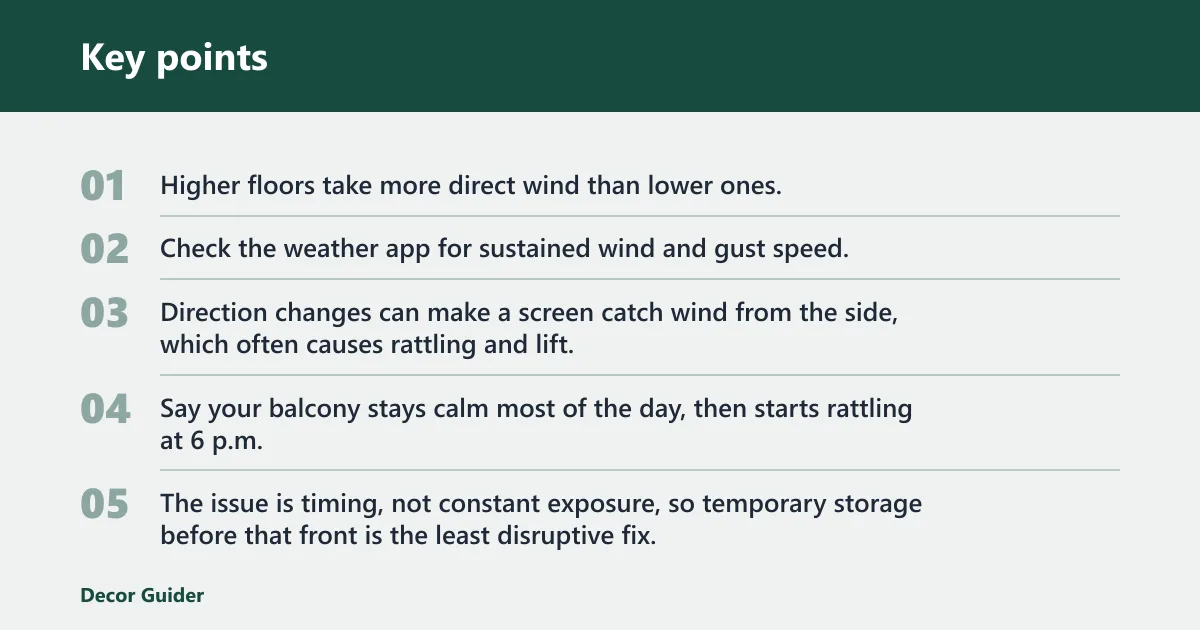
Higher floors take more direct wind than lower ones. Corner units, end units, and balconies that stick out past the facade often catch air from more than one side, which raises the sail effect on screens, umbrellas, and tall planters.
Gusts, direction changes, and timing
Check the weather app for sustained wind and gust speed. If gusts run 10 to 15 mph above the steady reading, set items before the front arrives, not after the wind has started to shift. Direction changes can make a screen catch wind from the side, which often causes rattling and lift.
Say your balcony stays calm most of the day, then starts rattling at 6 p.m. when a weather front moves through. The issue is timing, not constant exposure, so temporary storage before that front is the least disruptive fix.
How do you tell which way the wind is coming from?
Start with what moves first. If one side of a screen rattles, the wind is likely hitting that face or funneling around the corner. Notice whether the wind is steady or if it bursts in short pushes. A balcony can feel calm until a side gust turns a partial screen into a sail.
What makes a small balcony different?
Small balconies are more likely to funnel wind between walls, railings, and building edges, so even modest gusts can feel sharper. That means a solid screen can create more resistance than relief. On compact spaces, lower profiles, shorter spans, and faster storage usually work better than tall barriers.
How do you stop furniture from blowing over?
Use the furniture’s footprint and center of gravity to choose the fix. Low, broad pieces can usually be weighted or nested together, while tall or lightweight items are safer stored indoors when wind rises. If the item still slides after that, the balcony is too exposed for open placement.
- Measure the footprint. Check width, depth, and height of each chair, table, and stool. A wider base resists tipping better than a narrow one, especially on smooth balcony flooring.
- Lower the load. Fold chairs, remove cushions, and place heavier objects on the lowest shelf or seat. Keep the heaviest part closest to the floor to reduce tip risk.
- Anchor only if allowed. Use storage straps or approved clips to hold stacks together. If the lease bans drilling or rail ties, move the piece indoors instead of forcing a bad attachment.
- Store before gusts rise. If the weather app shows gusts above about 20 mph or a fast direction shift, move loose furniture inside about 1 to 2 hours ahead of time.
A common first-timer mistake is leaving a light bistro chair open because it looks stable. A 24-inch chair with a thin tubular frame can still slide or tip when a gust hits the backrest from the side.
When to anchor and when to store
Anchor only items with a stable base and an approved attachment point. Store anything tall, hollow, or top-heavy. If the furniture must be lifted to move it, it is often light enough to need indoor storage during windy periods.
How do you block wind without making it worse?
Choose partial filtering first. A slatted or perforated windbreak reduces pressure while still breaking up gusts, while a solid panel can act like a sail on a narrow balcony or at a high floor. Height matters too: a screen that rises well above seated eye level blocks more wind, but it also catches more force.
Solid vs slatted screens
Solid screens block more wind, but they also hold more load. Slatted, mesh, or perforated options let air pass through, which lowers the chance that the screen becomes the problem. On very exposed balconies, that difference can decide whether the screen stays put or rattles loose.
Railing attachment and height
Match the screen to the railing width and gap spacing before you buy. Narrow rails usually accept clip systems better than wide or irregular ones, and large gaps can let ties slip. Keep the top edge at or below the point where it stops being useful; going taller often adds wind load without much gain.
- Measure the rail first. Record the rail width, post spacing, and gap size. Confirm that the attachment point can hold the screen without bending or scratching the railing.
- Choose a permeable panel. Pick slatted or perforated material if the balcony gets regular gusts. Use a solid panel only when the balcony is sheltered and the lease allows the mounting method.
- Set the height low. Keep the screen only as tall as needed to block seated eye level. Lower height usually means less sail effect and less strain on clips.
- Inspect after the first wind. Recheck clips, ties, and edge tension after the first windy day. Replace any loose or cracked fastener at once.
How do you make a renter-safe fix?
Start with no-drill methods and check the lease before anything touches the railing. Many renters can use temporary clips, ties, or weighted bases, but some buildings limit visible screens, block heavy planters, or ban any fastening to the rail. If the rules are unclear, default to freestanding or indoor storage.
No-drill attachment methods
Use stainless steel or weatherproof clips, UV-resistant ties, or clamp-style mounts meant for outdoor use. Temporary hardware can fail fast if it is not rated for sun and rain. UV wear makes plastic brittle, and corrosion can loosen metal fasteners long before the screen itself looks worn.
Lease, code, and load limits
Check three things: whether the lease allows attachment, whether the railing can take the added load, and whether the screen blocks an emergency exit or required opening. A balcony railing is not a cargo rack, and a heavy screen or planter can exceed what the railing was meant to carry.
- Read the lease clause. Look for language on drilling, rail attachment, and visible exterior items. If the clause is strict, choose storage, weighted bases, or interior placement instead.
- Inspect the hardware. Replace cracked clips, rusted ties, and faded straps. UV damage and corrosion are common failure points on balconies with strong sun and wind.
- Test the pull by hand. Tug each attachment point after installation. If the screen shifts or the tie slides on the rail, the mount is not ready for gusts.
How do you secure balcony planters in strong wind?
Use the pot’s base weight, drainage, and center of gravity together. A planter with drainage holes and a broad, heavy base tends to resist wind better than a tall, empty-looking container. If the plant is top-heavy or the soil stays waterlogged, move it lower or bring it inside before storms.
Weighted planter basics
Choose frost- and wind-resistant materials and keep the heaviest part at the bottom. A shallow saucer can help with runoff, but it should not trap water under the pot. Wet soil adds weight, yet it can also shift, so stable placement matters more than raw mass alone.
- Check the pot base. Look for a wide footprint and drainage holes. Avoid a narrow decorative planter if the plant rises much higher than the container rim.
- Add mass low. Use the heaviest safe potting setup at floor level or on a low stand. Keep the weight under the plant rather than at the top of the container.
- Secure the landing spot. Place the planter on a non-slip tray or mat if permitted. Recheck after watering, since a wet surface can reduce grip.
When drainage is poor, the pot can become heavier in the wrong way: waterlogged soil shifts, the base can skate, and the planter may lean. If the floor below is also wet, fix blocked drainage first so the pot sits on a stable, dry surface.
What should I do if my balcony umbrella keeps tipping over?
Close it before wind becomes steady and remove it from the balcony if the forecast calls for gusts. An open umbrella is one of the strongest sail surfaces on a balcony, and a heavier base still may not stop tipping if the railing is exposed or the gusts keep shifting direction.
What makes umbrellas risky?
The canopy catches air from above and from the side, so even a moderate shift can lift or twist it. If the base is heavy but narrow, the umbrella can still walk across smooth flooring. On exposed balconies, the safest move is usually to close and store it before the wind rises.
- Close the canopy. Lower and tie the umbrella before the wind picks up. A closed canopy creates far less drag than an open one.
- Remove the pole. Take the umbrella off the stand when the forecast shows rising gusts or sudden direction changes. Store the fabric indoors so it stays dry and does not flap loose.
- Replace the setup. If shade is still needed, switch to a fixed awning, slatted screen, or compact shade that stays below the railing line.
Suppose a 7-foot umbrella stays upright at 8 mph sustained wind but starts wobbling when gusts jump to 18 mph. The better fix is storage before those gusts arrive, not a larger base that still leaves the canopy exposed.
Common mistakes with balcony wind fixes
Most failures come from treating every balcony as the same. A sheltered balcony can handle a solid screen or heavier decor, while an exposed corner unit may need partial filtering and fast storage instead. Loose clips, cracked ties, and blocked drainage also turn a good fix into a new problem.
- Using a solid screen where wind already funnels between walls
- Skipping lease checks before fastening anything to the rail
- Choosing a tall planter with a narrow base and poor drainage
- Leaving umbrellas open because the base feels heavy enough
- Ignoring UV wear on clips, ties, and straps
- Letting rug edges curl, which creates trip and lift risk
- Waiting until the wind starts instead of storing items ahead of time
Prevention: inspect clips, ties, and pot bases at the start of each season, and tighten or replace anything that feels brittle, rusty, or loose before the first windy stretch arrives.
Frequently asked questions
Why is my balcony so windy?
Higher floors, corner units, and balconies that face open air usually see more wind than lower or recessed ones. Check the weather app for gust speed, not just the steady reading, because direction shifts and front timing often create the worst movement. If wind channels between walls, it can feel stronger than the forecast suggests.
How do I stop my balcony furniture from blowing over?
Lower the center of gravity first, then decide whether to anchor or store. Fold chairs, remove cushions, and stack lightweight pieces only if they can sit flat. If gusts are forecast above 20 mph, move the most top-heavy items indoors rather than relying on weight alone.
What can I put on a windy balcony to block the wind?
Use slatted, perforated, or mesh windbreaks when you need partial filtering. Solid panels block more air but can catch more force and rattle loose on exposed balconies. Keep the screen height only as high as needed to cut seated-eye-level wind, and confirm that the railing can take the added load.
Are balcony privacy screens safe in high wind?
Only if the screen is designed for outdoor wind and attached with approved hardware. Perforated or slatted designs usually perform better than solid ones because they let air pass through. Replace worn ties, rusty clips, and brittle plastic parts, since UV wear often fails before the fabric does.
What are the best renter-friendly fixes for a windy balcony?
Use storage, temporary clips, weighted planters, and low-profile windbreaks that do not require drilling. Check the lease before attaching anything to the railing, and avoid oversized umbrellas or full solid screens on exposed balconies. If an item still moves after a quick hand tug, it is safer indoors.
Products related to this article
Sponsored / affiliate links. As an Amazon Associate I earn from qualifying purchases. I may earn additional commission from eligible campaigns.
 Felt Rug Pad - 1/2 6x9 Foot Extra Large Area Liner for All Floors and Trims, Thick Pad for Hardwood Floors Under Rugs, Keeps Rugs Softly and Securely in PlaceFelt Rug Pad - 1/2 10x14 Foot Extra Large Area Liner for All Floors and Trims, Thick Pad for Hardwood Floors Under Rugs, Keeps Rugs Softly and Securely in Place