Balcony String Lights Cost / Price / How Much
Balcony string lights vary widely in price and running cost, depending on length, bulb count, weather rating, and whether the set is sold as indoor/outdoor hardware. Buying the wrong length or power type wastes money on returns, extension cords, or dim lights. Below, you’ll get upfront price ranges, monthly running costs, and the best-value setup by balcony size and power access.
Balcony light cost table


This table separates what you pay at checkout from what you pay over time. That split matters on balconies, where a short run can be cheap upfront but expensive if you need batteries, an extension lead, or a larger length than the space actually needs.
| Balcony type | Recommended light type | Typical upfront spend | Estimated monthly running cost | Notes |
|---|---|---|---|---|
| Tiny rented balcony | LED string lights, warm white, plug-in if outlet is close | $15–$35 (retail listings sampled from Walmart, Target, Amazon, Home Depot) | $0.20–$0.60 at about 0.006–0.018kWh per hour and a $0.15–$0.25/kWh electricity rate (U.S. EIA average-price context) | Choose a short run so you do not leave slack in view. If there is no outlet, battery-powered lights can work, but battery replacement risk is higher. |
| Standard open balcony | LED string lights with outdoor weather rating | $20–$60 (sampled across U.S. big-box and marketplace listings) | $0.20–$1.00 based on 6W–18W LED sets used for 4–8 hours nightly at common U.S. rates | Outdoor exposure makes weather resistance important. Look for IP44 or higher when rain can reach the fittings (IEC/typical outdoor-use guidance). |
| Covered terrace | Commercial-grade LED string lights | $40–$120+ (higher-end commercial or replaceable-bulb sets sampled from lighting retailers) | $0.30–$1.50 depending on wattage, runtime, and local electricity rate | Heavier cord and replaceable bulbs can be worth paying for when the lights stay up for long periods. |
| No-outlet balcony | Solar string lights or battery-powered lights | $20–$80 for solar sets; battery sets can be lower at checkout but add battery costs over time | Low, but variable | Solar depends on sunlight and often looks dimmer. Battery-powered lights need AA batteries or rechargeable batteries, which adds ongoing cost. |
A good rule for balconies: buy the shortest run that still reaches your plan, then add only enough slack for corners and hooks. Oversizing raises the purchase price and leaves extra cable that is hard to hide.
How much do balcony string lights cost?
Most balcony string lights fall into a budget-to-mid-range band, but the price changes with length, bulb type, build quality, and whether the set is meant for outdoor use. In U.K. examples, basic consumer strands are commonly sold in roughly £10–£50 ranges, with more robust outdoor or commercial-style sets priced higher, depending on length and build quality.
How length changes price
Longer strands usually cost more because they use more cable, more bulbs, or a larger solar panel or plug-in driver. Common balcony-friendly lengths include 10m, 24ft, 25ft, and 48ft. A 24ft or 25ft run often suits a small or standard balcony, while 48ft can be excessive unless you are wrapping posts, rails, or a covered terrace edge.
Say your balcony is 8ft by 4ft with one rail to decorate. A 25ft set may fit with enough slack for corners, while a 48ft set would leave a visible coil or force you to bunch the wire awkwardly. That extra length is money spent on cable you do not need.
When commercial-grade lights cost more
Commercial-grade string lights usually cost more because they use a heavier cord and often have replaceable bulbs. That extra cost can make sense on exposed balconies or long-covered terraces where the lights stay installed longer and are likely to face more wear.
For a small rented balcony used a few evenings a week, commercial-grade hardware may be overkill. For a weather-exposed terrace where you want fewer replacements over time, the higher upfront spend can be easier to justify.
How much do balcony string lights cost to run?
Running cost depends on wattage, the number of hours the lights stay on, and your local electricity rate. In simple terms, you convert watts to kilowatts, multiply by the hours used, then multiply by your electricity price. LED strands are usually the lowest-cost option for a balcony.
Watts to kWh in simple terms
If a light set uses 6W, that is about 0.006kW. Run it for eight hours, and it uses about 0.048kWh. Then multiply by your electricity rate to estimate cost. A 6W set of 1,000 LED fairy lights costs about 0.09p an hour and about 0.72p for eight hours at a 15p/kWh rate; at 25p/kWh, that same run is about 0.15p an hour and 1.2p for eight hours using the same wattage math. A smaller 480-LED set using 3.6W costs about 0.1p for an hour at the same rate bands. These figures are based on the standard formula: watts ÷ 1,000 × hours × tariff.
Three sets of 480 LED lights cost about 0.16p an hour at a 15p/kWh rate. That is the kind of figure that matters on a long balcony where you may want multiple strands instead of one oversized set.
LED vs incandescent running cost
LED string lights use less power than incandescent lights, so they cost less to run. That makes LED the clear cost leader for balcony use. The lower running cost matters most if you keep the lights on several evenings a week or want to leave them lit for a long terrace dinner.
Why timers and dimmers matter
A timer shuts the lights off after the hours you set, and a dimmer lowers brightness when full output is too harsh. That trims wasted runtime and cuts glare. The savings are modest for low-watt LED strands, but they still help if you prefer shorter nightly use or want lower brightness late in the evening. They also make balcony lighting easier to control when the space doubles as a dining area or reading spot.
Picture a covered balcony where the lights stay on for four hours every night. A timer cuts off the extra hour you forgot about, and a dimmer lets you keep the warm look without running the lights at full brightness.
Which light type fits your balcony budget?
The cheapest type is usually a basic LED set, especially a short plug-in strand with a warm white finish. Solar and battery options can be useful where there is no outlet, but they may cost more over time if the light output is weak, the weather is cloudy, or batteries need frequent replacement.
LED string lights
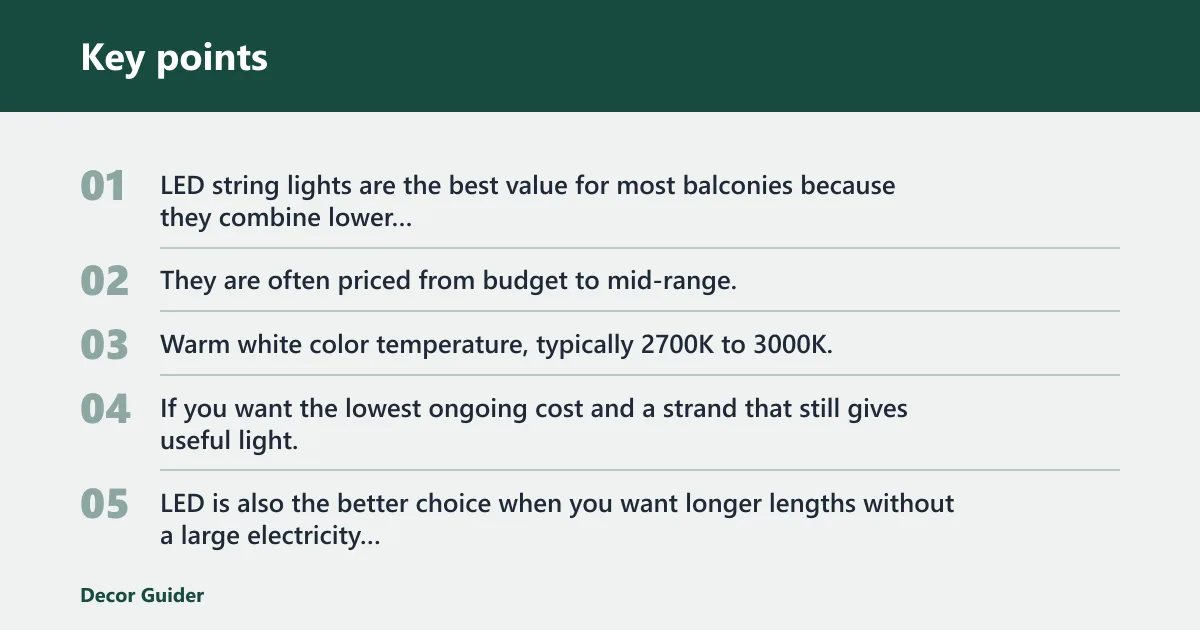
LED string lights are the best value for most balconies because they combine lower running cost with broad outdoor availability. They are often priced from budget to mid-range, and they suit both small and standard balcony setups. Warm white color temperature, typically 2700K to 3000K, gives a cozy evening look without harsh glare.
If you want the lowest ongoing cost and a strand that still gives useful light, start here. LED is also the better choice when you want longer lengths without a large electricity bill.
Incandescent string lights
Incandescent string lights have a traditional warm glow, but they cost more to run because they use more power. On a balcony, that higher wattage is hard to justify unless you are chasing a specific vintage look and accept the trade-off in efficiency.
They are rarely the best budget choice. For most buyers, the extra running cost outweighs the look advantage.
Solar and battery-powered options
Solar string lights avoid mains electricity, which can help on a balcony without an outlet. Solar-powered lights commonly start around £10–£25 for roughly 10–12 metres in U.K. retail listings, but performance depends on sunlight and they are often dimmer than plug-in lights. In cloudy climates or shaded balconies, that can turn into disappointment rather than savings.
Battery-powered lights are useful for tiny balconies, but they often need at least two AA batteries. A pack of 12 AA batteries can cost about £7.50 in U.K. retail listings, and replacement packs in U.S. multipacks commonly fall around the low single digits per 4–12 batteries depending on brand and chemistry. That replacement cost adds up, especially if the strand is used nightly or if you choose a brighter set.
What length should you buy?
Measure the balcony perimeter you actually want to light, then choose a strand with just enough extra length for corners and attachment points. The best length is the one that covers the space without creating a tangled surplus. Overbuying length increases cost and can make the finished look messy.
Measure balcony perimeter
Use the rail, wall edge, or overhead line you plan to follow. If your balcony is narrow, a shorter strand may still cover the visible edge well. If it has multiple corners, add slack so the cord does not pull tight at each turn.
Allow slack for corners
Slack is not waste if the run needs to turn a corner or dip between hooks. The problem is too much slack. On a small balcony, extra length can mean visible loops, more clips, and a higher price without better coverage.
Avoid paying for unused length
A common first-timer mistake is buying 48ft because it sounds safer, then finding that half the strand has nowhere to go. That often happens on rented balconies, where the usable hanging area is smaller than the full perimeter suggests. Measure first, then buy for the real layout.
What features are worth paying for?
Not every premium feature is worth it on a balcony. The ones that matter most are the ones that improve durability, weather resistance, or control. Warm white colour, an outdoor rating, and better cord quality usually matter more than decorative extras.
Warm white color temperature
Warm white, usually 2700K to 3000K, is the safest choice for a cozy balcony setting. It softens hard surfaces and pairs well with plants, cushions, and wood furniture. Cool white can look harsher, especially in a compact space where the lights sit close to eye level.
Outdoor weather rating
Look for weather-resistant builds if rain can reach the balcony. IP44 or higher is a common benchmark for outdoor use. That rating does not make a light indestructible, but it signals better resistance to splashes and outdoor exposure than a basic indoor strand. Higher ratings, such as IP65 or above, are commonly used for more exposed outdoor products where water jets or heavier weather exposure are expected.
Replaceable bulbs and heavier cords
Replaceable bulbs and a heavier cord are worth paying for when the lights will stay in place for a long season or face wind and repeated handling. These features usually push the upfront spend higher, but they can extend service life and reduce replacement costs later.
Small balcony budget setups
The best-value setup depends on size, power access, and exposure. Tiny balconies usually need short LED strands. Standard balconies do well with outdoor-rated LED lights. Covered terraces can justify better hardware. No-outlet spaces need solar or battery power, but those choices should be weighed against light output and replacement costs.
- For a tiny rented balcony, choose a short LED strand in warm white and avoid paying for extra length.
- For a standard open balcony, choose outdoor-rated LED lights with IP44 or higher if rain is likely.
- For a covered terrace, consider commercial-grade lights if you want a heavier cord and longer service life.
- For a no-outlet balcony, compare solar output against local sunlight, then check battery replacement cost before buying battery-powered lights.
Suppose you have a shaded north-facing balcony with no outlet. Solar lights may still power on, but weak sunlight can leave them dim and short-lived after sunset. In that case, a battery-powered strand may give more predictable light, even though the batteries add recurring cost. This is where balcony exposure matters as much as the sticker price.
For U.K. buyers, the headline number is not only the ticket price. A realistic estimate should assume a tariff, a wattage, and an actual nightly schedule. Using a 25p/kWh tariff, a 6W LED strand running for 5 hours a night costs about £0.23 per month; a 10W strand at the same tariff and runtime costs about £0.38 per month. At 15p/kWh, those same setups cost about £0.14 and £0.23 per month respectively. The real decision is whether the setup fits the balcony’s exposure, power access, and length.
Frequently asked questions
What is the cheapest type of balcony string lights?
The cheapest type is usually a basic LED strand with a short length and no premium hardware. It has a lower purchase price than commercial-grade lights and a much lower running cost than incandescent options, especially for regular evening use.
Are LED balcony string lights cheaper to run than incandescent?
Yes. LED lights use less power than incandescent lights, so they cost less to run. That difference matters on any balcony used often.
Do solar balcony string lights save money?
They can, but only when the balcony gets enough sunlight. Solar-powered lights commonly start around £10–£25 for a 10–12 metre set, yet weak sun, shade, or cloudy weather can reduce brightness and runtime. They save on electricity, but the light quality is not always as strong as plug-in LEDs.
How do I choose balcony string lights for a small space?
Choose a short LED strand in warm white, then match the length to the balcony perimeter plus a little slack for corners. Avoid oversized 48ft sets unless you truly need them. For a very small space, battery-powered lights can work, but replacement costs may be higher.
Products related to this article
Sponsored / affiliate links. As an Amazon Associate I earn from qualifying purchases. I may earn additional commission from eligible campaigns.