You’re scrolling through cabin options for your next cruise and you see it: an aft balcony cabin, often priced a bit higher than a standard side balcony. The photos show a massive teak deck and a direct view of the ship’s wake. It looks incredible. But you’ve also heard rumors about soot, vibration, and a long walk to the buffet. Is the hype real?
I’ve spent years cruising in every type of cabin, from inside rooms to suites, and I’ve taken eight cruises in aft balconies across different ship classes. I’ve felt the vibration at 20 knots, I’ve wiped soot off my chair, and I’ve also watched dolphins play in the wake from my private deck. This article isn’t a generic pros-and-cons list. It’s a decision matrix that scores the aft balcony against specific cruise types and traveler personalities. By the end, you’ll know exactly whether that premium is worth it for your next sailing.

LOVE STORY
LOVE STORY 3' x 10' Balcony Privacy…
- (Breathable Material with Some Visibility Through) Made with 100% new high density polyethylene(HDPE) material–no recycled materi…
- (Perfect Size and Durability Workmanship) Suitable for 3'tall chain link fence or other apartment railing.Anti-oxidation treatment…
- (Suitable Place and Notice) 85%-90% shading rate, prefect for your deck in backyard, patio,swimming pool,window shades,tennis cour…
As an Amazon Associate I earn from qualifying purchases.
Before we dive into the details, one practical note: if you’re cruising on a ship with metal railings and want to block the wind or create more privacy on your balcony, a simple privacy screen can make a big difference. The balcony privacy ideas guide covers several options, and a product like the LOVE STORY 3′ x 10′ Balcony Privacy Screen Cover attaches with zip ties and lets breeze through while blocking 85-90% of light. It’s a cheap fix that solves one of the few real downsides of an aft balcony.
The Aft Balcony: A Quick Overview
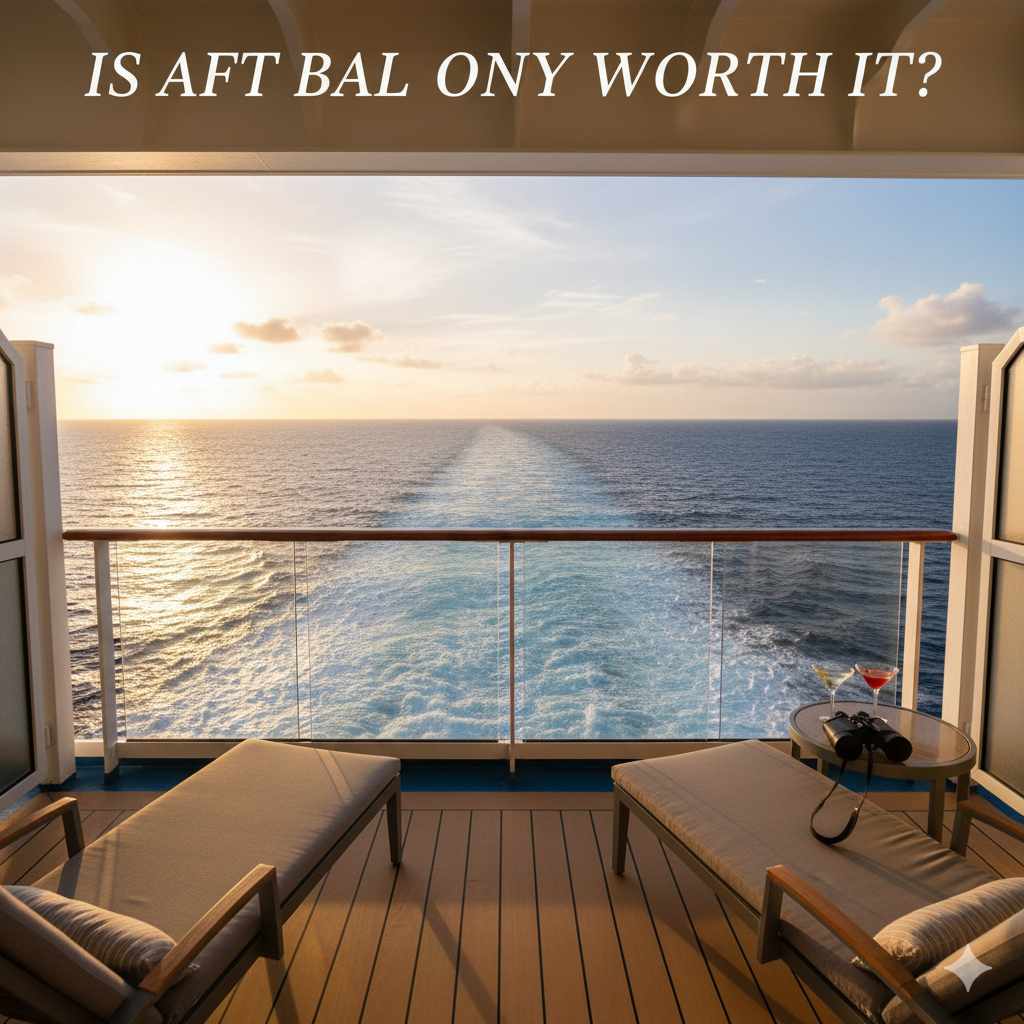
An aft balcony sits at the back of the ship, facing the stern. Instead of looking sideways at the ocean, you look directly behind the vessel at the churning wake. These cabins are usually on decks 6 through 10, and they’re a hot commodity because there are relatively few of them on any given ship.
The core appeal is the view. You get a 180-degree panorama of the sea behind you. There’s no wind tunnel effect because the ship’s forward motion pushes air away from the stern, so these balconies tend to be calmer than side balconies when the ship is moving. That’s a huge deal for people who want to sit outside while sailing.
But the trade-offs are real. You’re at the end of a long corridor, so you’ll walk further to get to most venues. And depending on the ship’s engine configuration, you might feel more vibration than you would mid-ship.
The Unmatched Wake View (and Why It Matters)
There’s something hypnotic about watching the ship’s wake. It’s a constant, churning trail of white water that stretches to the horizon. For many cruisers, this is the single biggest reason to book an aft balcony. You can sit there for hours, coffee in hand, and just watch the ocean roll by.
Psychologically, the wake view works on two levels. For some, it’s deeply calming—a rhythmic, repetitive visual that quiets the mind. For others, it can be mildly anxiety-inducing. The feeling of moving away from something, of leaving a trail behind, can trigger unease in people who prefer stability. I’ve read forums where cruisers describe feeling “pulled” backward. It’s rare, but it happens. If you’re prone to motion sickness or anxiety, the wake might not be your friend.
For everyone else, the wake view is a genuine upgrade over a side balcony. On a side balcony, you watch the ocean pass by. On an aft balcony, you watch the ocean recede. It’s a subtle difference, but it changes the whole feel of the space. You get more sky, more horizon, and a sense of being alone on the water.
One more thing: sun exposure. Aft balconies get sun at different times depending on the ship’s heading. On a southbound Caribbean cruise, the stern faces north, so you’ll get morning sun on one side and afternoon shade. On a transatlantic crossing, the stern faces east, meaning you get sun all day. If you want to sunbathe on your balcony, check your itinerary and the ship’s direction.
The Size Advantage: Are Aft Balconies Really Bigger?
This is where the myth meets reality. Yes, many aft balconies are larger than standard side balconies. But not all of them. The size difference depends entirely on the ship class and the specific deck.
On Royal Caribbean’s Oasis-class ships, for example, the aft balconies on deck 8 are enormous—some are nearly double the width of a standard balcony. They wrap around the corner, giving you a side view and a stern view. But on the same ship, the aft balconies on deck 11 are the same size as a regular balcony. You have to check the deck plans carefully.
On Carnival’s Vista-class ships, the aft balconies are consistently larger, but they have a metal support beam running through the middle of the balcony. That beam blocks part of your view and makes the space feel smaller than it is. You’ll see it in almost every cabin review for those ships.
Here’s a rule of thumb: if the balcony is marked as “extended” or “wrap-around” on the deck plan, it’s bigger. If it’s just labeled “aft,” assume it’s standard size. The extra cost you’re paying is for the location and the view, not necessarily the square footage.
The Vibration and Noise Reality Check
Let’s talk about the elephant in the room: vibration. Aft cabins sit directly above the ship’s propellers and, on many ships, above the engine room. When the ship is cruising at full speed, you will feel a constant, low-level hum. It’s not a violent shaking—it’s more like the subtle vibration you feel in a car when you’re driving on a rough highway.
I’ve experienced it on every aft balcony I’ve stayed in, but the severity varies. On a modern ship like the Norwegian Bliss, the vibration is barely noticeable. On an older ship like the Carnival Breeze, it’s more pronounced, especially on lower decks. If you’re a light sleeper, this could be a problem. But here’s the thing: most people get used to it within a day. Your brain filters it out, and you stop noticing it.
Noise is a different story. Aft cabins are usually quiet because there’s no foot traffic passing by your door. You’re at a dead end, so the only people who walk past are your neighbors. That’s a big advantage over a mid-ship balcony near the elevator bank. The trade-off is that you’ll hear the ship’s engines more clearly, especially during docking maneuvers. That’s a low rumble that lasts maybe 30 minutes at the start and end of each port day.
The Soot Problem: Myth or Fact?
Soot is the most common complaint about aft balconies, and it’s worth addressing head-on. Soot comes from the ship’s exhaust stacks. On most modern ships, the stacks are positioned so that exhaust blows away from the aft balconies. But on older ships, or when the wind is blowing in a certain direction, fine black particles can settle on your balcony furniture.
I’ve had cruises where I found a light dusting of soot on the table each morning. I’ve also had cruises where I never saw a single speck. It’s unpredictable. The worst offenders are ships with older engine technology, like some of the Carnival and Holland America ships built before 2026. On newer ships, the problem is largely solved.
If you do get soot, it’s a minor annoyance. You wipe off the chair before you sit down. It doesn’t stain your clothes or ruin your trip. But if you’re the kind of person who obsesses over a spotless balcony, an aft cabin might not be for you. You can also bring a small cloth or use a balcony privacy screen to create a barrier that catches some of the particles.
The Walking Distance Dilemma (and the Dead-End Factor)
Here’s the part that most reviews gloss over: the dead-end factor. An aft cabin is at the end of a long corridor. Every time you want to go to the main dining room, the buffet, or the pool, you walk the entire length of the ship. On a large ship like the Oasis class, that’s a 10-minute walk each way.
You’ll get your steps in, that’s for sure. But it’s not just the distance—it’s the mental fatigue of always being at the “back of the line.” You can’t just pop out of your cabin and be near the action. You’re committed to that walk. On a 7-night cruise, you’ll walk miles just getting to and from your cabin.
There’s a workaround: choose a deck that’s close to the venues you use most. If you love the buffet, pick a deck near the buffet. If you spend most of your time at the pool, pick a deck near the pool. The elevators at the aft of the ship are usually less crowded than the mid-ship ones, so you can save time there. But you’ll still have to walk through the corridor to get to the elevator bank.
For some people, this is a deal-breaker. For others, it’s a feature—the quiet, removed location means fewer people walking by your door and less noise from the hallways. It’s a trade-off you have to make consciously.
Aft vs. Side Balcony: Which is Better for Scenic Cruising?
This is where the decision matrix gets interesting. For scenic cruises like Alaska or the Norwegian Fjords, the choice between an aft and a side balcony isn’t obvious. It depends on the direction you’re sailing and what you want to see.
In Alaska, the best views are often on one specific side of the ship. For example, on the classic Inside Passage route, the glaciers are on the starboard side when you’re sailing north. If you’re on an aft balcony, you’ll see the glacier behind the ship, not the face of it. You’ll get a great view of the wake and the surrounding mountains, but you’ll miss the full glacier face.
On a Norwegian Fjord cruise, the scenery is all around you. The ship sails through narrow passages with mountains on both sides. An aft balcony is actually perfect here because you get a panoramic view of the fjord walls receding behind you. You don’t need to pick a side because the scenery surrounds the ship.
My honest advice: for Alaska, book a side balcony on the correct side of the ship. For fjords, an aft balcony is a fantastic choice. For Caribbean or Mediterranean cruises, the side doesn’t matter much, and the aft balcony wins for the wake view alone.
The Cost Question: When is the Premium Worth It?
Let’s talk money. Aft balconies typically cost 10-20% more than a standard side balcony on the same deck. That premium varies by cruise line, ship, and itinerary. On a 7-night Caribbean cruise, that might be $200-400 extra. On a 14-night transatlantic, it could be $600 or more.
Is it worth it? Here’s my rule: the longer the cruise, the more you’ll use your balcony, and the more the premium pays off. On a 7-night cruise with port-intensive itineraries, you’ll be off the ship most days, and you might only use your balcony for an hour each morning. That’s $50 per hour of balcony time. Not great.
On a 14-night transatlantic with several sea days, you’ll spend hours on that balcony every day. The cost per hour of enjoyment drops dramatically. Same goes for a 10-night Southern Caribbean or a 12-night Mediterranean. If you have multiple sea days, the aft balcony is worth every penny.
One more factor: motion sickness. Aft cabins are actually better for motion sickness than cabins at the very front of the ship. The stern has less vertical motion than the bow. You’ll still feel some rocking, but it’s less intense than being at the front. If you’re prone to seasickness, an aft balcony is a solid choice.
How to Book the Best Aft Cabin (Deck Selection & Guarantees)
Booking an aft cabin isn’t just about picking any available one. The deck you choose makes a huge difference in your experience.
Lower decks (6-8) have more vibration and more noise from the engine room. They also tend to be cheaper. Higher decks (9-11) have less vibration but can be windier when the ship is moving fast. The sweet spot is usually deck 8 or 9. You get a good balance of stability and quiet.
You also want to check what’s directly above you. If you’re under the buffet or the pool deck, you’ll hear chairs scraping at 6 AM. If you’re under cabins, you’ll hear nothing. Look at the deck plan and find what’s above your desired cabin. A cabin under the galley is a nightmare. A cabin under the spa is bliss.
Now, about guarantees. An “aft guarantee” means you’re guaranteed an aft cabin, but you don’t choose the specific one. This can save you money, but it’s a gamble. You might get a cabin with an obstructed view from a support beam, or you might get a wrap-around corner suite. If you’re flexible, it’s a good way to save 10-15%. If you need a specific cabin (like one with a larger balcony), pay the extra and pick your exact room.
Final Verdict: Is an Aft Balcony Worth It for You?
Let’s put this into a simple decision matrix. Score yourself on each factor from 1 (not important) to 5 (critical). If your total is over 25, book the aft balcony. If it’s under 15, save your money and book a side balcony.
| Factor | Your Score (1-5) | Why It Matters |
|---|---|---|
| Wake view appeal | _ | Hypnotic for most, anxiety-inducing for a few |
| Balcony size | _ | Often larger, but not always—check deck plans |
| Vibration tolerance | _ | Constant low hum, worse on lower decks |
| Soot annoyance | _ | Unpredictable, worse on older ships |
| Walking distance | _ | Long walk to everything, but quiet location |
| Scenic itinerary | _ | Great for fjords, bad for one-sided Alaska views |
| Cost premium | _ | 10-20% more, worth it on long cruises |
My personal take: I’ve never regretted booking an aft balcony, but I’ve also never booked one for a port-heavy Caribbean itinerary. I save them for transatlantics, fjords, and any cruise with multiple sea days. If you’re the kind of person who enjoys a quiet morning coffee on deck, an aft balcony is a rare treat. If you’d rather be at the pool bar, save the money.
One last tip: if you do book an aft balcony, bring a few extras to make it perfect. A small blanket for cool evenings, a magnetic hook for wet swimsuits, and a privacy screen if you want to block the wind or create a cozier space. These small touches turn a great cabin into a perfect one.
Frequently Asked Questions
Is an aft balcony cabin noisy?
Not from other passengers. You’re at a dead end, so there’s minimal foot traffic. You will hear engine noise and vibration, especially on lower decks. The engine sound is a low rumble, not a sharp noise. Most cruisers adjust within a day.
Do aft balconies have soot problems?
Sometimes. It depends on the ship’s age and wind direction. Newer ships rarely have soot issues. Older ships can drop fine black particles on your furniture. It’s a minor annoyance, not a deal-breaker. You wipe it off and move on.
Are aft balconies bigger than regular balconies?
Often, but not always. Some aft balconies are extended or wrap-around, while others are standard size. Always check the deck plan and look for “extended” or “wrap-around” labels. Don’t assume you’re getting more space just because it’s an aft cabin.
Which is better for Alaska: aft or side balcony?
Side balcony on the correct side of the ship. In Alaska, glaciers are often on one side only. An aft balcony gives you a wake view, but you’ll miss the full glacier face. For fjords, an aft balcony is better because the scenery surrounds the ship.
Is an aft guarantee worth the risk?
Yes, if you’re flexible. You save 10-15% but don’t choose your exact cabin. You might get a smaller balcony or a support beam in your view. If you need a specific cabin, book it directly. If you’re easy-going, the guarantee is a smart way to save money.
What to Do Next
- Check your itinerary: count the sea days. More sea days = more balcony time = worth the premium.
- Look at the deck plan: find the exact cabin number and check what’s above and below it. Avoid cabins under the galley or pool deck.
- Compare prices: an aft balcony costs 10-20% more. Calculate the cost per hour of balcony time based on your planned usage.
- Consider a guarantee if you’re flexible on cabin location and want to save money.
- Bring a privacy screen if you want to block wind or create more seclusion. The creative balcony garden ideas guide also has tips for making small outdoor spaces feel bigger.
- Book a mid-deck (8-9) for the best balance of vibration and wind.
- If you’re prone to motion sickness, an aft balcony is a safer bet than a forward cabin.
For more on choosing between specific cabin types, check this cove balcony comparison for Carnival ships. It covers a different but related trade-off.