Balcony Outdoor Curtain Review: Is It Worth It?
Yes, a balcony outdoor curtain is worth it when your balcony gets moderate sun or rain and you can mount hardware securely. Skip it for windy, fully exposed balconies or rentals that forbid drilling. Poor placement leads to flapping fabric, rust-prone hardware, and weak privacy, so exposure and anchoring matter more than fabric style.
Verdict

- 100% acrylic fabric resists weather
- Rust-free stainless steel grommets
- UV-stabilized prevents color fading
Based on the published specs and buyer feedback patterns, the Sweet Summer Living curtain is the stronger pick for a covered or partially sheltered balcony because its 100% acrylic fabric, rust-free stainless steel grommets, and UV-stabilized finish fit that use case well. It is less convincing for a bare, wind-prone ledge, where a privacy screen often holds position better and asks less of the mounting system.
Pros and cons
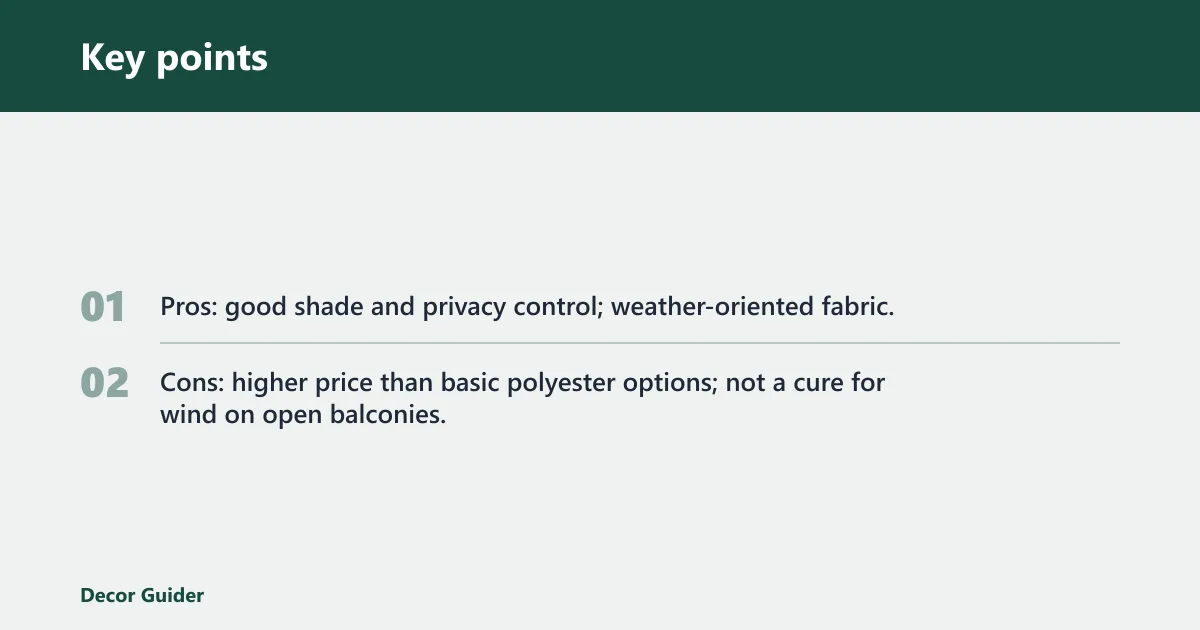
- Pros: good shade and privacy control; weather-oriented fabric; stainless grommets help with corrosion resistance.
- Cons: higher price than basic polyester options; not a cure for wind on open balconies; 120 x 50 inch sizing may not fit every rail or opening without planning.
Specs at a glance
| Factor | What matters on a balcony | Why it matters |
|---|---|---|
| Fabric options | Polyester, acrylic, olefin, HDPE | Polyester is common and affordable; acrylic tends to hold color better; olefin dries quickly; HDPE is useful where airflow and shade matter more than drape. |
| Weather claims | Water-resistant, water-repellent, waterproof, UV-resistant, mildew-resistant, fade resistance | These are not the same. Water-resistant and water-repellent can shed light rain; waterproof is a stronger claim; UV and fade resistance matter for sun-facing balconies. |
| Hardware | Grommets, rust-proof stainless steel grommets, top and bottom grommets, sturdy rod, extra support brackets, tie-down loops, weighted panels | Good hardware controls movement. Top and bottom grommets and weights matter most when wind is a problem. |
| Rod compatibility | Up to 1.25 inches | Check the rod diameter before buying. A mismatch can cause sagging or sliding issues. |
| Sizing | 52×84 inches, 54×84 inches, 4.5 x 7.5 ft, size options, panel count | Width and panel count change coverage. Two panels often close gaps better than one narrow panel on a balcony opening. |
| Privacy levels | Sheer, semi-sheer, light-filtering, privacy, blackout, filtered light | Higher privacy levels block more view, but they also cut more light. That tradeoff matters on small balconies. |
Who it
This is for apartment balcony owners who need privacy, moderate shade, and a softer barrier than a hard panel. It also fits covered balconies where rain and wind are limited, and where a secured rod or rail mount is possible. It is less useful for tenants who cannot drill, or for exposed balconies with strong crosswinds.
A common first-timer mistake is choosing a decorative balcony curtain before confirming whether the rod brackets can handle wind and moisture. A 54×84 inch curtain can still fail if the rod is thin, the bracket spacing is weak, or the balcony opening is too wide for one panel to cover cleanly.
Covered balcony owners
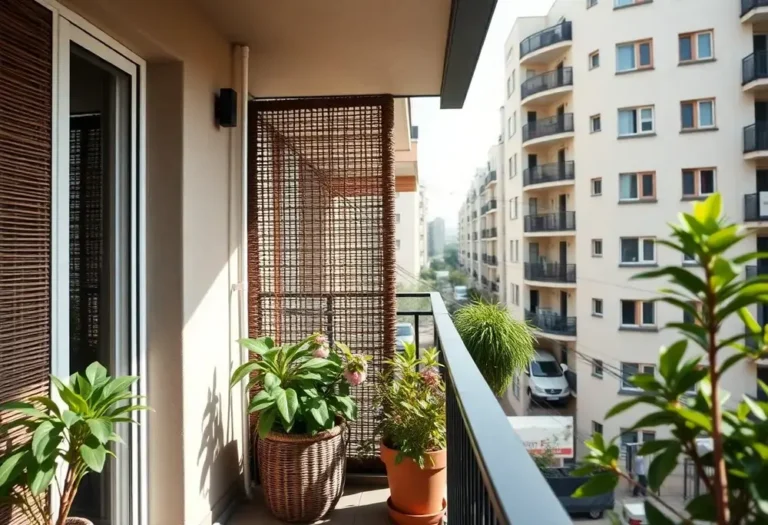
Covered balconies are the easiest match for outdoor curtains. The roof cuts direct rain and lowers wind load, so fabric choice can focus more on privacy and colorfastness than on survival in storms. Polyester, acrylic, and even some lighter panels make more sense here than on an open ledge.
Apartment balconies with street-level visibility
If passersby can see straight onto the balcony, curtains can be worth it for privacy alone. The best fit is usually a light-filtering or privacy panel rather than sheer fabric. Blackout can work too, but it will reduce daylight and can make the space feel closed in.
Small outdoor spaces with limited mounting options
Small balconies are where curtain buying gets tricky. If you have only a narrow rail or no safe place for support brackets, a privacy screen may be the cleaner option. Curtains need room to hang and enough hardware to keep the panels from swinging into chairs, plants, or doors.
What works
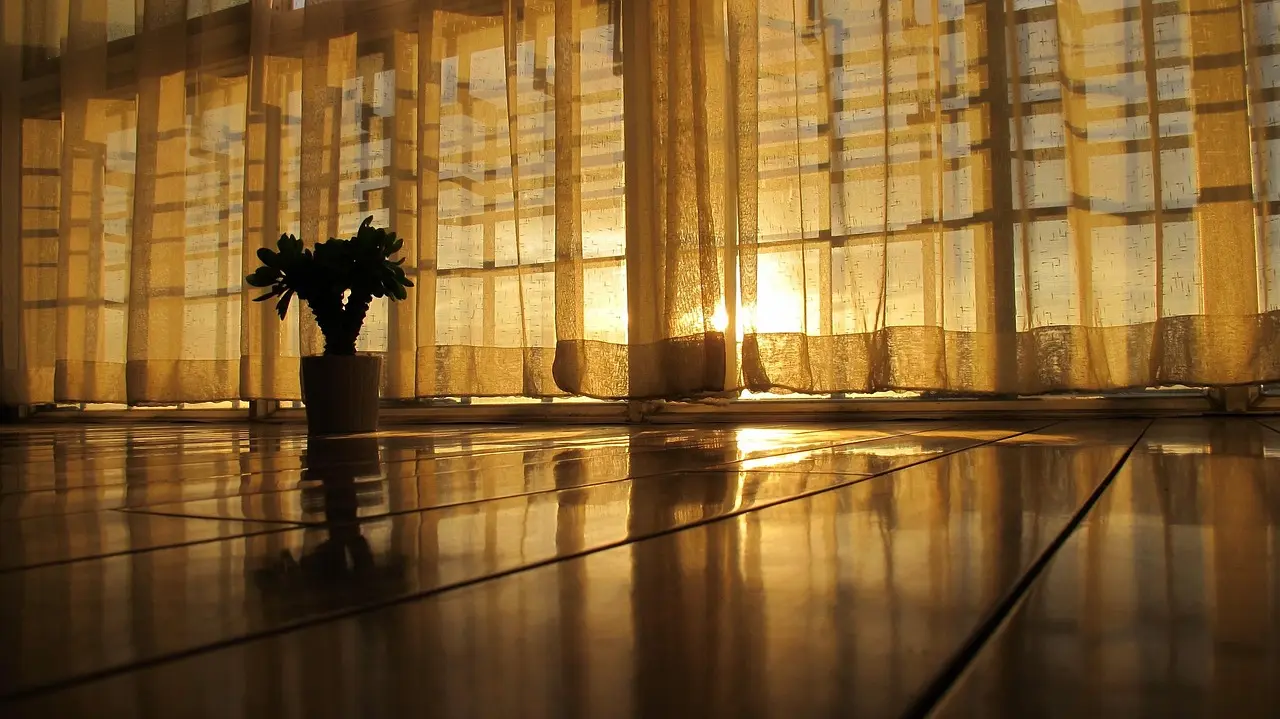
Outdoor curtains do three jobs well when the setup matches the balcony: they add shade, privacy, and a more finished look to decks, patios, and porches. They can make the space feel more like an outdoor room, but only if the fabric, size, and mount fit the exposure.
Fabric and weather claims
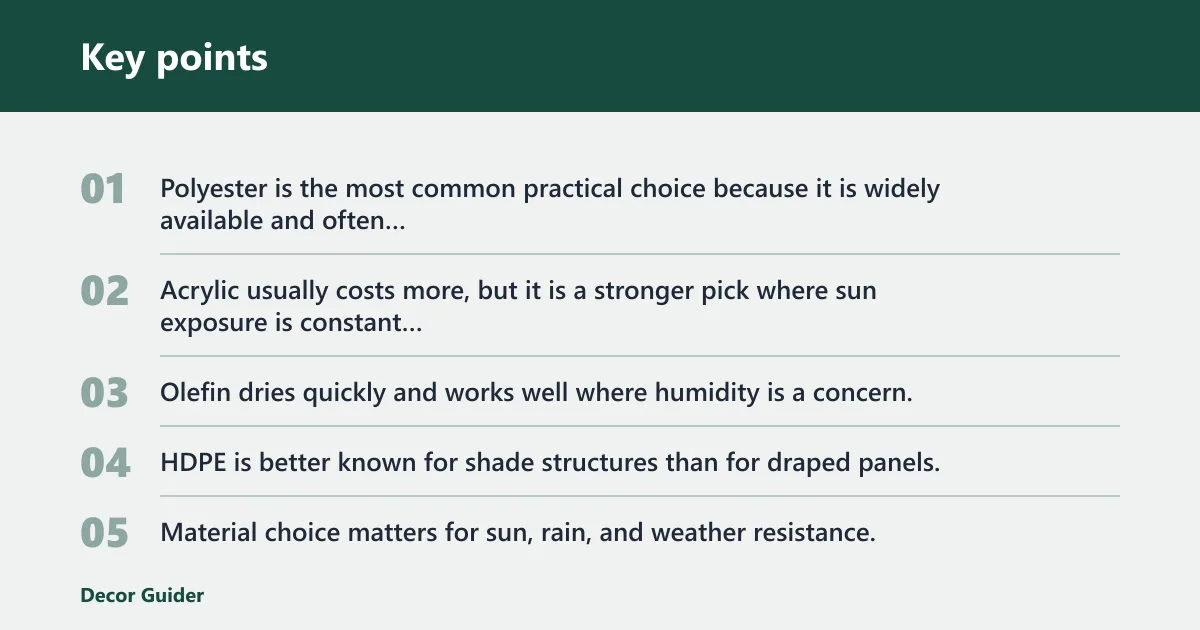
Polyester is the most common practical choice because it is widely available and often treated for outdoor use. Acrylic usually costs more, but it is a stronger pick where sun exposure is constant because fade resistance tends to matter more there. Olefin dries quickly and works well where humidity is a concern. HDPE is better known for shade structures than for draped panels, but it can make sense when airflow is more useful than a soft fold.
Material choice matters for sun, rain, and weather resistance. Water-resistant and water-repellent fabrics may handle spray and light rain, while waterproof fabrics aim for more complete barrier performance. UV-resistant and fade-resistant claims matter on sun-facing balconies, and mildew-resistant treatment matters most in humid climates or on balconies that stay damp after storms.
Privacy levels
Sheer panels let in the most light and allow the most visibility. Semi-sheer and light-filtering panels soften the view without turning the balcony dark. Privacy and blackout panels block far more sightlines, with blackout giving the most coverage and the most loss of daylight.
That tradeoff matters. If the balcony faces street level and you use it as a sitting area, privacy fabric is often worth the light loss. If the balcony already feels dim, a semi-sheer or light-filtering option may be better than full blackout.
Installation features that help
Smooth-sliding grommets make it easier to open and close panels without tugging the fabric. Rust-proof stainless steel grommets matter where moisture is common. Tie-down loops, weighted panels, and a sturdy rod reduce movement. Extra support brackets help when the span is wide or the curtain is heavy.
For rod compatibility, many buyers should check for up to about 1.25 inches before ordering hardware. That number matters because a curtain with heavy panels but a weak rod tends to sag at the center and rub at the grommets.
What does not?
Outdoor curtains do not solve every balcony problem. On open balconies, lightweight panels can lift, flutter, and twist enough to defeat privacy and wear out seams faster. In wet or windy climates, constant movement often shortens life more than the product page suggests.
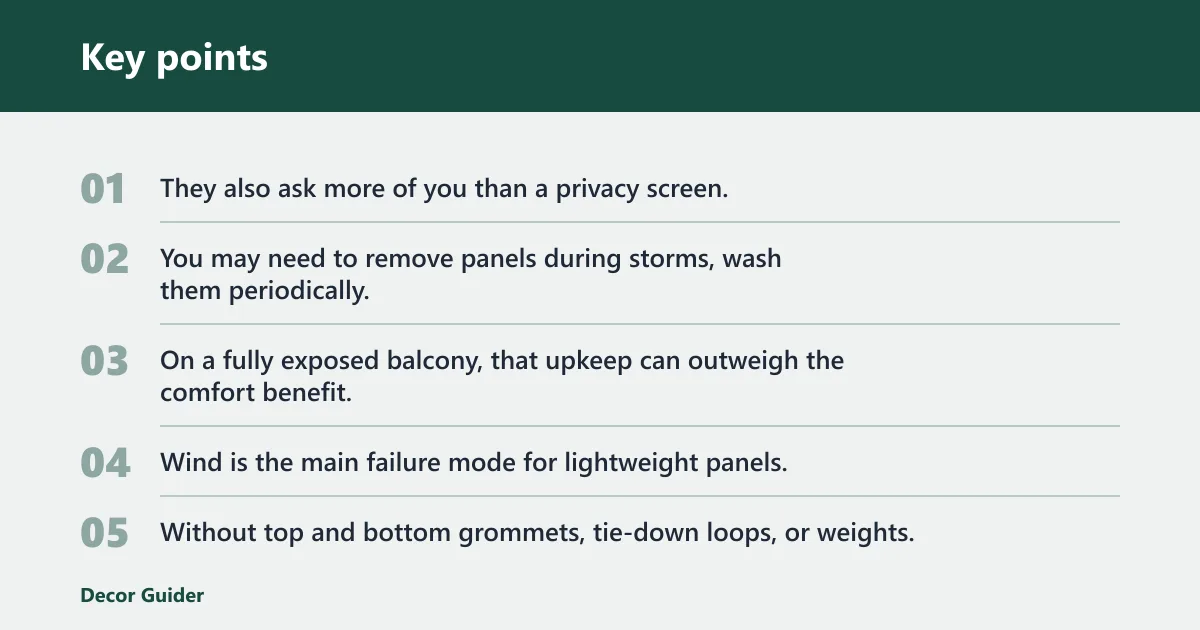
They also ask more of you than a privacy screen. You may need to remove panels during storms, wash them periodically, and check brackets for rust or loosening. On a fully exposed balcony, that upkeep can outweigh the comfort benefit.
Wind lift and flapping on open balconies
Wind is the main failure mode for lightweight panels. Without top and bottom grommets, tie-down loops, or weights, panels can billow and bang against railings. That does not only look messy; it can also strain the rod and loosen mounting points over time.
Maintenance and seasonal removal
Polyester usually brings the easiest care, and machine-washable privacy panels are a plus for rental balconies or dusty street-facing spaces. Acrylic and olefin can resist sun and moisture well, but they still need cleaning and periodic inspection. In harsh sun or wet climates, replacement may come sooner than in a sheltered setup.
Lifecycle cost is often missed. A cheaper polyester curtain may need replacement sooner in direct sun and rain, while a better acrylic panel can cost more upfront but last longer when the balcony is covered. Privacy screens may cost less to keep in place over time because they often have fewer fabric care demands.
Where curtains lose to privacy screens
Privacy screens usually win on wind handling and simplicity. They stay flatter, need less seasonal attention, and often work better when drilling is limited or the balcony opening is irregular. Curtains win when you want soft light control and easy opening, but they lose when the space is exposed and support is weak.
Are balcony outdoor curtains worth it?
They are worth it on covered balconies, street-facing balconies, and partially sheltered spaces where privacy or shade matters more than full wind blocking. They are not a good all-purpose answer for open, windy balconies. In those cases, a privacy screen or a mixed setup is usually the safer buy.
Covered balcony scenario
On a covered balcony, curtains usually make sense. Polyester or acrylic can work well, and even a 52×84 inch or 54×84 inch panel can be enough for a narrower opening. The main drawback is upkeep, not weather failure.
Exposed balcony scenario
On an exposed balcony, curtains are a weaker fit unless the mounting is very secure and the fabric is built for weather. Water-repellent or water-resistant fabric may help with light rain, but it will not fix wind lift. A privacy screen often holds up better here.
Windy balcony scenario
On a windy balcony, curtains are only worth it if you can use top and bottom grommets, tie-down loops, weights, or extra support brackets. Even then, expect some movement. If the balcony is very exposed, a screen or mixed barrier usually performs better.
Balcony curtain decision table
| Balcony scenario | Recommended fabric | Hanging method | Expected drawbacks | Worth it versus a privacy screen? |
|---|---|---|---|---|
| Covered balcony | Polyester or acrylic | Standard rod with rust-proof stainless steel grommets | Needs cleaning and may collect dust; can still shade out too much light if blackout is chosen | Yes, usually worth it if you want softer light control and more privacy |
| Exposed balcony | Acrylic or olefin | Sturdy rod with extra support brackets and weighted panels | Wind lift, faster wear, more frequent adjustment after storms | Often no; a privacy screen is usually the safer buy |
| Windy balcony | HDPE or tightly woven acrylic | Top and bottom grommets, tie-down loops, weights, strong brackets | Harder to open and close, more hardware to inspect, still not fully stable in gusts | Usually no unless you need curtains for view control and can secure them well |
| High-privacy balcony | Polyester blackout or dense privacy fabric | Rod-mounted panels with full overlap and smooth-sliding grommets | Less daylight, can make the space feel enclosed, may trap heat | Yes, if privacy is the main goal and light loss is acceptable |
Will balcony curtains work on a windy balcony?
They can work, but only if the hardware and fabric match the wind load. On a windy balcony, the goal is not perfect stillness. The goal is controlled movement, secure attachment, and a setup that does not pull the rod loose or whip the panel edge into the railing.
How to keep panels from blowing around
Start with a sturdy rod, then add weights or tie-down loops if the balcony is open. If the curtain has only top grommets, expect more lift. A denser fabric and a snug panel count help, but they do not replace anchoring points.
When top and bottom grommets help
Top and bottom grommets are useful when you need the fabric to stay aligned against a railing or post. They reduce swinging and can improve privacy on an exposed balcony, though they still rely on a secure frame. A loose mount turns that advantage into extra stress on the hardware.
When extra support brackets are needed
Support brackets become important when the span is wide, the curtain is heavy, or the rod is near the 1.25 inch compatibility limit. They are also useful when drilling is allowed but the wall material is weak. If brackets are not possible, a privacy screen may be the safer choice.
Should you buy it?
Buy balcony outdoor curtains if you need shade and privacy more than hard wind protection, and if you can secure the mount with the right rod and brackets. Skip them if the balcony is fully exposed, the building rules forbid drilling, or the only available anchor points are weak.
The Sweet Summer Living curtain is a better fit for a sheltered balcony where weather resistance, UV stability, and corrosion resistance matter. The RichSets black privacy curtain is the better budget-style alternative when you want a low-cost privacy barrier, 54 x 84 inch coverage, and machine-washable care, but its waterproof claim still does not make it a wind solution.
Alternatives

- Waterproof 100% polyester fabric
- Blocks views for privacy
- Machine washable for easy care
RichSets is the more budget-friendly alternative for privacy-first buyers. The 100 percent polyester fabric, black-out style coverage, rust-proof grommets, and machine-washable care make it practical for apartment balconies with street-level visibility. The drawback is that the 6-panel format can be more than you need for a small opening, and waterproof fabric still does not mean windproof performance.
Frequently asked questions
Are outdoor curtains worth it on a balcony?
They are worth it when you have moderate sun, some weather protection, and a secure way to mount them. They are less worth it on open, windy balconies or rentals with drilling limits. The right answer depends more on exposure and anchoring than on color or pattern.
Do balcony curtains actually provide privacy?
Yes, but the level varies a lot. Sheer panels give only daytime softness, while privacy and blackout panels hide far more from neighbors and street view. If you want real screening, choose dense fabric and enough panel width to close gaps at the edges.
Will outdoor curtains block wind on an exposed balcony?
Only partly. Curtains can slow a breeze, but they are not a true wind barrier on an exposed balcony. Lightweight fabric tends to flap, and that movement can be worse than the draft itself. For wind-prone spaces, a privacy screen usually performs better.
What fabric is best for balcony outdoor curtains?
Acrylic is the strongest all-around choice for heavy sun because it usually holds color better. Polyester is the common budget pick and can work well if treated for outdoor use. Olefin dries quickly, and HDPE fits shade-first setups where airflow matters more than drape.
How do I keep balcony curtains from blowing around?
Use a sturdy rod, rust-proof grommets, and, if the balcony is exposed, tie-down loops, weighted panels, or top and bottom grommets. Add support brackets when the span is long or the fabric is heavy. If you cannot secure those parts, choose a screen instead.
What size curtain should I buy for a balcony?
Common sizes such as 52×84 inches, 54×84 inches, and 4.5 x 7.5 ft cover many balcony openings, but width matters as much as height. Check the full span, not just the drop. Two panels often give better coverage than one narrow curtain.
Products related to this article
Sponsored / affiliate links. As an Amazon Associate I earn from qualifying purchases. I may earn additional commission from eligible campaigns.