Balcony Privacy Screens vs Outdoor Curtains: Fit Guide
For most apartment balconies, choose privacy screens when wind is strong or you need daytime screening with airflow; choose outdoor curtains when the balcony is sheltered, you want softer nighttime coverage, and you can secure fabric properly. Pick the wrong covering and you get flapping panels, blocked light, silhouettes after dark, or hardware that fails rental rules and needs replacing. This guide compares both by balcony condition, with renter-friendly picks for wind, tight layouts, neighbor sightlines, and night privacy.
Balcony privacy screens vs outdoor curtains: the core trade-off



The core trade-off is simple: outdoor curtains move more and feel softer, while privacy screens stay fixed and stop views more strongly. On a balcony, railing placement, edge exposure, and building rules shape that choice more than decor style.
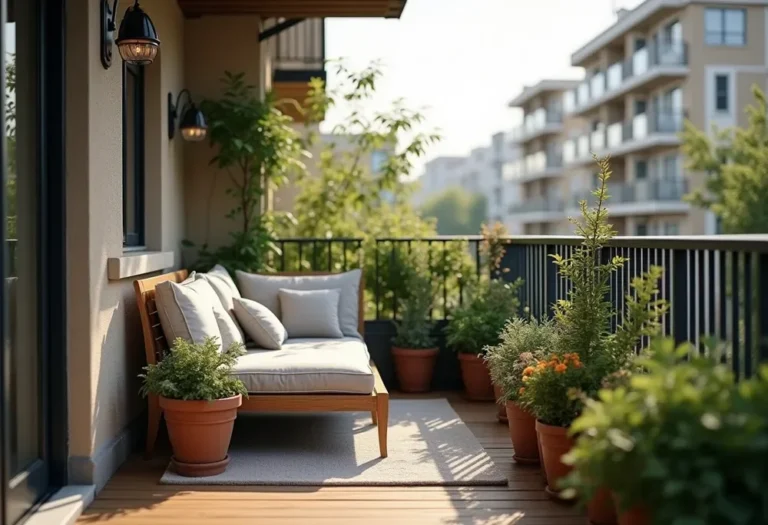
A balcony is typically above the ground floor and projects from a building wall, and balconies are commonly found on multi-level houses, apartments, and buildings. That puts wind, sightlines from nearby units, and attachment limits front and center, more than on a patio or porch.
| Decision factor | Balcony Privacy Screens | Outdoor Curtains | Winner |
|---|---|---|---|
| Privacy in daylight | Fixed barrier with stronger visual block | Flexible side privacy, softer cover | Balcony Privacy Screens |
| Night privacy | Usually better if the fabric is opaque | Can turn see-through if sheer or mesh is used | Balcony Privacy Screens |
| Airflow | Lower airflow than open curtains | Better when opened, but fabric can still slow air | Outdoor Curtains |
| Wind resistance | Tensioned screens are steadier at the edge | Can flap in wind and wear faster | Balcony Privacy Screens |
| Renter-friendly install | Often possible with tie-on or clamp methods | Needs rod or hardware; removal can be easier if freestanding | Tie |
| Space impact | Can feel boxed in on tiny balconies | Can also crowd narrow balconies if panels are deep | Tie |
| Maintenance | Less moving fabric, less handling | More opening, closing, washing, and wind wear | Balcony Privacy Screens |
| Hardware needs | May tie on without drilling | Needs rod, hooks, clamps, or a tension system | Balcony Privacy Screens |
Privacy and sightline control
Privacy screens win when the balcony edge faces a neighboring balcony, a shared court, or a property line that stays in view all day. Outdoor curtains still work, but they are stronger at soft side coverage than at creating a hard visual stop.
Airflow and comfort
Open curtains preserve more movement through the balcony than a solid screen. That matters on small apartment balconies, where a blocked edge can make the space feel still and warmer than expected.
Wind, wear, and fit
Strong crosswinds punish loose fabric. A tensioned screen is steadier on exposed edges, while curtains can flap, fray at the attachment points, and rattle against railings.
According to 32+ Balcony Privacy Ideas: Screens, Plants, and Curtains — The privacy screen claims 90% UV block. (source)
Which is better for your balcony conditions?
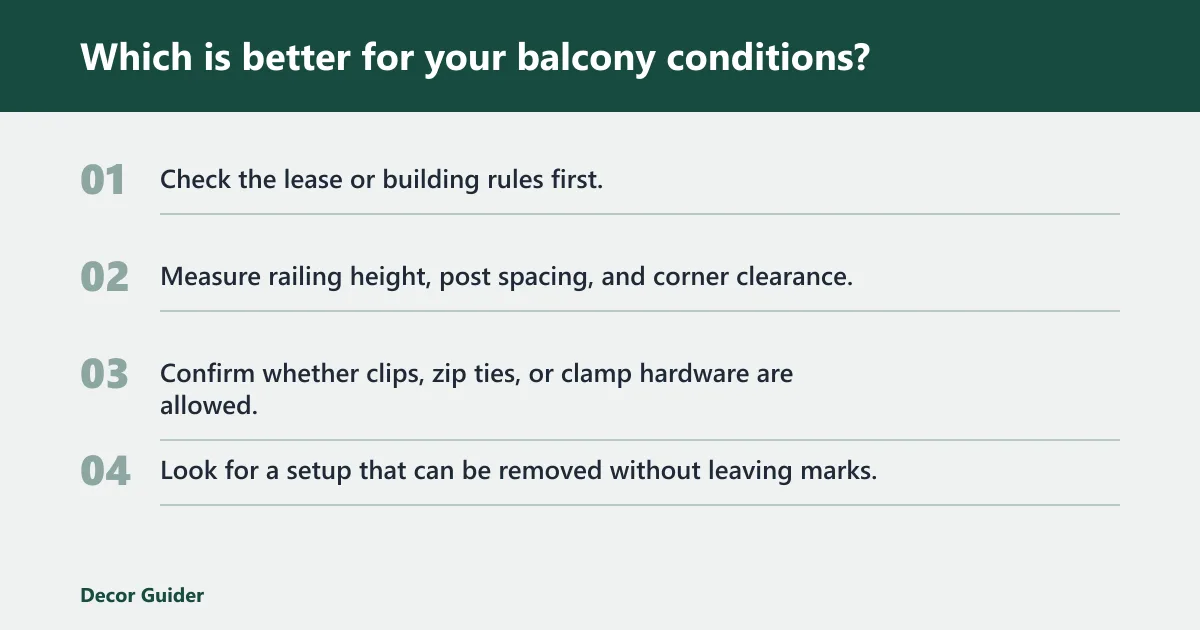
The better choice depends on exposure, railing geometry, and whether the space is covered or open to the weather. A sheltered balcony often favors curtains; a corner balcony on a high floor usually favors a screen or a mixed setup.
Renter-friendly balcony with no-drill limits
If drilling is off-limits, both options can still work, but the fit gets more specific. Balcony privacy screens can tie on without drilling, while curtain setups usually need a rod, hooks, clamps, or a tension system that matches the railing and the opening width.
- Check the lease or building rules first.
- Measure railing height, post spacing, and corner clearance.
- Confirm whether clips, zip ties, or clamp hardware are allowed.
- Look for a setup that can be removed without leaving marks.
Windy, exposed balcony
For exposed balconies, privacy screens usually win because they hold their shape better at the railing line. Outdoor curtains work only when the balcony is protected enough that flapping will be rare; otherwise the fabric becomes the weak point.
Covered balcony with steady weather
Covered balconies are where outdoor curtains make the most sense. They give flexible side privacy and a softer look, and they are easier to pull open when the balcony needs more light or a wider view.
Small balcony with tight clearances
On a small apartment balcony, space loss matters as much as privacy. A bulky rod, deep panel stack, or rigid screen panel can crowd movement, block drainage access, and make a narrow floor plan feel cramped.
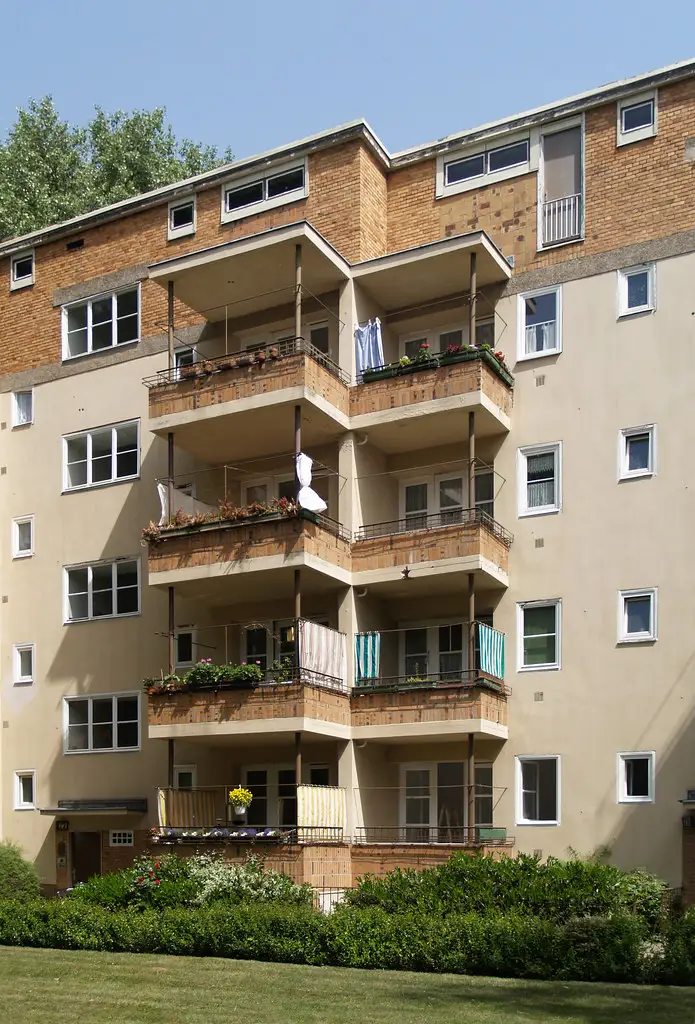
How do privacy, airflow, and night visibility compare?

Day and night are two different tests. Mesh or sheer materials may look private in daylight, then become much easier to see through once interior lights are on inside the apartment.
Daytime privacy versus nighttime privacy
Mesh shades work best when glare, heat, and airflow matter more than full privacy. They cut daytime visibility enough for many balcony edges, but at night they usually lose that cover because the lit interior turns the material into a partial screen.
Solution-dyed acrylic is described as a stronger choice when the balcony needs privacy after dark. It is described as opaque in many lighting conditions and as weather-resistant, though only water-resistant rather than fully waterproof.
Mesh shade fabric versus solution-dyed acrylic
Mesh shade fabric lets air through and reduces glare and heat. Solar screen fabric can also block a lot of UV, with some products claiming high UV blockage, while still allowing better airflow than vinyl or a solid wall-like barrier.
Solution-dyed acrylic is better when the goal is visual cover first and softness second. It gives a more solid look, but on a hot or very still balcony it can hold more warmth than mesh.
How airflow changes comfort on small balconies
Airflow is not a side issue on a small balcony. A hard barrier can improve privacy while making the space feel warmer, slower, and more enclosed, especially when the railing already sits close to a wall or neighboring unit.
What works better for renters and tricky railings?
For renters, the winner is often the option that fits the railing without permanent changes. Balcony railings are common mounting points, but they also create edge exposure, awkward attachment angles, and rules against drilling or permanent fasteners.
Railing mounting and edge exposure
Privacy screens are often used at balcony edges where sightlines are most direct. That makes them practical for property-line views, but the same edge placement also exposes them to gusts and tugging.
Outdoor curtains need a rod or hardware that can support movement every time the panels open or close. Grommets or curtain hooks make the sliding motion easier, but the whole setup still depends on a stable support line.
Rod, hook, clamp, and tension hardware
Clamp systems and tension hardware are useful when wall drilling is not allowed. Hooks and grommets suit curtain panels when the balcony already has a safe mounting path, while tie-on or clamp-based screens can be simpler on irregular railings.
What to do when drilling is off-limits
When drilling is not allowed, the first test is not style. It is whether the hardware can be removed cleanly, whether the balcony edge can carry the load, and whether the setup blocks drainage or emergency access.
- Measure the full opening, including corner turns.
- Check railing shape for flat, round, or narrow attachment points.
- Keep drainage paths clear at the floor edge.
- Avoid fabric that hangs into doors or walk lines.
Decision matrix: score both options across 8 balcony conditions
This matrix is built for apartment balconies, where the final answer usually comes from structure, wind, and neighbor sightlines rather than product label. A balcony may need both a fixed screen and a fabric panel when one option alone cannot handle privacy and comfort at the same time.
| Balcony condition | Balcony Privacy Screens | Outdoor Curtains | Winner |
|---|---|---|---|
| Renter-friendly install | 4/5 | 3/5 | Balcony Privacy Screens |
| Wind exposure | 5/5 | 2/5 | Balcony Privacy Screens |
| Night privacy | 4/5 | 2/5 | Balcony Privacy Screens |
| Airflow | 2/5 | 4/5 | Outdoor Curtains |
| Sun blocking | 4/5 | 3/5 | Balcony Privacy Screens |
| Maintenance | 4/5 | 2/5 | Balcony Privacy Screens |
| Space impact | 3/5 | 3/5 | Tie |
| Hardware needs | 4/5 | 2/5 | Balcony Privacy Screens |
The matrix gives screens the edge in exposed, high-visibility balconies because they hold up better at the railing and keep sightlines blocked after dark. Curtains win when airflow matters more and the balcony is covered or calm enough to keep fabric from moving constantly.
Choose Outdoor Curtains if… / Choose Balcony Privacy Screens if…
Choose outdoor curtains if the balcony is covered, wind is light, and you want flexible side privacy that can open for air and daylight. Choose balcony privacy screens if the balcony is exposed, neighbor sightlines are direct, and you need a fixed barrier that stays useful at night.
Choose outdoor curtains if…
Pick curtains when the balcony is sheltered from crosswinds, you want a softer look, and you need fabric that can open or close as the day changes. They also fit well when you can secure panels with rods, hooks, or a tension setup without violating rental rules.
They are the better answer for lounging, reading, or evening use on covered balconies. Solution-dyed acrylic is the stronger fabric choice when you want opaque privacy after dark, while mesh makes more sense if heat and air movement matter more than full cover.
Choose balcony privacy screens if…
Pick screens when the balcony railing faces another unit, the edge is windy, or you need daytime cover that stays in place with less fuss. A 3×10 ft balcony privacy screen is a common fit shape for longer railing runs, and a tie-on option can help when drilling is not allowed.
They also make more sense when maintenance needs to stay low. Solar screen fabric is a practical middle ground for sun, glare, heat, and airflow control, while solid or denser screen fabric is better when view blocking matters more than openness.
Frequently asked questions
Which is better for balcony privacy: screens or outdoor curtains?
For pure privacy, balcony privacy screens usually win because they create a fixed barrier at the railing and block views more consistently. Outdoor curtains are better when the balcony needs flexible side coverage and a softer feel, especially if the space is covered and wind is light.
Do outdoor curtains block more view than privacy screens?
Usually no. Outdoor curtains can block a lot of view when closed, but privacy screens tend to give a stronger and more stable visual block at the balcony edge. Curtains also depend more on fabric choice, and sheer or mesh versions can become less private after dark.
Are balcony privacy screens better in windy areas than curtains?
Yes. On exposed balconies, screens usually handle wind better because they are more fixed and less likely to flap. Curtains can move around, wear faster, and create noise when the balcony catches crosswinds, which makes them a weaker choice for high or open units.
Can I use outdoor curtains on a small apartment balcony?
Yes, but only if the setup is kept narrow and the mounting is carefully planned. Small balconies can feel crowded when panels, rods, and hardware eat into walking space. The safest choice is a covered balcony with a tidy hanging line and enough clearance for movement.
Which option is better for renters: privacy screens or curtains?
It depends on the lease and the railing. Screens can be more renter-friendly when they tie on without drilling, while curtains need rods, hooks, clamps, or tension hardware. If drilling is banned and the railing is awkward, the easier-to-remove option usually wins.
How do privacy screens compare with curtains for airflow and light?
Outdoor curtains usually allow better airflow when open and can be adjusted during the day. Privacy screens block more of the breeze and may reduce light more consistently, which helps with privacy but can make a small balcony feel warmer and more enclosed.
What material is best for a balcony privacy screen?
Mesh shade fabric is best when glare, heat, and airflow matter most. Solar screen fabric is a strong pick when UV control matters and the balcony still needs air movement, while denser screen materials work better if the main goal is stronger visual blocking.
Will outdoor curtains make a balcony feel smaller?
They can, especially on narrow balconies or when the panels hang deep into the walking path. The effect is strongest when the balcony is already tight or when heavy hardware takes up rail space. A covered balcony with slim hardware usually avoids that boxed-in feeling.
Products related to this article
Sponsored / affiliate links. As an Amazon Associate I earn from qualifying purchases. I may earn additional commission from eligible campaigns.