Balcony Rugs vs Outdoor Mats: Which Fits Best for You?
Choose a balcony rug if you want comfort and clear seating zones; choose an outdoor mat if your balcony is small, exposed, or gets wet often, since mats drain, dry, and clean faster. Pick the wrong one and moisture lingers, footing gets slick, or the layout feels cramped. This guide compares weather fit, traffic, size, and cleanup.
Balcony rugs vs outdoor mats: the core trade-off


The real difference is not decoration. A balcony rug usually defines a seating area and softens bare feet, while an outdoor mat gives faster cleanup, tighter coverage, and better behavior in wetter, busier spots. Outdoor rugs are made for rain, sun, and snow exposure, but they are generally water resistant rather than fully waterproof.
What each product is trying to do on a balcony
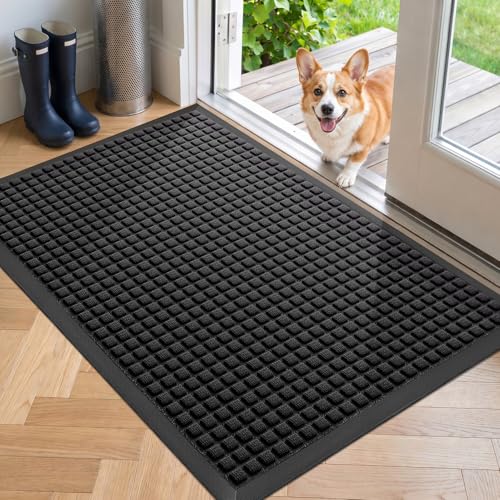
Balcony rugs cover more floor and make a small outdoor room feel planned. Outdoor mats usually stay thinner, smaller, and more utilitarian, so they fit entry points, traffic lanes, and awkward corners better than a full-size rug.
When coverage matters more than cleanup
If the balcony has a small seating zone with two chairs, a rug often works well because it helps anchor the arrangement. That matters on hard balcony floor materials such as concrete, wood decking, or tile, where airflow underneath still matters, but comfort and visual zoning matter just as much.
When cleanup matters more than comfort
If the balcony gets splashed, tracked with grit, or used as a pass-through, a mat is usually the better tool. It gives less surface to trap dirt and is easier to move, shake out, flip, or rotate depending on construction.
Side-by-side comparison table: rug vs mat across real balcony uses
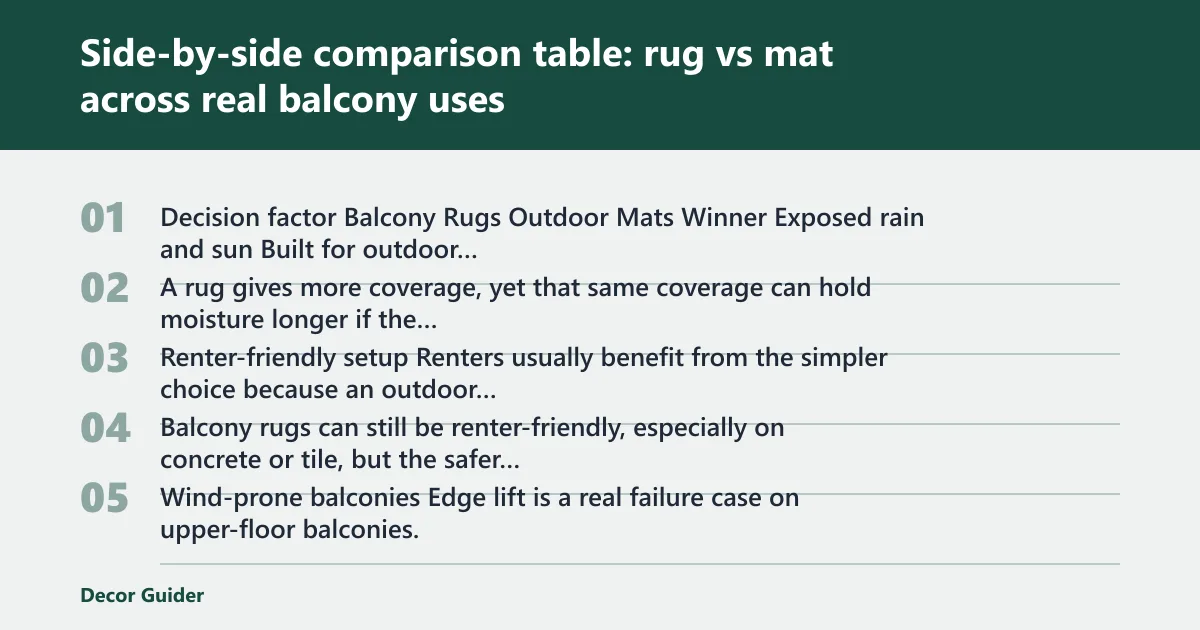
| Decision factor | Balcony Rugs | Outdoor Mats | Winner |
|---|---|---|---|
| Exposed rain and sun | Built for outdoor exposure, but best when water can drain and dry quickly | Usually better in wet spots because the smaller, thinner build dries faster | Outdoor Mats |
| Renter-friendly setup | Can work well if the finish is protected and the rug lifts without residue | Usually easier to remove, reposition, and store with less fuss | Outdoor Mats |
| Wind-prone balcony | More surface area means more chance of edge lift | Less likely to catch wind because it covers less floor | Outdoor Mats |
| Two-chair seating zone | Better for defining a lounge area under a cafe table set for two | Often too small to anchor furniture visually | Balcony Rugs |
| Dirt-tracking entry | Covers more area, but also collects more grit | Better for a landing strip at the door or traffic path | Outdoor Mats |
| Pet use | Comfortable for lounging, but fur and paw dirt spread farther | Quicker to shake, hose, or wipe after messes | Outdoor Mats |
| Planters | More exposed to staining where pots sit still | Smaller area limits the stain footprint | Outdoor Mats |
| Easy washdown and drying | Easy to hose off, but larger pieces take longer to dry | Faster washdown and faster drying because there is less material | Outdoor Mats |
| Storage between seasons | Bulkier to roll and store | Usually easier to store in a closet or bin | Outdoor Mats |
| Budget and size | Costs more as size increases, especially in balcony-friendly dimensions | Usually the lower-cost option in small footprints | Outdoor Mats |
Exposed rain and sun
Both products can be made for outdoor use, but exposure punishes the larger surface first. A rug gives more coverage, yet that same coverage can hold moisture longer if the balcony stays shaded or air does not move under it.
Renter-friendly setup
Renters usually benefit from the simpler choice because an outdoor mat is easier to lift, shake out, and remove before move-out. Balcony rugs can still be renter-friendly, especially on concrete or tile, but the safer pick is the one least likely to leave residue or trap moisture against a fragile finish.
Wind-prone balconies
Edge lift is a real failure case on upper-floor balconies. A smaller mat has less material for wind to catch, while a larger rug often needs more careful placement, furniture anchoring, or a backing that helps it stay flat.
Two-chair seating zones
For a compact seating area, a balcony rug usually does the better job of framing the space. It works especially well when paired with a cafe table set for two, because the rug can sit under the furniture without swallowing the full floor.
Dirt-tracking entry areas
Outdoor mats are better when the problem is grit at the door. They can sit in the path people actually use, catch debris, and clean up fast with a vacuum, damp cloth, or quick hose-down.
Pet use
Pets add hair, moisture, and the occasional accident. A mat is easier to move outside for a rinse, while a rug gives the pet a softer hangout spot but asks for more regular cleaning and drying attention.
Planter placement and stain risk
Planters are where many balcony coverings fail. Standing pots can leave rings, soil marks, or damp patches, so smaller mats are easier to protect and reposition, while larger rugs need planters lifted or rotated often.
Easy washdown and drying
Outdoor rugs are made to hose off and dry, but drying speed still depends on size, shade, and airflow. A mat wins when the priority is fast cleanup after rain, spills, or mud.
Seasonal storage
Storage favors the smaller product. A mat rolls tighter and is easier to move off the balcony when the weather shifts, while a rug takes more space and usually gets left out longer because moving it is more effort.
Budget and size
Budget pressure often pushes shoppers toward mats, especially when they only need a strip by the door. Larger balcony rugs tend to cost more because they use more material.
What is the difference between a balcony rug and an outdoor mat?
A balcony rug is usually thicker, larger, and better for defining a seating area, while an outdoor mat is usually thinner, smaller, and aimed at traffic or cleanup. Retailers sometimes group them together, but the use case is different: one zones the space, the other protects the floor and handles messes.
Thickness and coverage
Thickness affects comfort and how the piece lies on hard flooring. Coverage affects whether the balcony feels like one outdoor room or just a protected patch near the door.
Common retail naming
Shoppers often see both sold as outdoor rugs, which creates confusion. In practice, the smaller, slimmer pieces behave more like mats even when they are listed in the same aisle.
Best-fit use patterns
Choose the rug shape of solution for a lounge zone, and the mat shape of solution for entry cleanup or tighter footprints. That simple split usually prevents regret.
Are outdoor rugs waterproof or just water-resistant?
Outdoor rugs are generally water resistant rather than fully waterproof. That matters on balconies, because rain can pass through or sit on the surface, and the underside still needs airflow to dry. Polypropylene is common because it resists moisture better than many indoor textiles.
Why polypropylene is common outdoors
Dense flatwoven polypropylene is common in balcony rugs because it handles moisture, dirt, and sunlight better than many softer indoor materials. It also dries faster than absorbent fibers, which helps on concrete, wood decking, or tile.
How latex backing changes performance
Some outdoor rugs include synthetic latex backing. That can improve structure and help the rug lie flatter, but it does not remove the need for airflow or guarantee better drying after rain.
What happens after heavy rain
After heavy rain, a rug can stay usable, but it should not be left trapped against standing water. If the balcony stays wet for hours, or if the underside cannot breathe, mildew and odor become more likely.
Which is better for a small balcony: a rug or a mat?
For a small balcony, the better choice depends on whether the space is a seating zone or a traffic lane. A rug is better when the balcony holds two chairs and a table, while a mat is better when the floor space is tight, wet, or mostly used for passing through.
Two-person seating zone planning
A small balcony should usually start with the furniture footprint, not the decor piece. If a cafe table set for two fits with room to pull out chairs, a rug can define that zone without making the space feel chopped up.
Door swing and rail clearance
Leave clearance for doors and rails before choosing size. A rug that runs too close to the threshold can curl, bunch, or make the space feel cramped, especially on narrow balconies.
Traffic path around furniture
Plan a clear walking strip around chairs and planters. If people must step around the rug every time they enter, the mat option is usually more practical because it stays in the path without dominating the floor.
Size picks for compact layouts
On small balconies, sizes in a similar narrow-to-compact range can work when the goal is a lane or a small seating strip. Larger choices such as 160×230 cm, 200×300 cm, and 240×350 cm suit wider balconies with a real lounging footprint.
Can you leave a balcony rug outside in rain and sun?
Yes, if it is made for outdoor use, but “outside” does not mean “ignored.” Sun, wind, and rain are all expected exposures for outdoor rugs, yet drying time, airflow underneath, and shade level still affect how well the piece holds up over time.
Shade versus full exposure
A shaded balcony can keep the rug cooler, but it can also slow drying. A fully exposed balcony dries faster after a shower, though the surface may fade or wear faster from constant sun.
Drying time and airflow underneath
Airflow matters on every hard balcony floor. Concrete, wood decking, and tile can all hold dampness under a covering if the rug sits flat with no space to breathe.
When a mat is the safer pick
If standing water is common, or if cleanup needs to happen fast after every storm, a mat is the safer choice. It is easier to move aside, dry, and put back without waiting for a large surface to dry out.
Will an outdoor rug damage a wood or concrete balcony floor?
Outdoor rugs are made for hard outdoor floors, and a properly chosen one should not damage a wood or concrete deck. Problems usually come from trapped moisture, dirt buildup, or abrasive grit under the rug, not from the category itself. Airflow and cleaning matter more than the label.
Concrete, wood decking, and tile
Concrete usually tolerates outdoor rugs well, but wood decking needs more attention to drying. Tile is stable, yet the surface can still become slippery if water pools under or around the covering.
Residue and fragile finishes
Renters should think about residue, adhesive backs, and repeated friction on fragile finishes. A rug that lifts cleanly is easier to justify than one that sticks, scuffs, or holds damp debris underneath.
Failure cases to avoid
Curling edges can create trip points, and wet backing can hold mildew. Planters sitting in one place can also stain the same spot over and over, especially if soil and water stay trapped.
What material is best for an outdoor rug on a balcony?
Polypropylene is often a good starting point for a balcony because it resists moisture better than many indoor textiles and is commonly used in flatwoven outdoor rugs. Latex backing can help structure and grip, but the best material still depends on exposure, cleaning frequency, and how much the piece moves.
Why flatwoven construction matters
A dense flatwoven surface tends to dry faster than plush constructions and is easier to hose off. That makes it better for exposed balconies where dirt and water are normal, not rare.
When backing matters
Latex backing can help a rug lie flatter on hard floors and feel more stable underfoot. It is useful, but it does not replace the need to check whether the balcony floor can dry underneath.
How do you clean an outdoor rug on a balcony?
Day-to-day care is simple: use a damp cloth, vacuum with a standard floorhead, and clear off dry debris before it gets ground in. For deeper cleaning, hose the rug down, use a soft brush with mild detergent on stubborn spots, and hang it to dry fully before putting it back.
- Vacuum or sweep loose dirt with a standard floorhead.
- Wipe fresh marks with a damp cloth.
- Use a garden hose to rinse the surface.
- Apply mild detergent and a soft brush to stubborn stains.
- Hang the rug to dry completely before returning furniture.
Storage between seasons
When the balcony is unused for a while, roll the rug or mat dry and store it in a clean, dry place. Wet storage invites odor, mildew, and sticky backing.
Choose balcony rugs if… / choose outdoor mats if…
Choose a balcony rug if the balcony holds a defined seating zone, if the furniture should feel anchored, and if there is enough floor area for a clear walking path. Choose an outdoor mat if the space is narrow, the weather is wet, or cleanup and quick removal matter more than visual zoning.
Choose balcony rugs if…
- You want a clear lounge area with two chairs and a table.
- The balcony is large enough for 160×230 cm or larger without blocking circulation.
- You want a softer step and more coverage on hard flooring.
- The floor can breathe underneath and dry out between rains.
Choose outdoor mats if…
- The balcony is small, windy, or exposed to frequent rain.
- You need faster cleanup for dirt, pets, or entry traffic.
- You want lighter coverage that is easier to move, store, and rotate.
- You are prioritizing renter-friendly removal and minimal fuss.
Frequently asked questions
Can you use an outdoor mat indoors too?
Yes, many outdoor mats can work indoors, especially in kitchens, mud areas, or other high-traffic spots. The key is checking the backing and texture so it does not scratch floors or feel too utilitarian for the room it is entering.
Products related to this article
Sponsored / affiliate links. As an Amazon Associate I earn from qualifying purchases. I may earn additional commission from eligible campaigns.