Balcony String Light Problems / Not Working / Troubleshooting
If balcony string lights are dead, start with the power source and fuse, then move to the first unlit bulb or connector; if they flicker, check loose plugs, wet sockets, or a failing controller. Ignoring the fault wastes time, can trip protection devices again, and leaves wet wiring unsafe. This guide maps the quickest checks for plug-in, solar, battery, and LED strings that fail, dim, flicker, or quit after rain.
What the symptom means

No power at all
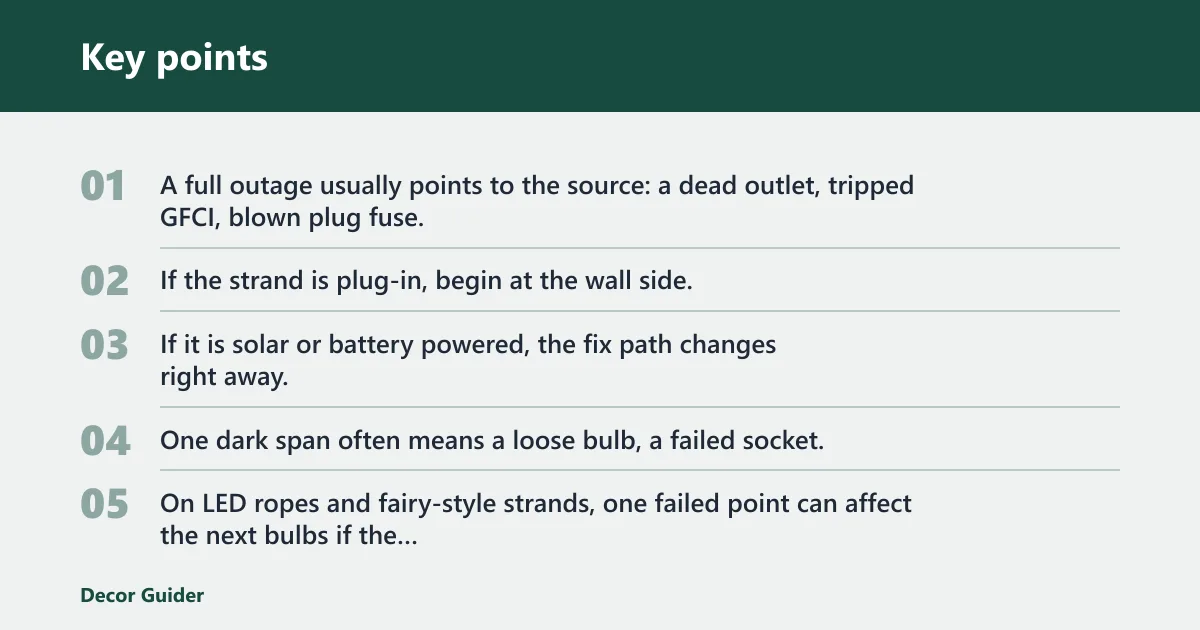
A full outage usually points to the source: a dead outlet, tripped GFCI, blown plug fuse, off timer, empty battery pack, or a solar panel that cannot charge. If the strand is plug-in, begin at the wall side. If it is solar or battery powered, the fix path changes right away.
One dead section
One dark span often means a loose bulb, a failed socket, or a series-wired section with an open circuit. On LED ropes and fairy-style strands, one failed point can affect the next bulbs if the wiring runs in series. Parallel sets fail more locally.
Flickering or intermittent light
Intermittent light usually tracks to a poor plug connection, a loose bulb, moisture in a socket, or a controller that is not stable with LED load. Flicker after wind or rain points more toward connection trouble than a full strand failure.
Dim output
Dim light can mean voltage drop from an overloaded extension cord, a weak power source, a failing battery pack, or a controller that is not meant for that LED strand. It can also happen when the set is longer than the maker intended for that voltage and wattage.
What you’ll need
- Known-good outlet or power source
- Replacement bulb or spare fuse that matches the strand
- Outdoor-rated extension cord with the correct load rating
- Dry cloth and a small flashlight
- Multimeter, if you already have one
- Timer or smart plug, if the lights use one
- Replacement controller or remote, if the set has one
How to isolate the fault
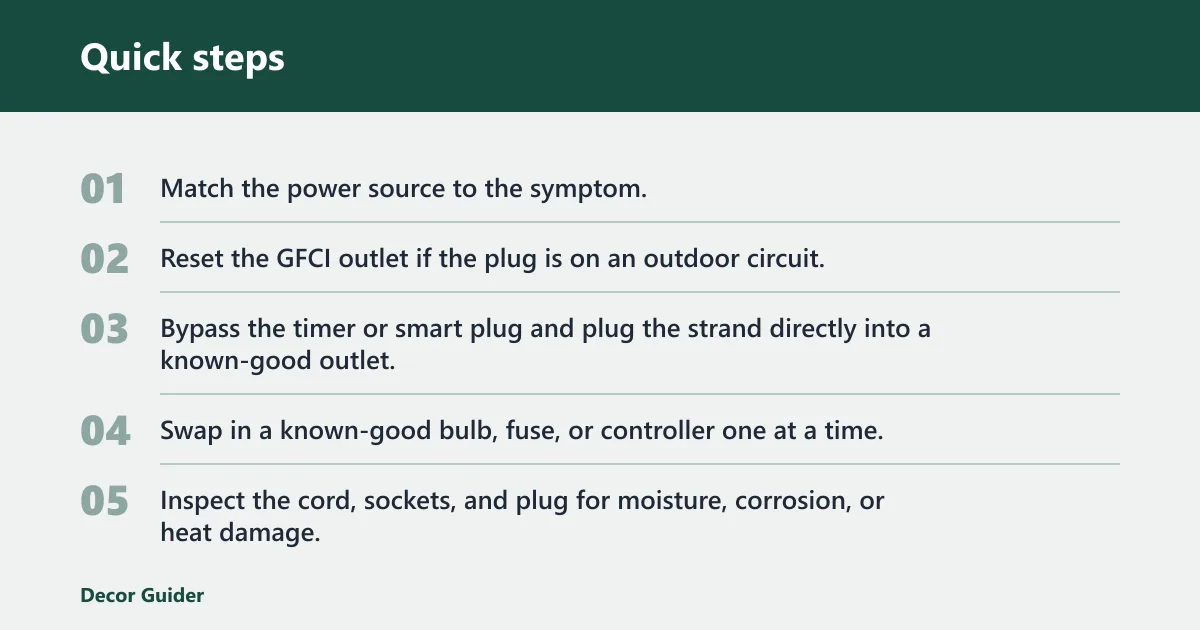
- Match the power source to the symptom.
- Reset the GFCI outlet if the plug is on an outdoor circuit.
- Bypass the timer or smart plug and plug the strand directly into a known-good outlet.
- Swap in a known-good bulb, fuse, or controller one at a time.
- Inspect the cord, sockets, and plug for moisture, corrosion, or heat damage.
Power source checks by type
Plug-in strings depend on outlet function, extension cord rating, and timer or smart plug compatibility. Solar strings need enough sun on the panel and a charged battery. Battery-powered sets need fresh cells and clean contacts. A plugged-in set with a dead outlet behaves very differently from a solar set with a dirty panel.
Say your plug-in rope of light is dark on a covered balcony. If the same outlet powers a lamp, the issue is likely in the string, fuse, or controller. If the light only works when the timer is bypassed, the timer or smart plug is the fault.
GFCI behavior
Outdoor circuits often run through a GFCI outlet with test and reset buttons. If it has tripped, the outlet may look normal while still cutting power. Press Reset after confirming the connected lights are unplugged if the outlet trips again immediately. Repeat trips point to a wet plug, damaged cord, or other ground fault.
On apartment balconies, weather-exposed outlets are common near railings and exterior walls. Any outlet with a cover or wet surroundings deserves extra caution before retrying the lights.
Balcony string light problems matrix
| Symptom | Likely cause | Fastest test | Fix | Replace or repair? |
|---|---|---|---|---|
| No power | Dead outlet, tripped GFCI, blown fuse, off timer, empty battery pack | Plug a known-good lamp into the outlet, or bypass the timer | Reset GFCI, replace fuse, charge or replace batteries, restore the timer | Repair if the cord and plug are intact; replace if fuse failure repeats or the plug is damaged |
| One dead section | Loose bulb, bad socket, series wiring break | Swap in one known-good bulb in the dark section | Seat the bulb fully or replace the failed bulb | Replace the strand if the socket is corroded or the break is inside the sealed rope |
| Flickering | Loose plug, wet connection, unstable controller | Wiggle-test the plug and bypass the controller | Dry connections, tighten seating, reset or replace the controller | Repair if it stops after drying; replace if flicker returns with a known-good controller |
| Rain-related outage | Water intrusion at plug, socket, or inline connector | Unplug and inspect for droplets, fogging, or green corrosion | Dry fully, then retest after several hours | Replace if moisture damage keeps returning or corrosion is visible |
| Dim lights | Voltage drop, weak battery, incompatible dimmer, overloaded extension cord | Move the strand to a direct outlet | Use an outdoor-rated cord with adequate load capacity or a compatible dimmer | Repair if the brightness returns on a direct outlet; replace the dimmer or cord if it stays dim |
| GFCI trips | Moisture, damaged insulation, ground fault, overloaded outdoor circuit | Disconnect everything on that outlet and press reset | Dry all connections and reduce the load on the circuit | Replace the strand if the trip repeats with a known-good outlet |
Why are my balcony string lights not working?
Start by matching the power source to the symptom. Plug-in lights usually fail at the outlet, fuse, timer, or plug connection. Solar lights usually fail from low charge, a dirty panel, or a drained battery. Battery-powered strings usually need fresh cells or clean contacts before anything else.
Plug-in lights
Check the outlet first, then the extension cord rating, then the plug fuse if the set has one. Many plug-in LED sets also require a compatible dimmer or smart plug. If the controller is between the plug and the lights, bypass it and test the strand at the outlet.
Solar lights
Solar balcony lights need the panel in direct light for enough time to charge the pack. If the panel sits behind glass or under a deep overhang, the battery may never fill. Clean the panel and check the on/off switch before assuming the strand has failed.
Battery-powered lights
Battery sets are the fastest to check. Replace the cells, clean the contacts, and confirm the battery door closes tightly. If the lights blink briefly and quit, the pack may be low even when the batteries are new, which points to a contact or controller issue.
LED strand issues
LED string lights often list voltage, wattage, bulb count, and whether the wiring is series or parallel. A 120-volt plug-in strand with a higher bulb count is more sensitive to a bad socket in a series run than a parallel run. Check the first dark point, then work outward.
Can a bad bulb or socket stop the whole strand?
Yes, especially on series-wired strings. A loose bulb can open the circuit, and a burned-out bulb may do the same on some older or simpler sets. Socket corrosion is worse than a single bad bulb because it can prevent contact even with a replacement installed correctly.
Loose bulb
Turn the lights off, let them cool, and twist the bulb until it seats fully. If the bulb feels wobbly, remove it and inspect the base for bent pins or a cracked shell. Replace it only with the compatible bulb type listed for the strand.
Burned-out bulb
Use one known-good replacement bulb in the dark section. If the set comes back, the problem was the bulb. If it stays dark, move to the socket or fuse. On many mini-light sets, one bulb failure can affect a stretch of the run.
Socket corrosion
Look for green buildup, white crust, or rusty marks inside the socket. Corrosion raises resistance and can make a section flicker or stay dark. If cleaning does not restore contact, replacement is usually the better choice because the socket itself has degraded.
Replacement bulb match
Match the bulb type, voltage, base, and LED or incandescent format. A 12-volt replacement should not be used in a 120-volt plug-in string. When the package lists a specific replacement part number, use that number instead of a generic bulb shape.
Why do balcony lights fail after rain?
Rain failure usually means water intrusion at a plug, connector, socket, or controller. Balcony lights can also fail from condensation after a temperature drop, even when there was no direct rainfall. The faster clue is where the water sits: at the plug end, in a socket, or inside an inline controller box.
Water in plugs or sockets
Unplug the strand before touching wet parts. Dry the outside with a cloth, then leave the set disconnected until all visible moisture is gone. If you see green corrosion or a cloudy film inside the connector, the water has already started to damage the metal contacts.
IP rating and sealing
Look for the IP rating on the tag or box. A higher protection rating means better resistance to dust and water, but it does not make exposed connections waterproof. Sealed connections still need a drip loop and a dry mounting point on a balcony.
Dry-out time before retesting
Give wet connections several hours to dry before retesting. A damp plug may work briefly and then trip the GFCI again. If the set fails only after rain and comes back when fully dry, the issue is moisture intrusion rather than a dead strand.
Corrosion and replacement
If rain keeps causing the same outage, the connector or socket may already be corroded. Repeated moisture plus visible damage is a repair-versus-replace decision. For a sealed rope light with internal damage, replacement is usually more practical than trying to clean inside it.
Suppose a 50-bulb balcony strand works all week, then fails after one storm. If the outlet resets and the lights return after a full dry-out, the moisture path is the main fault. If the GFCI trips again the next evening, the strand or connector likely has deeper damage.
Common mistakes
- Using a general indoor extension cord instead of an outdoor-rated cord with enough load capacity.
- Ignoring a tripped GFCI because the outlet still looks powered.
- Mixing a dimmer or controller that is not rated for LED string lights.
- Replacing bulbs before checking the fuse in the plug.
- Retesting a wet strand before the plug, socket, and controller are fully dry.
- Assuming a solar set has failed when the panel simply has not charged enough.
How do I reset plug-in LED string lights?
Turn the lights off, unplug the strand, and wait about 30 seconds before reconnecting it directly to a known-good outlet. If the set uses a remote or inline controller, remove power first, then restore it and select the first lighting mode again. If the controller still misbehaves, bypass it if the design allows.
Fuse in the plug
Many plug-in LED strings hide a small replacement fuse in the male plug cap. Open the fuse compartment only after unplugging the set, then replace it with the exact same type and rating printed on the plug or packaging. A blown fuse often looks dark, broken, or clouded.
Dimmer or controller
LED sets can flicker or stay dim when a dimmer is incompatible with the strand wattage or voltage. Reset the remote, replace its coin cell or battery if needed, and test the lights on full power. If the strand works directly but fails through the controller, the controller is the weak point.
How to reset the set
- Unplug the strand from the outlet.
- Turn the controller to Off, if present.
- Wait 30 seconds.
- Reconnect to a known-good outlet.
- Press the remote or controller power button once.
- Test one mode at full brightness before restoring the normal setup.
What should I check first if outdoor string lights have power but stay dark?
Check the first unlit bulb, the connector, and the fuse after confirming the outlet is live. If the power source is good but the strand stays dark, the problem is usually inside the lighting run rather than at the wall. A known-good bulb or controller is the fastest isolation tool.
Known-good isolation test
Swap in a known-good bulb in the first dead socket, then test a known-good controller if the set uses one. If the strand lights up, replace the faulty part and stop there. If it still stays dark, the fault is deeper in the cord or plug assembly.
When to replace the whole set
Replace the strand when the cord jacket is cracked, the sockets are corroded, the plug overheats, or the fuse fails more than once without an obvious cause. For apartment balconies, repeated failure is often cheaper to solve with a new outdoor-rated set than with more patchwork repairs.
Frequently asked questions
How do I troubleshoot outdoor string lights that won’t turn on?
Use a known-good outlet, then bypass any timer or smart plug. If the string still stays dark, inspect the plug fuse and the first bulb or socket. For solar or battery lights, confirm charge or battery contact before assuming the strand itself has failed.
Can a bad bulb make the whole string light set stop working?
Yes, on many series-wired strands a single bad or loose bulb can open the circuit. Replace it with the exact bulb type meant for the set. If the strand stays dark after one known-good bulb is seated correctly, move to the socket or fuse.
Why do my balcony lights flicker or go out when it rains?
Rain points to moisture in a plug, socket, or controller. Unplug the lights, dry the connections, and wait several hours before retesting. If the GFCI trips again or corrosion is visible, the wet area has likely damaged the contacts or insulation.
Are my string lights the problem or is the outlet faulty?
Test a lamp or charger in the same outlet. If that device works and the lights do not, the strand, fuse, or controller is the likely fault. If the outlet fails too, reset the GFCI and inspect that circuit before working on the lights again.
Products related to this article
Sponsored / affiliate links. As an Amazon Associate I earn from qualifying purchases. I may earn additional commission from eligible campaigns.