Artificial Plants vs Real Plants for Balcony Decor
Choose real plants for sunny, sheltered balconies if you can water often; choose artificial plants for windy spots, low-light corners, frequent travel, allergies, or strict load limits. The wrong choice can leave scorched leaves, toppled pots, moldy soil, or decor that fades fast. This guide compares both options by sun, wind, watering burden, safety, and upkeep so you can pick the right one.
Artificial plants vs real plants for balcony decor: the core trade-off


Artificial plants cut watering and pruning, while real plants respond to light, wind, and weather in ways that can look better or fail faster. On a balcony, that difference matters more than it does indoors because railing exposure, rain splash, and strong sun can punish the wrong choice quickly.
The best pick depends on conditions, not trend. A sheltered balcony can support real greenery with regular care, while a hot, windy, or hard-to-access balcony often favors faux foliage that stays steady where live plants would struggle.
| Decision factor | Artificial Plants | Real Plants for Balcony Decor | Winner |
|---|---|---|---|
| Sun tolerance | Good only when UV-stabilized; standard polymers can yellow or embrittle in sun | Strong if the species matches the exposure | Real plants |
| Wind and railing exposure | Can tip or scuff if too light; heavy planters help | Leaves can tear, stems can snap, pots can dry out fast | Tie |
| Watering burden | No watering, fertilizing, or repotting | Regular watering and seasonal care required | Artificial plants |
| Privacy and screening | Stable screen if sized well and placed out of harsh sun | Dense real screening can work, but growth takes time | Artificial plants |
| Realism from a few feet away | High only with better materials and careful styling | Natural texture, movement, and change | Real plants |
| Space and pot weight | Can be light or heavy depending on planter choice | Soil, drainage, and mature plant mass add weight | Tie |
Sun tolerance
Real plants win in full sun when you can match species to the site, because live foliage can cope with bright exposure if the plant is suited to it. Faux plants only hold up well outdoors when the product is rated for UV exposure; standard interior polymers may yellow or embrittle in sunny outdoor exposure.
Wind and railing exposure
Wind is hard on both options. Real plants lose moisture and can break; artificial plants can look worse if they are too light, too glossy, or too large for the pot. A heavier base, a lower profile, and sheltered placement near a wall usually matter more than the material alone.
Watering and monthly upkeep
Artificial plants have the clear advantage on maintenance. They skip watering, fertilizing, pruning, and repotting, though monthly dusting helps preserve faux realism. Real plants ask for more attention, and balconies with fast-drying containers often need frequent checks in warm weather.
Privacy and screening
If you need immediate screening, faux greenery can be easier to size and maintain as a consistent screen. Real plants can do the same, but only after growth fills in the container or trellis. On a balcony, that growth takes time and depends on light and water.
Realism from a few feet away
Real plants still lead on realism because they move, age, and vary with the season. High-quality faux pieces can come close, especially when the leaf shape, finish, and pot are chosen well. Cheap pieces often lose the race fast because they reflect light too strongly or repeat the same leaf pattern.
Space and pot weight
Compact balconies punish oversized containers. Real plants need soil and drainage, which adds weight, while faux arrangements can be easier to place on a shelf or stand. Even so, a flimsy faux plant in a tiny pot can tip easier than a modest live plant in a heavier container.
📊 Modern premium faux plants are described as using 3D injection molds cast from living plant specimens. Source: Artificial Plants Guide: Materials, Styling & Care.
Which works better by balcony condition?

The better option depends on the balcony itself. Strong sun, wind, railing exposure, and access to water matter more than the headline promise of “low-maintenance” or “natural.” Use the condition first, then match the plant type.
Sunny balconies
Real plants usually win if the balcony gets direct sun and you can water often, because sun-loving species are built for active light. Artificial plants can work only if they are UV-stabilized and not placed where standard polymers bake all day. Without that rating, fading and surface damage become real risks.
Shaded balconies
Artificial plants often win in deep shade because many live plants become thin, leggy, or unhappy with too little light. This is where faux greenery can provide a steady visual screen without asking for a grow light or constant correction. Real plants still work if shade-tolerant species are used, but the margin is narrower.
Windy high-rise balconies
Artificial plants can work better here if you choose a weighted planter, a shorter profile, and materials that do not flutter hard. Real plants may dry out too fast and suffer breakage. On exposed upper floors, the best result often comes from smaller, denser arrangements rather than tall, loose stems.
Small balconies with limited floor space
Artificial plants often win because you can use one or two well-placed pieces as permanent decor. Small balconies get crowded quickly, so oversized planters can block movement. A common first-timer mistake is buying a tall faux tree for a 4-foot-wide balcony, then finding it narrows the usable space and looks forced.
Rentals with drilling limits
Artificial plants are easier when you cannot install trellises, wall planters, or permanent supports. They can sit in freestanding containers and still add green volume. Real plants can work too, but they often need more structure if you want vertical screening or climbing growth.
Travel-heavy or low-care households
Artificial plants are the stronger choice if you travel often or do not want the balcony to depend on a watering schedule. Real plants can fail fast after missed care on hot days. Faux greenery keeps its shape, color, and privacy value while you are away, provided it is cleaned and placed sensibly.
Which artificial plant materials look most believable outdoors?
The most believable outdoor faux plants are not all built the same. PE, PVC, silk fabric, and real-touch latex or polyurethane each suit different balcony uses, and the best choice depends on size, touch, glare, and exposure. Material matters more than the label “artificial.”
PE faux plants for statement pieces
PE faux plants are often the strongest realism choice for larger pieces. Modern premium faux plants are described as using 3D injection molds cast from living plant specimens, and PE faux plants are presented as the best realism option for large statement plants. They usually work best when the goal is a big, believable focal point.
PVC faux plants for budget picks
PVC faux plants are a budget-friendly option for common plant shapes. They can work well for palms and snake plants, but lower-cost PVC can show a reflective plastic sheen under overhead lighting. That sheen becomes more obvious on a balcony with strong daylight or bright exterior lamps.
Silk fabric faux plants for tabletop arrangements
Silk faux plants are recommended for delicate arrangements like orchids and ivy. Their printed botanical dyes and soft tonal gradients suit tabletop styling better than harsh sun exposure. Avoid them in high-humidity bathrooms, and be cautious on balconies that trap moisture after rain.
Real-touch latex and polyurethane for lifelike foliage
Real-touch latex and polyurethane are premium materials for lifelike texture. They are described as premium materials for lifelike texture, with steel-reinforced wire stems that help shapes hold. These materials are a strong choice for living-looking succulents and monsteras when the balcony calls for close-up realism.
UV-stabilized materials and what the label should say
UV-stabilized materials resist yellowing and fading, which matters for sunny patios and covered porches. The label should tie that claim to ISO 4892-3 testing if the piece is meant for light exposure outdoors. If the product does not say how it handles UV, treat it as an indoor piece.
Safety, durability, and label checks
Balcony decor has to survive more than a camera angle. Heat, wind, splash, and limited airflow can change how both faux and real plants behave, so a label check matters before styling begins. Safety labels matter even more near lights, vents, and enclosed corners.
UV resistance and outdoor fading
UV-stabilized claims are worth checking when the balcony gets direct sun. Standard interior polymers may yellow or embrittle in sunny outdoor exposure, which can make a faux plant look tired long before it should. For patios and porches, artificial plants can be used if materials are suitable.
Flame-retardant labels near heat sources
If balcony lighting, heat vents, or nearby fixtures are in the setup, look for flame-retardant certification such as NFPA 701. That matters most where heat is close to the greenery or where fabric elements hang near a warm source. It is a label check, not a style preference.
Low-VOC and non-toxic checks for enclosed spaces
Low-VOC and non-toxic labels matter in enclosed balconies, small apartment loggias, and spaces with limited airflow. These labels are worth checking before adding large faux arrangements, especially if the balcony is used often. They are also useful in homes with children or pets.
Moisture, drainage, and mildew issues with real plants
Real plants need drainage that matches the pot size and the watering habit. Poor drainage creates standing water, which can lead to odor, mildew, and root stress. On a balcony, water also has to be managed so runoff does not stain flooring or pool around the container base.
How do I stop artificial balcony plants from looking fake?
Start by placing faux plants where living plants plausibly grow, then size them to the balcony instead of the catalog photo. Good placement, mixed textures, and a believable pot matter more than buying a larger plant. Avoid glossy leaves, oversized blooms, and all-faux groupings with no variation.
Use placement that matches real growing habits
Put faux plants in corners, beside seating, near railings with shelter, or under a partial overhang where real plants could plausibly sit. That keeps the setup from reading as stage decor. The placement rule is simple: place faux plants where real plants plausibly grow.
Mix faux with dried and living greenery
A mix of faux, dried, and living greenery often looks more believable than a full faux cluster. One live herb, one dried stem arrangement, and one realistic faux plant can soften repetition. This mix also helps the balcony feel less static across the season.
Mind scale, pot weight, and wind resistance
Choose plant scale for the balcony width, not for a larger room. A narrow balcony usually looks better with smaller clusters or one vertical feature than with a giant floor plant. Wind resistance improves when the pot is heavier, the foliage is denser, and the top-heavy silhouette is reduced.
Say your balcony is six feet wide
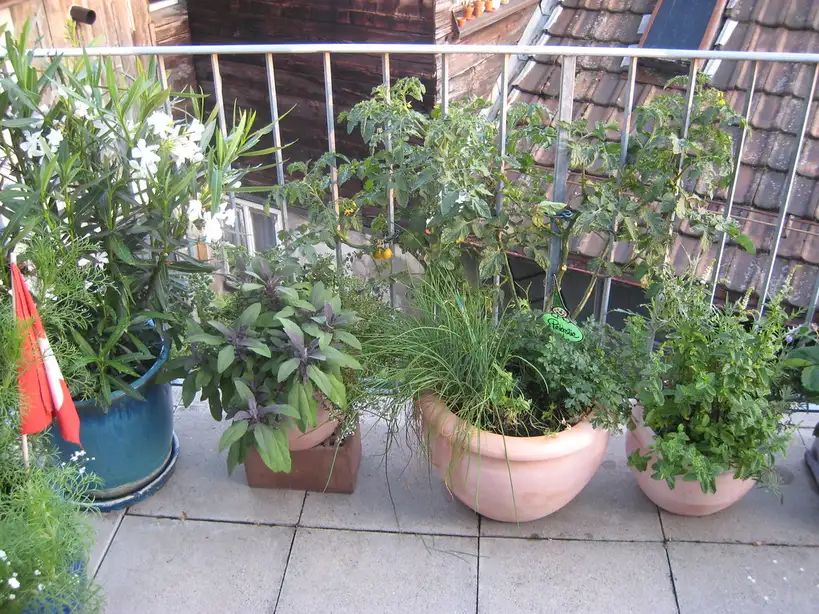
Suppose a moderately wide balcony gets afternoon sun and strong street-level gusts. A tall, feather-light faux palm in a narrow pot will sway, lean, and look temporary. A shorter PE plant in a heavy planter, set beside a real chair and a small herb pot, usually reads as deliberate rather than fake.
What are the pros and cons of faux plants on balconies?
Faux plants are useful on balconies because they avoid watering and can hold a steady look through the season. Their weak points show up fast in harsh sun, wind, and close viewing. The biggest mistake is assuming all faux plants behave the same outdoors.
Pros
- No watering, fertilizing, or repotting.
- Useful for low-light corners and busy routines.
- Can provide instant screening.
- Helpful for allergy-sensitive households.
Cons
- Standard polymers can fade or embrittle in sun.
- Cheap finishes can look shiny or plastic.
- Dust builds up and dulls realism.
- Lightweight pieces can tip in wind.
Can artificial plants be used on outdoor patios and porches?
Yes, artificial plants can be used on outdoor patios and porches if the materials are suitable for the exposure. UV-stabilized products are the safer bet for sun, and flame-retardant certification matters when heat sources are nearby. Without those checks, outdoor life can age the decor quickly.
Decision matrix: 6 common balcony scenarios
This matrix scores the two options by the conditions that usually decide balcony success. The scores are directional, not lab results. Use them to match the plant choice to the site before you buy or style anything.
| Scenario | Artificial Plants | Real Plants for Balcony Decor | Best pick |
|---|---|---|---|
| Full sun, sheltered balcony | 3/5 if UV-stabilized | 5/5 if sun-loving species are chosen | Real Plants for Balcony Decor |
| Deep shade, little direct light | 5/5 | 2/5 unless shade-tolerant plants are used | Artificial Plants |
| Windy railing exposure | 4/5 with weighted pots and low profile | 2/5 because drying and breakage are common | Artificial Plants |
| Privacy screening for a small balcony | 4/5 for immediate coverage | 3/5 because growth takes time | Artificial Plants |
| Frequent travel, irregular care | 5/5 | 1/5 without outside help | Artificial Plants |
| Allergy-sensitive household | 4/5 | 2/5 depending on plant type and pollen | Artificial Plants |
Best pick for full sun
Real plants win if the balcony gets strong sun and the household can keep up with watering. Faux plants can work here only with UV-stabilized materials and careful placement. If the balcony is uncovered, standard interior pieces are a poor fit.
Best pick for shade
Artificial plants usually win because shade limits what many live plants can do. A small balcony with low light often looks better with one well-chosen faux piece than with several stressed live plants. This is especially true when privacy is the goal.
Best pick for wind exposure
Artificial plants are the more practical choice when the balcony is windy and exposed to railing gusts. The setup still needs weight and restraint in scale. Real plants can work if they are compact and sheltered, but the risk of drying and breakage stays higher.
Best pick for privacy screening
Artificial plants win when you need immediate, consistent coverage. Real plants can eventually fill in, but the wait can be long. If the balcony is narrow, a faux screen can provide privacy without crowding the floor.
Best pick for frequent travel
Artificial plants win clearly for frequent travel. They do not need a watering backup or a strict care calendar. Real plants can survive trips only if someone can maintain them during hot spells and dry winds.
Best pick for allergy-sensitive homes
Artificial plants are the safer bet for allergy-sensitive households, especially on enclosed balconies. They reduce contact with pollen, soil, and decaying plant matter. Low-VOC and non-toxic labels add another useful filter when the space has limited airflow.
Choose Artificial Plants if… / Choose Real Plants for Balcony Decor if…
Choose artificial plants if you need steady decor in shade, wind, or travel-heavy routines, or if the balcony has rental limits, allergy concerns, or no easy watering access. Choose real plants if your balcony gets the right light, you want seasonal change, and you can keep up with care.
Choose artificial plants if you want lower upkeep and stable looks
Pick faux greenery when the balcony must stay presentable with limited attention. It also makes sense when the goal is immediate privacy, a fixed layout, or decor that does not depend on weather. Just make sure the material suits the sun and the exposure.
Choose real plants if you want growth, seasonal change, and live plant behavior
Pick real plants when the balcony can support living conditions and you want the natural changes that come with them. Real greenery handles sun, movement, and seasonal shifts in a way faux pieces cannot duplicate. The payoff is higher, but so is the care requirement.
Frequently asked questions
Are artificial plants good for balcony decor?
Yes, artificial plants can be good balcony decor when the balcony has shade, wind, travel constraints, or limited care access. The key is choosing outdoor-suitable materials, not indoor-only plastics. They work best when sized to the balcony and placed where real plants would plausibly sit.
Do real plants or artificial plants work better on a sunny balcony?
Real plants usually work better on a sunny balcony if you can water often and choose sun-tolerant species. Artificial plants can still work, but only if they are UV-stabilized and not exposed to all-day direct sun without protection. Standard interior pieces fade or break down faster outdoors.
How do artificial plants compare with real plants for a small balcony?
Artificial plants often fit a small balcony better when space is tight and care time is limited. They give immediate shape without requiring drainage, soil refresh, or frequent watering. Real plants can still work, but the pot size, weight, and light needs have to be managed carefully.
Which artificial plant materials look most realistic outdoors?
PE and real-touch latex or polyurethane usually look most realistic for larger balcony pieces. PVC is useful for budget shapes but can look shiny, while silk fabric suits delicate tabletop arrangements more than sun-baked exposures. For outdoor use, UV-stabilized labeling matters as much as surface texture.
What should I choose for a balcony if I travel often?
Artificial plants are usually the better choice if you travel often. They hold their shape and color without a care schedule, which matters on balconies that heat up quickly. Real plants can still work only if someone can water and monitor them during your trips.
Products related to this article
Sponsored / affiliate links. As an Amazon Associate I earn from qualifying purchases. I may earn additional commission from eligible campaigns.