Cat Balcony Safety: The Complete Risk-Assessment Guide for Apartment Living
Why Balcony Safety Is Non-Negotiable for Cats
You open the sliding door on a warm morning, and your cat bolts past your legs onto the balcony. She weaves between the railing bars, tail high, chirping at pigeons. It’s a lovely scene until she spots a bird and lunges. That’s when you realize the gap between the railing and the floor is just wide enough for her head — and maybe her whole body if she’s determined.
Every year, veterinarians treat cats for falls from balconies, often called ‘high-rise syndrome.’ A study from the Journal of the American Veterinary Medical Association found that falls from heights between 2 and 32 stories result in serious injuries, with the highest risk at 5 to 9 stories. Cats have a survival instinct that helps them right themselves, but concrete, railings, and bushes below don’t care about instincts. The only reliable protection is a properly cat-proofed balcony.

TailTastic
Tailtastic PopUp Cat Tent for Outdoor, Portable…
- Enhanced Entertainment: Our outdoor cat tent comes furnished with a bonus jumping cloth, providing extra fun for cats as they enjo…
- Spacious Design: With dimensions of 45.5" x 24.5" x 21.5", this outdoor cat enclosures offer generous space for cats to roam freel…
- Versatile Functionality: This cat playpen for indoor cats serve as a cozy resting and sleeping area . It can also double as a port…
As an Amazon Associate I earn from qualifying purchases.
This guide walks you through a complete risk assessment: where cats escape, which solutions fit your cat’s personality and your budget, and how to train your cat to use the balcony safely. You’ll leave with a clear plan — not just a shopping list.
If you want a quick, portable option for supervised outdoor time, the Tailtastic PopUp Cat Tent works well. It sets up in seconds, gives your cat a shaded, insect-protected space, and folds into a carry bag. It’s not a permanent balcony fix, but it’s handy for travel or for cats that need a secure spot while you read on the patio.
Assessing Your Balcony and Your Cat’s Risk Profile
Before buying anything, you need to know exactly where your cat could slip out. Most escapes happen through gaps you didn’t notice because you’re taller than your cat. Get on your hands and knees. Look at the balcony from a cat’s eye level. You’ll be surprised.
The 4 Escape Zones You Must Inspect First
1. Railing gaps and balusters. Measure the space between vertical balusters. If it’s wider than 2 inches, a determined cat can squeeze through. Even if the gap is 2 inches at the bottom, it may widen at the top due to settling or poor installation. Use a tape measure at every section.
2. The gap between railing and floor. This is the most overlooked spot. Many railings sit a few inches above the deck to allow for water drainage. A 3-inch gap is plenty for a cat’s paw to hook and pull herself under. Seal this with a wood or PVC trim board, or install mesh that extends to the floor.
3. Corners and joints. Where the railing meets the wall or the floor, there’s often a triangular gap. Cats love to wedge into corners. Use a piece of plywood or a metal corner brace to close these off.
4. The door and window openings. If your balcony door doesn’t seal tightly, a cat can push it open. Check the weatherstripping. Also, if you have a sliding door, make sure the track is clean and the door closes flush. Some cats learn to paw at the handle — a childproof lock or a simple hook-and-eye latch can stop that.
Matching the Solution to Your Cat’s Personality
Not all cats are the same. A 12-year-old arthritic cat might be fine with a low barrier, while a 6-month-old kitten can jump 5 feet vertically and climb anything. Here’s a quick breakdown:
- Climbers — cats that scale screens or furniture. They need a fully enclosed catio or netting that goes over the top, not just up the sides.
- Jumpers — cats that launch at birds or bugs. They need a ceiling or a high netting canopy, plus a solid railing extension.
- Diggers and squeezers — cats that try to push under barriers. They need mesh anchored to the floor, not just zip-tied to the railing.
- Skittish cats — cats that panic at loud noises. They might bolt through a gap they’d never normally use. They need a fully enclosed space and a hiding box.
Your cat’s age matters too. Kittens grow fast, so leave extra margin in your measurements. Senior cats may have reduced depth perception, making them more likely to misjudge a jump. Adjust your solution to the most vulnerable version of your cat, not the current one.
The 7 Best Cat-Proofing Solutions (Ranked by Cost & Difficulty)
Here’s a comparison of the most common methods. Costs are estimates based on typical retail prices and may vary. DIY difficulty ranges from 1 (easy) to 5 (advanced).
| Solution | Cost Range | DIY Difficulty | Best For | Limitations |
|---|---|---|---|---|
| Balcony netting | $20–$80 | 2 | Renters, quick install | Needs sturdy anchors; can sag |
| Mesh fencing (polyethylene) | $50–$150 | 3 | Permanent railings | Requires drilling into railing or wall |
| Plexiglass panels | $100–$300 | 4 | Wind protection, clear view | Heavy; needs professional cutting |
| Lattice panels | $40–$120 | 2 | Hide gaps, decorative | Gaps may be too wide for small cats |
| Catio (full enclosure) | $300–$2,000+ | 5 | Permanent, multi-cat homes | Expensive; may need HOA approval |
| Portable cat tent | $30–$100 | 1 | Supervised outdoor time | Not a full balcony barrier |
| Deterrents (motion-activated air, citrus sprays) | $20–$60 | 1 | Training aid | Not a physical barrier; cats adapt |
The Ultimate Barrier: Netting and Mesh
Netting is the go-to for most apartment balconies because it’s cheap, removable, and doesn’t damage walls if you use tension rods or zip ties. Look for UV-stabilized polyethylene netting with a mesh size of 1 inch or smaller. A 1-inch mesh prevents most cats from poking their heads through and getting stuck.
Installation: Measure the height and length of the area you need to cover. Buy netting that’s at least 6 inches taller than your railing, and plan to overlap seams by 4 inches. Use heavy-duty zip ties (at least 50-pound test) to attach the netting to the railing every 6–8 inches. Anchor the bottom to the floor with adhesive hooks or small eye screws. If you’re a renter, use removable adhesive hooks and tension rods — no drilling.
The biggest mistake people make is leaving the netting loose. A cat can push through a loose section. Pull it taut and check for gaps after a week, as the netting may stretch.
The Fortress: Catios and Full Enclosures
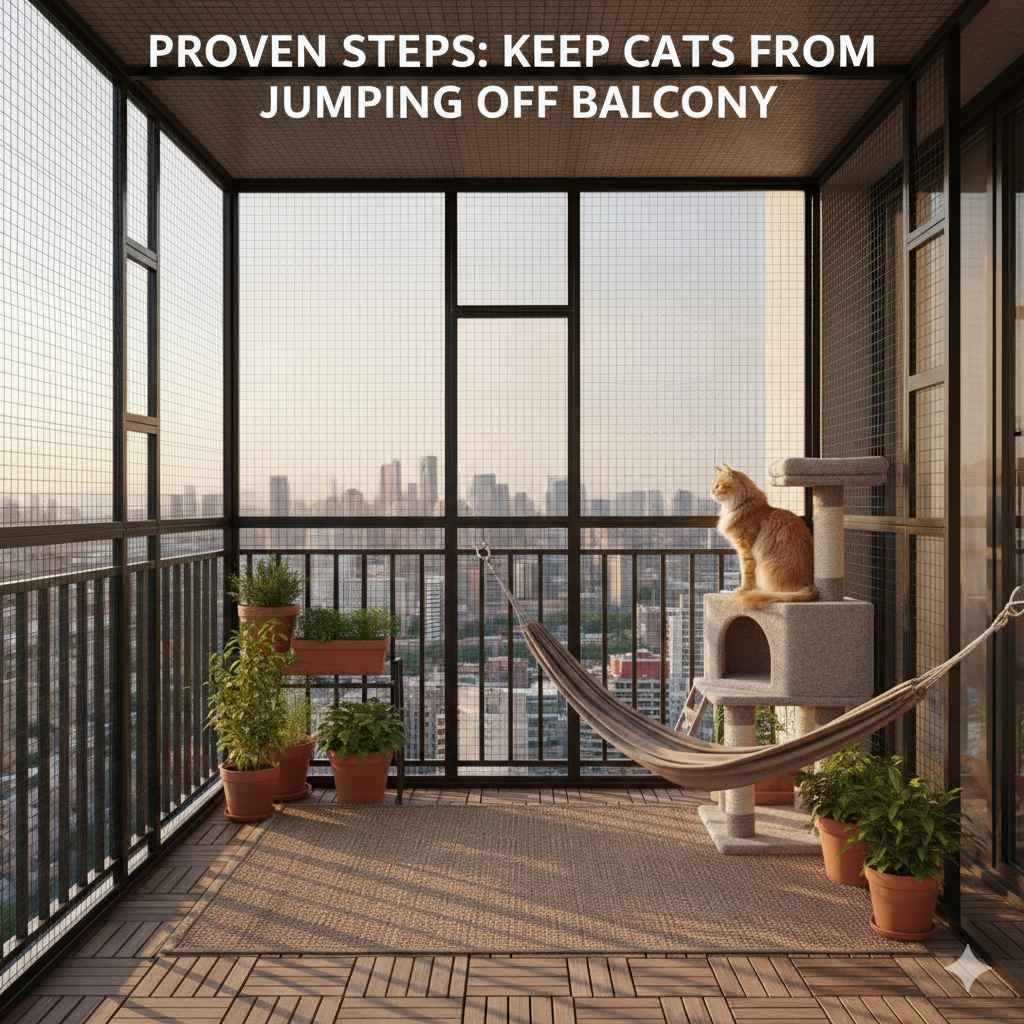
A catio is a fully enclosed structure — think of it as a screened-in porch for your cat. It can be a DIY wood frame with wire mesh or a pre-fabricated metal unit. Catios provide the highest level of safety because they cover all six sides, including the top. They also give your cat vertical space to climb, which satisfies her natural instincts.
If you own your home, a catio is worth the investment. A simple 4x4x6-foot catio costs about $300 in materials if you build it yourself. Pre-fabricated models range from $500 to $2,000, depending on size and features. Check your HOA rules before building — some prohibit structures that alter the building’s exterior. If you rent, you’ll likely need explicit permission.
One trade-off: catios block the view from your balcony. If you love sitting outside, consider a half-catio that covers only one section, leaving the rest open for you.
The Quick Fix: Plexiglass and Lattice Panels
Plexiglass panels are a popular choice for balconies with wide railing gaps. They attach to the inside of the railing and create a solid barrier. You can buy pre-cut panels at hardware stores or have them cut to size. Use clear acrylic for visibility, or frosted for privacy. Installation requires drilling into the railing or using heavy-duty adhesive brackets.
Lattice panels are cheaper and easier to install, but they have gaps. A standard lattice has 2-inch diamond openings — fine for adult cats, but a kitten could squeeze through. If you use lattice, double-layer it with mesh behind it.
Neither option prevents a cat from climbing over the top. If your cat is a jumper, you still need a top barrier.
The Behavioral Layer: Deterrents and Training
Physical barriers are non-negotiable, but training reduces the chance of escape. You can teach your cat to associate the balcony with calm, not excitement. Start by letting her explore the balcony while you’re present, using treats to reward relaxed behavior.
Deterrents like motion-activated air cans (e.g., Ssscat) can keep a cat away from the door or a specific gap. Citrus sprays work for some cats, but many ignore them. These are training aids, not solutions — your cat might learn to avoid the spray but still bolt out when a bird flies by.
How to Introduce Your Cat to the Balcony (Step-by-Step)
Even with a perfect barrier, a sudden introduction to the balcony can overwhelm a cat. She might panic and try to jump over the netting. Follow this desensitization protocol:
- First week: Keep the balcony door closed. Let your cat see and smell the balcony through the glass. Feed her near the door so she associates it with good things.
- Second week: Open the door but block the threshold with a baby gate or your body. Let her sniff the air while you sit nearby. Give treats when she stays relaxed.
- Third week: Allow supervised access for 5–10 minutes at a time. Stay close. Watch for signs of stress — flattened ears, tail twitching, or crouching. If she seems anxious, go back to the previous step.
- Fourth week: Extend access to 20–30 minutes. Always accompany her. Never leave her alone until she’s consistently calm for at least two weeks.
During this period, provide a hiding box or a towel-covered crate on the balcony. Cats feel safer when they can retreat. Place a scratching post or a cardboard box to redirect her attention from the railing.
Seasonal Safety: Heat, Cold, and Weather Hazards
Balconies are harsh environments. Concrete absorbs heat and can burn paw pads in summer. On a 85°F day, the surface can reach 120°F. Provide a shaded area with a cooling mat or a damp towel. Never leave a cat on a balcony without access to fresh water — and even then, don’t leave her out for more than 30 minutes in extreme heat.
In winter, snow melt chemicals like rock salt can get on your cat’s paws and cause chemical burns if licked. Wipe her paws with a damp cloth after she comes inside. Also, check that balcony netting is still secure after heavy snow — the weight can pull it down.
Wind is another factor. A sudden gust can startle a cat and cause her to lose balance. If you live in a breezy area, secure all loose items and ensure netting is taut. During storms, bring your cat inside entirely.
Emergency Plan: If Your Cat Escapes or Falls
Even with the best precautions, accidents happen. Preparation reduces panic and improves your cat’s chances.
- Microchip your cat. This is the single most effective way to reunite with a lost cat. Keep your contact info updated.
- Use a breakaway collar with an ID tag. Include your phone number and ‘I’m lost’ on the tag. Breakaway collars prevent choking if the collar snags on a railing.
- Take a recent photo. Keep it on your phone so you can share it immediately.
- Know your local animal control and vet emergency numbers. Save them in your phone.
- If your cat falls and is injured, do not move her unless absolutely necessary. Call a vet immediately. Cats often hide pain, so even a seemingly minor fall warrants a check-up.
- If she escapes without injury, search the immediate area first. Cats usually stay within a 100-meter radius. Check under cars, in bushes, and up trees. Call her name softly, and bring a can of food to lure her.
Final Verdict: Building a Safe, Enriching Outdoor Experience
Cat balcony safety isn’t about wrapping your balcony in plastic and calling it done. It’s about understanding your cat’s behavior, closing the gaps she’ll find, and giving her a space where she can enjoy the outdoors without turning your heart into a racehorse.
- Inspect every gap wider than 2 inches, especially at the floor and corners.
- Choose a solution that matches your cat’s age and agility — netting for renters, a catio for homeowners.
- Anchor netting taut and check it monthly for sagging or damage.
- Introduce the balcony gradually over 3–4 weeks, using treats and a hiding box.
- Never leave a cat unsupervised on a balcony until she’s proven calm for two weeks.
- Adapt for seasons: provide shade and water in summer, wipe paws in winter.
- Microchip, tag, and photograph your cat, and keep emergency contacts handy.
Your cat doesn’t need a huge space — she needs a safe one. With the right barriers and a little patience, you can give her fresh air and bird-watching without the fear. For more ideas on making your balcony a welcoming spot, check out our small balcony design ideas or explore apartment balcony garden ideas to add safe, cat-friendly plants like cat grass.
Products related to this article
Sponsored / affiliate links. As an Amazon Associate I earn from qualifying purchases. I may earn additional commission from eligible campaigns.