Why Is My Soft-Close Drawer Not Closing Properly?
A soft-close drawer that stops short is usually blocked, misaligned, or has a failed damper. Check those in that order, and replace the slide only after the obstruction is gone and the drawer still will not close. Ignoring it can damage slides, fronts, and cabinet edges. This guide shows how to isolate the symptom, adjust the drawer, and tell when the hardware needs repair or replacement.
This guide is part of our Dresser and Drawer Repair: Fixing Sticking Drawers, Slides, Smells and Finishes series.
What the symptom is telling you

The way a drawer fails tells you where to start. A drawer that stops about 1 to 2 inches short often points to end-of-travel trouble. One that drags on one side often points to alignment, a cabinet issue, or a bent slide member. Bounce-back usually means the damper is not catching or the drawer is hitting something before the soft-close unit engages.
Soft-close drawer troubleshooting matrix
| Symptom | Likely cause | Fastest check | Fix | Replace or repair decision |
|---|---|---|---|---|
| Won’t close fully | Obstruction, out-of-square drawer box, weak damper engagement | Slide the drawer out and look for packed sawdust, a screw head, or a foreign object at the last inch of travel | Clear the path, square the drawer, then retest | Replace only if the drawer still stops short after alignment and cleaning |
| Stops 1 to 2 inches short | End-of-travel engagement missed, misadjusted slides, integrated damper failure | Watch whether both sides reach the same point before the stop | Re-seat the slides and check reveal spacing | Repair if the slide is adjustable; replace if the damper is non-serviceable |
| Closes on one side only | Uneven mounting, loose screws, rack in the cabinet opening | Measure side-to-side gaps and inspect both front attachment points | Level the slide pair and tighten or repair fasteners | Repair first; replace only if a bent slide member remains out of line |
| Bounces back open | Damper not catching, drawer hitting a stop, front too proud | Check whether the soft-close piston meets its trigger near the last inch | Adjust the drawer front and verify clearances | Replace the damper if the trigger point is correct and the drawer still rebounds |
| Soft-close works only sometimes | Intermittent obstruction, loose mounting screws, worn internal mechanism | Open and close the drawer several times while watching both slide sides | Tighten screws, clear the track, and reset alignment | Replace worn hardware if the problem returns after fixing fitment |
| Closes slowly on one side but not the other | Uneven loading, side-to-side misalignment, damaged left or right damper pair | Remove heavy contents and repeat the close test | Balance the load and adjust slide position | Replace the matching side if one damper is weaker or broken |
| Needs a push to latch | Drawer front not flush, cabinet opening interference, worn locking lever | Check reveal and front height against the cabinet opening | Adjust the front and locking hardware | Repair if adjustment exists; replace if the lock or clip is damaged |
| Scrapes, then stops | Paint buildup, swollen wood edges, bent metal parts, or a racked cabinet | Inspect the track edges and the clearance at top and sides | Remove buildup, plane swollen edges if needed, and square the opening | Replace damaged slide parts after the interference source is fixed |
What should you check first?
Start with the easiest causes: clear the drawer path, check load and balance, and look for loose mounting screws. Those three checks solve many soft-close failures because they affect the drawer before the damper ever gets a chance to work. If the drawer still stops short after that, move to alignment and hardware condition.
Clear the drawer path
- Empty the drawer enough to reduce weight and see the tracks.
- Pull it open and inspect both slide members for debris or packed sawdust.
- Look for a screw tip, utensil, clip, or other foreign object in the track.
- Check for paint buildup, swollen wood edges, or bent metal near the last inch of travel.
- Wipe the slides clean and retest the close action.
On undermount and side-mount soft-close slides, a tiny obstruction can stop the end-of-travel piston from engaging. Even a rough paint ridge on one side can create the same symptom as a failed damper.
Check load and balance
Overweight drawers and uneven loading can keep the slide from running true. Front-heavy drawers, back-heavy drawers, and sagging boxes all change the angle at which the slides meet their closing point. If the drawer closes after removing heavy items, the hardware may still be fine.
Suppose a kitchen utensil drawer closes normally when nearly empty but stops halfway when packed with cast-iron tools on one side. That points to load imbalance or drawer-box sag, not an automatic need for new slides.
Look for loose mounting screws
Loose screws at the front and rear attachment points can let the slide shift out of alignment. Use the correct driver bit size for the screw head, and check for stripped holes before you tighten hard. If a screw spins, the hole may need repair with a plug, filler, or a larger fastener that matches the thread type and material.
Soft-close slides often rely on precise mounting. A screw that is only slightly loose can change the closing angle enough to keep the damper from engaging at the right point.
Why alignment matters more than the slide
Many soft-close drawers fail because the drawer box and cabinet opening are out of alignment, not because the slide is worn out. Before replacing any hardware, check reveal, spacing, level, and square. If those are off, even a new slide can behave the same way as the old one.
Check reveal and side gaps
The drawer front should show a consistent reveal around the opening. Side-to-side spacing should stay even, and the front should sit flush rather than pinched on one side. If the gap narrows at the top or one side sits proud, the slide pair is likely sitting out of position.
Soft-close drawer slides, whether undermount or side-mount, depend on cabinet-to-drawer alignment. The drawer front can still look nearly straight while the slide body is twisted just enough to block the closing damper.
Confirm the drawer box is square
A square drawer box keeps both slides moving together. If one corner sags or the box rakes out of square, the closing motion will feel uneven. That can look like a bad damper, but the real issue is the box geometry.
A square check is simple: compare opposite diagonals, inspect the joints, and look for a bottom panel that has shifted. If the drawer box is warped, the slide may never line up long enough to catch at the end of travel.
Verify cabinet opening clearance
Check for interference from a face frame, false front, or uneven cabinet side. There should be clearance at the top and sides so the drawer can enter the opening without rubbing. A racked cabinet or a base that is out of level can tilt the opening just enough to cause drag on one side.
A common first-timer mistake is blaming the slide when the cabinet side is actually bowed inward. The drawer may look centered, then bind only in the last inch because the opening narrows under load.
How do you tell if the damper is broken?
A broken soft-close damper usually shows up at the end of travel, not at the beginning. If the drawer moves freely until the last inch and then slams, rebounds, or fails to slow down, the piston or shock unit may not be engaging. If adjustment does not change that behavior, the hardware may be worn or non-serviceable.
Test end-of-travel engagement
Watch the drawer as it nears closed position. The damper should engage at the designed end-of-travel point and usually slow the last part of the stroke. If the drawer reaches that point but never slows, the internal mechanism may have a broken spring or failed piston.
Some slides use a closing-damper mechanism that is built into the slide body. Others use a removable unit. If the mechanism is integrated, there may be no repair path beyond replacement.
Look for matching left and right parts
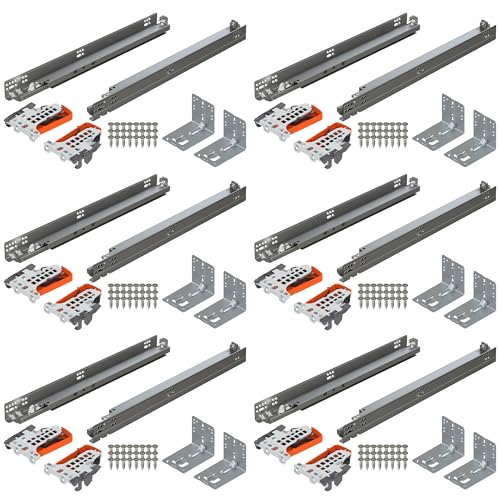
Many soft-close systems use a left/right matching pair. Replacing only one side with an incompatible part can leave the drawer closing unevenly or not catching at all. Match the part shape, mounting points, and weight rating before ordering a replacement.
Full-extension and partial-extension variants also matter. A replacement must match the travel length and the cabinet-to-drawer alignment requirements of the original slide.
Spot non-serviceable or integrated hardware
Some drawer slides have non-serviceable dampers or a sealed shock unit that cannot be adjusted. If the slide lacks a clear adjustment point, clip-on release lever, or serviceable piston, the repair choice may be replacement rather than tuning. Check the manufacturer-specific settings before forcing a fix.
Do not assume every soft-close drawer can be adjusted without removing it. Some models allow micro-adjust screws or cam adjusters at the front, while others need the drawer lifted off for access to the hardware.
When repair is enough and when to replace
Repair is usually enough when the drawer is clean, square, and lightly loaded, but the slide is simply out of position or has a loose fastener. Replace hardware when the damper is broken, the slide metal is bent, the load rating is no longer adequate, or the model is non-serviceable and no compatible part is available. The deciding factor is symptom plus condition, not age alone.
Adjust or re-seat the slides
If the drawer closes halfway, check the mounting screws, lock the slide in the correct position, and use the available adjusters. Cam adjusters, locking levers, and micro-adjust screws can correct height, side-to-side spacing, and front position on many systems. Re-seat both sides so the motion stays even.
After adjustment, retest with the drawer partially loaded. If the symptom changes from one-sided drag to full, even travel, the slide probably did not need replacement.
Repair stripped holes or bent parts
Loose screws that will not hold point to stripped holes, not automatic slide failure. Repair the hole, then reinstall with the correct screw length and thread type. If a slide member is bent, straightened slightly out of square, or warped by past force, replace that part instead of fighting it.
Replace slides or damper hardware
Replace the slide or damper when the drawer still stops short after cleaning, alignment, and fastener repair. Match the new part to the original mounting style, extension type, weight rating, and left/right layout. If the hardware is integrated, replacing the whole slide set may be the only practical option.
Frequently asked questions
Why is my soft close drawer not closing fully?
A soft-close drawer that will not close fully usually has one of a few issues: something in the path, a drawer or cabinet alignment problem, or a worn damper that often no longer catches near the end of travel. Check in that order, because the first two are far more common than a failed slide.
Why is my soft close drawer not closing fully kitchen?
In a kitchen, extra weight, moisture-related swelling, and cabinet racking are common reasons a soft-close drawer will not close fully. A drawer packed with heavy utensils or containers can sag, while humid conditions can swell wood edges enough to create drag at the last inch.
How to fix a soft close drawer that won’t close
Begin by removing obstructions, cleaning the tracks, and tightening the mounting screws. Next, check the reveal, drawer square, and cabinet clearance. If the drawer still will not close, test the damper engagement and confirm that the slide model is serviceable before replacing anything.
Why does my soft-close drawer stop before it shuts?
When a soft-close drawer stops before it shuts, the stop point usually tells you the problem is near the end of travel. That can mean the damper is not engaging, the drawer is slightly out of square, or the slide is hitting a hidden obstruction such as a screw head, debris, or a swollen edge.
Why won’t my soft-close drawer catch and close all the way?
If the drawer will not catch, the damper may be missing its trigger point because the drawer is misaligned or the slide is loose. It can also happen when the internal spring or shock unit has failed. Check the left and right sides together, since a mismatch can prevent the catch from engaging evenly.
How do I tell if the soft-close mechanism is broken or just misaligned?
A misaligned drawer usually shows uneven gaps, one-sided drag, or a front that sits proud on one side. A broken mechanism usually shows no slowing at the end of travel, bounce-back, or intermittent soft-close action even after alignment is corrected. If adjustment changes nothing, suspect the hardware.
Can a soft-close drawer be adjusted without removing it?
Often, yes. Many slides include front-access cam adjusters, micro-adjust screws, or clip-on release levers that let you change height or side-to-side position in place. If the slide lacks those features or the drawer must be lifted to reach the hardware, removal may be necessary.
Do I need new slides if the drawer only closes halfway?
Not always. A drawer that closes halfway can be blocked, out of alignment, overloaded, or held off track by loose screws or debris. Replace the slides only after you verify square, clearance, and damper engagement, because a half-close symptom often comes from a fixable setup problem.
Why does my soft-close drawer close slowly on one side but not the other?
Slow closing on one side usually points to uneven loading, a mismatched left/right pair, or a slide that is mounted out of line. Check the weight distribution first, then compare both slides for bent parts, loose screws, and correct engagement at the same point in the closing stroke.
What should I check first when a soft-close drawer won’t close properly?
Start with the path, the load, and the screws. Those are the quickest checks and the most common causes. If the drawer still fails after that, move to alignment, then damper condition. That order prevents unnecessary slide replacement and usually leads to the real fault faster.
Products related to this article
Sponsored / affiliate links. As an Amazon Associate I earn from qualifying purchases. I may earn additional commission from eligible campaigns.