Toilet Rough-In Size Chart
A standard toilet rough-in is 12 inches in many homes, but 10-inch and 14-inch layouts are common too; measure from the finished wall to the floor bolts, then choose a toilet listed for that rough-in and allow about 1/2 inch of clearance. Pick the wrong size and the tank can hit the wall, the bowl can crowd the door, or the unit may need to go back. This guide explains exact measuring points, how to read a toilet rough-in size chart, how to handle borderline numbers, and how to check depth in small bathrooms.
What toilet rough-in means
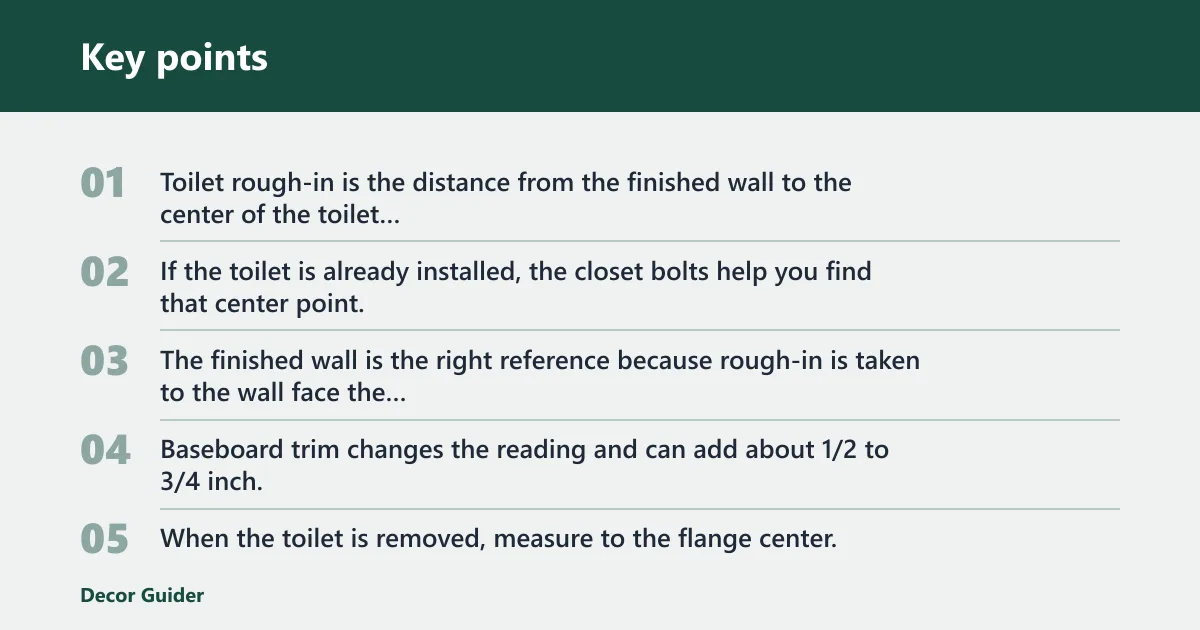


Toilet rough-in is the distance from the finished wall to the center of the toilet flange, the floor drain opening below the toilet. Do not measure to the baseboard or framing. If the toilet is already installed, the closet bolts help you find that center point.
Finished wall vs. baseboard
The finished wall is the right reference because rough-in is taken to the wall face the toilet actually sits against. Baseboard trim changes the reading and can add about 1/2 to 3/4 inch, enough to move a borderline rough-in into the wrong size.
Flange center and closet bolts
When the toilet is removed, measure to the flange center. When the toilet stays in place, the closet bolts mark the rough-in line because their centers line up with the flange centerline. That gives you a practical way to check fit without lifting the fixture first.
Why the number matters for fit
Rough-in decides whether the tank clears the wall and whether the bowl lands where you expect in the room. It also narrows the toilet list you should shop from. Most US toilets are built for a 12-inch rough-in, so a mismatch often means the toilet is the wrong size, not just the wrong style.
Use the chart below as a buy/no-buy filter. The same rough-in can still fail a bathroom if the toilet depth is too long or the bowl shape crowds the room, so read the rough-in and the depth together.
| Rough-in | Decision | Expected tank-to-wall gap | Likely fit risks | Small-bath recommendation |
|---|---|---|---|---|
| 10 inches | Buy 10-inch | Designed for a close, normal set without forcing the tank into the wall | Limited selection; a 12-inch model is unlikely to fit correctly | Best when the room is tight and you need a true 10-inch rough-in toilet |
| 11.5 inches | Remeasure first | Borderline; could become a standard 12-inch fit after checking finishes | Baseboard, tile build-up, or measurement error may be hiding the true rough-in | Use a round-front shape only after the final rough-in is confirmed |
| 12 inches | Buy 12-inch | Typical small gap that lets the tank sit off the wall without crowding it | Depth still matters in a narrow bath, even when the rough-in is correct | Best default choice for most bathrooms; choose elongated only if front space remains |
| 12.5 inches | Check offset flange | May look slightly open or slightly tight depending on finish layers and flange position | Could indicate a finish reference error or an offset flange; some models will sit too close to the wall | Round-front is the safer fallback if the room is shallow, but confirm the plumbing first |
| 14 inches | Buy 14-inch | Designed to leave the correct wall space for a true 14-inch rough-in | Buying a 12-inch model can leave an awkward gap or placement problem | Works in older layouts; confirm depth and side clearance before choosing bowl shape |
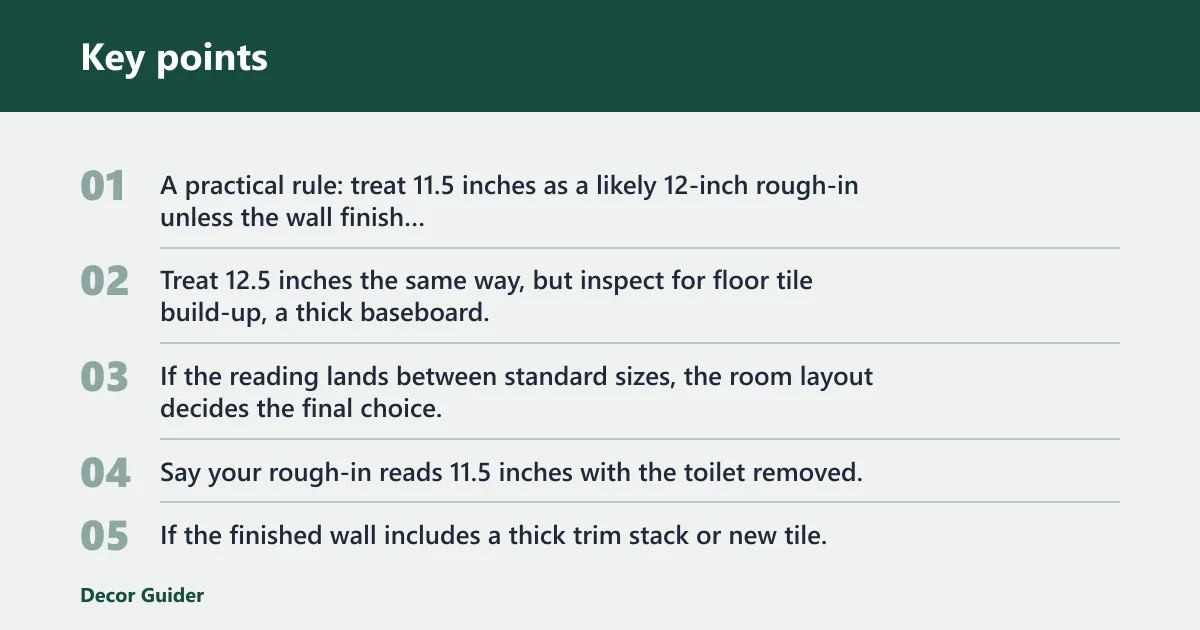
A practical rule: treat 11.5 inches as a likely 12-inch rough-in unless the wall finish is unusual or the toilet must sit very close to the wall. Treat 12.5 inches the same way, but inspect for floor tile build-up, a thick baseboard, or an offset flange before you buy. If the reading lands between standard sizes, the room layout decides the final choice.
Say your rough-in reads 11.5 inches with the toilet removed. If the finished wall includes a thick trim stack or new tile, the true rough-in may still be 12 inches. In that case, buying a 12-inch model is usually the right move, but you still need to confirm the front clearance and the tank-to-wall space before installation.
How do you measure toilet rough-in?
Measure from the finished wall to the center of the flange or bolt line, not to the baseboard or the framing behind the wall. If the toilet is installed, use the closet bolts as your target. If the toilet is removed, measure directly to the flange center for the cleanest number.
With the toilet installed
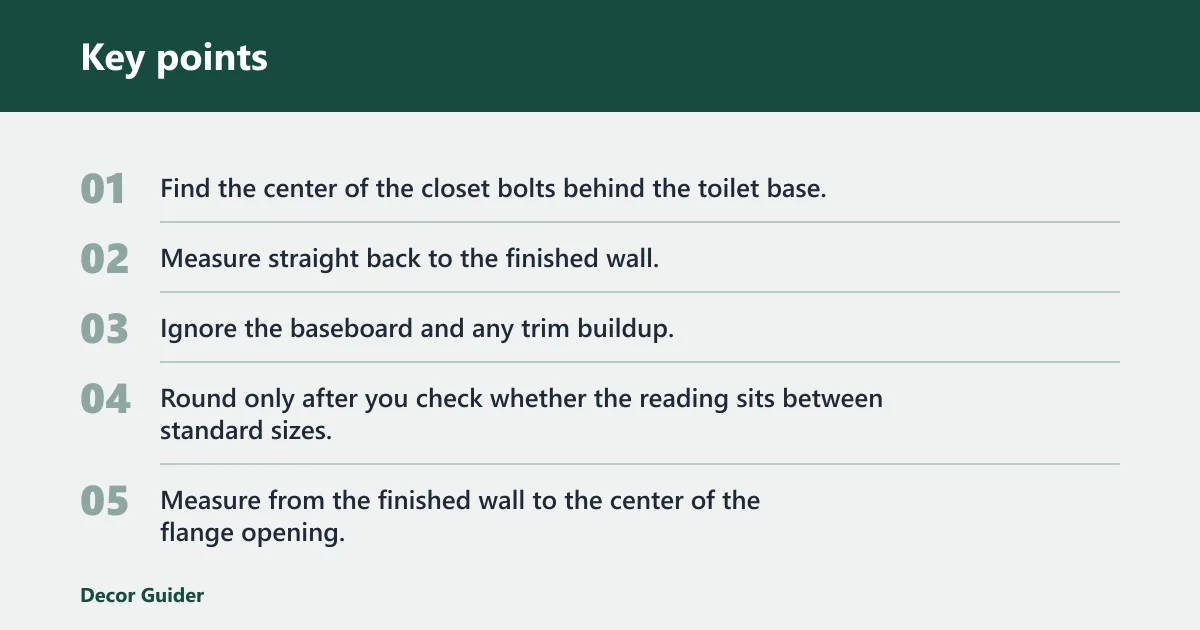
- Find the center of the closet bolts behind the toilet base.
- Measure straight back to the finished wall.
- Ignore the baseboard and any trim buildup.
- Round only after you check whether the reading sits between standard sizes.
This method works when you do not want to remove the toilet yet. The bolt centers line up with the flange centerline, so the reading is close enough to tell you whether you are dealing with a 10-inch, 12-inch, or 14-inch rough-in.
With the toilet removed
- Measure from the finished wall to the center of the flange opening.
- Confirm that you are measuring to the drain center, not the edge of the pipe.
- Check whether the floor finish changed the wall-to-flange distance.
- Compare the number against the toilet’s listed rough-in before you buy.
This is the better method when the toilet is already out. It removes guesswork, which matters in old homes and remodels where tile, backer board, or a wall finish has changed the original spacing.
Common mistakes to avoid
- Measuring to the baseboard instead of the finished wall.
- Measuring to the edge of the closet bolt instead of the centerline.
- Using unfinished framing or drywall instead of the final wall surface.
- Ignoring floor or wall finish buildup after tile, backer board, or trim changes.
- Assuming rough-in alone guarantees fit without checking toilet depth and clearance.
A common first-timer mistake is reading the rough-in off the trim. The toilet then arrives with a tank that sits too close to the wall, or the bowl projection leaves too little room in front of the toilet. The fix is simple: remeasure from the finished wall and compare that number to the toilet’s listed rough-in.
Toilet clearance checks
Clearance numbers turn rough-in into a usable layout check. The International Plumbing Code calls for 15 inches from the toilet centerline to a side wall and 21 inches of clear space in front of the toilet. If either number is tight, the toilet shape and depth matter just as much as the rough-in.
| Check | Minimum | What to look for |
|---|---|---|
| Side clearance | 15 inches from centerline to side wall | Measure from the toilet centerline, not the bowl edge or tank edge |
| Front clearance | 21 inches in front of the toilet | Confirm clear floor space, not just open distance to a vanity or door leaf |
15-inch side clearance
Measure from the toilet centerline to the nearest side wall or obstacle. If the number falls short, the toilet may feel squeezed even if the rough-in is correct. This check matters most in narrow rooms where a long bowl and a nearby wall compete for the same space.
21-inch front clearance
Measure the open space in front of the bowl. The 21-inch minimum is easy to misread if the bathroom door, vanity, or tub edge is nearby. Use the actual clear floor area, not the distance to a fixture that blocks the path.
Where the clearance numbers come
The 15-inch side-clearance and 21-inch front-clearance rules are widely used in the IPC and many local plumbing codes; always confirm local amendments if your jurisdiction is stricter. For a quick code-based fit check, compare your layout against the current plumbing code requirements before you choose the bowl shape.
If the room is short front-to-back, start with a round-front bowl and a 12-inch rough-in model if the measurement allows it. If the rough-in is borderline, a shorter bowl can solve the room problem even when the wall-to-flange distance is correct. The goal is to fit the toilet and preserve usable circulation space. For more layout help, see bathroom clearance code and elongated vs round toilets.
What should you do if your rough-in is off?
If the number is off, check whether the flange is offset, whether tile or wall finish changed the reading, and whether the home uses nonstandard plumbing. Do not force a 12-inch toilet onto a 10-inch or true 14-inch layout without checking the listed rough-in first. The right fix depends on the actual centerline, not the label on the box.
Offset flange checks
An offset flange can move the drain center from where you expected it. That can create a borderline reading that looks like 11.5 or 12.5 inches, even though the plumbing geometry is what changed. If the measurement does not match the toilet you want, inspect the flange before choosing a replacement. See our toilet flange repair guide and offset flange guides for the next step.
Tile build-up and finish changes
Floor tile build-up can change the finished floor height and alter the rough-in reading from the wall to the center of the flange. Wall finish can do the same if you measured to the wrong surface. Recheck after all finish layers are in place, because the final number is what matters for the purchase.
When to choose a different toilet size
If the rough-in is truly 10 inches, buy a 10-inch toilet. If it is truly 14 inches, look for a 14-inch rough-in toilet. If the number is borderline and the room is tight, pick the toilet size that protects clearance first, then decide between round-front and elongated based on the remaining front-to-back space.
Model-specific fit references
When you compare a toilet’s size to your measurement, use the manufacturer’s product page for the rough-in and depth numbers. For example, TOTO Drake II is listed as a 12-inch rough-in model with a 28.25-inch depth, and Kohler Highline Comfort Height is listed as a 12-inch rough-in model with a 30.25-inch depth. Those numbers help you judge whether a standard rough-in will still work in a small bath.
Frequently asked questions
What is a toilet rough-in?
Toilet rough-in is the distance from the finished wall to the center of the toilet flange. It tells you which toilet size fits the plumbing location in your bathroom. Standard rough-in sizes are 10, 12, and 14 inches, with 12 inches being the most common.
Why does rough-in size matter when buying a toilet?
Rough-in size determines whether the toilet tank clears the wall and whether the toilet sits correctly over the drain. If the rough-in is wrong, the toilet may not fit at all, or it may leave too little room in front of the bowl or beside the fixture.
How do you measure toilet rough-in with the toilet installed?
Measure from the finished wall to the center of the closet bolts behind the toilet. Those bolt centers line up with the flange centerline, so the reading shows the rough-in without removing the toilet. Do not measure to the baseboard, because the trim can add about 1/2 to 3/4 inch.
How do you measure toilet rough-in after removing the toilet?
Measure from the finished wall to the center of the flange opening in the floor. That is the most direct way to confirm the rough-in because it uses the actual drain center. If the floor or wall finish changed, use the finished wall as the reference, not framing or trim.
What are the standard toilet rough-in sizes?
The standard rough-in sizes are 10 inches, 12 inches, and 14 inches. A 12-inch rough-in is the most common size in modern homes, and most US toilets are built for it. Older homes are more likely to have 10-inch or 14-inch layouts.
Can you use a 12-inch toilet on a 10-inch rough-in?
Usually no, not as a normal direct-fit choice. A true 10-inch rough-in toilet is designed for that shorter wall-to-flange distance. Forcing a 12-inch toilet onto a 10-inch rough-in can create tank-to-wall problems or improper placement over the drain.
What should you do if your rough-in falls between standard sizes?
First, remeasure from the finished wall and check for baseboard, tile build-up, or an offset flange. If the number still lands between sizes, use the room layout to decide. In a tight bathroom, choose the toilet that preserves front clearance, then pick round-front if depth is still too tight.
Products related to this article
Sponsored / affiliate links. As an Amazon Associate I earn from qualifying purchases. I may earn additional commission from eligible campaigns.