Pouf vs Stool vs Footstool: A Practical Buyer’s Decision Guide
You spot a low, upholstered thing at a friend’s place. You ask what it is. They say “ottoman.” Then you see a similar one online labeled “pouf,” and another called a “footstool.” Three names, three products that look nearly identical, and you have no idea which one fits your living room. This confusion is normal, and the furniture industry doesn’t make it easy.
This guide breaks down the real differences between a pouf, a stool, and a footstool. You’ll learn how each one is built, how tall it should be for your body, what it can store, and how long it will last. You’ll also get a clear comparison table and a few honest opinions on where each type shines and where it falls short. By the end, you’ll know exactly which piece to buy for your space, your habits, and your budget.

ALASDO
ALASDO Storage Ottoman Footrest Stool Small Ottoman…
- 【ottoman】Our ottoman has the better size and Relaxed color,Length 17 x width 13 x height 13 inches and Grey,It is also a comfortab…
- 【Magic storage space】When our storage ottoman is assembled, we have 43L storage space,Put tools, blankets, books, magazines, sport…
- 【Multipurpose ottoman】Storage ottoman footstool can be used as a coffee table, small seat, chair stool, bed footstool, fishing sto…
As an Amazon Associate I earn from qualifying purchases.
If you need a versatile option that stores stuff and works as a footrest, the ALASDO Storage Ottoman Footrest Stool is a solid middle ground. It folds flat when not in use, holds up to 400 lbs, and offers 43 liters of hidden storage. That combination of strength and practicality makes it a smart pick for small apartments or busy family rooms.
What Exactly Is a Footstool? (The Umbrella Term)
Footstool is the broadest term of the three. Any low piece you rest your feet on qualifies. That includes ottomans, poufs, and even simple wooden stools with a padded top. So when you hear “footstool,” think category, not specific product.
The classic footstool has a rigid frame, usually wood or metal, with a cushioned top. It might have four legs or a solid base. Height typically ranges from 10 to 14 inches, matching the average sofa seat height. A footstool’s only job is leg support. It doesn’t store anything, and it’s not meant for sitting.
Some footstools are upholstered in fabric or leather, others are bare wood. The bare ones are easier to clean but less comfortable without shoes. The upholstered ones feel nicer but show wear faster, especially if you use them daily.
The Ottoman: Storage, Structure, and Versatility
An ottoman is a footstool with ambition. It usually has a solid frame, a cushioned top, and often a hollow interior for storage. Some ottomans are tufted, some have nailhead trim, and some flip open to reveal space for blankets, magazines, or remote controls.
The defining feature is the frame. Ottomans use wood or MDF, which gives them structure and load-bearing capacity. A good one can handle 300 to 500 pounds, so you can sit on it, kneel on it, or use it as a makeshift coffee table. That sturdiness comes at a cost: weight. A typical storage ottoman weighs 15 to 25 pounds, which makes it less portable than a pouf.
Ottomans also come in a range of heights. Low ones, around 12 inches, work as footrests. Taller ones, 16 to 18 inches, can double as extra seating or a surface for trays and drinks. Some even have a hard top that flips over to create a table. That versatility explains why ottomans dominate living room furniture sales.
When to Choose an Ottoman Over a Footstool
Pick an ottoman when you need more than a footrest. If your living room lacks a coffee table, a storage ottoman can fill that role. If you often have guests and need extra seating, a sturdy ottoman works as an occasional chair. If clutter is a problem, the hidden storage helps you hide it fast.
One trade-off: ottomans are bulkier. They don’t slide under a sofa easily, and they take up visual space. In a tiny room, a simple footstool might be the better call. But for most homes, the added function of an ottoman outweighs the footprint.
The Pouf: Soft, Frameless, and Casual
A pouf is the laid-back cousin of the ottoman. It has no frame, no legs, and no hard edges. Poufs are filled with foam, polyester fiber, beads, or natural materials like wool or cotton. They’re essentially large floor cushions that happen to be firm enough to rest your feet on.
Poufs are lighter than ottomans, often under 10 pounds. You can kick them around the room, use them as a footrest, a side table, or a seat for a child. They’re popular in bohemian and casual interiors because they add texture and color without the visual weight of a framed piece.
The downside is support. A pouf won’t hold a 200-pound adult the way an ottoman will. The fill compresses over time, and the shape can distort. You also can’t store anything inside a pouf, unless you buy a specialty one with a zipper and hollow core, which is rare.
Do Poufs Hold Their Shape?
It depends on the fill. High-density foam holds up for several years, but it’s heavy and expensive. Polyester fiber clumps and flattens after a year or two. Polystyrene beads shift and lose volume, though they’re cheap to replace. Natural fills like wool and kapok are resilient but pricey.
A good rule: if you plan to sit on a pouf regularly, buy one with a zipper so you can add more fill later. Without that, you’re stuck with a sagging lump. I’ve seen plenty of poufs that looked great in the store but looked deflated after six months of daily use.
The Hassock: The Lightweight Middle Ground
A hassock is a firm, upholstered footstool with no frame and no legs. Think of it as a cross between an ottoman and a pouf. It’s usually rectangular or round, covered in fabric, and filled with dense foam or cotton. Unlike a pouf, a hassock has a defined shape and a flat top.
Hassocks are lighter than ottomans and easier to move. They’re also more stable than poufs because the fill is packed tighter. You’ll often see them in traditional or transitional living rooms, paired with wingback chairs.
The catch: hassocks rarely have storage, and they’re not built for heavy sitting. They’re best used as a footrest or a small accent piece. If you want something that can double as a seat, skip the hassock and get an ottoman.
Side-by-Side Comparison: Size, Storage, and Support
| Feature | Footstool | Ottoman | Pouf | Hassock |
|---|---|---|---|---|
| Typical height | 10-14 inches | 12-18 inches | 12-15 inches | 10-14 inches |
| Weight | 5-15 lbs | 15-25 lbs | 5-10 lbs | 8-15 lbs |
| Storage | None | Often yes | Rarely | None |
| Frame | Wood or metal | Wood or MDF | None | None |
| Load capacity | Up to 200 lbs | 300-500 lbs | Up to 150 lbs | Up to 200 lbs |
| Best for | Simple footrest | Storage + seating | Casual decor | Light footrest |
| Price range | Low | Medium to high | Low to medium | Low to medium |
This table gives you a quick snapshot. If you need storage, the ottoman wins. If you need portability, the pouf wins. If you need a sturdy footrest that doesn’t take up space, the footstool wins. For most people, an ottoman is the best all-rounder because it covers multiple needs at once.
Ergonomics: Which Height Is Right for Your Body?
Height matters more than you think. The ideal footrest height depends on your sofa or chair seat height and your leg length. The goal is to keep your knees at a roughly 90-degree angle when your feet are on the rest. If the footrest is too low, your knees stay bent too much, which cuts off circulation. If it’s too high, your hips tilt forward, causing lower back strain.
Measure your sofa seat height first. Standard sofas have seats that are 15 to 18 inches from the floor. For those, a footstool or ottoman between 12 and 14 inches tall works best. If you have a low lounge chair with a 12-inch seat, look for a footrest around 10 inches. If you have a tall bar stool, you’ll need a footrest that’s 16 inches or higher.
One more thing: consider your own height. Taller people (over 6 feet) may prefer a slightly taller footrest, around 15 inches, to keep their knees from jutting up. Shorter people (under 5’4″) often do better with a 10- or 11-inch piece. Don’t rely on the “one size fits all” label. Sit down, put your feet up, and see if your knees feel relaxed or strained.
Material Matters: Durability and Maintenance
Fabric choice affects how long your piece lasts and how much upkeep it needs. Here’s a breakdown of common materials and what to expect over five years.
- Polyester and microfiber: Stain-resistant and fade-resistant. Good for homes with kids or pets. They pill after heavy use, but a fabric shaver fixes that.
- Leather and faux leather: Easy to wipe clean, but prone to cracking if exposed to direct sunlight. Faux leather peels after a few years, so expect to replace it sooner.
- Cotton and linen: Breathable and soft, but they stain easily and wrinkle. Best for low-traffic rooms.
- Wool and wool blends: Durable and naturally stain-resistant. They cost more but hold up well. They can shed at first.
Fill material matters just as much. High-density foam (1.8 to 2.0 lbs per cubic foot) holds its shape for years. Low-density foam flattens quickly. Polyester fiber is cheap but compresses. Beads are lightweight but shift and lose volume. If you want a piece that lasts, check the density rating before buying.
For storage ottomans, the frame material is key. Solid wood is the most durable but heavy. MDF is lighter and cheaper, but it can warp if exposed to moisture. Look for a piece with reinforced corners and a load rating of at least 300 lbs if you plan to sit on it.
Styling Multiple Pieces in One Room
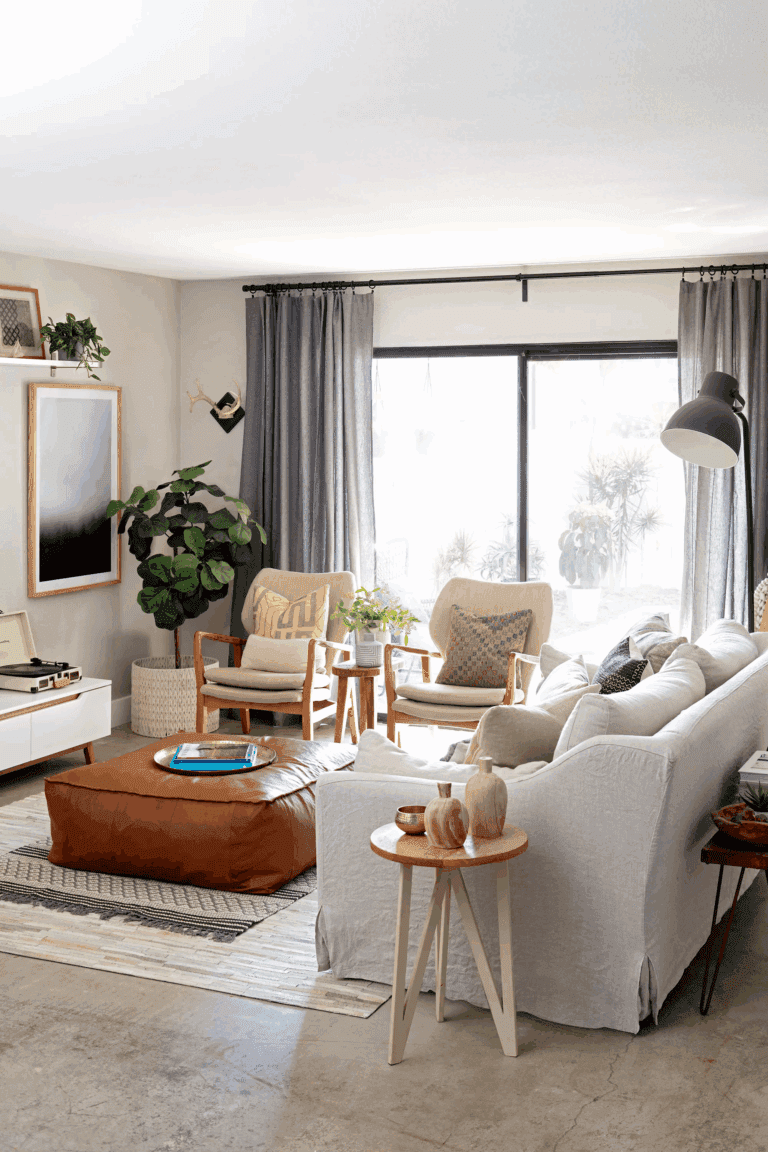
You don’t have to pick just one. A living room can handle a pouf, an ottoman, and a footstool at the same time, as long as they don’t compete for attention. The trick is to vary heights and textures while keeping a common color palette.
For example, use a large storage ottoman as the coffee table centerpiece. Place a smaller pouf to one side for extra seating. Add a low footstool near an armchair for reading. Choose fabrics that complement each other—say, a leather ottoman, a woven pouf, and a linen footstool. That mix adds depth without looking cluttered.
One mistake I see often: buying three pieces that are all the same height. That creates a monotonous line. Instead, aim for one tall piece (16-18 inches), one medium (12-14 inches), and one low (8-10 inches). The variety makes the room feel intentional.
If you’re unsure about mixing, start with one piece and add more as you get comfortable. You can always move them between rooms. A pouf works in a bedroom corner, a footstool fits under a desk, and an ottoman anchors a playroom.
How to Choose Based on Your Space and Lifestyle
Let’s make this practical. Answer these questions and the right choice becomes obvious.
- Do you need storage? If yes, get an ottoman with a lid. Check the interior dimensions to make sure your blankets or books fit.
- How often will you move it? If you rearrange furniture often, a lightweight pouf is easier to shift. If it stays put, an ottoman’s weight is fine.
- Will anyone sit on it? For regular sitting, choose a piece with a solid frame and high-density foam. Poufs and hassocks aren’t ideal for that.
- What’s your floor type? Hardwood floors need felt pads on furniture legs to avoid scratches. Poufs and hassocks skip that issue since they sit flat.
- Do you have pets? Choose a stain-resistant fabric and avoid delicate weaves. Leather is easy to clean but claws can puncture it.
For small apartments, a folding storage ottoman like the ALASDO model is a smart pick. It gives you a footrest, a seat, and a storage box, then folds to 17x13x2.5 inches when you need floor space. That’s a feature you won’t find in a pouf or a standard footstool.
For larger homes, a solid wood ottoman with a tufted top feels more substantial. It anchors the room and lasts decades if you care for it. Poufs work best as accent pieces in reading nooks or kids’ play areas.
Frequently Asked Questions
What’s the main difference between a pouf and an ottoman?
The frame. An ottoman has a rigid internal structure (wood or MDF), so it holds weight and often has storage. A pouf has no frame—it’s just a fabric shell filled with foam or beads. That makes poufs lighter and softer, but less supportive and without storage.
Can I use a pouf as a regular seat?
You can, but it’s not ideal. Poufs are typically rated for 150 pounds or less. Sitting on one for an hour will compress the fill and strain your lower back. If you need occasional seating, look for a pouf with high-density foam and a flat top. For daily seating, an ottoman is safer.
How do I clean a fabric footstool or ottoman?
Check the label for cleaning codes. Most fabrics can be spot-cleaned with a mild detergent and water. Use a vacuum with an upholstery attachment to remove dust and crumbs. For removable covers, machine wash on gentle and air dry. Avoid soaking the fill, as it can trap moisture and develop mildew.
What’s the best height for a footstool with a standard sofa?
Measure your sofa seat height first. A footstool should be 1 to 2 inches lower than the seat height. For a typical sofa at 17 inches, choose a footstool around 15 inches. This keeps your knees at a 90-degree angle and your feet flat.
Are storage ottomans worth the extra cost?
If you need hidden storage, yes. They replace a coffee table and a storage bin, so the cost evens out. Look for one with a sturdy lid that stays open on its own, and check the interior dimensions. A shallow ottoman won’t hold much more than a couple of throws.
Final Verdict: Which One Should You Buy?
- Choose a footstool if you only need a simple, low-cost leg rest and don’t care about storage or sitting.
- Choose an ottoman if you want a multifunctional piece that stores items, supports sitting, and works as a table. It’s the best value for most homes.
- Choose a pouf if you want a lightweight, casual accent that you can move around easily. Just don’t expect it to last a decade.
- Choose a hassock if you like the structure of a footstool but prefer a softer, frameless feel.
- Match the height to your sofa and body. A 12- to 14-inch height works for most people, but measure to be sure.
- Check the fill density and frame material before buying. High-density foam and solid wood last longer than cheap alternatives.
- Consider a folding storage ottoman if space is tight. It gives you all the benefits without the permanent footprint.
You don’t need to overthink this. Start with your primary need: foot comfort, storage, or style. Then pick the piece that matches. If you’re still torn, go with a good ottoman—it does the most jobs well. For more on the differences between specific types, see our guide on ottoman vs pouf. And if you’re curious about making your own pouf, we have a DIY pouf tutorial that’s simpler than you’d think.
Products related to this article
Sponsored / affiliate links. As an Amazon Associate I earn from qualifying purchases. I may earn additional commission from eligible campaigns.