Pouf vs Garden Stool: Which Fits Best for Your Space?
Choose a pouf for soft extra seating, foot support, or a low accent piece. Choose a garden stool for a firmer perch, a steadier side table, or covered outdoor use. For covered patios and mixed indoor-outdoor spaces, a garden stool is often the safer all-purpose pick. Pick wrong, and you get soggy fabric, unstable side-table use, or a piece that looks right but fails where you need it. This guide compares material choices, weather resistance, seat height, styling, and the best use case for each.
Pouf vs garden stool: the core trade-off
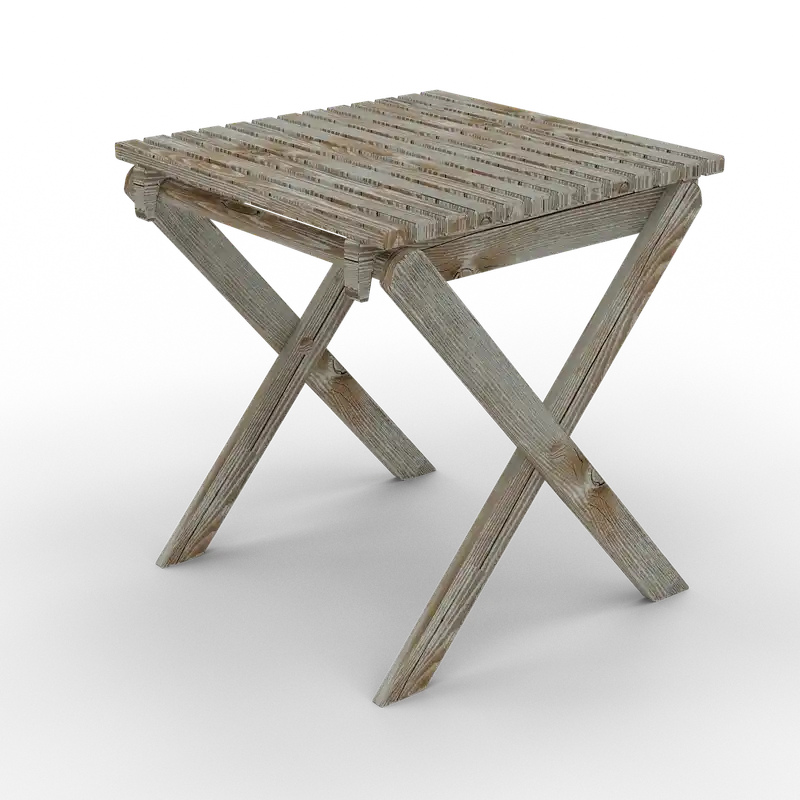
A pouf is a small, cushioned piece of furniture without a back or arms. It sits directly on the floor without legs or a rigid frame, and it is usually softer, smaller, legless, and lacks storage. A garden stool is a harder stool, often ceramic, metal, or wood in the market, built for firmer seating, plant display, or side-table use.
The main trade-off is simple. Poufs are easier to move and more comfortable for casual lounging, while garden stools are usually steadier, easier to wipe clean, and better suited to covered patios or damp conditions.
What a pouf is
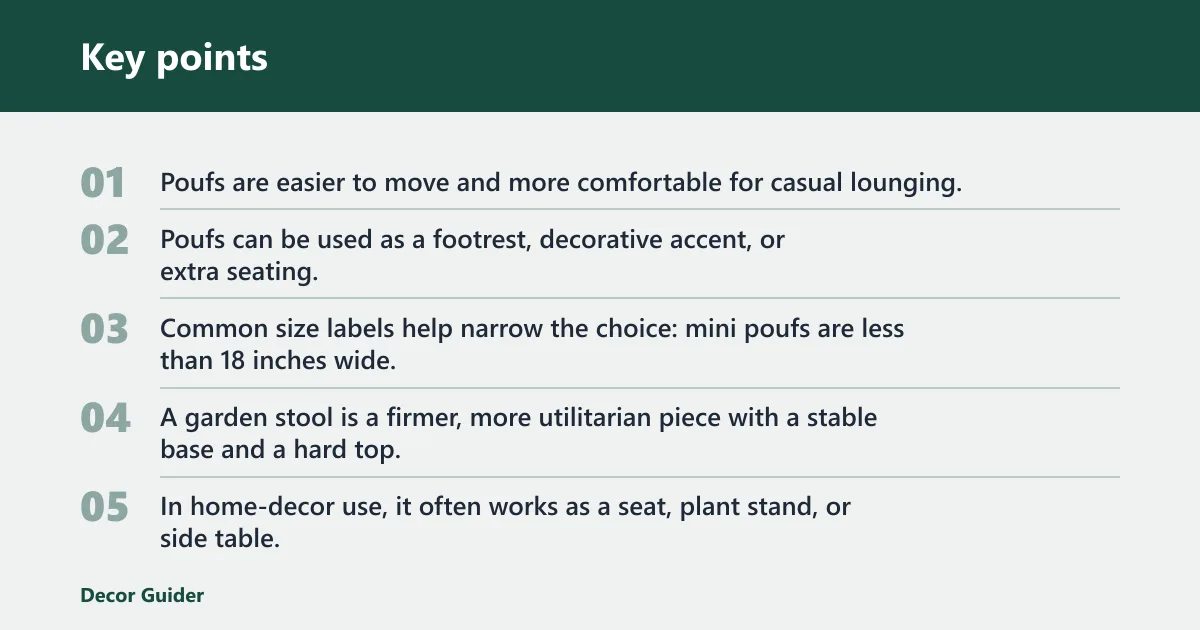
Poufs can be used as a footrest, decorative accent, or extra seating. Common size labels help narrow the choice: mini poufs are less than 18 inches wide, small poufs are 18 to 25 inches wide, medium poufs are 26 to 40 inches wide, and large poufs are over 40 inches wide. Poufs are usually softer than stools.
What a garden stool is
A garden stool is a firmer, more utilitarian piece with a stable base and a hard top. In home-decor use, it often works as a seat, plant stand, or side table. For outdoor use, the material matters more than the label, because moisture, rust, UV fade, and wipe-clean surfaces determine how long it stays useful.
How they compare at a glance
Use this comparison when you need a quick answer. The winner changes with the job: poufs win on softness and portability, while garden stools win on stability and outdoor durability.
| Decision factor | Pouf | Garden Stool | Winner |
|---|---|---|---|
| Extra seating comfort | Soft, cushioned, low and casual | Firmer and less forgiving | Pouf |
| Side-table use | Works with a tray, but top can shift | Usually flatter and more stable | Garden Stool |
| Portability | Lightweight and easy to move | Often heavier and less convenient to move | Pouf |
| Moisture exposure | Fabric and fill can be at risk | Better when made with outdoor-safe materials | Garden Stool |
| Easy cleaning | Depends on cover and fill | Usually easier to wipe down | Garden Stool |
| Covered patio fit | Works if kept dry and stored carefully | Usually better for this setting | Garden Stool |
Extra seating comfort
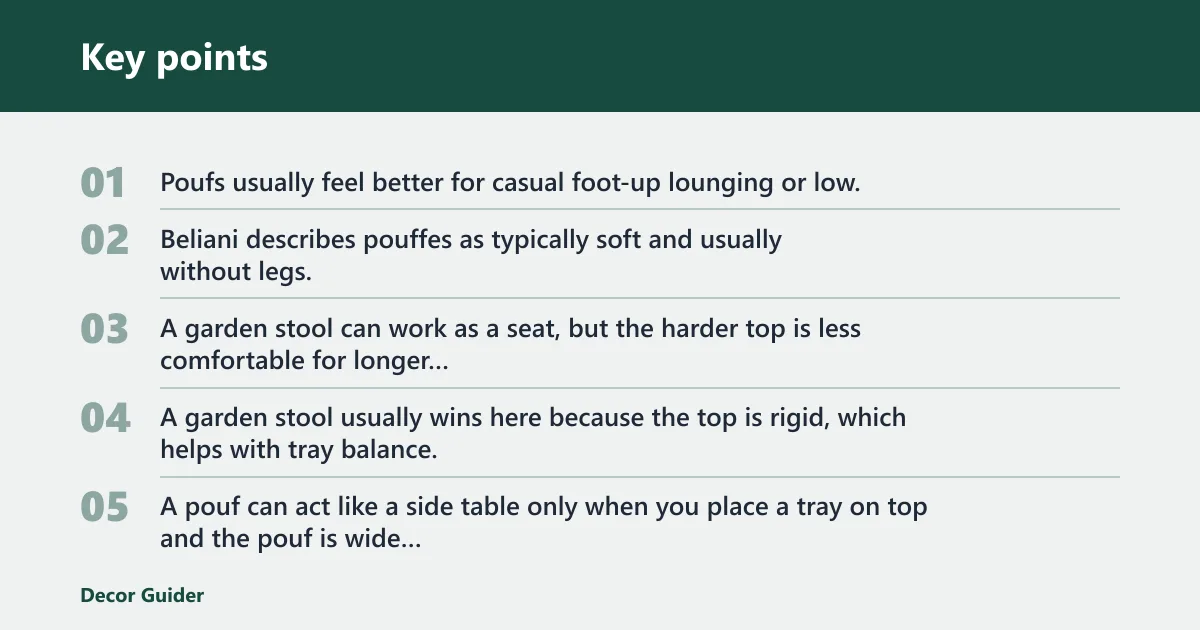
Poufs usually feel better for casual foot-up lounging or low, informal seating because they are soft and cushioned. Beliani describes pouffes as typically soft and usually without legs, and as footrests or low seating options. A garden stool can work as a seat, but the harder top is less comfortable for longer sitting.
Side-table use
A garden stool usually wins here because the top is rigid, which helps with tray balance, drinks, and books. A pouf can act like a side table only when you place a tray on top and the pouf is wide and stable enough to support it. Without that tray, a pouf is a poor choice for items that can spill.
Portability
Wayfair says poufs are lightweight and easy to move from room to room. That matters if you want flexible seating in a den, bedroom, or balcony that changes use often. Garden stools can move too, but their material and structure often make them less convenient to shift repeatedly.
Outdoor durability
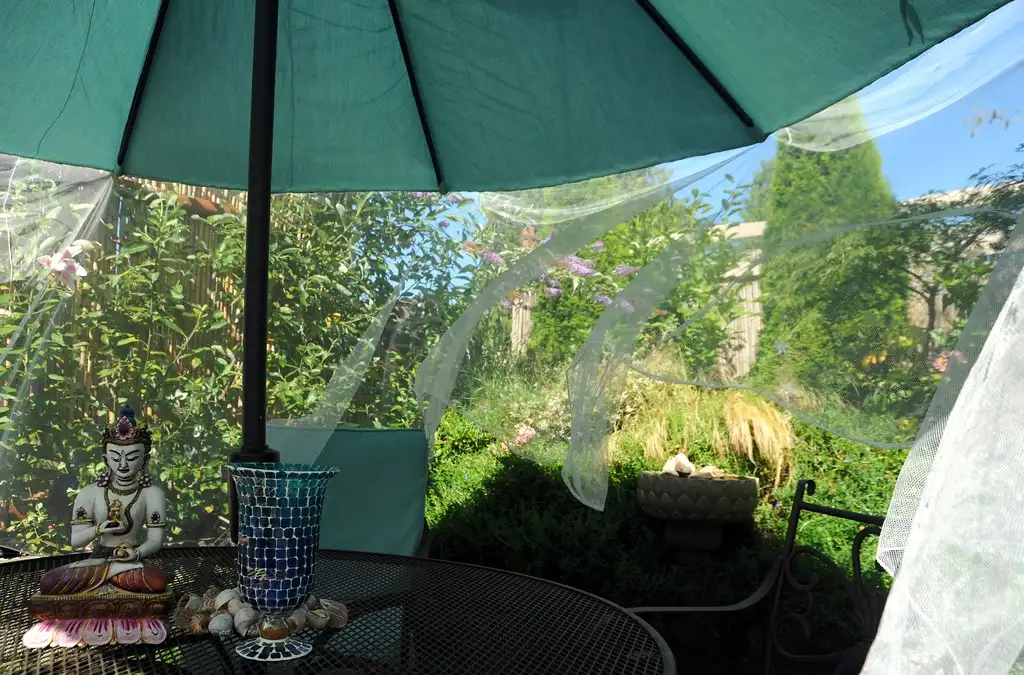
Garden stools usually handle outdoor exposure better, especially on a covered patio where light moisture and temperature changes are part of normal use. A pouf can work outdoors only when the cover and fill tolerate humidity and spills. Walmart shows an indoor/outdoor ottoman pouf cube among pouf products, but that does not mean every pouf is outdoor-ready.
Can a pouf work outdoors like a garden stool?
Yes, a pouf can work outdoors in some cases, especially on a covered patio or sheltered balcony if the cover handles moisture and the fill does not hold dampness. A pouf can work on a covered patio or sheltered balcony if the cover resists moisture and the fill will not trap dampness, but it is a risky choice in exposed rain, heavy dew, or direct sun. For outdoor use, the material matters more than the shape.
Covered patio use versus fully exposed outdoor use
Covered patios reduce rain exposure, but they do not remove moisture risk. Wind-blown drizzle, condensation, and wet shoes still reach furniture, so a fabric pouf needs more care than a hard stool. Fully exposed areas usually favor garden stools with weather-resistant surfaces and bases that will not wick water.
Material and fill limits to watch for
Look for wipe-clean covers, closed-cell or moisture-tolerant fill, and stitching that does not soak up water easily. Fabric poufs with absorbent covers may stain or mildew if stored outdoors for long periods. A hard garden stool made from materials like ceramic, metal, or treated wood is often easier to trust in that setting.
When a tray makes a pouf more useful
Suppose your pouf sits beside a sofa on a covered balcony. With a rigid tray, it can hold a cup and a book for a short visit. Without the tray, the surface is too soft and uneven for dependable side-table use.
Is a garden stool better for side-table use?
Usually yes. A garden stool gives you a flatter, firmer top, better tray stability, and more confidence for drinks, books, and plants. A pouf can do the job in a pinch, but it is more likely to shift, sink under weight, or let a tray slide if the top is too soft or rounded.
Flat top and tray stability
A hard top gives the tray a stable base, which matters when you set down a mug or a vase. Poufs are soft by design, so even a good tray can tilt if the top compresses unevenly. For everyday side-table use, rigidity beats softness.
Weight capacity and tip resistance
Stability matters as much as surface area. A low, broad garden stool tends to resist tipping better than a plush pouf, especially on uneven patio pavers or outdoor rugs. That makes it safer for plants, stacked books, or a drink you do not want to chase.
Best uses for drinks, books, and plants
Choose a garden stool for a drink station, a reading perch, or a plant stand. Choose a pouf only if the “table” role is occasional and you are comfortable adding a tray every time. For mixed seating and table duty, a garden stool is the cleaner fit.
Which is easier to clean and maintain?
Garden stools are usually easier to clean because hard surfaces wipe down quickly and do not hold spills the way fabric does. Poufs depend on the cover and fill; some are manageable with spot cleaning, while others can be difficult to dry or deodorize after a spill. Moisture resistance matters more on patios than in living rooms.
Wipe-clean surfaces versus fabric covers
Ceramic, metal, and many treated wood finishes can be cleaned with a damp cloth. Fabric poufs often need more care, especially if the cover is not removable. If the piece sits near food, drinks, or muddy shoes, the harder surface has a clear advantage.
Moisture, stains, and rust resistance
For patio use, rust resistance and UV or fade resistance matter as much as the initial look. Metal garden stools need weather-safe finishes, and wood needs proper outdoor treatment. A pouf can stain fast if it absorbs moisture, so it is a weaker pick unless the fabric is meant for outdoor use.
What matters most in a covered patio setting
A covered patio still needs easy cleanup after pollen, wet leaves, or humidity. If you want the lowest-maintenance option, choose a garden stool with a hard, nonabsorbent surface. If you want a softer seat, keep the pouf indoors or store it when weather shifts.
What height and size should I choose for a patio stool or pouf?
Pick the size by job, not by guesswork. For a pouf, mini under 18 inches works as a small accent, small 18 to 25 inches fits many footrest tasks, medium 26 to 40 inches is better for casual seating, and large over 40 inches suits bigger lounge areas. A patio stool should stay low enough to feel stable and high enough to use without awkward reaching.
Seat height and footrest comfort
For a footrest, the best choice is the one that matches your chair seat height closely enough to keep your legs relaxed. Too tall feels awkward, and too low gives less support. A firm stool usually keeps that relationship more predictable than a plush pouf that compresses under weight.
Size by room or patio footprint
Small balconies usually need a compact piece that can tuck away fast. Larger patios can handle a medium or large pouf, but only if the space will still feel open after you add it. Garden stools usually occupy less visual softness, so they can work in tighter spaces when you need a table more than a lounge piece.
Decision matrix: choose by use case
This matrix scores the two options across the situations that matter most. Use it to match the furniture to the setting, especially when you are deciding between a covered patio and an indoor room.
| Scenario | Pouf | Garden Stool | Winner | Short recommendation |
|---|---|---|---|---|
| Covered patio | 3/5 | 4/5 | Garden Stool | Choose the stool unless the pouf is clearly outdoor-rated and stored dry. |
| Indoor footrest | 5/5 | 3/5 | Pouf | Choose the pouf for softer leg support and casual lounging. |
| Extra guest seat | 4/5 | 3/5 | Pouf | Choose the pouf if guests need a softer, lower seat for short periods. |
| Side table | 2/5 | 5/5 | Garden Stool | Choose the stool for trays, drinks, books, and better tip resistance. |
| Easy cleaning | 2/5 | 5/5 | Garden Stool | Choose the stool if spills, dust, or patio dirt are likely. |
| Portability | 5/5 | 3/5 | Pouf | Choose the pouf if you want to move it often between rooms. |
| Wet-weather tolerance | 1/5 | 4/5 | Garden Stool | Choose the stool for damp climates, sheltered exposure, or frequent condensation. |
| Styling flexibility | 4/5 | 4/5 | Tie | Both work well; pick the material and finish that matches the setting. |
Choose pouf if… / choose garden stool if…
Choose a pouf if you want softness, easy movement, and an occasional footrest or extra seat indoors. It is also the better pick when you want a casual accent piece that can move between a bedroom, living room, or covered lounge area, as long as moisture is not a major concern.
Choose a garden stool if you need a firmer seat, a steadier side table, or a piece that can handle covered outdoor use with less fuss. It is the safer pick for drinks, plants, frequent wiping, and damp conditions. If your patio is open to rain, prioritize outdoor-rated materials over upholstered comfort.
Frequently asked questions
What is the difference between a pouf and a garden stool?
A pouf is a soft, cushioned, backless, legless piece that sits directly on the floor and works best as a footrest, extra seat, or accent. A garden stool is firmer and usually better for side-table use, plant display, and covered outdoor spaces where stability matters more.
Which is easier to clean: a pouf or a garden stool?
A garden stool is usually easier to clean because hard surfaces wipe down quickly and resist spills better. Poufs depend on fabric type, cover construction, and fill. If you expect dust, food, or outdoor grime, the stool is the lower-maintenance pick.
Can I use a garden stool for gardening tasks or just as decor?
A garden stool can be useful for light gardening-adjacent tasks such as holding tools, supporting a plant, or giving you a short perch while you work. It is also common as decor. It is not the same thing as a work stool built for kneeling or heavy-duty garden labor.
Products related to this article
Sponsored / affiliate links. As an Amazon Associate I earn from qualifying purchases. I may earn additional commission from eligible campaigns.