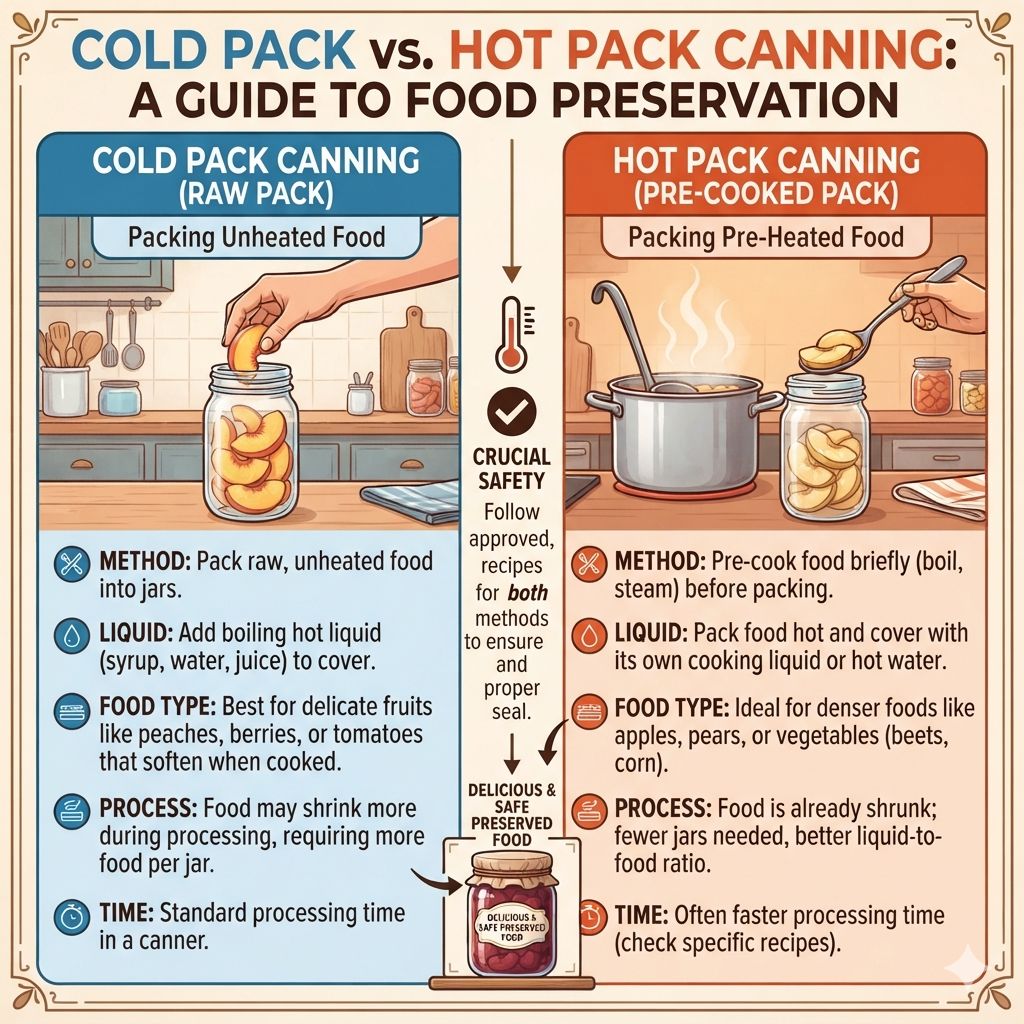
Cold pack canning, often called raw pack canning, involves placing food directly into jars without pre-heating. Hot pack canning, conversely, involves heating food before packing it into jars. Each method has distinct advantages and is suited for different types of foods to ensure optimal preservation and quality.
As an Amazon Associate I earn from qualifying purchases.

Key Takeaways
- Cold pack canning places uncooked food directly into jars, preserving more natural texture and nutrients but potentially leading to more headspace loss.
- Hot pack canning involves pre-heating food, which helps shrink food, remove air, and reduce the risk of spoilage, leading to a more compact pack.
- The choice between cold pack and hot pack canning depends on the food type, desired texture, and preservation goals.
- Both methods require proper sterilization of jars and lids and adherence to tested processing times for safe food preservation.
- Hot pack canning is generally recommended for most vegetables and fruits to ensure better quality and safety, especially for long-term storage.
What is Cold Pack Canning?
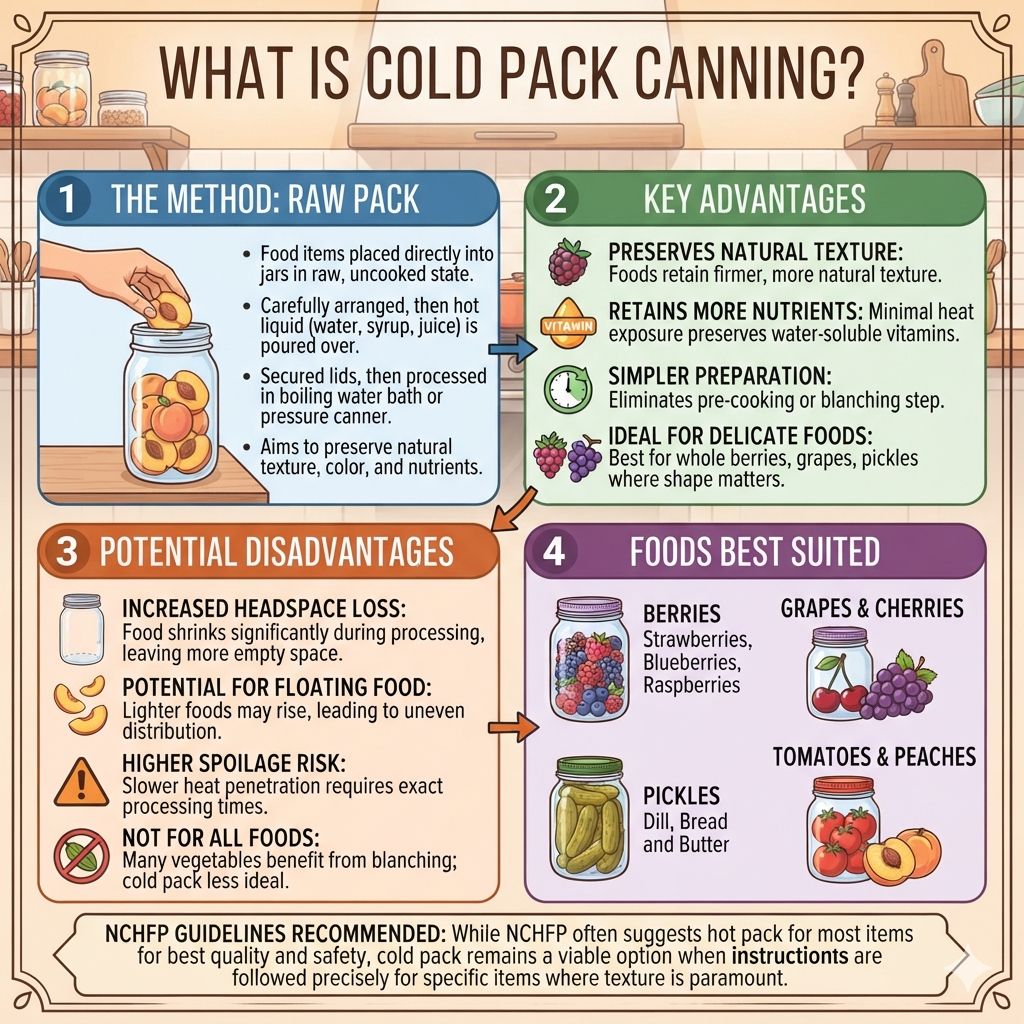
Cold pack canning, also frequently referred to as raw pack canning, is a method where food items are placed directly into canning jars in their raw, uncooked state.
This technique aims to preserve the food’s natural texture, color, and nutritional value as much as possible by avoiding the heat exposure that occurs during pre-cooking.
The raw food is carefully arranged in the sterilized jars, and then hot canning liquid (water, syrup, or juice) is poured over it, leaving a specific amount of headspace at the top of the jar. The lids are secured, and the jars are processed in a boiling water bath or pressure canner according to tested recipes.
Advantages of Cold Pack Canning
- Preserves natural texture: Foods often retain a firmer, more natural texture compared to when they are cooked beforehand.
- Retains more nutrients: Minimal heat exposure means fewer water-soluble vitamins are lost during the initial preparation phase.
- Simpler preparation: Eliminates the step of pre-cooking or blanching, potentially saving time for certain foods.
- Better for specific foods: Ideal for foods like whole berries, grapes, or certain pickles where maintaining original shape and firmness is a priority.
Disadvantages of Cold Pack Canning
- Increased headspace loss: Foods shrink significantly during processing, which can lead to a large amount of empty space (headspace) in the jar. This can make the final product look less appealing.
- Potential for floating food: Lighter foods may rise to the top during processing, leading to uneven distribution and potential spoilage if not properly submerged.
- Higher risk of spoilage: Because the food isn’t pre-heated, there’s a slightly higher risk of spoilage if air pockets are not properly removed or if processing times are not exact.
- Not suitable for all foods: Many vegetables benefit from blanching to deactivate enzymes and improve texture, making cold pack less ideal for them.
Foods Best Suited for Cold Pack Canning
- Berries (strawberries, blueberries, raspberries)
- Grapes
- Cherries
- Certain pickles (dill pickles, bread and butter pickles)
- Tomatoes (though hot pack is often preferred for better quality)
- Peaches (whole or halves, though some prefer hot pack for better texture)
The National Center for Home Food Preservation (NCHFP) provides guidelines that often recommend hot pack for most items to ensure quality and safety. However, for specific items where texture is paramount, cold pack can be a viable option when instructions are followed precisely.
What is Hot Pack Canning?
Hot pack canning, also known as cooked or hot water bath canning, involves heating food items before they are packed into canning jars.
This pre-heating step is designed to accomplish several important goals that contribute to safer and higher-quality preserved food.
Foods are typically heated in water, syrup, or juice until they reach a certain temperature, then carefully spooned into sterilized jars. This process shrinks the food, removes trapped air, and deactivates enzymes that can cause spoilage and affect the quality of the food over time. After packing, hot canning liquid is added, lids are applied, and jars are processed in a boiling water bath or pressure canner.
Advantages of Hot Pack Canning
- Reduces headspace loss: Pre-heating causes food to shrink, resulting in a more compact pack and less empty space in the jar. This creates a more aesthetically pleasing product.
- Removes air: Heating helps to drive out air from the food tissues, reducing the risk of oxidation and spoilage.
- Improves quality: Deactivates enzymes that can degrade food quality, leading to better flavor, color, and texture retention over long storage periods.
- Safer for most foods: Generally considered safer for vegetables and meats because the pre-heating step helps destroy spoilage-causing microorganisms and enzymes.
- Better liquid distribution: Foods pack more densely, allowing liquid to distribute more evenly.
Disadvantages of Hot Pack Canning
- Texture changes: Foods can become softer or mushier due to the pre-heating process, which may not be desirable for all types of produce.
- Nutrient loss: Some water-soluble vitamins can be lost during the initial heating and draining stages.
- More preparation time: Requires an extra step of heating the food before packing, which can add to the overall canning time.
Foods Best Suited for Hot Pack Canning
- Most vegetables (corn, beans, peas, carrots, broccoli)
- Meats and poultry
- Soups and stews
- Sauces and purees
- Many fruits where a softer texture is acceptable (applesauce, pears)
According to the USDA Complete Guide to Home Canning, hot packing is the preferred method for most foods because it leads to a better product and reduces the potential for spoilage.
Cold Pack vs. Hot Pack Canning: A Detailed Comparison
The choice between cold pack and hot pack canning hinges on several factors, including the type of food, desired final texture, and preservation goals. While both methods can yield safely preserved foods when done correctly, they offer distinct advantages and disadvantages.
| Feature | Cold Pack Canning (Raw Pack) | Hot Pack Canning (Cooked Pack) |
|---|---|---|
| Preparation | Food packed raw into jars. | Food is pre-heated before packing into jars. |
| Texture | Generally firmer, more natural texture. | Can be softer; food shrinks during heating. |
| Headspace | More headspace loss during processing; can look less appealing. | Less headspace loss; more compact and visually appealing pack. |
| Air Removal | Less effective at removing air. | More effective at removing air and deactivating enzymes. |
| Nutrient Retention | Potentially higher retention of water-soluble vitamins initially. | Some loss of water-soluble vitamins during heating. |
| Preparation Time | Slightly faster as it skips pre-cooking. | Takes longer due to the pre-heating step. |
| Recommended For | Berries, grapes, some pickles where texture is key. | Most vegetables, meats, fruits, sauces, soups. |
The primary benefit of hot packing is its ability to ensure a higher quality product with a longer shelf life by addressing air pockets and enzyme activity. Cold packing is often chosen when the absolute priority is maintaining the food’s original form and texture, like in whole fruits or certain delicate vegetables.
How to Choose the Right Method for Your Food
Selecting between cold pack and hot pack canning isn’t a one-size-fits-all decision; it depends significantly on the food you intend to preserve.
Understanding the characteristics of each food item and how it reacts to heat will guide you toward the optimal canning method.
| Food Type | Recommended Method | Reasoning |
|---|---|---|
| Berries (Strawberries, Blueberries) | Cold Pack | Maintains shape and firmness; less prone to mushing. |
| Tomatoes (Whole/Halved) | Hot Pack | Improves quality by removing air; leads to a more compact pack. Cold pack is acceptable but may result in floating. |
| Leafy Greens (Spinach) | Hot Pack | Essential for wilting and removing air; significantly reduces volume. |
| Root Vegetables (Carrots, Potatoes) | Hot Pack | Reduces volume and improves texture and flavor retention. |
| Peaches (Slices) | Hot Pack | Helps prevent fruit from floating and results in a better-looking jar. Cold pack is sometimes used but can lead to fruit rising. |
| Beans (Green Beans, Lima Beans) | Hot Pack | Blanching (part of hot packing) is essential for enzyme inactivation and improved texture. |
Consulting reliable sources like the NCHFP or university extension offices is vital. They provide specific recipes and guidelines for hundreds of foods, detailing whether cold or hot pack is recommended and the precise processing times required. For example, the NCHFP states that hot packing is recommended for most vegetables to improve quality and reduce spoilage.
Tips for Successful Cold Pack Canning
- Use high-quality, fresh produce.
- Pack jars firmly but without crushing the food.
- Ensure all food is submerged in liquid after packing.
- Leave the correct headspace as specified in tested recipes (often larger for cold pack).
- Check for buoyant food items and try to adjust during packing.
Tips for Successful Hot Pack Canning
- Heat food thoroughly but avoid overcooking.
- Pack hot food immediately into hot jars to prevent thermal shock.
- Add hot liquid to maintain temperature.
- Remove air bubbles carefully with a non-metallic spatula.
- Ensure correct headspace and tighten lids according to instructions.
The key is to always follow a tested recipe. These recipes are developed based on scientific research to ensure the safety and quality of your canned goods, taking into account the method of packing.
Processing Methods: Boiling Water Bath vs. Pressure Canning
Regardless of whether you choose cold pack or hot pack canning, the method used to process the jars—destroying microorganisms and creating a vacuum seal—is equally critical for safety.
Two primary methods exist: the boiling water bath and pressure canning.
The choice between these two methods depends entirely on the acidity of the food being canned. High-acid foods are processed in a boiling water bath, while low-acid foods require the higher temperatures achieved by a pressure canner.
Boiling Water Bath Canning
This method is suitable for high-acid foods, which include most fruits, pickles, jams, jellies, and tomatoes (often acidified further with lemon juice or citric acid). The boiling water bath reaches a temperature of 212°F (100°C) at sea level.
- Process: Jars filled with food (either cold or hot packed) and sealed are submerged in a large pot of boiling water. The water must cover the tops of the jars by at least 1-2 inches.
- Time: Processing times vary based on the food type, jar size, and altitude, and are specified in tested recipes.
- Purpose: The boiling temperature is sufficient to destroy molds, yeasts, and some bacteria in high-acid foods, and to inactivate enzymes that cause spoilage. It also creates the vacuum seal.
Pressure Canning
This method is essential for low-acid foods, which include all vegetables (unless acidified), meats, poultry, seafood, and dairy products. Because low-acid foods can support the growth of dangerous bacteria like Clostridium botulinum (which causes botulism), higher temperatures are needed. A pressure canner can reach temperatures of 240°F (116°C) or higher, which is necessary to destroy botulism spores.
- Process: Jars filled with food (usually hot packed) are placed in a pressure canner with a specified amount of water. The canner is sealed, and heat is applied until the required pressure is reached.
- Time & Pressure: Processing times and required pressure levels (measured in pounds per square inch, psi) are critical and vary based on the food, jar size, and altitude.
- Purpose: The high temperatures achieved under pressure are the only safe way to eliminate the risk of botulism from low-acid foods.
The U.S. Department of Agriculture (USDA) emphasizes that pressure canning is the only safe method for preserving low-acid foods to prevent the risk of botulism.
Common Mistakes to Avoid in Cold Pack and Hot Pack Canning
Even with the best intentions, canning mistakes can happen, leading to spoiled food, broken seals, or, more critically, unsafe food.
Understanding these common pitfalls can help you achieve successful canning results every time.
Mistakes in Cold Pack Canning
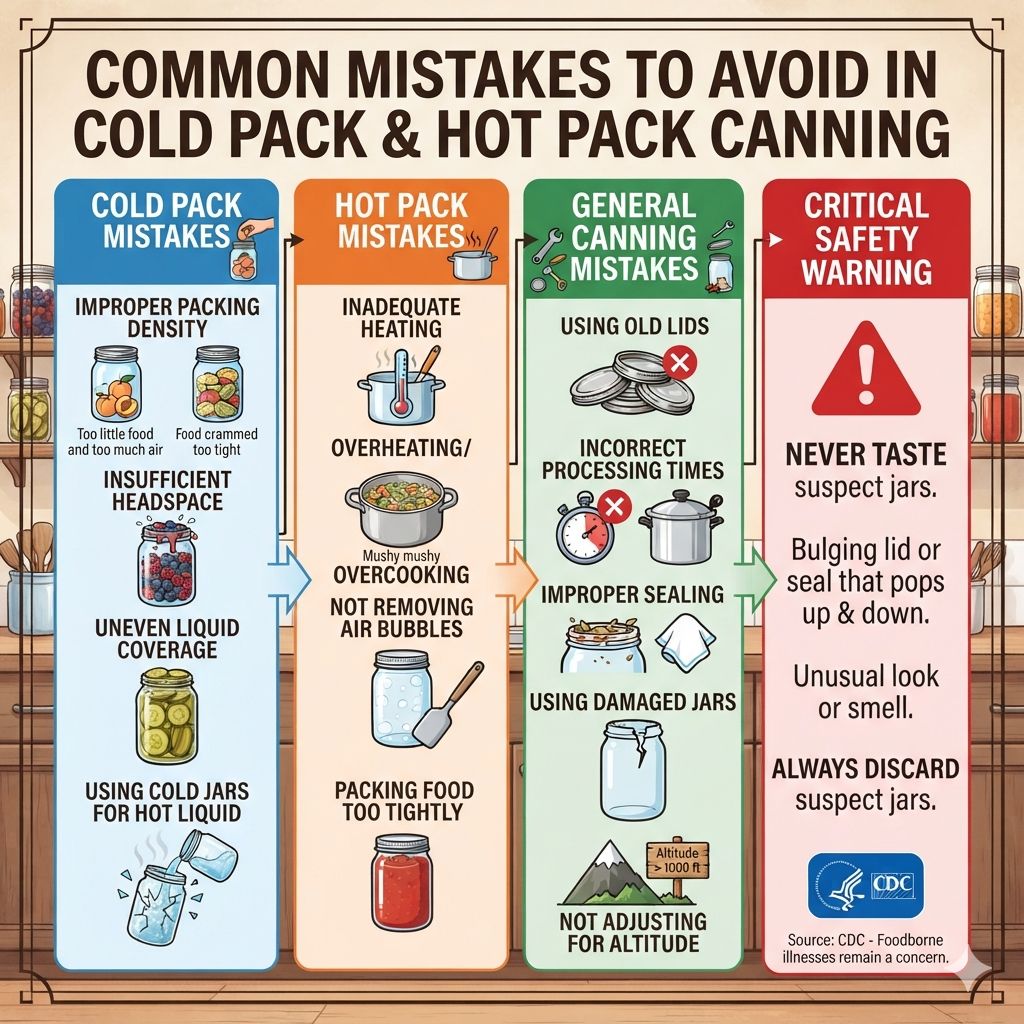
- Improper Packing Density: Packing food too loosely leaves too much air and liquid space, leading to floating food. Packing too tightly can prevent liquid from penetrating adequately.
- Insufficient Headspace: Not leaving enough headspace (typically 1/2 inch for cold pack) can cause food to boil out of the jar during processing, breaking the seal.
- Uneven Liquid Coverage: If some food is not fully submerged in liquid after processing, it’s more prone to spoilage and discoloration.
- Using Cold Jars for Hot Liquid: Pouring very hot liquid into cold jars can cause them to break due to thermal shock.
Mistakes in Hot Pack Canning
- Inadequate Heating: Not heating the food to the specified temperature or for the required duration means enzymes aren’t deactivated and spoilage is more likely.
- Overheating/Overcooking: This can result in a mushy texture and loss of desirable nutrients and flavor.
- Not Removing Air Bubbles: Trapped air can lead to floating food, increased spoilage, and poor seals. A non-metallic tool should be used to release them.
- Packing Food Too Tightly: Similar to cold pack, this can prevent liquid from circulating properly and reduce processing effectiveness.
General Canning Mistakes
- Using Old Lids: Reusing canning lids that have been previously sealed can lead to seal failures. Always use new lids for each canning session.
- Incorrect Processing Times: Deviating from tested processing times, especially for low-acid foods, poses a significant safety risk.
- Improper Sealing: Not wiping jar rims clean before applying lids can prevent a proper vacuum seal.
- Using Damaged Jars: Jars with nicks or cracks on the rim can prevent a good seal.
- Not Adjusting for Altitude: Processing times and pressure levels must be adjusted for altitudes above 1,000 feet.
According to data from the Centers for Disease Control and Prevention (CDC), while rare, foodborne illnesses from improperly canned foods remain a concern. Following precise instructions from reputable sources is paramount for safety.
Frequently Asked Questions
What is the main difference between cold pack and hot pack canning?
The primary difference lies in the preparation of the food: cold pack canning involves packing raw food into jars, while hot pack canning requires pre-heating the food before packing. This pre-heating in hot pack helps remove air, shrink food, and deactivate enzymes, generally leading to a higher quality and safer product.
Can I use cold pack canning for all vegetables?
While some vegetables like peppers or onions can be cold packed, it is generally not recommended for most vegetables. Hot packing, which includes blanching, is preferred for vegetables to improve quality, remove air, and ensure enzyme inactivation, reducing spoilage risk.
Does cold pack canning preserve more nutrients than hot pack canning?
Cold pack canning may retain slightly more water-soluble vitamins initially due to less heat exposure. However, hot pack canning often results in a more stable product that retains its quality for longer, and the difference in nutrient retention over the long term is often minimal and outweighed by quality and safety benefits.
What happens if food floats in my cold pack canned jars?
Floating food in cold pack canning is a common issue. It indicates that air pockets were not sufficiently removed or the food is too light. If the jar is properly sealed and processed, it might still be safe, but it’s less visually appealing and can be more susceptible to spoilage or spoilage on the surface if the seal fails.
Which method is better for fruit preservation?
For most fruits, especially when preserving them whole or as slices, both methods can be used, but hot pack canning is often recommended by experts like the NCHFP. Hot packing helps prevent fruit from floating, reduces headspace, and results in a more uniform product. However, for delicate fruits like whole berries, cold pack might be preferred to maintain their shape and texture.
Final Thoughts
Deciding between cold pack and hot pack canning involves balancing texture, convenience, and optimal preservation. While cold pack offers simplicity and can maintain a fresher texture for certain delicate items, hot pack canning generally yields a more stable, compact, and high-quality product, especially for vegetables and meats. Always prioritize safety by using tested recipes and the correct processing methods—boiling water bath for high-acid foods and pressure canning for low-acid foods—to ensure your preserved foods are both delicious and safe to consume.
Related pick: Check today's price on Amazon