Best Outdoor Wall Lights for Porches (2026): Research Shows
The best outdoor wall lights for porches are damp- or wet-rated sconces sized to about one-third of the door height and mounted 60 to 66 inches from the floor, with bulb output matched to porch size. Poor sizing or placement leaves the entry dim, glare-heavy, or visually off-balance, and can waste money on fixtures that do too much or too little. This guide compares fixture types, mounting height, brightness, and style choices so you can choose the right porch wall light.
Quick comparison
| Product | Badge | Best for | Price | ||
|---|---|---|---|---|---|
 |
ropelux Solar Lights Outdoor Waterproof, 3 Modes Porchropelux | Our pick | 2Pack · 5W · 3 modes · Solar | $61.99
Price as of 21 Oct 2026
|
View |
 |
Roravilila 17 Inch Large Gold Outdoor Sconces Wall LightingRoravilila | Upgrade pick | 17" · 2-Pack · Gold · ETL Listed | $79.99
Price as of 21 Oct 2026
|
View |
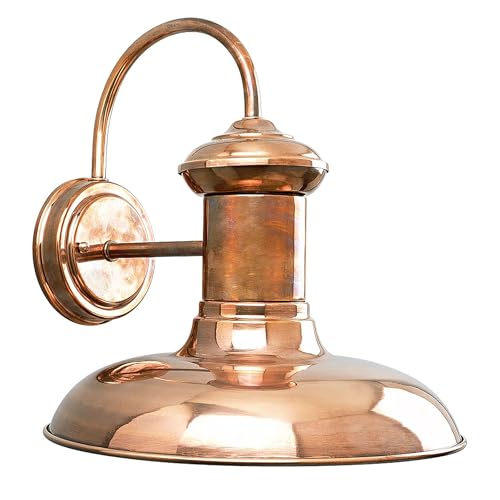 |
Progress Lighting Brookside Outdoor Wall Light, Copper |Progress Lighting | Also great | 12" · Copper · 100W Max · Victorian | $194.42
Price as of 21 Oct 2026
|
View |
Use the table below to match porch width, ceiling height, and door count to the fixture shape that fits the space. It is built for entry lighting first, then style.
The strongest choice for most standard porches is a wall lantern or outdoor porch sconce with a controlled downward spread. Low ceilings, narrow entries, and security-heavy setups need different fixtures.
How we chose
This guide focuses on four decision points that matter most on a porch: fixture type, light spread, weather resistance, and maintenance burden. It also separates decorative ambient light from security lighting, because those jobs are not the same.
We prioritized fixtures that fit common porch layouts, including single-door entries and wider stoops. We also weighed finish durability, mounting hardware, and whether the light uses a replaceable bulb or built-in LED construction.
For product examples, we relied on published product details, manufacturer specs, and buyer feedback. That keeps the guidance grounded in what is verifiable before you buy.
Wall lanterns: best for most porches
- Solid copper construction for longevity
- Rustic vintage design aesthetic
- Accepts various bulb types up to 100W
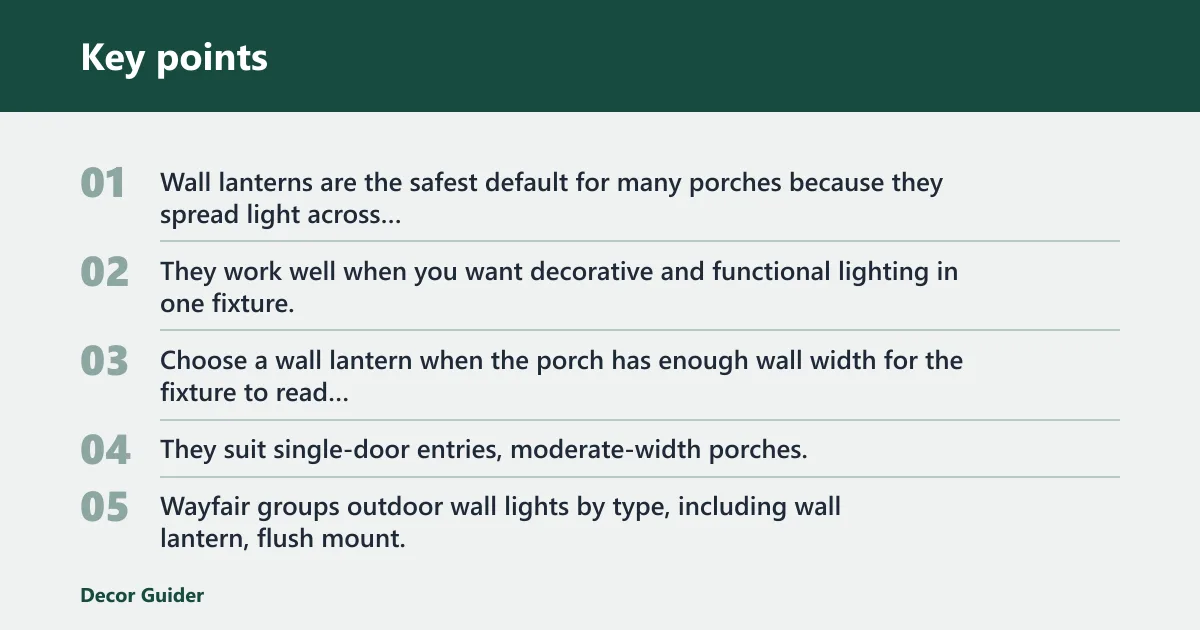
Wall lanterns are the safest default for many porches because they spread light across the entry without looking undersized on taller walls. They work well when you want decorative and functional lighting in one fixture, especially at a single front door or a standard stoop.
Best porch layouts for wall lanterns
- No wiring required with solar power
- Motion sensor covers up to 16.5ft
- IP65 waterproof for outdoor durability
Choose a wall lantern when the porch has enough wall width for the fixture to read clearly from the walkway. They suit single-door entries, moderate-width porches, and porches where the light should feel welcoming instead of purely task-focused.
Wayfair groups outdoor wall lights by type, including wall lantern, flush mount, armed sconce, and barn light. That grouping is useful because porch fit changes with the shape of the wall and the amount of ceiling clearance.
Size and mounting height targets
For most porches, aim for a fixture that is about one-third the door height. Wayfair’s height filters break outdoor wall lights into small under 12 inches, medium 12 to 18 inches, and large 18+ inches, which gives you a quick way to match scale to wall size.
Mount most porch wall lights 60 to 66 inches from the floor, then adjust for transom windows, sidelights, or unusually tall trim. A fixture that is too small looks lost. One that is too large can throw light into people’s eyes instead of onto the steps.
Finish choices that work well outdoors
Black, bronze, brass, white, and nickel are the most useful finish choices for outdoor wall lights because they coordinate with common door hardware and exterior trim. Wayfair also lists brown and copper among outdoor finish options.
Black and bronze are the easiest to fit into many exteriors. Brass reads warmer, white can blend into light trim, and nickel works well when the rest of the entry uses cooler metals. Finish choice should support the architecture, not fight it.
Sconces: best for narrow entries
An outdoor porch sconce is the better pick when the entry is narrow, the ceiling is low, or the wall area beside the door is limited. It gives you decorative and functional light without the visual bulk of a lantern.
When a porch sconce beats a lantern
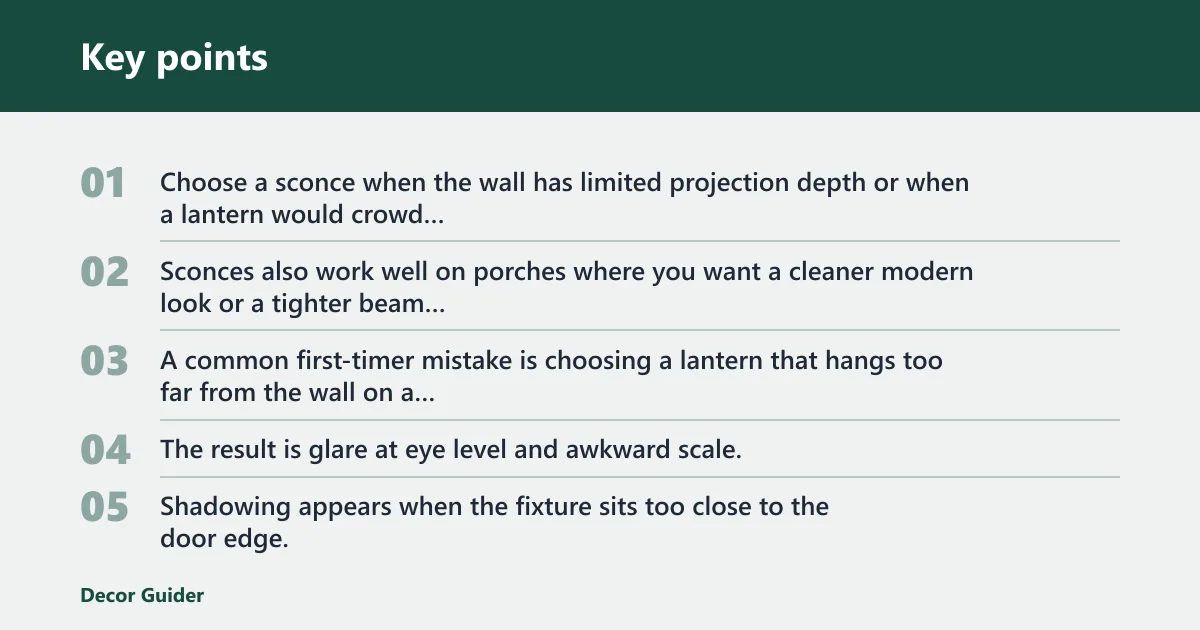
Choose a sconce when the wall has limited projection depth or when a lantern would crowd a narrow entry. Sconces also work well on porches where you want a cleaner modern look or a tighter beam that stays closer to the wall.
A common first-timer mistake is choosing a lantern that hangs too far from the wall on a shallow porch. The result is glare at eye level and awkward scale. A flatter sconce reduces that problem.
Avoiding shadowing near the door
Shadowing appears when the fixture sits too close to the door edge, when the bulb points outward instead of down, or when the porch has a deep overhang that blocks spill light. If the entry has two doors or a door plus sidelights, a pair of sconces can balance the wall better than one central lantern.
Open-bottom designs can also pull in insects because they leave the bulb exposed from below. For porches with bugs or bright evening use, a closed or partially enclosed diffuser is usually a better choice.
When to choose a decorative outdoor porch sconce
- ETL listed for safety compliance
- IP65 rated for heavy weather
- Sturdy metal construction resists rust
Choose a decorative outdoor porch sconce when the entry should feel finished in daylight and still give usable light after dark. Wet-environment suitability matters here, because porch walls can see rain, wind-blown moisture, and temperature swings.
For that reason, look for weather resistance that is clearly stated for exterior use. One reviewed outdoor wall light uses corrosion-resistant steel for wet environments, which is useful in exposed spots where finish protection matters.
How do you choose the right size porch wall light?
Pick size by door height, wall width, and how much of the porch the light needs to cover. Small fixtures work on tight entries, medium sizes fit most single-door porches, and large fixtures suit wide stoops or tall facades.
Small, medium, and large fixture ranges
Wayfair’s size categories are a practical starting point: small under 12 inches, medium 12 to 18 inches, and large over 18 inches. Small lights are easier to fit beside narrow trim. Medium fixtures are the most flexible. Large fixtures help on tall walls where a tiny light would look lost.
Depth matters as much as height and width. A wide fixture that projects too far can create glare along the walking path, while a very shallow fixture may not spread light far enough across steps or porch corners.
Width, depth, and height checks
Check the wall space beside the door before you buy. You need enough width for the fixture to sit clear of trim, enough depth to avoid a crowding effect, and enough height so the light does not sit too close to the eye line.
Say your porch has a 7-foot door and a narrow wall beside the frame. A medium sconce around the middle of Wayfair’s 12 to 18 inch range will usually read better than an oversized lantern, because the light will look proportionate without overpowering the entry.
Mounting height by porch scale
The 60 to 66 inch mounting range works for many porches because it places the center of the light near typical eye height without aiming directly into the eyes. Taller porches may call for a slightly higher placement if the door trim or transom would otherwise crowd the fixture.
For paired fixtures, keep both sides aligned. Uneven mounting height makes the entry feel lopsided, even when the bulbs are bright enough.
Porch lighting decision table
| Porch width and ceiling height | Door count | Best fixture type | Mounting height range | Finish | Sensor option |
|---|---|---|---|---|---|
| Narrow porch, low ceiling | Single door | Flush mount or compact sconce | 60 to 66 inches to center, or as trim allows | White or nickel for a lighter visual footprint | Dusk-to-dawn if you want automatic on/off |
| Standard porch, average ceiling | Single door | Wall lantern or outdoor porch sconce | 60 to 66 inches to center | Black or bronze for broad compatibility | Dusk-to-dawn for convenience, dimmable if the porch is also a sitting area |
| Wide stoop, taller wall | Single or double door | Large wall lantern or armed sconce | Placed to balance the wall and avoid eye-level glare | Black, bronze, or brass | Motion sensor for security-focused entries |
| Long entry wall with garage nearby | One door plus side access | Barn light or armed sconce | Match adjacent fixtures and keep beam directed downward | Bronze or black | Motion sensor with adjustable sensitivity and range |
| Covered porch with decorative goal | Double door | Matched wall lantern pair | Centered for symmetry | Brass, bronze, or black | Smart outdoor wall light for scheduling and brightness control |
This table is a decision aid, not a style rule. If glare is already a problem, move toward a fixture with better shielding or a lower-output bulb, even when the finish or shape looks attractive.
Are dusk-to-dawn porch lights worth it?
Dusk-to-dawn porch lights are worth it when you want the entry to turn on automatically at night and stay on without manual switching. They are especially useful for front doors, side entries, and any porch that should look occupied after dark without constant adjustment.
When automatic on/off makes sense
Dusk-to-dawn operation is a good fit for homeowners who want a lighted entry every evening with little upkeep. Bob Vila notes dusk-to-dawn operation as a useful feature, along with motion sensors and dimmable settings.
That makes it a strong choice for convenience and energy-saving behavior, especially on a porch that does not need full brightness all night. The tradeoff is that it is not the best pick when you only want light during short visits.
Motion sensor outdoor light use cases
A motion sensor outdoor light is better when security matters more than constant ambient light. It is useful for entries, garages, and side paths because the fixture activates when movement is detected, which can deter unwanted approach and help you see the path instantly.
For best results, look for adjustable sensitivity and detection range. A sensor that is too sensitive can turn on for passing cars or blowing branches. One that is too narrow may miss a person approaching from the side.
Smart outdoor wall light features
Smart outdoor wall lights are worth considering when you want app control, brightness adjustment, color customization, and scheduling features in one built-in LED design. Bob Vila’s top pick is the Govee Smart Outdoor Wall Light, and its published details include adjustable brightness and app control.
The main drawback of built-in LED smart fixtures is replacement cost if the unit fails. They can reduce maintenance during normal use, but they are less flexible than bulb-based lights when you want a quick bulb swap.
What is the best brightness for front porch lighting?
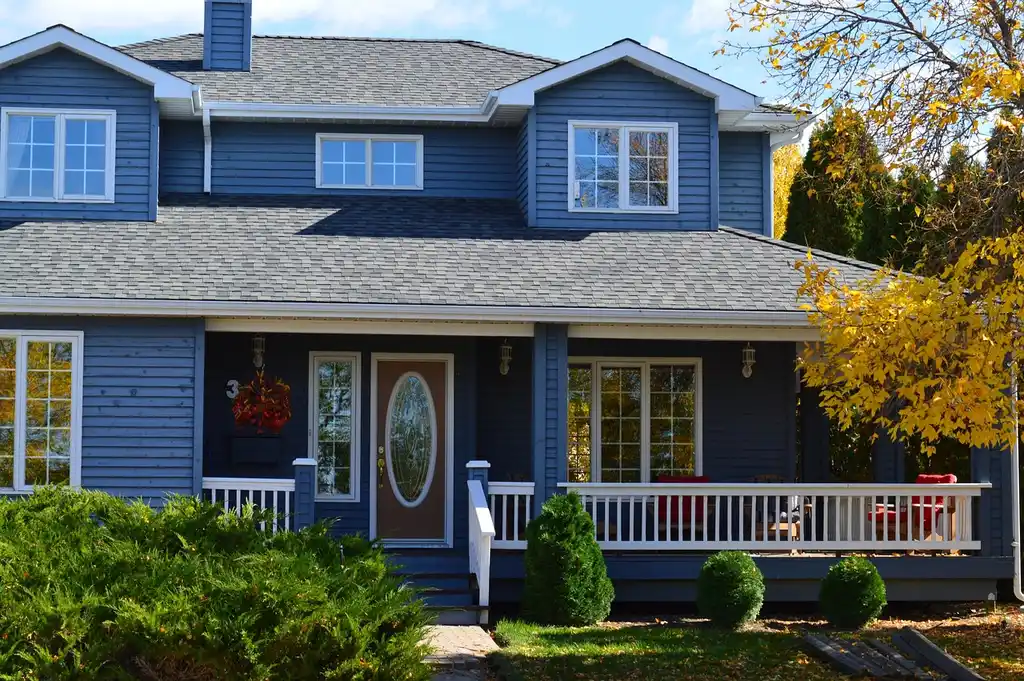
The best brightness for front porch lighting depends on whether you need ambient light or security light. Ambient lighting should let you find keys, steps, and the lock without washing out the doorway. Security lighting can be brighter, but it should still control glare and spill.
Ambient light versus security light
Ambient porch light should cover the door, steps, and a small area around the entry. Security lighting should reach farther, especially toward side access, garage approaches, or dark corners. A brighter fixture is not automatically better if it throws light into the eyes instead of onto the ground.
Suppose a porch has one overhead light and a dark side corner near the steps. Adding a motion sensor wall light aimed into that corner often works better than simply installing a brighter decorative sconce at the door.
Brightness and illumination spread
Look for a fixture that sends light where people walk, not straight out into the yard. A bulb-based wall lantern can give a softer spread, while an armed sconce or barn light can aim more deliberately at the porch surface and walkway.
Open-bottom fixtures can create harsh downward glare and invite insects if the bulb is exposed. Closed or shielded designs are usually better for porch comfort, especially in warm months when bugs are active.
Which one should you buy?
For the most common porch, start with a medium wall lantern or outdoor porch sconce in black or bronze, mounted 60 to 66 inches from the floor. That combination usually gives the best balance of scale, spread, and visual fit.
Best for small porches
Choose a flush mount or compact sconce if the porch is narrow or the ceiling is low. A smaller fixture keeps the wall from feeling crowded and reduces the risk of glare at the doorway. White or nickel can help the fixture disappear a little more against light trim.
Best for wider stoops
Choose a larger wall lantern or a matched pair of sconces when the stoop is wide or the wall is tall. This keeps the lighting from looking undersized. Bronze, black, or brass usually works well where the fixture needs to read clearly from the curb.
Best for security-focused entries
Choose a motion sensor outdoor light or a barn light when the main goal is coverage and alerting, not decoration. A controlled beam and adjustable sensor are more useful than a purely ornamental shape if the entry is near a garage or side path.
Best for low-maintenance lighting
Choose a smart outdoor wall light if you want app control, scheduling, and built-in LED operation. Choose a bulb-based fixture if you want easier replacement and a wider choice of bulb color and output. Bob Vila’s budget pick, the Design House Jelly Jar Classic Wall Light, uses a 60W medium base bulb and comes in oil rubbed bronze, white, satin nickel, or black.
That bulb-based design has a clear maintenance advantage: if the lamp source wears out, you replace the bulb rather than the whole unit. The tradeoff is that the fixture’s performance depends on the bulb you choose, so brightness and color temperature become part of the shopping decision.
How to choose
Start with porch layout, not finish. If the entry is narrow or low, choose flush mount or a compact sconce. If the porch is standard size, a medium wall lantern or sconce is usually the safest fit. For wider stoops, move up in size or use a pair.
- Measure the wall space beside the door and note the ceiling height.
- Check whether the porch needs ambient light, security light, or both.
- Pick the fixture type that fits the wall: lantern, sconce, flush mount, armed sconce, barn light, or bulkhead light.
- Match size to the porch using the under 12 inches, 12 to 18 inches, or 18+ inches guide.
- Choose a finish that works with the door hardware and trim: black, bronze, brass, white, nickel, or another listed outdoor finish.
- Decide on the control style: dusk-to-dawn for convenience, motion sensor for security, or smart control for scheduling and brightness changes.
- Confirm weather resistance for exterior use and look for corrosion-resistant steel or a clearly stated wet-location rating when the porch gets exposed rain.
For durability, do not confuse general outdoor use with higher waterproof claims. Wet-location suitability is enough for many covered porches. Premium fixtures may cite IP65 or IP67 waterproof rating, which is a stronger comparison point when the entry sees harsher weather.
For bulb-based fixtures, check the socket type and wattage limit before you buy bulbs. The Design House Jelly Jar Classic Wall Light uses an E26 medium-base bulb and allows up to 60W in the cited product details. That format keeps replacement simple, but it also means the bulb choice affects the final look and output.
For built-in LED smart fixtures, think about long-term replacement differently. You may get app control and scheduling, but the whole unit can be more involved to replace if it fails. That tradeoff is worth it only when the control features will actually get used.
Frequently asked questions
What are the best outdoor wall lights for porches?
The best outdoor wall lights for porches are damp- or wet-rated fixtures that fit the porch scale and direct light onto the entry rather than outward into the yard. For many homes, a medium wall lantern or outdoor porch sconce is the most balanced choice because it covers both appearance and function.
Should porch lights be flush, lantern, or sconce style?
Choose flush mount for low ceilings and tight entries, lanterns for broader decorative presence, and sconces for narrow walls or cleaner modern lines. The right answer depends on how much wall space you have and whether the light is doing decorative work, security work, or both.
How do you hang outdoor porch lights?
Most porch lights mount to a standard electrical box with the included mounting plate and hardware, then need proper sealing around the base. If the wall is exposed to weather, use a fixture rated for exterior use and follow the manufacturer’s instructions for caulk and wiring. If you are unsure about the wiring, use a licensed electrician.
Products related to this article
Sponsored / affiliate links. As an Amazon Associate I earn from qualifying purchases. I may earn additional commission from eligible campaigns.