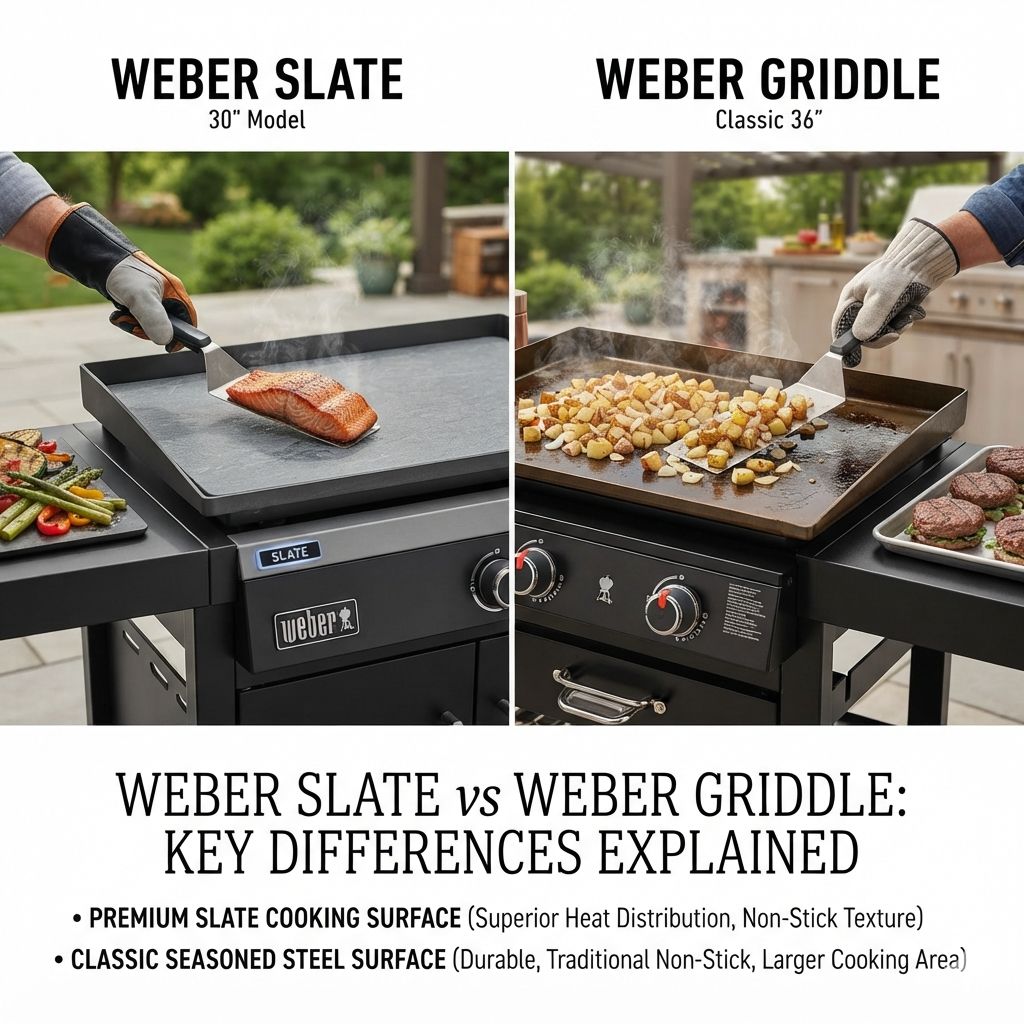
Weber Slate vs Weber Griddle: Key Differences Explained
Choosing between a Weber Slate and a Weber Griddle can significantly impact your outdoor cooking experience, with each offering unique advantages for different culinary styles. Understanding their core differences—from cooking surface and heat distribution to versatility and maintenance—is crucial for making the right investment for your patio or backyard. This guide will break down exactly what sets these two popular outdoor cooking appliances apart, helping you decide which one best suits your grilling and searing needs.
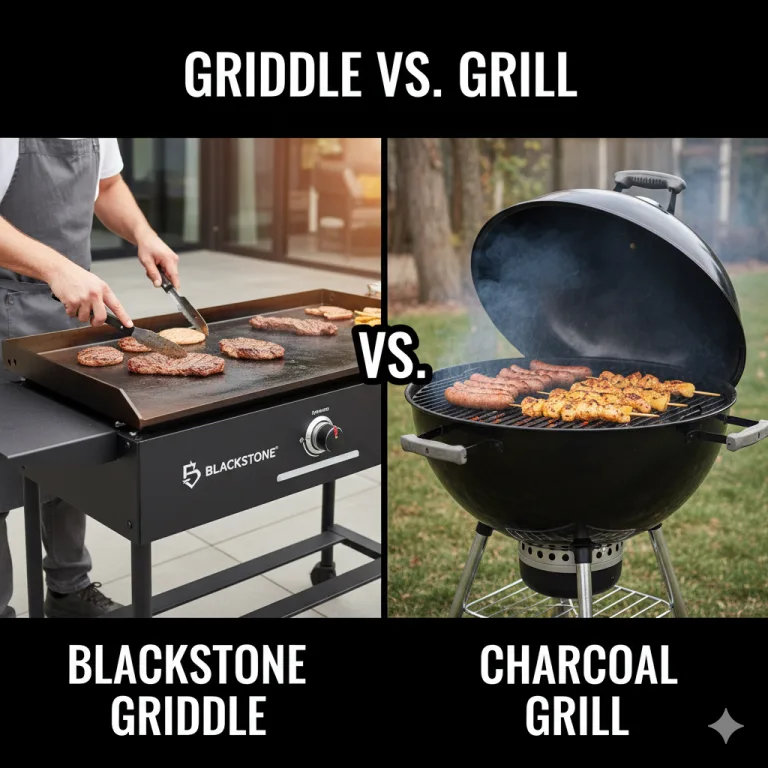
In short, the Weber Slate excels at high-heat searing for classic grilled flavors on its open-flame cast iron grates, while the Weber Griddle provides a flat, versatile cooking surface perfect for everything from breakfast to smash burgers, offering more control over precise heat zones.
Key Takeaways
- The Weber Slate features an open-flame design with cast iron grates ideal for traditional grilling and searing.
- The Weber Griddle offers a large, flat steel surface for versatile cooking, accommodating a wide range of dishes.
- Heat management differs significantly, with the Slate offering intense, direct heat and the Griddle providing more controlled, even zones.
- Maintenance for the Slate is similar to a traditional grill, while the Griddle requires seasoning and regular cleaning of its flat top.
- Choosing depends on your preference for classic grilling versus flat-top versatility for diverse outdoor meals.
What is the Weber Slate?
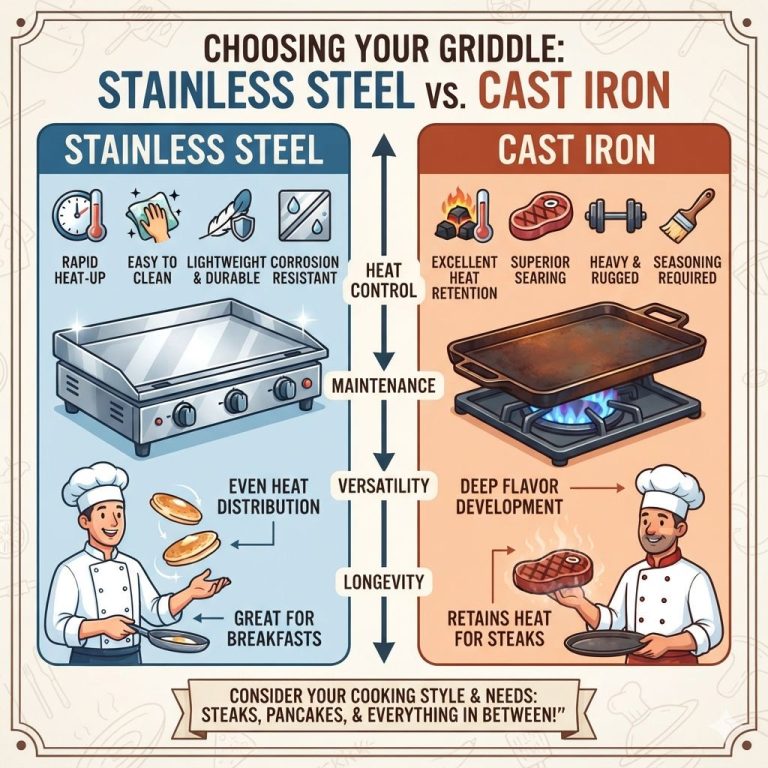
The Weber Slate is designed to mimic the intense heat and distinctive sear marks characteristic of traditional charcoal and gas grills, but within a standalone, portable griddle unit. Its primary cooking surface consists of robust cast iron grates, an ideal material for achieving excellent heat retention and those coveted grill marks on proteins like steaks, burgers, and chicken. This setup allows for direct flame exposure, which is fundamental for developing the smoky flavors and crispy exteriors that many outdoor cooks associate with grilling.
It’s engineered for high-performance searing, meaning it can reach and maintain high temperatures efficiently. This makes it perfect for quickly cooking thinner cuts of meat or achieving a beautiful crust on thicker steaks. The open design also allows for natural grease management, as fats and drippings fall away from the food, contributing to a cleaner flavor and reducing flare-ups compared to some enclosed grill designs. The Weber Slate aims to provide the authentic grilling experience in a griddle format, bridging the gap between traditional grilling and flat-top cooking.
The cast iron grates on the Weber Slate are a significant feature, offering superior heat conductivity and retention. They heat up quickly and evenly, and importantly, they are designed to impart those signature grill marks. For users who love the visual appeal and the specific texture that grilling provides, the Slate is a compelling option. Its construction often emphasizes durability and a robust build, ensuring it can withstand the rigors of outdoor cooking and frequent high-heat use.
- Cooking Surface: Primarily cast iron grates for searing and grill marks.
- Heat Type: Direct flame exposure for authentic grilling flavor and texture.
- Ideal For: Steaks, burgers, chicken, and other proteins where grill marks are desired.
- Heat Retention: Excellent due to cast iron material.
- Portability: Often designed with portability in mind for various outdoor settings.
- Maintenance: Similar to traditional grills, involving grate cleaning and seasoning.

What is the Weber Griddle?
The Weber Griddle, on the other hand, is built around a large, flat, seasoned steel cooking surface. This design fundamentally changes the cooking dynamics, moving away from open flames and grill marks to a uniform, continuous heat zone that’s perfect for a completely different set of culinary applications. Think of it as a massive, high-performance stovetop for your patio, capable of handling a wide array of foods that might fall through traditional grill grates or require more precise temperature control across a larger area.
Its flat top is exceptionally versatile. It’s ideal for cooking delicate items like fish and vegetables without them falling apart, for creating perfect smash burgers by pressing them directly onto the hot surface, or for cooking a full breakfast spread featuring pancakes, eggs, and bacon all at once. The steel surface is typically seasoned, which builds up a non-stick layer over time, similar to cast iron skillets, and contributes to flavor development. This seasoning process is key to its performance and longevity.
The ability to control heat zones is another major advantage of the Weber Griddle. Many models are designed with multiple burners, allowing you to create distinct hot and cool zones across the expansive surface. This means you can sear food on one end while gently warming other items on the cooler side, or even cook different types of food simultaneously at their ideal temperatures. This level of control is difficult to achieve on a traditional grill with its more generalized heat.
- Cooking Surface: Large, flat, seasoned steel surface.
- Heat Type: Indirect, even heat distribution across the entire surface.
- Ideal For: Pancakes, eggs, bacon, smash burgers, stir-fries, vegetables, fish, and delicate items.
- Heat Control: Excellent, with potential for distinct heat zones.
- Versatility: Can cook a wide variety of foods not suitable for traditional grills.
- Maintenance: Requires regular seasoning and cleaning of the flat top.
How Do They Differ in Heat Management?
The fundamental difference in how the Weber Slate and Weber Griddle manage heat dictates their primary use cases. The Weber Slate, with its open-flame design and cast iron grates, is built for high-heat searing and direct grilling. It excels at generating intense, concentrated heat that directly contacts the food. This is crucial for developing aMaillard reaction, which is responsible for the browning and complex flavors on the surface of meats.
| Heat Management Feature | Weber Slate | Weber Griddle |
|---|---|---|
| Primary Heat Source | Open flames from burners | Burners heating the steel plate from below |
| Heat Distribution | More localized, intense heat directly over flames | Even and consistent heat across the entire surface, with zone control possible |
| Searing Capability | Excellent for creating distinct grill marks and deep sear | Good for searing, but produces a flat crust rather than grill marks |
| Temperature Control | Direct control over burner intensity, less precise zoning | Precise control over multiple burner zones for varied cooking temps |
The heat generated by the Slate is perfect for achieving that satisfying sizzle and char that outdoor grill enthusiasts crave. It’s about getting a quick, intense blast of heat to cook food rapidly while imparting flavor through direct contact with the hot grates.
The Weber Griddle, conversely, uses burners positioned beneath its thick steel plate to heat the surface indirectly and evenly. This approach prioritizes consistent temperature across the entire cooking area, making it ideal for foods that benefit from uniform cooking or require careful temperature management. For instance, when cooking a dozen pancakes, you want them all to cook at the same rate, which the Griddle’s even heat distribution facilitates beautifully.
Moreover, the Griddle’s design often incorporates multiple independent burners. This allows for sophisticated heat zone management. You can dial down the heat on one section to keep food warm, crank it up on another for searing, and maintain a moderate temperature in a third for gentle cooking. This flexibility is a significant advantage for complex meals or when entertaining guests, as it allows for simultaneous cooking of various dishes at their optimal temperatures. This level of granular control is a stark contrast to the more generalized heat of the Slate.
Versatility: What Can You Cook?
When it comes to versatility, the Weber Griddle generally takes the lead due to its flat, expansive cooking surface. It opens up a world of culinary possibilities that are simply not feasible on a traditional grill or even the Weber Slate. Its ability to cook a wide variety of foods simultaneously makes it a true all-in-one outdoor kitchen appliance.
The most obvious advantage is breakfast. You can cook eggs, bacon, sausage, pancakes, and hash browns all at the same time, on the same surface, without ingredients falling through grates or flavors intermingling in unwanted ways. This makes weekend brunches a breeze. Beyond breakfast, the Griddle shines with smash burgers, where the direct contact with the hot steel creates an unparalleled crust. It’s also excellent for searing delicate fish fillets or scallops that might break apart on a grill.
Here’s a breakdown of common foods and how they fare on each:
| Food Item | Weber Slate (Grill Grates) | Weber Griddle (Flat Top) | Best For |
|---|---|---|---|
| Steak | Excellent (Distinct grill marks, smoky flavor) | Good (Creates a flat crust, even cooking) | Slate for classic grilled steak |
| Burgers | Excellent (Grill marks, smoky flavor, potential for grease flare-ups) | Excellent (Perfect for smash burgers, no fallen meat) | Griddle for smash burgers, Slate for traditional |
| Chicken | Excellent (Grill marks, smoky flavor) | Good (Even cooking, can get crispy skin) | Slate for classic grilled chicken |
| Fish | Fair (Can stick, delicate pieces may fall) | Excellent (No sticking, holds delicate fillets) | Griddle for most fish |
| Vegetables | Fair (Smaller pieces fall through) | Excellent (Can chop and stir-fry, no lost pieces) | Griddle for most vegetables |
| Pancakes/Eggs | Not Recommended (Will fall through, stick easily) | Excellent (Uniform cooking, no sticking) | Griddle for breakfast items |
| Stir-fry | Not Possible | Excellent (Large surface for tossing ingredients) | Griddle for stir-fry |
| Tacos/Fajitas | Good (Can char ingredients) | Excellent (Sear meats and veggies simultaneously) | Griddle for controlled searing and mixing |
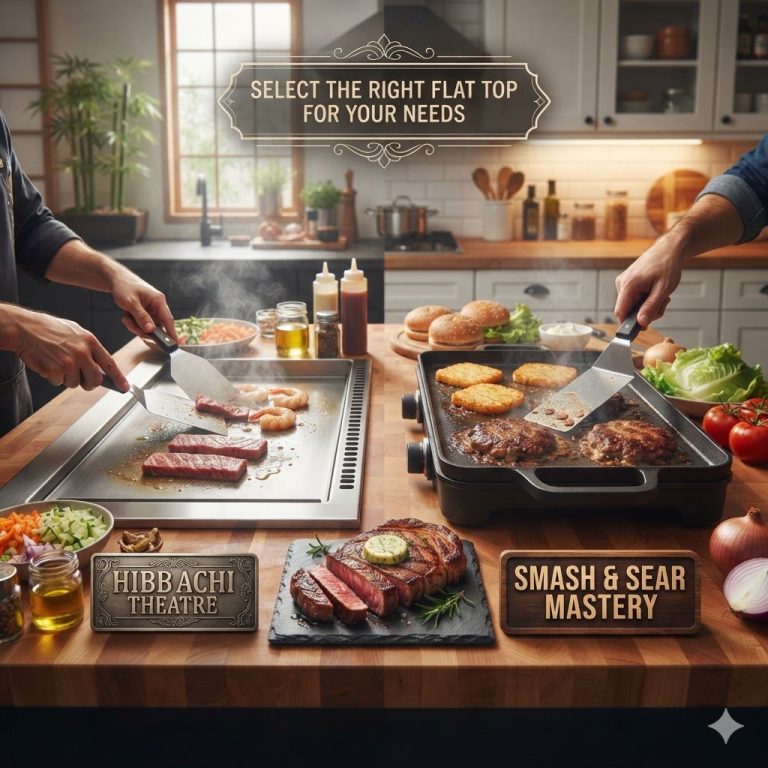
The Griddle’s flat surface also makes it ideal for stir-fries, hibachi-style cooking, and anything involving finely chopped ingredients. The absence of grates means no food is lost, and it simplifies the tossing and cooking process for dishes that require constant movement. Its large area is perfect for entertaining, allowing you to cook a variety of items for a crowd without multiple pans or grills.
The Weber Slate, while less versatile in terms of food types, is king for achieving authentic grilled flavors and textures. If your primary goal is to replicate the experience of cooking over charcoal or gas with distinct grill marks and a smoky aroma, the Slate is your go-to. It’s designed for perfection in grilling meats.
Important: When cooking delicate items like fish or vegetables on the Weber Slate, consider using a grill basket or foil packets to prevent them from falling through the grates.
Maintenance and Cleaning: What to Expect
The maintenance requirements for the Weber Slate and Weber Griddle differ significantly due to their distinct cooking surfaces. Understanding these differences is key to keeping your appliance in optimal condition and ensuring its longevity.
For the Weber Slate, maintenance is very similar to that of a traditional gas or charcoal grill. The primary focus is on cleaning the cast iron grates. After each use, it’s recommended to scrape off any food debris while the grates are still warm. For deeper cleaning, they can be scrubbed with a stiff brush or a specialized grate cleaner. Seasoning the cast iron grates periodically, just like you would a cast iron skillet, helps maintain their non-stick properties and prevents rust.
Any grease or drippings that fall through the grates are typically collected in a grease tray or pan, which needs to be emptied and cleaned regularly to prevent grease fires and buildup. The exterior of the Slate will also require occasional wiping down and cleaning, depending on its material, to keep it looking its best. Overall, the maintenance is straightforward if you’re familiar with grill care.
The Weber Griddle, however, has a unique maintenance regimen centered around its seasoned steel flat top. The key is preserving and building upon the seasoning. After cooking, once the surface has cooled slightly, it should be cleaned with a scraper (often provided with the griddle) to remove any food particles. Avoid using harsh soaps or abrasive scrubbers that can strip away the seasoned layer.
A light coat of cooking oil (like vegetable or canola oil) should then be applied to the surface and wiped around to protect it from rust and maintain the non-stick coating. If the griddle surface develops rust spots or loses its seasoning over time, it will need to be re-seasoned, which involves cleaning it down to the bare metal and then applying multiple thin layers of oil, heating the griddle between each application. This process is similar to seasoning a new cast iron pan.
Here’s a comparative look at their cleaning routines:
| Maintenance Task | Weber Slate (Grill Grates) | Weber Griddle (Flat Top) |
|---|---|---|
| Daily Cleaning | Scrape grates, empty grease tray | Scrape flat top, wipe with oil |
| Deep Cleaning | Scrub grates, may use oven cleaner for heavy buildup | Re-seasoning if seasoning is damaged or rust appears |
| Seasoning | Periodic seasoning of cast iron grates | Regular maintenance and occasional re-seasoning of steel top |
| Rust Prevention | Proper cleaning and occasional oiling of grates | Consistent oiling after each use, proper storage |
| Materials Used | Grill brush, grate cleaner, degreaser | Griddle scraper, oil, paper towels, possibly steel wool for rust |
The Griddle requires a more hands-on approach to its cooking surface to maintain its performance, but many users find this process rewarding as it enhances the cooking experience over time. Both appliances benefit from being covered when not in use to protect them from the elements.
Warning: Never use abrasive cleaners or steel wool on a seasoned griddle surface unless you intend to re-season it. This will strip the essential non-stick layer.
Portability and Design Considerations
Both the Weber Slate and the Weber Griddle are often designed with portability in mind, but their physical construction and intended use can influence how portable they truly are. Weber generally offers models within their outdoor cooking lines that balance sturdiness with the ability to be moved around a patio, backyard, or even taken on camping trips.
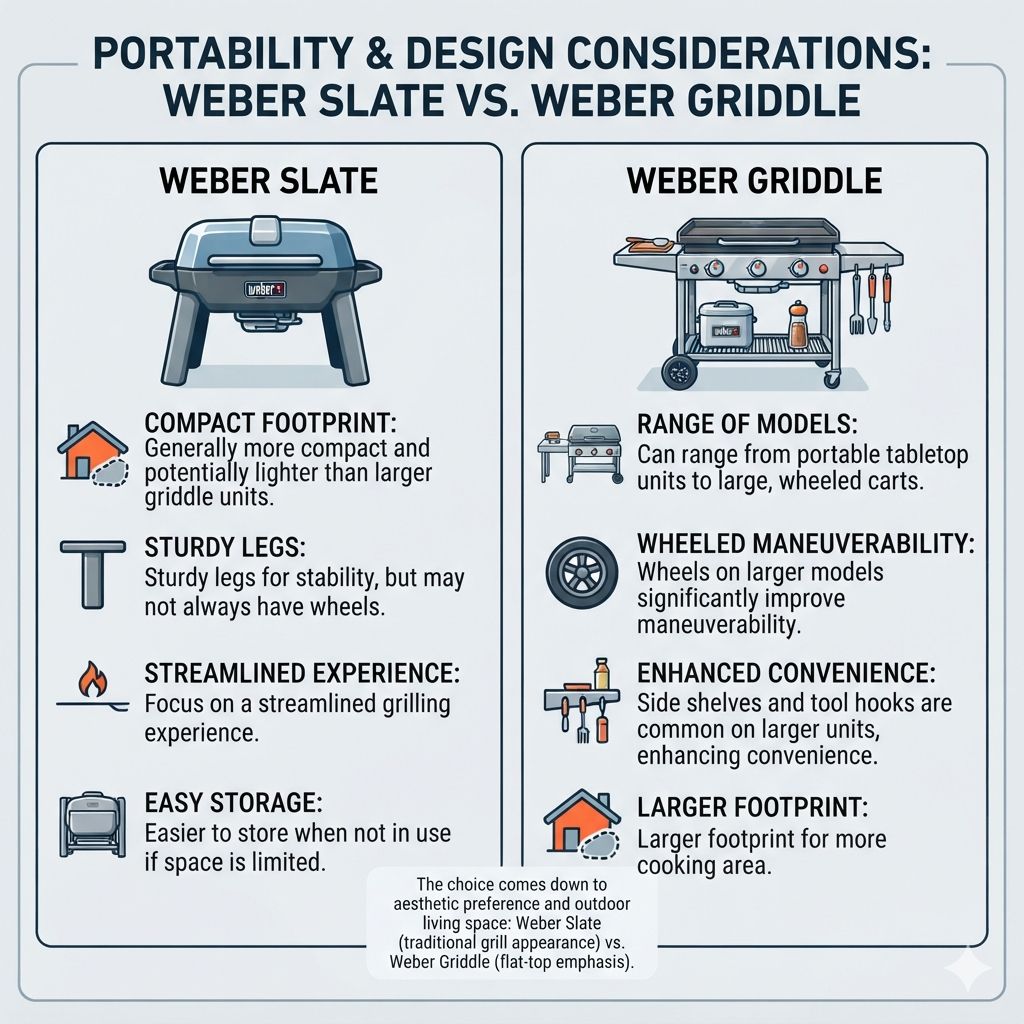
The Weber Slate typically features a robust build, often with solid legs and a relatively compact footprint. Its design is usually focused on providing a stable cooking platform while still being manageable enough to move by one or two people. The grates are usually fixed, and the overall structure is designed to withstand high heat and outdoor conditions. Portability here means it can be relocated within your outdoor space, or potentially transported in a vehicle for tailgating or camping, though its weight might be a factor depending on the specific model.
The Weber Griddle can vary more in design. Some models are compact, tabletop units, while others are larger, more elaborate freestanding units with wheels and side tables, similar to a full-size gas grill. The larger models, while offering more cooking space and features, naturally become less portable. However, even the larger freestanding griddles are designed to be maneuvered around a patio due to their integrated wheels.
Here’s a look at common design elements influencing portability:
- Weber Slate:
- Generally more compact and potentially lighter than larger griddle units.
- Sturdy legs for stability, but may not always have wheels.
- Focus on a streamlined grilling experience.
- Easier to store when not in use if space is limited.
- Weber Griddle:
- Can range from portable tabletop units to large, wheeled carts.
- Wheels on larger models significantly improve maneuverability.
- Side shelves and tool hooks are common on larger units, enhancing convenience.
- Larger footprint for more cooking area.
The choice between them might also come down to aesthetic preference and the specific outdoor living space. The Weber Slate often has a more traditional grill-like appearance, while the Weber Griddle presents a more modern, commercial-style cooking station. Both brands are known for their quality construction, using durable materials to ensure longevity and consistent performance in various weather conditions.
Price Comparison: What’s the Investment?
The price point for both the Weber Slate and the Weber Griddle can vary significantly depending on the model, size, features, and retailer. However, it’s generally true that both represent a considerable investment for an outdoor cooking appliance. Weber products are known for their premium quality, which is reflected in their pricing.
The Weber Slate, being positioned as a high-performance grilling griddle, typically falls into a mid-to-high price range for portable cooking appliances. Its cost is influenced by the quality of its cast iron grates, burner system, and overall construction. Simpler models might be more affordable, while those with advanced features or larger cooking surfaces will command higher prices. Expect to invest a few hundred dollars, potentially upwards of $500 or more for premium configurations.
The Weber Griddle’s price range can be even wider. Small, portable tabletop griddles might be priced comparably to some basic grates, coming in under $200. However, larger, freestanding models with multiple burners, side shelves, and advanced temperature control systems can easily rival or exceed the cost of the Weber Slate, with prices ranging from $400 to well over $800 for top-tier units.
Here’s a general price expectation:
| Appliance Type | Estimated Price Range (USD) | Key Factors Influencing Price |
|---|---|---|
| Weber Slate (Entry-Level to Mid-Range) | $300 – $600 | Size of cooking surface, number of burners, material quality |
| Weber Slate (Premium Models) | $600+ | Advanced features, larger cooking areas, premium finishes |
| Weber Griddle (Portable/Tabletop) | $150 – $300 | Size, burner count, build material |
| Weber Griddle (Freestanding/Large) | $400 – $800+ | Number of burners, heat zone capabilities, side shelves, cart design, overall build quality |
When making a decision, it’s important to consider not just the upfront cost but also the long-term value. Both appliances are built for durability. The choice may come down to which type of cooking experience you value more and how much you are willing to invest to achieve it.
Reading reviews and comparing specific model features is crucial for finding the best fit for your budget and culinary goals.
Frequently Asked Questions
What is the main difference between a Weber Slate and a Weber Griddle?
The main difference lies in their cooking surfaces: the Weber Slate uses open-flame cast iron grates for traditional grilling and searing, while the Weber Griddle features a large, flat steel surface for versatile, even cooking.
Can the Weber Slate make smash burgers?
While you can sear burgers on the Weber Slate, it won’t create the same ‘smash’ effect or the perfectly flat, uniform crust achieved on a flat-top griddle. The grates will leave grill marks rather than a smooth sear.
Is the Weber Griddle good for cooking breakfast?
Yes, the Weber Griddle is exceptional for cooking breakfast. Its flat, even surface is perfect for pancakes, eggs, bacon, and potatoes without them falling through or sticking inconsistently.
Which one is easier to clean?
Cleaning a Weber Slate is similar to cleaning a traditional grill, focusing on grate maintenance. The Weber Griddle requires more specialized care to maintain its seasoned surface, including regular oiling and occasional re-seasoning, which some find more involved.
Which appliance is better for outdoor entertaining?
Both can be great for entertaining, but the Weber Griddle often offers more flexibility for cooking a diverse range of dishes simultaneously due to its large, uniform surface and potential for heat zoning. The Slate is better if your guests primarily want grilled meats.
Final Thoughts
Deciding between the Weber Slate and the Weber Griddle ultimately hinges on your personal cooking style and priorities. If the iconic char, smoky flavor, and distinct grill marks of traditional grilling are paramount, the Weber Slate is the superior choice. Conversely, if you crave the ultimate in versatility, precise heat control for a wide array of dishes from breakfast to stir-fries, and a large, unified cooking surface, the Weber Griddle is likely the perfect fit. Consider what foods you love to cook most and how you envision your outdoor culinary adventures to make the best selection.
Products related to this article
Sponsored / affiliate links. As an Amazon Associate I earn from qualifying purchases. I may earn additional commission from eligible campaigns.