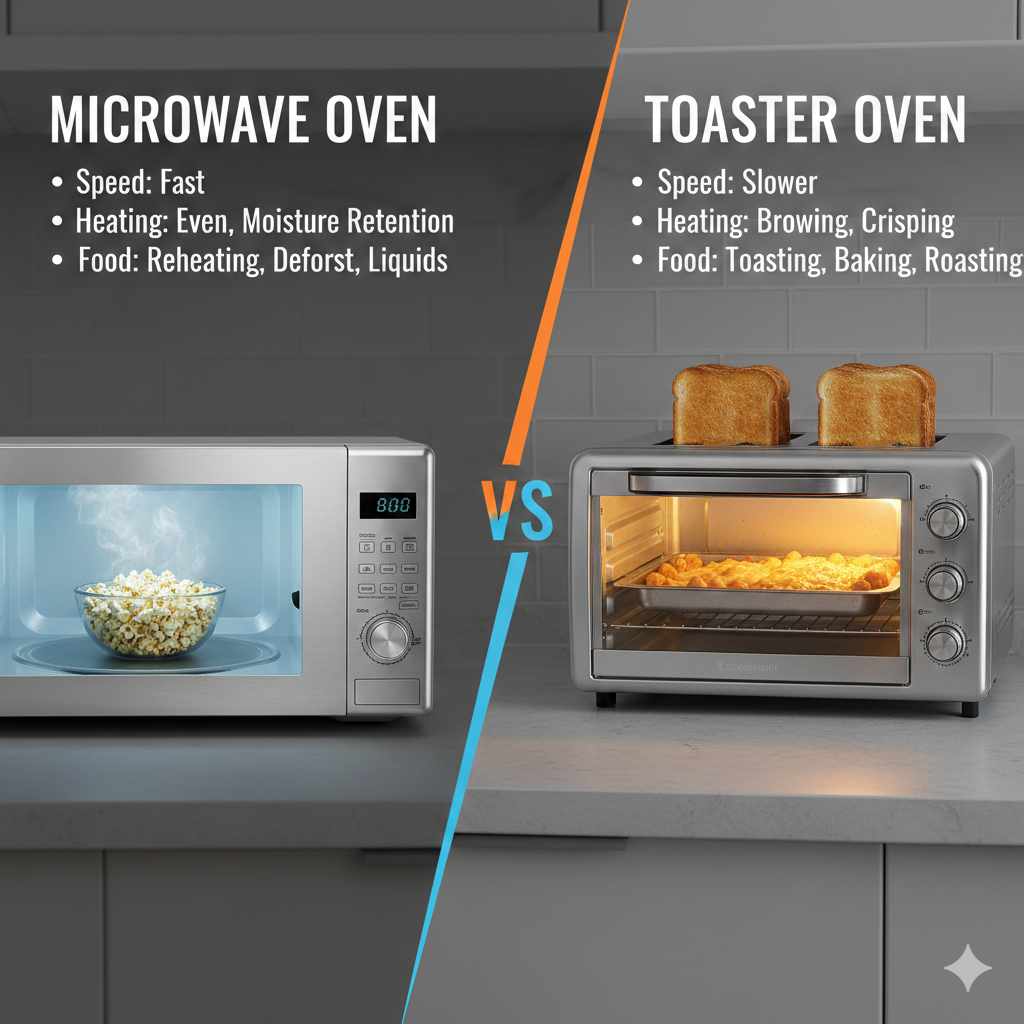
The microwave excels at speed and reheating liquids, while the toaster oven is superior for crisping and baking small items. Choosing between them depends entirely on your daily cooking needs—one prioritizes speed, the other texture.
Are you staring at your kitchen counter wondering where to put that new small appliance? Maybe your old one finally gave out. It’s easy to get confused between the workhorse microwave and the versatile toaster oven. Both heat food, but they do it in totally different ways. This choice matters because the wrong one can’t handle the jobs you need done most.
Don’t sweat it! We are going to break down exactly how these two gadgets work, what they do best, and which one deserves that precious counter space in your kitchen. By the end of this guide, you will know exactly which oven fits your lifestyle perfectly. Let’s dive in and settle this countertop debate!
Understanding the Basics: How They Cook Food
Before we compare them side-by-side, let’s quickly look under the hood. The biggest difference between a microwave and a toaster oven is the actual method they use to generate heat.
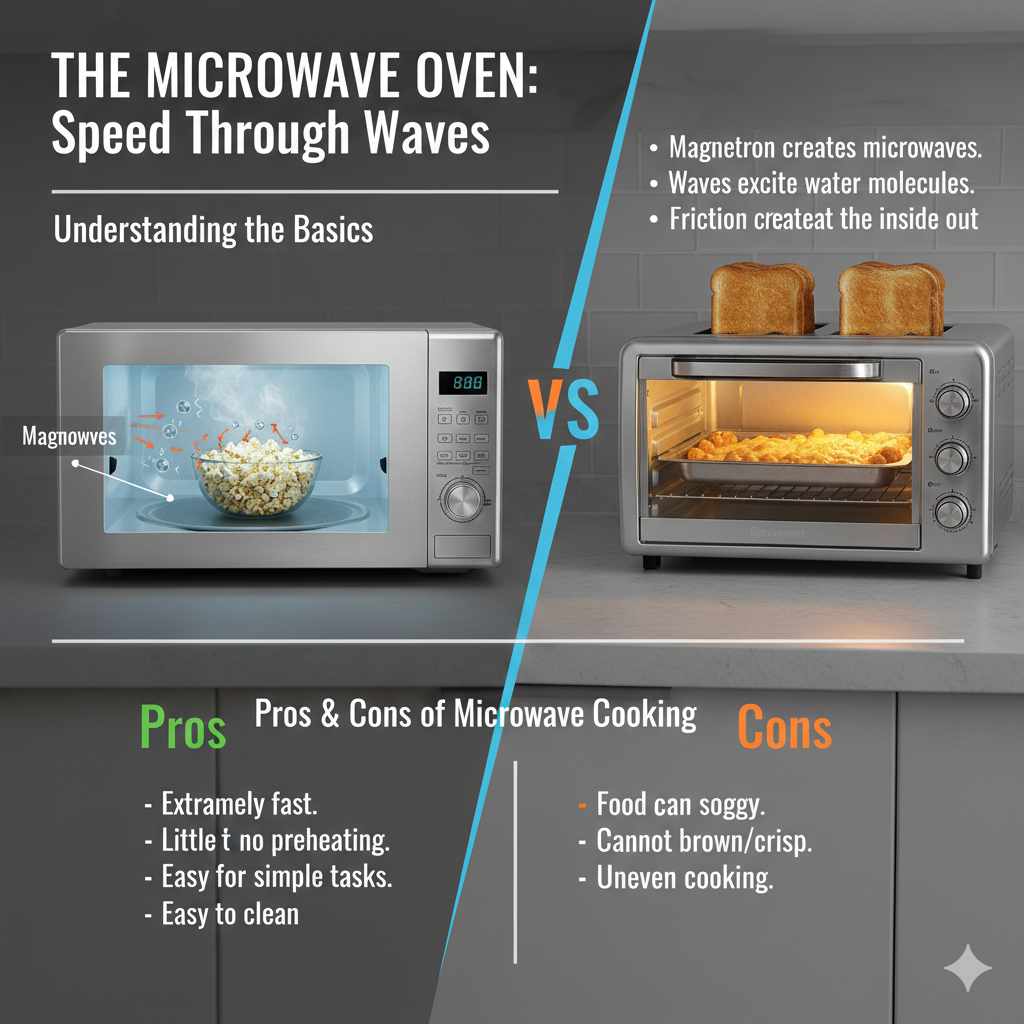
The Microwave Oven: Speed Through Waves
A microwave oven is a speedy wizard. It doesn’t use heating elements the way a traditional oven does. Instead, it uses a special part called a magnetron.
This magnetron creates invisible waves—microwaves. These waves cause the water molecules inside your food to wiggle around really fast. That motion creates friction, and friction makes heat. It heats the food from the inside out, which is why it cooks so quickly.
Pros of Microwave Cooking
- Extremely fast reheating and defrosting.
- Requires very little preheating time (often none).
- Easy for simple tasks like melting butter or boiling water.
- Generally easier to wipe clean inside.
Cons of Microwave Cooking
- Food often comes out soggy or chewy.
- Cannot brown or crisp food (no Maillard reaction).
- Uneven cooking is common without stirring or rotating.
The Toaster Oven: Gentle, Radiant Heat
The toaster oven is much closer to your standard full-sized oven, just smaller. It uses glowing metal coils, usually located at the top and bottom, to generate radiant heat.
This heat cooks the food from the outside in, very much like grilling or baking on a stovetop. Because the heat is dry and direct, it achieves that lovely golden-brown color and crisp texture we all love.
Pros of Toaster Oven Cooking
- Perfect for making toast, bagels, and crisping leftovers.
- Great for small-batch baking (cookies, muffins) or roasting vegetables.
- More even cooking results for items that need browning.
- Uses less energy than heating up a big oven for small meals.
Cons of Toaster Oven Cooking
- Takes longer to heat up than a microwave.
- Can easily burn food near the heating elements if not watched.
- Not ideal for heating liquids or soups.
Microwave Oven vs Toaster Oven: Key Performance Showdown
Now that we know how they work, let’s see how they stack up in real-world kitchen scenarios. Think about what you cook most days—that’s your winner!
Speed and Efficiency
When seconds count, the microwave is unbeatable. If you need to thaw frozen chicken breasts in 15 minutes or reheat last night’s pasta in two, the microwave wins instantly.
A toaster oven needs time to get those elements hot. Even if you are just toasting bread, you have to wait for the internal temperature to rise before the browning starts. For efficiency in pure reheating time, microwaves are engineered for maximum speed.
Texture and Cooking Results
This is where the toaster oven shines like a freshly polished chrome bumper! If you hate soggy pizza crust or flabby french fries, the toaster oven is your friend.
The dry, radiant heat evaporates surface moisture, leading to that satisfying crunch. Microwaves, conversely, heat up the moisture already in the food, steaming it rather than baking it. If texture matters more than speed, the toaster oven is the clear choice.
Capacity and Space Saving
Microwaves are usually deeper and taller, designed to hold a standard dinner plate. They take up a significant footprint but often offer more vertical space.
Toaster ovens are typically wider and shallower, optimized for flat items like baking sheets or toast racks. If you live in a tiny apartment, a compact toaster oven might offer a better baking experience without taking up wall-to-wall space.
If you are interested in understanding appliance efficiency ratings, the U.S. Department of Energy provides excellent resources on how different heating elements affect energy usage at home, which can be helpful when deciding which appliance to use for which task (Energy.gov Appliance Standards Information).
Side-by-Side Comparison Table
To make the final decision easier, here is a quick reference guide comparing the most important factors:
| Feature | Microwave Oven | Toaster Oven |
|---|---|---|
| Primary Cooking Method | Electromagnetic waves (exciting water molecules) | Radiant heat elements (like a small oven) |
| Best For | Reheating, defrosting, turning water hot | Baking, broiling, toasting, crisping |
| Browning/Crisping Ability | None (can cause rubbery texture) | Excellent |
| Preheat Time | None to near-instant | 5–10 minutes |
| Best for Liquids | Yes (heating soup, coffee) | No (unless in a microwave-safe dish) |
| Ideal For Small Families/Singles | Yes, for speed | Yes, for texture and baking |
When to Choose the Microwave: The Speed Demon
You should grab the microwave if your kitchen routine is driven by speed above all else. Think about those rush mornings or late nights when you just need food accessible.
Top 5 Microwave Jobs
- Reheating Leftovers: Nothing beats two minutes for hot rice or soup.
- Defrosting: Quickly taking the ice core out of frozen meats or leftovers.
- Making Beverages: Heating up coffee or water for tea instantly.
- Softening Butter/Chocolate: Perfect for quick baking prep.
- Making Microwave Popcorn: The dedicated function for this snack.
If you are primarily making quick meals in non-fancy containers (plastic, glass, or ceramic safe for microwaves), the microwave is the reliable choice. Remember, safety first: never put metal or certain plastics in the microwave, as this can cause sparking or melting.
When to Choose the Toaster Oven: The Texture Master
If you are someone who values that perfect golden edge on your toast or actually likes to bake small portions of muffins without turning on the huge oven, the toaster oven deserves the spotlight.
Top 5 Toaster Oven Jobs
- Toast and Bagels: It toasts evenly across the surface.
- Roasting Small Batches: Small batches of asparagus or chicken pieces cook beautifully with slightly crispy edges.
- Reheating Pizza: It revives pizza to its original crisp, cheesy glory.
- Baking Small Items: Cooking 4 cookies or a couple of biscuits.
- Broiling: Many models have a broiler setting perfect for melting cheese on an open-faced sandwich.
The toaster oven also tends to be slightly more energy efficient than heating a massive conventional oven for one or two servings. For resources on maximizing small-appliance efficiency, organizations focused on home energy savings often share helpful tips.
Installation and Safety Checks (The Dustin Hall Way)
Whether you pick the microwave or the toaster oven, safety setup is critical. As someone who always stresses keeping things running smoothly and safely, here are the steps I recommend for installation.
Microwave Safety Installation Checklist
- Clearance is Key: Ensure there is ample space above, behind, and on the sides as recommended in the manual. Microwaves need ventilation to keep the magnetron cool.
- Stable Surface: Place it on a counter that is sturdy, flat, and can handle the weight, especially when running.
- Keep Away from Water: Do not place it directly next to a sink where splashes could damage the electronics.
Toaster Oven Safety Installation Checklist
- Heat Clearance: This is crucial! Toaster ovens get hot on the exterior top and sides. Keep flammable items (like paper towels or plastic containers) well away—usually 4 to 6 inches minimum clearance.
- Check the Cord: Make sure the power cord does not touch the hot metal housing or drape over hot heating elements.
- Use the Right Tray: Always use the provided crumb tray or a metal baking sheet that fits. Never put cardboard or plastic inside!
Pro Tip: Always plug these appliances directly into a wall outlet, not into an extension cord or cheap power strip. These devices draw significant power, and overloaded extension cords can pose a fire risk. This is true for any high-wattage kitchen gear.
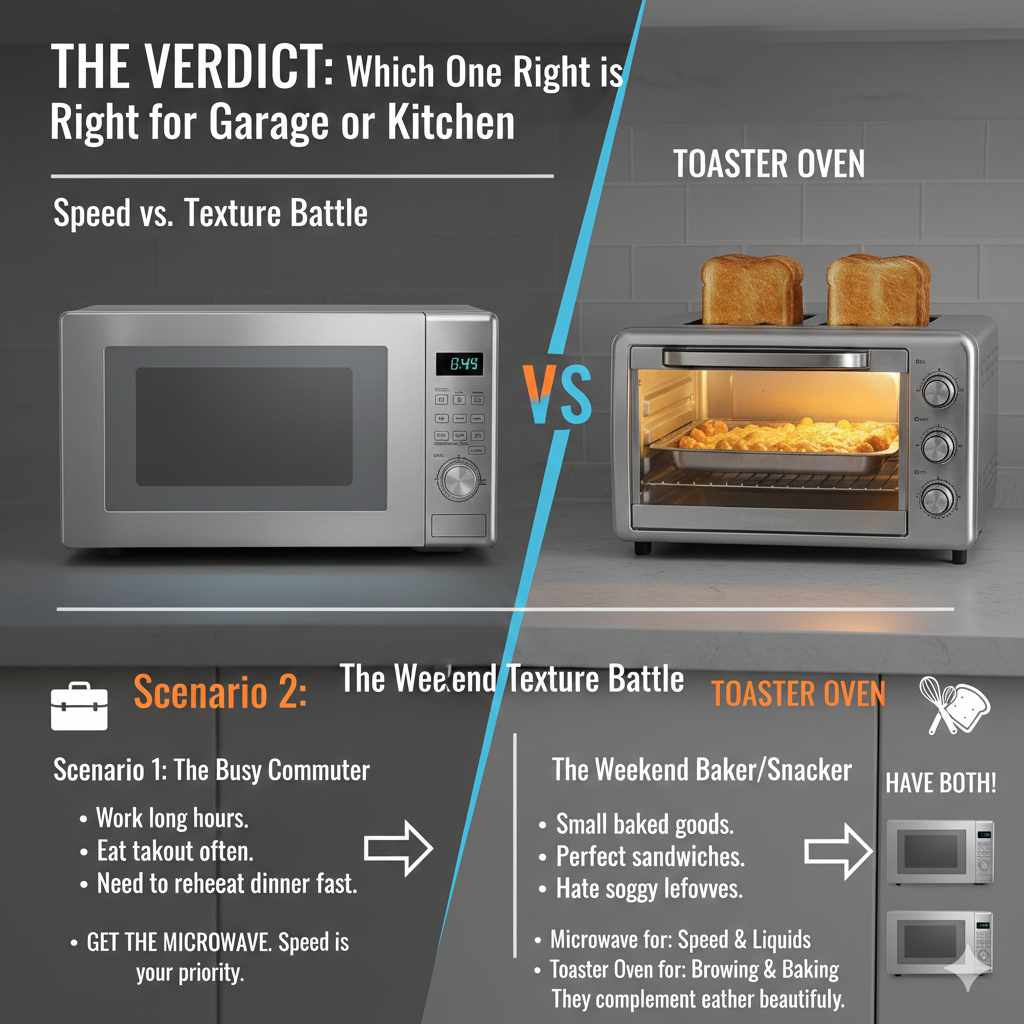
The Verdict: Which One is Right for Your Garage or Kitchen?
So, after looking at the speed versus texture battle, the choice boils down to usage patterns. Do you need a rapid thaw button, or do you crave a crunchy crust?
Scenario 1: The Busy Commuter
If you work long hours, eat takeout often, and just need to reheat dinner fast before collapsing, get the Microwave. Speed is your priority.
Scenario 2: The Weekend Baker/Snacker
If you love making small batches of baked goods, enjoy perfectly toasted sandwiches, or hate soggy leftovers, get the Toaster Oven. Texture and versatility are your goals.
Scenario 3: The Full Kitchen Setup (The Best of Both Worlds)
If you have the counter space and the budget, the ideal setup is having both! Use the microwave for speed and liquids, and use the toaster oven for anything that needs to be browned or truly baked. They complement each other beautifully.
Frequently Asked Questions (FAQ)
Q1: Can a toaster oven safely brown food like a microwave can’t?
A: Exactly! Toaster ovens use radiant heat elements that get hot enough to cause the Maillard reaction, which is what creates browning and crispiness. Microwaves transfer energy through water molecules, causing steam, which makes food soggy instead of brown.
Q2: Which appliance uses less electricity overall?
A: Generally, the toaster oven uses less electricity per use if you are only toasting bread or heating one small quality, because it doesn’t need high power to generate powerful waves like a microwave does. However, if you run the microwave for 30 seconds, it’s more efficient than running the toaster oven for 10 minutes.
Q3: Can I use metal pans in a toaster oven?
A: Yes, you typically can use small metal pots, pans, or foil trays in a toaster oven, as long as they are designed for ovens and do not touch the heating elements. Never use metal in a microwave.
Q4: Which one is easier to clean when there’s a big mess?
A: For liquid spills, the microwave is often easier if you use a steam cleaning method (heating a cup of water and lemon). For baked-on grease or crumbs, the flat bottom and removable crumb tray of the toaster oven often allow for easier scrubbing and wiping.
Q5: Are there combination microwave/toaster oven units available?
A: Yes, these are called convection microwaves. They offer the best of both worlds by combining microwave speed with a convection fan (which circulates the heat for better baking). They are usually more expensive than buying two separate units.
Q6: If I only have room for one, which one should a beginner pick?
A: For a pure beginner focused on quick meals and reheating, the microwave is the most universally necessary appliance in modern kitchens. But if you value home-cooked textures, go with the toaster oven.
Conclusion: Making Your Confident Choice
Deciding between the microwave oven vs toaster oven comes down to knowing your priorities. Think of the microwave as your pit crew specialist—it handles rapid pit stops for reheating and thawing with unbeatable speed. The toaster oven, on the other hand, is your detailing specialist—it takes a little longer, but it finishes the job with a perfect shine, texture, and crispness that the microwave simply cannot achieve.
By understanding the technology—waves versus radiant heat—you empower yourself to choose the right tool for the job. Whether you value that extra minute saved in the morning or the perfect crunch on your frozen waffle, you now have the knowledge to confidently select the appliance that belongs on your countertop. Go ahead, hook it up safely, and enjoy your perfectly heated meals!