King Bed vs Queen Bed for Master Bedrooms: Which Fits?
Choose a king only if your master bedroom still leaves about 24-30 inches of walking space on both sides and at the foot; otherwise, a queen is usually the better fit. Too much bed can block doors, drawers, and nightstand access, and that turns a room meant for daily use into a tight pass-through. This guide compares king vs queen beds by room size, circulation, furniture placement, and the comfort tradeoff for couples.
King bed vs queen bed for master bedrooms: the real trade-off
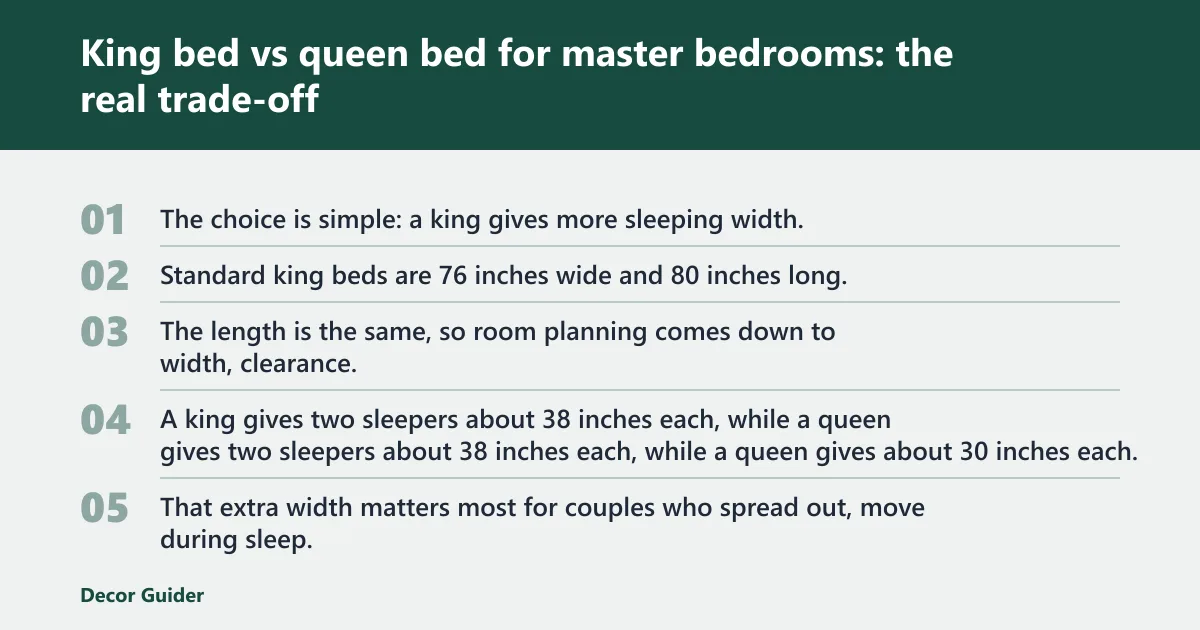


The choice is simple: a king gives more sleeping width, while a queen gives more usable floor space. Standard king beds are 76 inches wide and 80 inches long; standard queen beds are 60 inches wide and 80 inches long. The length is the same, so room planning comes down to width, clearance, and furniture placement.
| Decision factor | King Bed | Queen Bed for Master Bedrooms | Winner |
|---|---|---|---|
| Sleeping width for two | 38 inches per person | 30 inches per person | King Bed |
| Room fit in tighter master bedrooms | Needs more width and clearance | More space-efficient | Queen Bed for Master Bedrooms |
| Moving and doorway handling | Heavier to move, harder to fit | Easier to transport and place | Queen Bed for Master Bedrooms |
| Cost across bed setup | More expensive than queen beds | Lower cost than king | Queen Bed for Master Bedrooms |
| Best use case | Large master bedrooms, couples wanting extra width | Smaller master bedrooms, storage-heavy layouts | Depends on room size |
Sleeping width is the main comfort difference
A king gives two sleepers about 38 inches each, while a queen gives about 30 inches each. That extra width matters most for couples who spread out, move during sleep, or share the bed with a pet.
A common mistake is buying the larger mattress first and planning the room later. In a bedroom with one narrow walkway and a deep dresser, the bed can crowd the route to closets and doors before the couple ever gets the extra width they wanted.
Room fit matters more than the label “master bedroom”
King beds are usually found in master bedrooms, but that does not mean every master bedroom should take one. A queen is generally used in guest rooms and smaller master bedrooms because it preserves circulation and leaves more room for storage.
Suppose a room measures 12 by 12 feet and also needs a dresser and two nightstands. A queen can fit the furniture plan more comfortably, while a king may start to pinch the walking lanes that make the room easy to use every day.
The right size protects the rest of the layout
The bed should not block access to nightstands, dresser drawers, or the closet door swing. A practical rule of thumb is to leave some space around a king bed, and many layouts feel better when you can keep enough walking room where you need to pass.
That clearance is not a luxury detail. It keeps the room functional when you need to open drawers, step around bedding, or pass from the entry to the ensuite without turning sideways.
📊 Sleep Advisor suggests 12 feet by 14 feet may be preferred for a king-size mattress. Source: Queen vs. King Bed Size Comparison.
What size master bedroom do you need for each bed?

A room around 12 by 12 feet is a common baseline, and both king and queen beds can fit there in simple layouts. A 12 by 14 foot room is a better target for a king because the added length gives you more usable circulation and less chance of crowding nightstands, drawers, or door swings.
Clearance for nightstands, drawers, and walking lanes
You need more than mattress footprint. Nightstands need side space, dresser drawers need room to open, and the path from the door to the bed should stay open without squeezing past corners. If the room only fits the mattress on paper, it is not a good fit in practice.
When a king starts to feel too large
A king starts to feel too large when the furniture plan forces a narrow path on both sides, blocks one side table, or pushes a dresser so close that drawers cannot fully open. It can also feel oversized if the room has an ensuite door, closet door, or window placement that breaks up the remaining wall space.
- Measure the room, including door swings and closet access.
- Mark the mattress footprint: 76 by 80 inches for a king, 60 by 80 inches for a queen.
- Add nightstands and check drawer clearance.
- Confirm that you still have about 24-30 inches of walk space where you need to move.
- Choose the size that keeps the room useful, not only the bed comfortable.

Master bedroom bed-fit checklist
Use this checklist before you buy. The room can be large enough on paper and still fail if the bed blocks drawers, door swing, or a direct walking lane from the entry to the closet or bath.
| Room dimensions and clearances | Queen verdict | King verdict | California king verdict |
|---|---|---|---|
| 12 by 12 feet bedroom, simple layout, limited storage | Yes | Maybe | No |
| 12 by 14 feet bedroom, standard nightstands, one dresser | Yes | Yes | Maybe |
| At least about two feet outside the bed on usable sides | Yes | Yes | Maybe |
| Clear drawer opening for dresser and nightstand access | Yes | Maybe | No |
| Doorway, closet door, or ensuite door near the bed | Usually yes | Maybe | Maybe |
| Need for extra sleeping width for two adults | Maybe | Yes | Yes |
Queen verdict: best when the room is tight, storage-heavy, or split by doors and furniture. King verdict: best when the room can keep useful clearance on both sides and at the foot. California king verdict: best only when the room can handle the extra length and the sleeper really needs it.
Which bed feels better for couples?
A king usually feels better for couples who want more personal space, while a queen works well when the pair sleeps close and the room layout matters more. The comfort difference comes from width, not length, since both sizes are 80 inches long.
Side sleepers versus back and stomach sleepers
Side sleepers often move more through the night and benefit from the extra width of a king. Back and stomach sleepers may be fine on a queen if they do not spread out much. Body size matters too; larger partners and couples with different shoulder widths often notice the queen’s tighter feel more quickly.
Pet sharing and co-sleeping change the answer
If a dog sleeps at the foot of the bed or a child joins the bed often, a king is usually the safer choice. The same is true when one partner wants more space and the other sleeps light or shifts frequently. The extra width reduces the chance that one person is pushed to the edge.
Picture a 12 by 14 foot room with two adults, a medium dog, and two nightstands. A king may solve the sleeping-space problem, but only if the room still leaves clear walking lanes. If not, the layout can become more annoying than the mattress is comfortable.
What does a king bed cost beyond the mattress?

A king bed costs more than a queen after the mattress purchase. The frame, box spring or foundation, sheets, and often the delivery or moving effort all rise with size. King beds are also heavier to move and harder to fit through tight turns, which can matter more than the sticker price.
Frame, foundation, and center support
Frame fit matters because a king mattress needs proper support, especially at the center. Many king frames use center leg support, and a mismatch between the mattress size and the frame can create fit problems or poor support. Nonstandard mattresses also raise the risk of buying the wrong base.
Sheets and bedding cost more as size grows
Standard-size bedding is easier to find for king and queen than for nonstandard options, but king sheet sets generally cost more because they use more material. The same pattern usually applies to mattress protectors, blankets, and some bed frames. That difference is small once, then noticeable across the whole setup.
Delivery, moving, and doorway fit
Queen beds are easier to move and transport. A king can be awkward through narrow hallways, tight stair turns, or small bedroom doors, and that adds friction if the home has older trim or limited clearance. Split king setups can reduce that problem because the bed is delivered as two halves.
King, California king, or split king?
A standard king is 76 by 80 inches and is the wider option; a California king is 72 by 84 inches and trades width for length. Split king setups divide the bed into two halves, which can help with adjustable bases and make moving easier, but they require matching components.
Standard king dimensions and use case
The standard king is the wider option, so it suits couples who want more personal width. It is the common choice for master bedrooms when the room can support the footprint and the goal is maximum shared sleeping space rather than extra length.
California king dimensions and use case
A California king measures 72 by 84 inches. It is narrower than a standard king but longer, so it is often considered by taller sleepers who need the extra length more than the extra width. The trade-off is that you give up some shoulder room.
Split king for flexibility and easier moving
Split king beds use two halves, which helps with adjustable bases and can simplify moving through stairs or tight hallways. The trade-off is the seam between the two sides and the need to match compatible bedding and frame parts. It is best when flexibility matters more than a single-piece mattress.
Choose queen if… / Choose king if…
Choose a queen if the room is tight, the bedroom needs storage, or door and drawer clearance are already difficult to manage. Choose a king if the room can keep about 24-30 inches of walking space around the bed, and the couple wants more width for sleep comfort.
Choose queen if…
- The master bedroom is closer to a 12 by 12 foot layout than a 12 by 14 foot layout.
- You need a dresser, nightstands, or closet access to stay easy to use.
- The room has a tricky door swing, narrow entry, or limited wall space.
- You want lower cost and easier moving.
Choose king if…
- The room can hold the bed and still leave useful walking lanes on both sides and at the foot.
- You and your partner want noticeably more personal space.
- One or both sleepers are larger, or one is a restless sleeper.
- You share the bed with a pet or a child often enough that extra width matters.
Frequently asked questions
Is a king bed too big for a master bedroom?
A king is too big when it blocks the room’s daily function, not when it merely fits on a floor plan. If you cannot keep about 24-30 inches of clear space where you walk, open drawers, and access nightstands, a queen is usually the smarter layout choice.
What size room do you need for a king bed?
Sleep Advisor says both sizes should fit well into rooms measuring 12 feet by 12 feet, and 12 feet by 14 feet may be preferred for a king-size mattress. That said, the real test is whether the room still leaves useful clearance around the bed after furniture is placed.
How much wider is a king bed than a queen bed?
A king mattress is 16 inches wider than a queen mattress. That extra width is the main reason couples choose king over queen, because both beds are 80 inches long. The gain is real, but it should be weighed against the room’s actual circulation space.
Does a queen bed work in a master bedroom for couples?
Yes, a queen works in many master bedrooms, especially when the room is smaller or the layout includes storage, doors, or a narrow walkway. It is often the better choice when the room needs to stay easy to move through rather than simply house the largest possible mattress.
Is a king bed worth the extra cost over a queen?
A king is worth the extra cost when the couple will use the added width and the room can support the larger frame, bedding, and moving needs. If the room will feel cramped, the extra spending buys a bigger obstacle rather than a better bedroom.
What is the difference between a standard king and a California king?
A standard king measures 76 by 80 inches, while a California king measures 72 by 84 inches. The standard king is wider, and the California king is longer. Taller sleepers often consider the California king, but couples who want maximum width usually prefer the standard king.
Which bed size is easier to move and fit through doorways?
A queen is easier to move and transport, and it is usually simpler to fit through doorways, halls, and stair turns. A king is heavier and more awkward to handle, especially in homes with tight access. Split king setups can reduce that challenge by dividing the load.
Products related to this article
Sponsored / affiliate links. As an Amazon Associate I earn from qualifying purchases. I may earn additional commission from eligible campaigns.