How to Refinish a Headboard: A Decision-Based Guide for Wood, Veneer, and Upholstered Frames
That headboard in your guest room has good bones, but the finish is shot. Maybe it’s cloudy with old wax, scratched from moving, or just a color you never liked. You could buy a new one, but the frame is solid and the style is right. Refinishing it is the smarter move, and it’s a weekend project if you make the right calls upfront.
This guide walks through the entire process, but it’s not a single rigid tutorial. The right method depends on what your headboard is made of, how thick the veneer is, and what kind of damage you’re dealing with. You’ll learn how to assess the piece, strip or sand it safely, repair structural issues, and choose a final seal that matches your lifestyle. By the end, you’ll know exactly which path to take and which shortcuts to avoid.

Minwax
Minwax Antique Furniture Refinisher, 1 Quart
- ANTIQUE FURNITURE RESTORATION – Minwax Antique Furniture Refinisher is a low viscosity, amber-colored blend of solvents and wood c…
- GENTLE FORMULA – This antique wood refinishing formula contains natural wood oils that penetrate and condition wood. It can be use…
- EASY TO APPLY – With no scraping, no sanding, and no mess, it’s easy to apply this wood refinish in just a few steps.
As an Amazon Associate I earn from qualifying purchases.
One product worth having in your corner is the Minwax Antique Furniture Refinisher. It’s a low-viscosity solvent blend that dissolves old varnish, shellac, and lacquer without harsh scraping. It also contains wood conditioners that penetrate the grain, which is a nice bonus when you’re working with dried-out vintage pieces. It won’t remove paint or polyurethane, but for old-school clear finishes, it saves you hours of sanding.
Assess Your Headboard: Wood Type, Finish, and Structural Integrity
Before you buy a single chemical, figure out what you’re working with. This step prevents most refinishing disasters.
Identify the Wood and Original Finish
Look at the raw wood on the underside or back of the headboard. If it’s pale with a straight, subtle grain, it’s likely maple, birch, or poplar. If it has a pronounced, wavy grain and a warm amber tone, it’s probably oak, cherry, or walnut. Pine is soft, light, and often has visible knots.
Next, test the finish. Put a drop of denatured alcohol on a hidden spot and wait 30 seconds. If the finish softens or gets tacky, it’s shellac. If it doesn’t react, test another spot with acetone or nail polish remover. Lacquer will dissolve. If neither solvent touches it, the finish is either varnish or polyurethane, which means you’ll need a stronger chemical stripper or a heat gun.
This matters because the Minwax refinisher mentioned above only works on shellac and lacquer. Using it on polyurethane is a waste of time. Matching the solvent to the finish is the difference between a 20-minute strip and a three-hour fight.
Solid Wood vs. Veneer: The Thickness Test
Veneer is a thin layer of real wood glued over plywood or particleboard. It’s common on mid-century and mass-produced headboards. The thickness determines your approach. If the veneer is less than 1/16 inch thick, you cannot sand through it without risking bare particleboard. You’ll need to strip chemically and sand only lightly, with a maximum grit of 220.
If you’re not sure, look at the edges. Solid wood has continuous grain wrapping around the edge. Veneer has a visible seam where the thin layer meets the core. Another test: knock on it. Solid wood sounds dense and dull; veneer over hollow core sounds like a cardboard box.
Structural Check Before You Start
Wobble the headboard. Push on the top corners. If it flexes, you need to fix the joints before you strip, not after. Loose glue and wobbly legs will only get worse when you add the weight of a wet finish. Check for cracked veneer, split panels, and missing hardware. Make a list of repairs now so you’re not scrambling mid-project.
Safety First: Lead Testing, Ventilation, and Essential PPE
If your headboard is from before 1978, assume the old paint or finish contains lead. That’s not paranoia; it’s standard practice for anyone who works with vintage furniture. Lead dust is a neurological toxin, and sanding old finish turns it airborne.
Buy a 3M LeadCheck swab kit. It costs about $10 and takes two minutes. Swab the surface, and if it turns pink or red, you have lead. Do not sand it dry. Instead, use a chemical stripper that encapsulates the finish, or wet-sand with a spray bottle and a sponge. Even then, wear an N95 or P100 respirator, not a cloth mask. A cloth mask stops exactly zero lead dust.
Chemical strippers emit strong fumes, especially methylene chloride-based ones. Work outdoors or in a garage with the door open. Set up a fan blowing out behind you. Wear chemical-resistant gloves (nitrile gets eaten by strippers; use neoprene or butyl) and safety glasses. The skin on your hands absorbs solvents quickly, and the burn from a stripper is not a joke.
Gather Your Materials: The Complete Checklist
You don’t need a workshop full of tools, but you do need the right stuff. Here’s the list that covers most headboard refinishing projects:
- Chemical stripper (gel type for vertical surfaces) or heat gun
- Minwax Antique Furniture Refinisher for shellac/lacquer finishes
- Plastic scraper (metal scrapers gouge soft wood)
- Steel wool: 0000 grade for final smoothing
- Sanding blocks and sandpaper: 80, 120, 180, 220 grits
- Wood filler (stainable or paintable, depending on your path)
- Wood glue and clamps for joint repairs
- Tack cloth or a lint-free rag dampened with mineral spirits
- Stain, paint, or the final seal of your choice
- Good brushes: a 2-inch synthetic brush for paint, a natural bristle brush for oil-based products
- PPE: N95 respirator, neoprene gloves, safety glasses
Skip the cheap brush. A $5 brush leaves streaks and shed bristles in your finish. Spend $15 on a decent one; it’s the difference between a professional look and a craft project.
Step 1: Strip the Old Finish (Chemical vs. Heat Gun)
You have two main options for removing an old finish, and neither is universally better.
Chemical stripping is the safer choice for veneer and intricate details. Apply a thick gel stripper with a brush, wait 15-30 minutes for it to bubble, then scrape off the sludge with a plastic scraper. Work in small sections, about 1 square foot at a time, so the stripper doesn’t dry out. For stubborn corners, apply a second coat. Neutralize the wood afterward with mineral spirits to remove the waxy residue that strippers leave behind. If you skip this, your new stain will blotch.
Heat guns are faster on flat, solid wood surfaces. You soften the finish with heat and scrape it off as it lifts. But heat guns scorch wood if you linger, and they can delaminate veneer in seconds. I’ve seen more than one nice headboard ruined by a heat gun on a curved edge. Use heat only on solid wood, and keep the gun moving constantly.
For shellac or lacquer finishes, the Minwax Antique Furniture Refinisher is your shortcut. Apply it with a rag, let it sit briefly, and wipe the finish off. No scraping, no sanding. It’s not perfect for thick, built-up polyurethane, but for a vintage headboard with a decade of wax buildup, it works beautifully.
How to Handle Intricate Carvings and Spindles
Carved details and turned spindles are where most people give up. You can’t sand them flat without losing the detail, and a scraper won’t fit in the grooves. Use a brass-bristle brush (brass is softer than steel and won’t scratch the wood) dipped in chemical stripper. Work it into the crevices, let it sit, then brush again. For deep carvings, use an old toothbrush with the same stripper.
After the finish is gone, clean the crevices with a soft toothbrush dipped in mineral spirits. Do not use steel wool on carvings; it leaves bits of metal in the grain that rust and stain the wood later.
Step 2: Repair and Stabilize (Fixing Joints and Veneer)
Now that the finish is off, you can see the real condition of the wood. Fix structural issues before you sand or stain.
Wobbly legs and loose joints: Separate the joint if possible, clean off old glue, apply fresh wood glue, and clamp it tight. Wipe away the squeeze-out with a damp rag before it dries. If the joint is too tight to separate, inject glue with a syringe and clamp it. Let it cure for 24 hours. Don’t rush this; the clamp time is what makes the joint hold.
Cracked veneer: If the veneer is lifting, inject glue under it with a syringe, press it down with a flat block and clamp, and wipe away excess. If the veneer is cracked but not lifting, fill the crack with wood filler that matches your stain. If the veneer is missing entirely, you have a decision: fill the spot with wood filler and paint the whole headboard, or glue in a patch of new veneer. Patching is more work but looks far better if you’re staining.

Dents and dings: Use a damp cloth and a hot iron. Place the cloth over the dent, apply the iron for 10 seconds, and the steam swells the wood fibers back up. It won’t fix deep gouges, but it handles most surface dents without filler.
Step 3: Sanding—Grit Sequence and Avoiding Common Mistakes
Sanding is where you smooth the surface and open the grain for stain. It’s also where people sand right through veneer.
Start with 80 grit only if you’re removing old finish or leveling a repair. If you stripped chemically, skip 80 and start at 120. Move to 150, then finish with 220. That progression removes scratches from the previous grit. Jumping from 120 to 220 leaves visible swirl marks that show up after staining.
Sand with the grain, never across it. Cross-grain scratches are nearly impossible to remove later. Use a sanding block, not your bare hand; your hand follows the contours of the wood and rounds off sharp edges.
For veneer, stop at 220 and do not press hard. The veneer is thin, and you’re just smoothing, not shaping. After sanding, wipe the surface with a tack cloth to remove all dust. Any dust left behind will show through the stain as a rough patch.
Step 4: Staining vs. Painting: Choosing Your Path
This is the fork in the road. Your choice depends on the wood condition and your style preference.
Stain shows off the wood grain. It works best on solid wood or thick veneer with attractive grain. If your headboard is made of poplar or particleboard, staining is a mistake; the grain is boring or nonexistent. Test the stain on a hidden spot first. Some woods, like pine and cherry, blotch easily and need a wood conditioner before staining. Apply the conditioner, wait 15 minutes, then apply the stain with a rag in the direction of the grain. Wipe off the excess after 5-10 minutes. The longer you leave it, the darker it gets.
Paint is more forgiving. It hides repairs, covers ugly grain, and works on any material. It’s the right choice for a headboard that’s been patched or has mismatched wood pieces. If you’re painting, you don’t need to sand to bare wood; a light scuff with 120 grit is enough to give the paint something to grip.
Priming and Painting for a Flawless, Brush-Stroke-Free Finish
Primer is not optional. It seals the wood, prevents tannin bleed-through, and gives the paint a uniform base. Use a shellac-based primer like Zinsser B-I-N for stained wood or a high-quality latex primer for bare wood. Let it dry completely, then sand lightly with 220 grit to knock down the raised grain.
For the paint, use a high-quality acrylic latex or a furniture-specific paint. Apply thin coats. Thin coats dry faster and don’t leave brush strokes. Use a foam roller for the flat panels and a synthetic brush for the edges and details. Roll the paint on, then immediately tip it off by dragging a dry brush lightly over the wet surface. This smooths out the roller texture. Two thin coats are better than one thick coat. Wait 4 hours between coats, and sand very lightly with 320 grit between them for a glass-smooth result.
Step 5: Sealing and Protecting (Wax, Poly, or Oil)
The final seal determines how the headboard looks and how it holds up. Here’s the honest comparison:
| Seal Type | Durability | Appearance | Maintenance | Best For |
|---|---|---|---|---|
| Polyurethane (water-based) | High; resists scratches and moisture | Clear, slightly plastic sheen | Low; needs re-coat only if damaged | Headboards that get bumped, kids’ rooms |
| Polyurethane (oil-based) | Very high; toughest film | Warm amber tint, deep glow | Low; long cure time (24 hrs) | Solid wood, heirloom pieces |
| Danish Oil | Medium; penetrates wood, no film | Natural matte finish, grain pops | Medium; reapply yearly | Minimalist look, hand-rubbed feel |
| Furniture Wax | Low; scratches easily | Soft sheen, feels like bare wood | High; reapply every few months | Decorative pieces, low-traffic areas |
Wax is the easiest to apply but the weakest protection. It’s fine for a headboard that sits against a wall and never gets touched. Polyurethane is the workhorse; it dries hard and shrugs off bumps. Danish oil is a middle ground; it soaks into the wood and hardens it from within, but it doesn’t build a surface film, so it won’t protect against deep scratches.
My rule: if you painted it, use a water-based polyurethane in a satin sheen. It dries fast and doesn’t yellow. If you stained it, use an oil-based polyurethane for that warm, classic glow. Apply three thin coats, sanding lightly with 320 grit between each coat. Wait 2 hours between coats.
Final Assembly and Styling Tips
Reattach the headboard to the bed frame only after the final coat has cured fully. Polyurethane takes 24 hours to cure, not just dry. If you bolt it on sooner, the finish can dent and stick to the hardware.
When you place the headboard back, use felt pads on the back to protect the wall from scratches. If you refinished a wooden headboard and want to soften the look, add a tufted headboard style accent by leaning a few large pillows against it. The contrast between the smooth wood and soft fabric is a classic bedroom look.
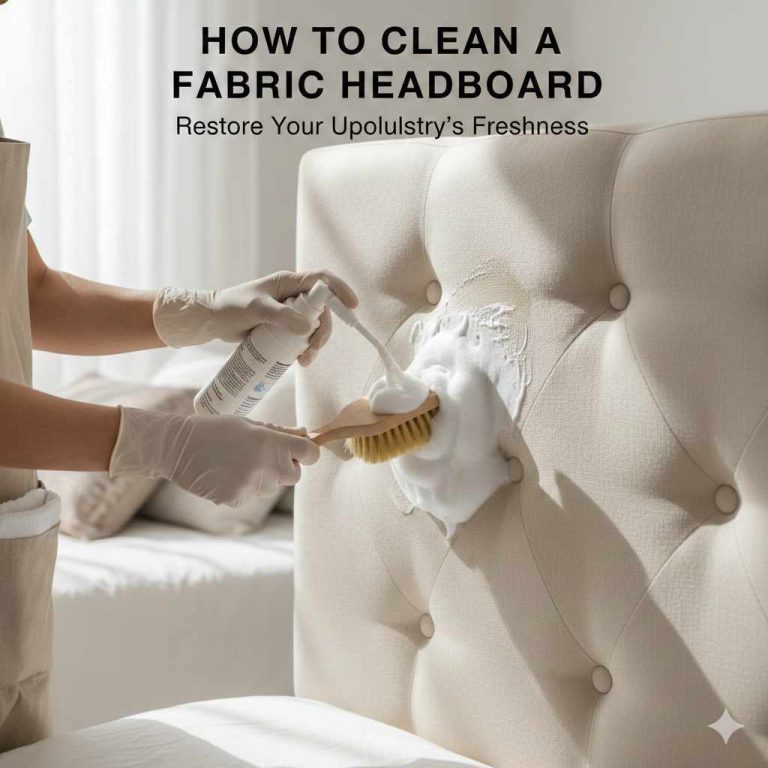
If you’re working with a metal or upholstered frame instead of wood, the process is different. For metal, you’ll need to remove rust, prime with a metal primer, and spray paint. For upholstered pieces, you’re usually better off cleaning the fabric headboard rather than refinishing it. This guide assumes you’re working with wood, which is the most common scenario.
Troubleshooting Common Refinishing Nightmares
Blotchy Stain
This happens when the wood absorbs stain unevenly. Pine, cherry, and birch are notorious. Fix it by sanding back to bare wood and applying a wood conditioner before re-staining. If you don’t want to sand again, apply a gel stain over the blotchy area; gel stains sit on top of the wood and don’t penetrate unevenly.
White Rings or Cloudy Finish
Moisture trapped under the finish. Place a cloth over the ring and apply a warm iron for a few seconds. The heat drives the moisture out. If that fails, the damage is in the finish itself, and you’ll need to strip and reseal that section.
Brush Strokes in Paint
You applied the paint too thick or used a cheap brush. Wait for the paint to dry, sand with 320 grit, and apply a thinner coat. Use a foam roller for the flat areas next time.
Sticky Finish That Never Dries
You didn’t wait long enough between coats, or the room is too humid. Move the piece to a dry, warm area and wait 48 hours. If it’s still tacky, you’ll need to strip it and start over. There’s no shortcut for this one.
Veneer Bubbles
Slit the bubble with a razor blade, inject glue under it, press flat with a block, and clamp. Wipe away the squeeze-out immediately.
What to Do Next: Five Things Worth Remembering
- Test the finish with denatured alcohol before choosing a stripper; shellac and lacquer dissolve easily, polyurethane does not.
- Assume lead paint on anything pre-1978. Test it, and never dry-sand a lead-positive surface.
- Strip chemically on veneer and carvings; save the heat gun for flat, solid wood only.
- Fix wobbly joints and cracked veneer before you sand or stain. A repaired piece finishes better than a perfect-looking one with hidden damage.
- Choose your seal based on use: polyurethane for durability, Danish oil for a natural look, wax only for low-traffic pieces.
- Sand in sequence (120, 150, 220) and always with the grain. Skipping grits shows up after staining.
- If you’re painting, never skip primer. It’s the difference between a finish that lasts and one that peels.
Refinishing a headboard is a satisfying project, but it rewards patience and punishes shortcuts. Take the time to assess the wood, choose the right chemicals, and let each coat cure fully. The result is a piece that looks custom-made and will last another decade. For a related project, the same techniques apply to refinishing an armoire if you ever decide to tackle a bigger piece.
Products related to this article
Sponsored / affiliate links. As an Amazon Associate I earn from qualifying purchases. I may earn additional commission from eligible campaigns.