DIY Fabric Headboard Tutorial: Build a Custom Upholstered Headboard That Lasts
You’ve seen the $800 headboard in the catalog. You’ve also seen the particleboard version that wobbles after a year. Neither feels right. Building your own fabric headboard solves both problems — you control the materials, the fit, and the style, and you can do it for a fraction of the store price. This guide walks you through the entire process, from measuring and cutting to mounting and repairing, so you get a headboard that still looks sharp five years from now.
You’ll learn how to pick fabric that survives pets and spills, how to create a curved or arched shape without fancy tools, and how to mount it without wrecking your walls. I’ll also show you how to fix sagging fabric and loose corners later — the stuff most tutorials skip. By the end, you’ll have a headboard that fits your bed perfectly and your budget even better.

MAQQL
MAQQL Wall-Mounted Upholstered Headboard Panels, Light Gray…
- Customizable Wall-Mounted Upholstered Headboard Panels Transform your bedroom with this set of 9 light gray faux leather headboard…
- Comfortable, Silent Design for Relaxation Designed for ultimate comfort, these upholstered headboard panels are filled with high e…
- DIY Installation with Flexible Arrangement Options These lightweight wall-mounted panels are perfect for DIY installation, giving…
As an Amazon Associate I earn from qualifying purchases.
If you’re short on time or want a no-sew alternative, the fabric headboard panels from MAQQL (light gray faux leather, 24×12 inches, pack of 9) attach directly to the wall, so you skip the plywood and stapling entirely. They’re modular, so you can arrange them to fit a queen or king bed, and the faux leather wipes clean. But if you want a fully custom shape or a specific fabric pattern, the DIY route below gives you total control.
Why Build Your Own Fabric Headboard?
Store-bought headboards are either overpriced or underbuilt. A decent upholstered headboard costs $300–$600, and many use thin MDF that sags under the foam. Building your own lets you choose solid plywood, dense foam, and a fabric you actually like — for $100–$150 in materials. Plus, you can match the exact width of your bed frame and the height you want, not what a manufacturer decided.
There’s also the satisfaction factor. When someone asks where you got it, saying “I made it” feels better than “I clicked ‘add to cart’.” And if the fabric wears out or you redecorate, you can reupholster it instead of tossing the whole thing.
This tutorial assumes basic skills: you can use a drill, a staple gun, and a jigsaw. It’s not hard, but it takes a few hours and a clean workspace. Let’s get into the materials.
Materials and Tools: The Complete Checklist
Here’s what you need, with the exact stuff that works best. Don’t skimp on the staple gun — a cheap manual one will make your hand cramp and might not drive staples deep enough into plywood.
- Plywood base: 3/4-inch sanded plywood for strength. For a queen bed (60 inches wide), cut a rectangle about 60 x 40 inches. For king (76 inches), go 76 x 40. Adjust height to your preference — 36–48 inches is typical.
- Foam padding: 2-inch thick upholstery foam (density 1.8–2.0 lb/ft³) for comfort. You can use 1-inch if you want a firmer feel.
- Batting: 1–2 layers of polyester batting (quilt batting works) to smooth out the foam edges.
- Fabric: 2–3 yards for a queen, 3–4 for a king, plus extra for pattern matching. See the fabric section below.
- Staple gun: Electric or pneumatic. A manual one is okay for a small headboard but not for this.
- Staples: 1/4-inch or 5/16-inch crown staples, 3/8-inch long. Buy a box of 5000.
- Jigsaw: For cutting curves or arched shapes.
- Drill and screws: For attaching mounting cleats or bed frame brackets.
- Spray adhesive: To glue foam to plywood (optional but recommended).
- Measuring tape, straightedge, pencil.
- Scissors or utility knife for cutting foam and batting.
Choosing the Right Fabric (Durability & Pattern)
Fabric is where you can’t just pick what looks pretty. Think about how you’ll use the headboard. If you read in bed, you need something soft but durable. If you have pets, avoid delicate weaves like linen that snag easily. If you spill coffee, go for a stain-resistant option.
Here are the best fabric types for a headboard:
- Performance velvet: Soft, but the pile shows marks. Look for a stain-resistant finish.
- Microfiber or polyester: Durable, easy to clean, and cheap. Great for pets.
- Linen blend: Looks high-end but wrinkles and stains easily. Only if you don’t have kids or pets.
- Outdoor fabric: Made for sun and rain, so it’s tough and wipeable. Surprisingly soft, and it comes in many colors.
- Faux leather: Wipes clean, but it can crack in dry climates and feels cold in winter. The MAQQL panels use this, and it’s fine for a wall-mounted option.
For pattern matching, buy extra fabric. If your pattern has a large repeat (say, 24 inches), you’ll need one extra repeat per panel to align the pattern across the headboard. Measure the repeat distance (the distance before the pattern repeats) and add that to your total yardage. For a queen with a 24-inch repeat, buy 3.5 yards instead of 2.5. It’s better to have leftover than to be short.
Foam and Batting Alternatives (Budget vs. Comfort)
Foam is the biggest cost after fabric. A 2-inch thick, 60×40 piece runs about $40–$60 at a fabric store. Cheaper options: use a 1-inch foam and add a layer of quilt batting for softness. Or use a yoga mat (the dense foam kind) if you want a firm, low-profile headboard — just cut it to size.
For batting, you can skip it if you use a thick foam, but it’s worth the $10. Batting smooths out the foam’s texture so you don’t see the foam’s dimpled surface through the fabric. One layer of good batting is enough.
Step 1: Measure and Cut the Plywood Base
Measure your bed frame’s width. The headboard should be the same width or slightly wider. For a queen, that’s 60 inches; for a king, 76. Height is your call — 40 inches is a good middle ground for most rooms. Mark the plywood with a straightedge and pencil.
If you want a curved or arched top, draw the shape on the plywood. A simple arch: find the center of the top edge, then use a string and pencil as a compass to draw a half-circle. Or trace a large bowl for a gentle curve. Cut with a jigsaw, staying just outside the line — you can sand to the line later.
Sand the edges lightly to remove splinters. Wipe off the dust.
Step 2: Attach Foam and Batting (Curved Edge Technique)
Lay the plywood flat. Spray adhesive on one side and press the foam onto it. Trim the foam to match the plywood’s shape, leaving a 1-inch overhang on all sides. For curved edges, cut the foam with a utility knife at a 45-degree angle so the foam wraps around the curve smoothly instead of bunching.
For batting, lay it over the foam and staple it to the back of the plywood. Start at the center of each side, pulling tight but not stretching. For curved corners, make small cuts in the batting (every 1–2 inches) so it lies flat as you fold it around the curve. Staple every 2 inches.

If you’re doing an arched top, cut the batting in a circle that’s about 6 inches larger than the arch, then pleat it as you staple — like wrapping a ball. It takes practice, but the fabric will hide minor wrinkles.
Step 3: Upholstering the Fabric (Stretching & Corners)
Lay the fabric right-side down on a clean floor. Place the padded plywood on top, foam side down. Center the pattern if you have one. Starting at the middle of each side, pull the fabric over the edge and staple it to the back. Work from the center outward, pulling firm but even tension. Staple every 2–3 inches, keeping the fabric smooth.
For curved edges, staple the fabric every 1–2 inches, pulling gently as you go. The fabric will pleat naturally; you can fold the pleats to one side and staple them down.
How to Fold Perfect Mitered Corners
The corners are where most DIY headboards look homemade. Here’s the trick: at each corner, pull the fabric tight and fold it into a triangle, like wrapping a gift. Staple the fold down, then trim the excess fabric so it doesn’t bunch. For a sharper corner, make a small cut in the fabric at the corner (about 1 inch from the edge) before folding — this lets the fabric wrap cleanly without a big bulge.
Practice on a scrap piece first if you’re nervous. Once you staple, it’s hard to fix without leaving holes.
Step 4: Adding Nailhead Trim or Tufting (Optional)
Nailhead trim gives a tailored, classic look. You can buy strips of nailhead trim at fabric stores — they come in a flexible strip that you hammer in. Measure the perimeter and cut the strip to fit. Start at a corner, hammer the nails in every 1/2 inch, and use a miter tool to cut the strip at 45 degrees for clean corners. It’s tedious but worth it.
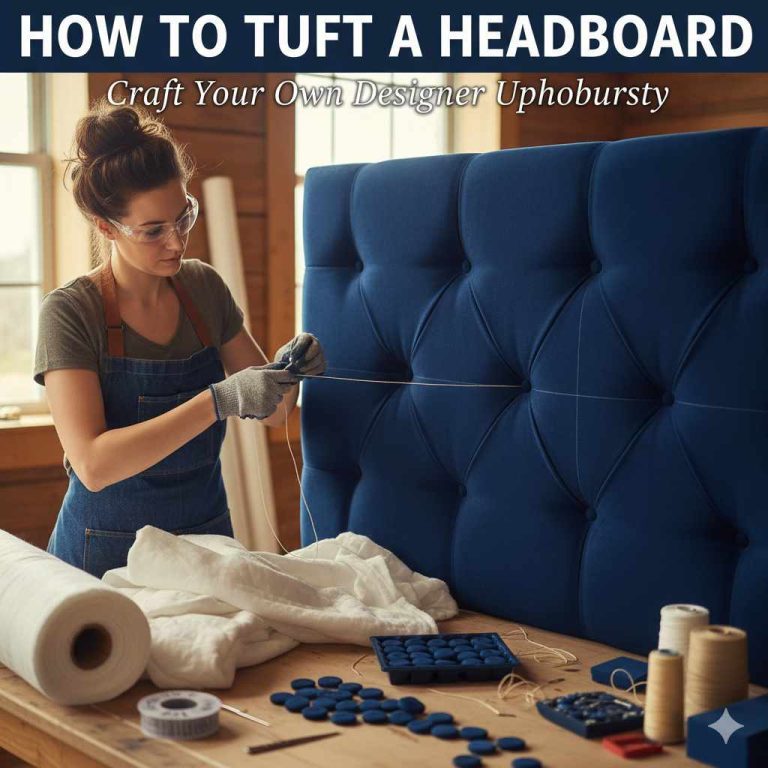
Tufting is more advanced. You’ll need to drill holes in the plywood, pass a needle and thread through the foam and fabric, and secure with a button. Do this before you finalize the fabric, because you’ll be pulling the fabric tight as you go. If it’s your first time, skip tufting — it’s easy to mess up and hard to fix.
Step 5: Mounting Options (Wall vs. Bed Frame)
You have two main ways to attach the headboard. Each has trade-offs.
| Method | Pros | Cons | Best For |
|---|---|---|---|
| Wall-mounting cleat | Sturdy, no visible brackets, works with any bed frame | Requires drilling into wall, leaves holes | Permanent setups, heavy headboards |
| Bed frame brackets | No wall damage, easy to remove | Needs a bed frame with pre-drilled holes, headboard sits slightly off-wall | Renters, frequent movers |
| Adhesive wall strips | No drilling, minimal damage | Only works for lightweight panels (<10 lbs), can fail | Small DIY panels, temporary |
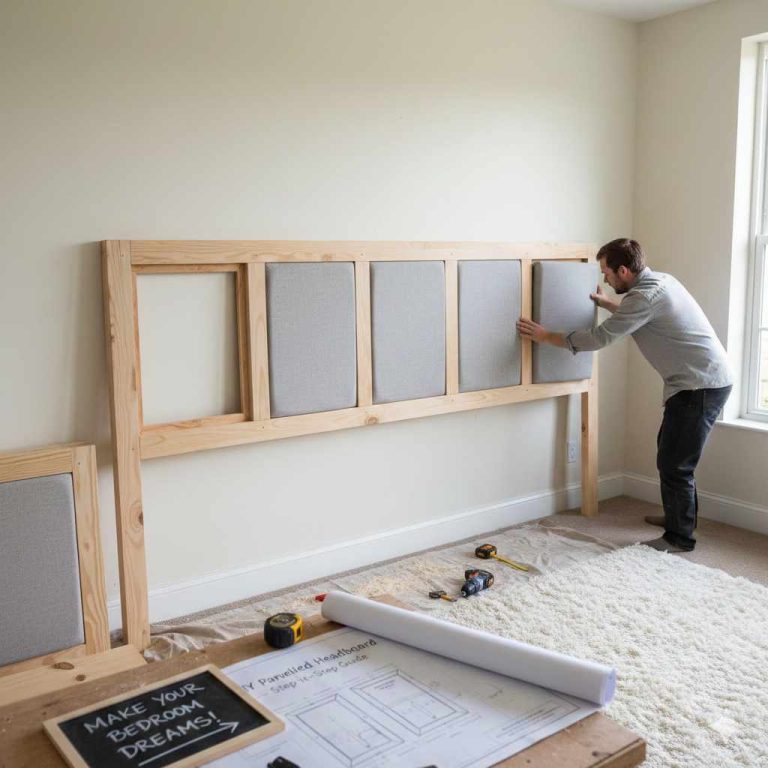
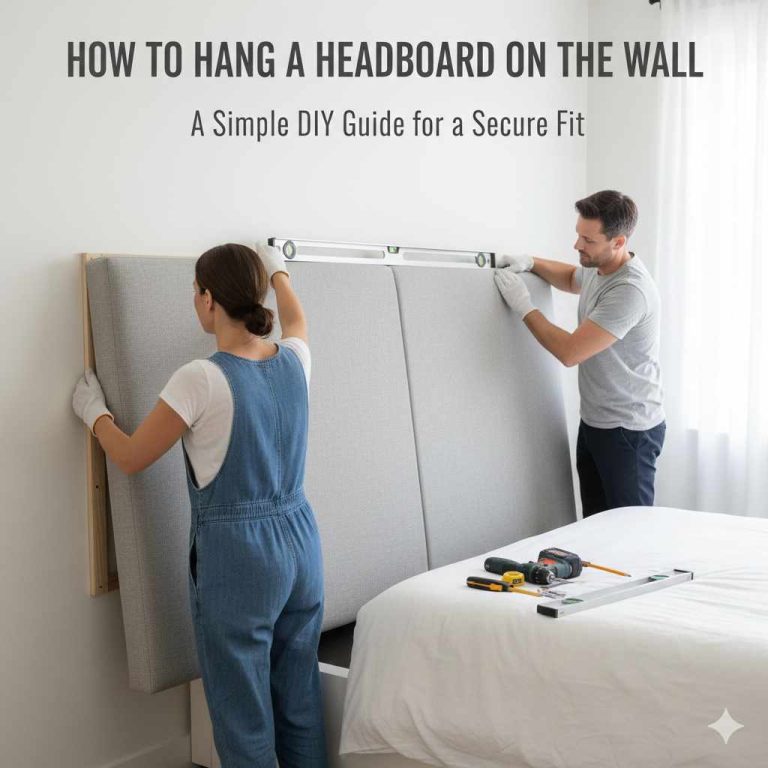
For a wall-mounting cleat, cut a 2×4 to the width of the headboard and screw it to the wall studs. Screw a matching cleat to the back of the headboard, then hook them together. This is the most secure method.
Rental-Friendly Mounting Without Drilling
If you rent, use a bed frame with legs that have holes for a headboard. Most metal bed frames have them. Attach the headboard directly to the frame using bolts and nuts — no wall holes. For a heavier headboard, use a French cleat on the wall but fill the holes with spackle when you move out. You can also use heavy-duty adhesive strips rated for 20+ pounds, but they work best on smooth walls and with lighter headboards (like the MAQQL panels, which are lightweight).
Another trick: build a freestanding headboard by adding two legs (2x4s) to the back, then lean it against the wall. No mounting at all, but it can slide if you lean hard.
Troubleshooting: Fixing Wrinkles and Sagging Later
Two years in, your headboard might develop wrinkles or sagging fabric. It happens, especially with cheap foam or thin batting. Here’s how to fix it.
Wrinkles: If the fabric is loose, re-staple it. Remove the staples along the offending edge, pull the fabric tighter, and re-staple. For small wrinkles, use a damp cloth and a hot iron (on the fabric’s back side) to shrink the fabric slightly — but test on a scrap first.
Sagging foam: If the foam has compressed, replace it. Remove the fabric and batting, pull out the old foam, and cut new foam to the same shape. Reassemble. It’s a few hours of work, but it’s cheaper than a new headboard.
Loose corners: If the mitered corners have popped, fold the fabric back, apply fabric glue to the plywood, and press it down. Staple again for extra security.
For regular cleaning, vacuum the fabric monthly and spot-clean with a mild detergent. Check out this fabric headboard cleaning guide for more details.
Cost Breakdown: Under $30 vs. Premium Build
Here’s what you’ll actually spend.
- Budget build: Use 1/2-inch plywood (free if you have scrap), 1-inch foam ($20), a cheap manual staple gun ($15), and fabric from a remnant bin ($15). Total: under $50, but you’ll feel the quality difference.
- Standard build: 3/4-inch plywood ($25), 2-inch foam ($45), batting ($10), fabric ($40 for 3 yards of polyester), electric staple gun ($40). Total: $160. This is the sweet spot for durability.
- Premium build: Hardwood plywood ($50), high-density foam ($80), designer fabric ($100+), nailhead trim ($30), pneumatic stapler (rental $20). Total: $280+. You’re paying for materials, not labor.
The standard build is what I recommend. It costs about the same as a cheap store-bought headboard, but it’s solid wood and made to your specs.
Your Bedroom Upgrade Awaits
Building a DIY fabric headboard is a weekend project that pays off every night. You get a custom piece that fits your space, your style, and your budget. The key is to pick durable materials and mount it securely, so it lasts for years.
- Measure your bed frame width and decide on height before cutting plywood.
- Choose fabric based on how you live — pets, kids, spills — not just looks.
- Add extra yardage for patterned fabric with large repeats.
- Use 3/4-inch plywood and 2-inch foam for a sturdy, comfortable headboard.
- Practice mitered corners on scrap fabric to avoid frustration.
- Mount with a wall cleat for permanence or bed frame brackets for rentals.
- Fix wrinkles and sagging early — re-staple or replace foam before it worsens.
If you want a faster, no-tools option, the MAQQL wall-mounted panels are a solid alternative. But for a truly custom piece, grab your plywood and staple gun — you’ll be glad you did.
Products related to this article
Sponsored / affiliate links. As an Amazon Associate I earn from qualifying purchases. I may earn additional commission from eligible campaigns.