You’ve been there: a beautiful pork chop, seared dark on the outside, but the moment you cut into it, it’s dry, chalky, and about as exciting as a boiled shoe. The problem isn’t the meat. It’s the method. Most people treat pork chops like chicken breasts—cook them until they’re white all the way through, then wonder why they taste like cardboard.
Here’s the truth: pork chops are more like steak than chicken. They need high heat, a good sear, and a little respect for carryover cooking. In this guide, you’ll learn exactly how to cook pork chops in a skillet so they come out golden, crusty, and juicy every single time. No brining overnight. No complicated equipment. Just a few techniques that fix the most common problems.

Lodge
Lodge Pre-Seasoned Cast Iron Skillet with Silicone…
- Versatile Cooking Skillet: The Lodge Cast Iron Skillet is a multipurpose, everyday cooking pan that excels at searing, sautéing, b…
- Pre-Seasoned & PFAS-Free: This pre-seasoned skillet is made with 100% natural vegetable oil for a naturally nonstick finish and is…
- Superior Heat Distribution: The heavy-duty cast iron frying pan cooks evenly, making it ideal for precision recipes and consistent…
As an Amazon Associate I earn from qualifying purchases.
And the right pan makes a real difference. I use a Lodge Pre-Seasoned Cast Iron Skillet for this recipe because it holds heat like a brick and gives you that deep, even crust you can’t get from a thin nonstick pan. It’s pre-seasoned, so it’s ready to cook on day one, and the silicone handle holder means you won’t burn your hand when you’re moving it around. You can use stainless steel too, but cast iron is my pick for the job.
Why Skillet Pork Chops Fail (And How to Fix It)
Let’s skip the theory and name the three reasons your pork chops end up tough and dry.
- You’re cooking thin chops like they’re steaks. Thin-cut chops (under 1 inch) cook fast and dry out before you get a good crust. Thick-cut chops (1 to 1.5 inches) give you time to build a crust without overcooking the center.
- You’re flipping too often. Every time you flip, you’re moving the meat around. That prevents a crust from forming. Leave it alone for 3 to 4 minutes per side.
- You’re skipping the rest. Pork needs to rest after cooking to let the juices redistribute. Cut into it too soon, and all that moisture ends up on the cutting board, not in your mouth.
Fix those three things, and you’re 80% of the way there. The rest is technique.
The Best Pork Chops for Skillet Cooking
Not all pork chops are created equal. Here’s what to look for.
- Bone-in vs. boneless: Bone-in chops (like rib chops or loin chops) have more flavor and stay juicier because the bone insulates the meat. Boneless chops are easier to eat but dry out faster. If you go boneless, get the thickest ones you can find.
- Thickness matters: Aim for at least 1 inch thick. Thick-cut chops (1.5 inches) are ideal for skillet cooking because you can sear the outside without overcooking the inside.
- Look for marbling: A little fat running through the meat means more flavor and moisture. Lean chops are the ones that turn out dry.
If you can buy from a local butcher or a farm, do it. The flavor difference is real. But even grocery-store chops work with the right technique.
The Secret: A 30-Minute Dry Brine
Most recipes tell you to season right before cooking. That’s a mistake. Salt needs time to work its way into the meat, not just sit on the surface.
A dry brine is simple: salt the chops on both sides and let them sit for 30 minutes at room temperature. During that time, the salt draws out some moisture, then the moisture reabsorbs into the meat, carrying the salt with it. The result is a chop that’s seasoned all the way through, not just on the outside.
Here’s the exact process:
- Pat the chops dry with paper towels. This is crucial—moisture is the enemy of a good crust.
- Sprinkle kosher salt on both sides. Use about 1/2 teaspoon per chop, depending on thickness.
- Place the chops on a plate or rack and let them sit for 30 minutes.
- After 30 minutes, pat them dry again. You’ll see moisture on the surface—that’s the brine doing its job.
If you have more time, 2 hours is even better. But 30 minutes is enough to make a noticeable difference.
How to Sear Pork Chops to Golden Perfection
Now for the main event. Here’s how to cook pork chops in a skillet with a crust that shatters and a center that’s juicy.
Step 1: Pat Dry and Season
After the dry brine, pat the chops dry again. Then add your other seasonings—black pepper, garlic powder, paprika, or whatever you like. Don’t add more salt; the brine already did that.
Step 2: Get the Pan Screaming Hot
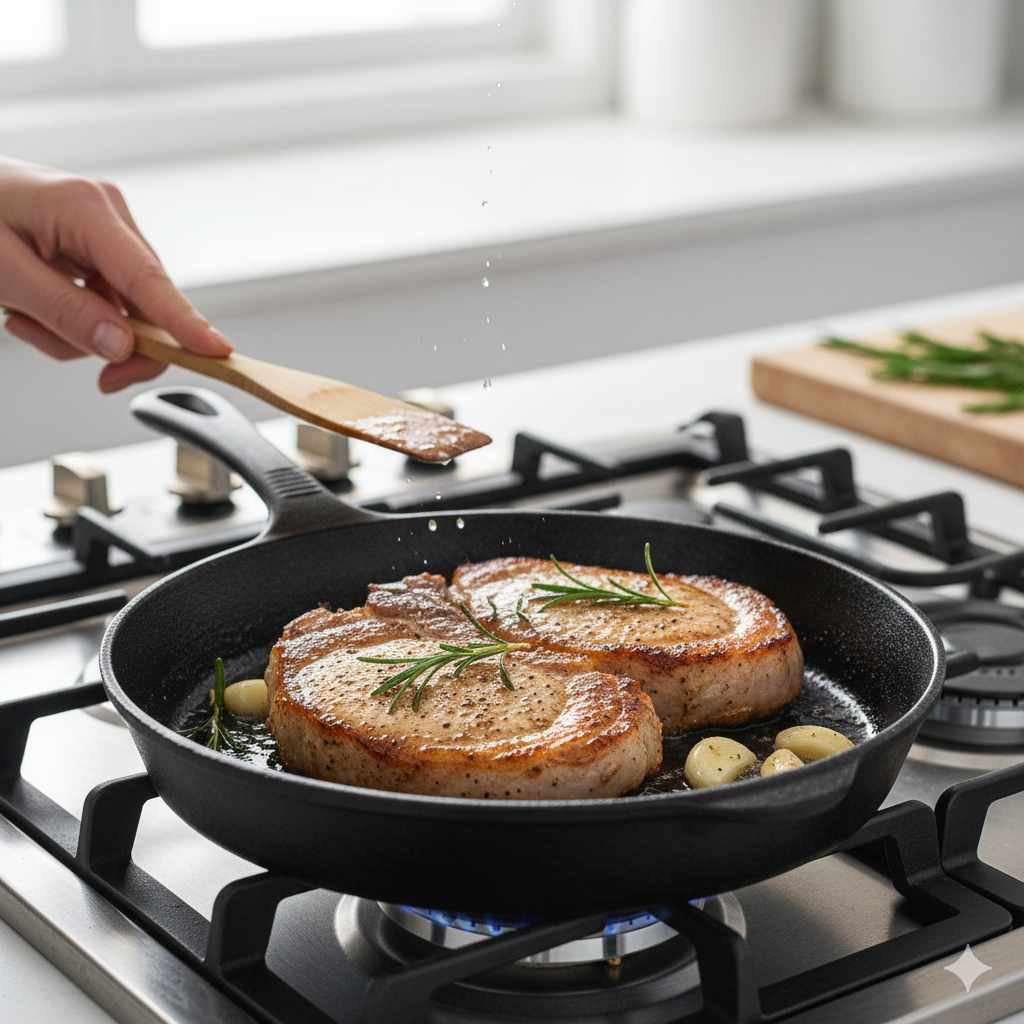
Place your cast iron skillet over medium-high heat for 3 to 4 minutes. You want it hot enough that a drop of water dances on the surface and evaporates instantly. Add a high-smoke-point oil (like canola or grapeseed) and swirl to coat the bottom. You should see a slight shimmer, not smoke.
Step 3: The Sear and the Flip
Lay the chops in the pan. Don’t crowd them—leave at least an inch of space between each chop. If you crowd the pan, the temperature drops, and the chops steam instead of sear.
Cook for 3 to 4 minutes without moving them. You’ll see the edges turn brown. Flip once and cook the other side for another 3 to 4 minutes. If you’re using a thick chop (1.5 inches), you might need an extra minute per side.
Pro tip: Use your finger to press on the chop. If it feels like the flesh between your thumb and forefinger when your hand is relaxed, it’s medium-rare. If it feels like the base of your thumb when you touch your thumb and pinky together, it’s well done. That’s the finger test—more on that below.
How to Tell When Pork Chops Are Done (Without a Thermometer)
Thermometers are great, but not everyone has one. And you can learn to judge doneness by touch and sight.
- The finger test: Press the center of the chop with your index finger. Compare the firmness to the fleshy part of your palm just below your thumb. If it feels like that relaxed muscle, it’s medium-rare (145°F). If it feels firmer, it’s more done.
- Visual cues: Look at the color of the juices. When you press the chop, if the juice runs clear (not pink), it’s done. If it’s still pink, it needs more time. Also, the meat should be opaque all the way to the center, with just a hint of pink in the middle if you like it medium.
Remember, the temperature will rise another 5 to 10 degrees while the chop rests. So if you pull it off the heat when it’s 140°F, it’ll hit 145°F by the time you serve it. That’s carryover cooking—use it to your advantage.
Butter Basting vs. Oil: Which is Better?
Oil gives you a clean, neutral sear. Butter adds flavor but burns at high temperatures. So which should you use?
Here’s the thing: you don’t have to choose. Start with oil for the sear, then add butter at the end for flavor.
The process: after you flip the chop, add a tablespoon of butter and a few thyme sprigs or a crushed garlic clove to the pan. Tilt the pan slightly and use a spoon to baste the melting butter over the top of the chop. Do this for the last minute or two of cooking. The butter browns and adds a nutty, rich flavor that oil can’t match.
If you’re using a nonstick pan, be careful—butter burns at 350°F, and nonstick pans are usually not rated for high heat. Cast iron or stainless steel handle the heat better.
| Pan Type | Best For | Watch Out For |
|---|---|---|
| Cast Iron | High-heat searing, even crust | Heavy, needs oil to prevent sticking |
| Stainless Steel | Even browning, pan sauce | Food sticks unless properly preheated |
| Nonstick | Delicate fish, eggs | Not for high heat, no fond for pan sauce |
For pork chops, I go cast iron every time. The heat retention is unmatched, and the fond (the browned bits left in the pan) makes the best pan sauce.
The Perfect Pan Sauce (In 2 Minutes)
Once your chops are resting, don’t wash the pan. That browned residue is pure flavor.
- Remove excess oil, leaving about a tablespoon.
- Add a minced shallot or garlic and cook for 30 seconds until fragrant.
- Pour in 1/2 cup of chicken broth or white wine. Scrape the bottom with a wooden spoon to release the fond.
- Let it bubble and reduce by half, about 1 minute.
- Stir in a tablespoon of cold butter to thicken and shine the sauce.
Pour it over your chops and thank me later.
How to Avoid Tough, Chewy Pork Chops
The #1 mistake is overcooking. But there’s another culprit: cutting into the meat too soon. Rest your chops for 5 minutes under a loose piece of foil. This allows the juices to redistribute. If you cut immediately, the juices run out, and you’re left with dry meat.
Another mistake is cooking cold chops straight from the fridge. Let them sit at room temperature for 15 to 20 minutes before cooking. This ensures even cooking—otherwise, the outside is done while the inside is still cold.
One more: don’t press down on the chops with your spatula. That squeezes out the juices. Let them sear naturally.
What to Serve with Skillet Pork Chops
You’ve got the perfect chop. Now what goes on the plate?
- Mashed potatoes or roasted potatoes
- Green beans or asparagus sautéed in the same pan
- Applesauce or sautéed apples—classic pairing
- A simple green salad with a vinaigrette
- Rice pilaf or buttered noodles
The pan sauce adds richness, so keep the sides simple. You don’t want to compete with the pork.
Storage, Freezing, and Reheating Leftovers
Leftover pork chops are a gift. Here’s how to keep them good.
- Storage: Wrap in foil or place in an airtight container. Refrigerate for up to 4 days.
- Freezing: Wrap each chop individually in plastic wrap, then place in a freezer bag. They’ll keep for up to 3 months.
- Reheating: The microwave will ruin the crust. Instead, reheat in a skillet over medium-low heat with a splash of broth or water, covered, for 3 to 4 minutes per side. This steams the meat and keeps it moist.
For frozen chops, thaw overnight in the fridge before reheating.
Frequently Asked Questions
How long does it take to cook pork chops in a skillet?
For a 1-inch thick chop, about 6 to 8 minutes total (3 to 4 minutes per side). For a 1.5-inch chop, 8 to 10 minutes. Always use the finger test or a thermometer to check doneness.
Should I use bone-in or boneless pork chops for skillet cooking?
Bone-in chops are more forgiving because the bone helps conduct heat and keeps the meat moist. They also have more flavor. If you go boneless, get thick-cut (at least 1 inch) and be extra careful not to overcook.
Can I use olive oil to sear pork chops?
Extra-virgin olive oil has a low smoke point (about 375°F) and will burn at high heat, leaving a bitter taste. Use a neutral oil like canola, grapeseed, or avocado oil for the sear, then add butter at the end for flavor.
What internal temperature should pork chops be?
The USDA recommends 145°F, followed by a 3-minute rest. That gives you a slightly pink center—safe and juicy. If you prefer well done, go to 160°F, but expect drier meat.
Why is my pork chop rubbery?
Rubbery texture comes from overcooking or cooking at too low a heat. High heat creates a crust quickly, sealing in moisture. Low heat dries out the meat before it browns. Also, make sure you’re not overcrowding the pan, which causes steaming.
More Easy Pork Chop Recipes
Once you’ve mastered the basic skillet method, try these variations:
- Pan-seared pork chops with garlic butter
- Simple skillet pork chops with apples
- Cast iron steak technique—same principles apply to pork
Each recipe builds on the same fundamentals: dry brine, hot pan, don’t crowd, rest. Master those, and you can cook any protein in a skillet.
What Actually Matters: A Quick Recap
- Buy thick-cut, bone-in chops if you can—they’re more forgiving.
- Dry brine for at least 30 minutes—it’s the easiest flavor upgrade.
- Pat the chops completely dry before searing—moisture kills crust.
- Get the pan hot and use a high-smoke-point oil.
- Don’t crowd the pan, and don’t flip too often.
- Use the finger test or a thermometer to hit 145°F, then rest for 5 minutes.
- Make a quick pan sauce with the fond—it’s free flavor.
Now go buy some pork chops and give it a try. Your skillet will thank you.