How Much Does a Vintage Dresser Cost?
A vintage dresser usually costs about $150 to $1,200, with fair offers for common solid-wood pieces often landing around $300 to $800 after you factor in condition, era, and size. Antique dealers and marketplaces generally use the 100-year rule for the antique cutoff, so a piece made around 1925 or earlier is typically antique, while newer pieces are usually vintage. Miss the condition, construction, or transport costs, and you can overpay for damage, hard-to-find parts, or delivery that costs more than the dresser itself. This guide shows how to estimate a fair price from a listing by checking materials, age, condition, restoration needs, and shipping costs.
Vintage dresser price estimator
How do you estimate a fair listing price?
Start with the listing price, then adjust for condition, construction, age, and logistics. A clean, well-built dresser can hold value even with a few cosmetic flaws. A warped, smelly, or heavily altered piece can be worth far less than the asking price. A simple way to think about it is: listing price + transport + repairs = true cost.
| Price band | Typical condition | What you should see | Fair price range |
|---|---|---|---|
| Budget | Rough, incomplete, or damaged | Missing hardware, sticky drawers, finish loss, light water marks, repair needed | $75 to $250 |
| Midrange | Used but sound | Solid frame, working drawers, ordinary wear, minor veneer or finish wear | $250 to $500 |
| Strong value | Very good original condition | Stable joints, original pulls, good finish, little odor, clean drawer action | $500 to $900 |
| Premium | Exceptional, collectible, or branded | Known maker, desirable style, original finish, excellent construction, proven provenance | $900 to $1,200+ |
| Add-on cost | Typical trigger | What it usually covers | Common price range |
|---|---|---|---|
| Local pickup | Distance under about 30 miles | Buyer loads the piece; cost is often fuel and labor only | $0 to $75 |
| Regional delivery | In-town or nearby metro delivery | Curbside or one-person drop-off is common | $75 to $250 |
| National freight | Long-distance shipping | Carrier quote depends on size, weight, route, and handling class | $300 to $900+ |
| Drawer repair | Sticking, loose, or warped drawers | Planing, slide repair, joint glue-up, or hardware replacement | $50 to $200 |
| Refinishing | Strip, sand, stain, or paint | More labor if the old finish is damaged or uneven | $200 to $800+ |
That table is meant to help you price the real deal, not the ideal listing. A $300 dresser that needs $250 in freight and $150 in repairs is a different buy from a $450 local pickup piece with original pulls and smooth drawers. In practice, the better offer is the one that keeps the total cost aligned with the dresser’s likely resale or use value.
What should trigger a steep discount?
If the listing shows multiple red flags at once, the asking price should fall fast. Smoke odor, active moisture damage, broken drawer runners, missing feet, heavy veneer loss, and mismatched replacement hardware are all strong discount signals. A piece that is attractive in photos but unstable in person should be priced as a repair project, not as a finished dresser.
How do you read the price bands in practice?
Budget pieces usually make sense only when the buyer can repair or reuse them cheaply. Midrange dressers are the safest everyday buy because the frame is usable and the flaws are usually cosmetic. Strong-value and premium pieces need stronger proof, such as original finish, better hardware, or a known maker, to justify the higher price.
What era clues help with dating?
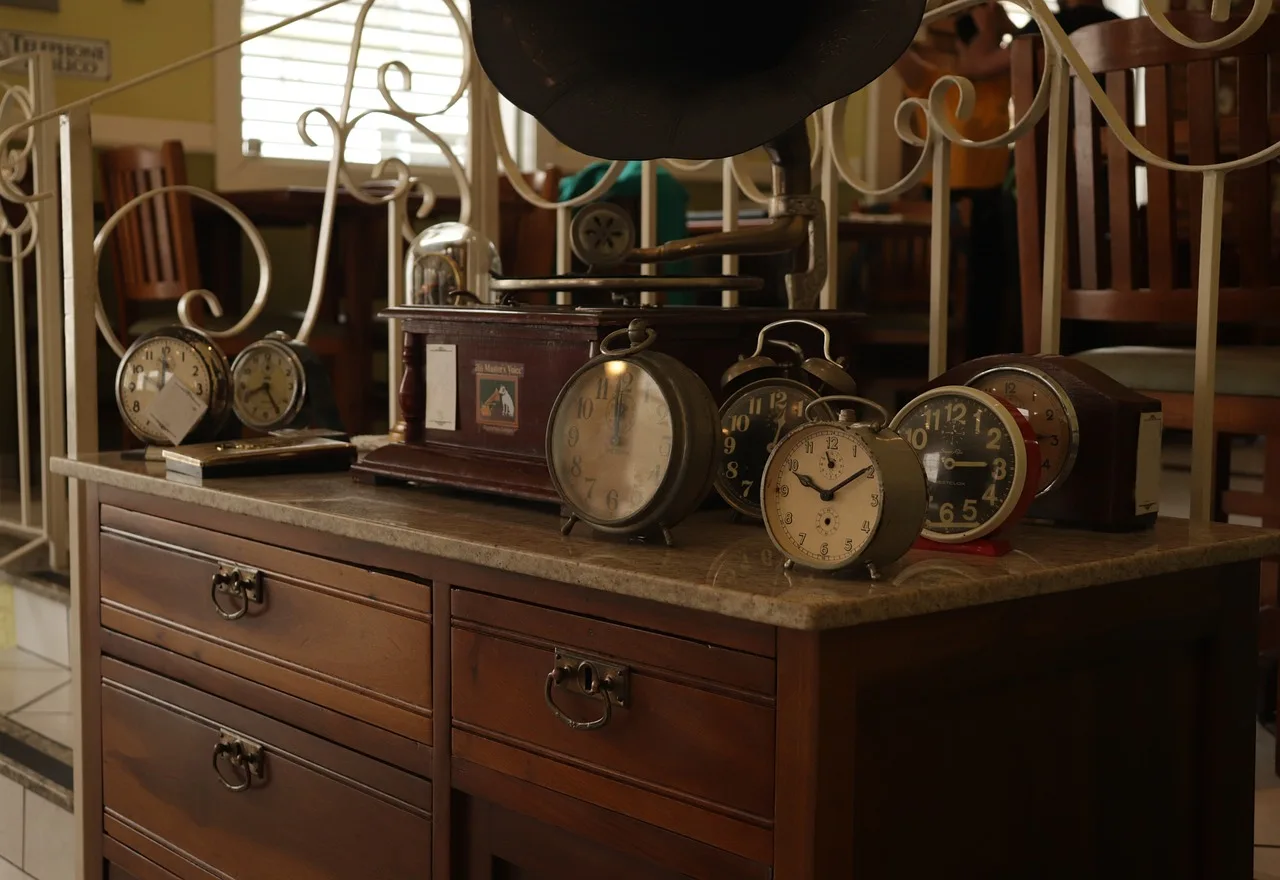
Construction details can point to a rough era even when the seller gives no date. Hand-cut or irregular dovetails, pegged joinery, and older-style hardware often suggest earlier production. Machine-cut dovetails, plywood bottoms, and standardized pulls usually point to mid-20th century or later. Finish, back construction, and the type of fasteners also help narrow the date.
What are good and bad dating signs?
Good signs include consistent wear, period-correct hardware, and drawers that fit the case well without obvious modern alterations. Bad signs include fake distressing, mismatched screws, modern drawer slides added to an old case, and a story that does not match the construction. If the age claim and the build details conflict, treat the dresser as newer until proven otherwise.
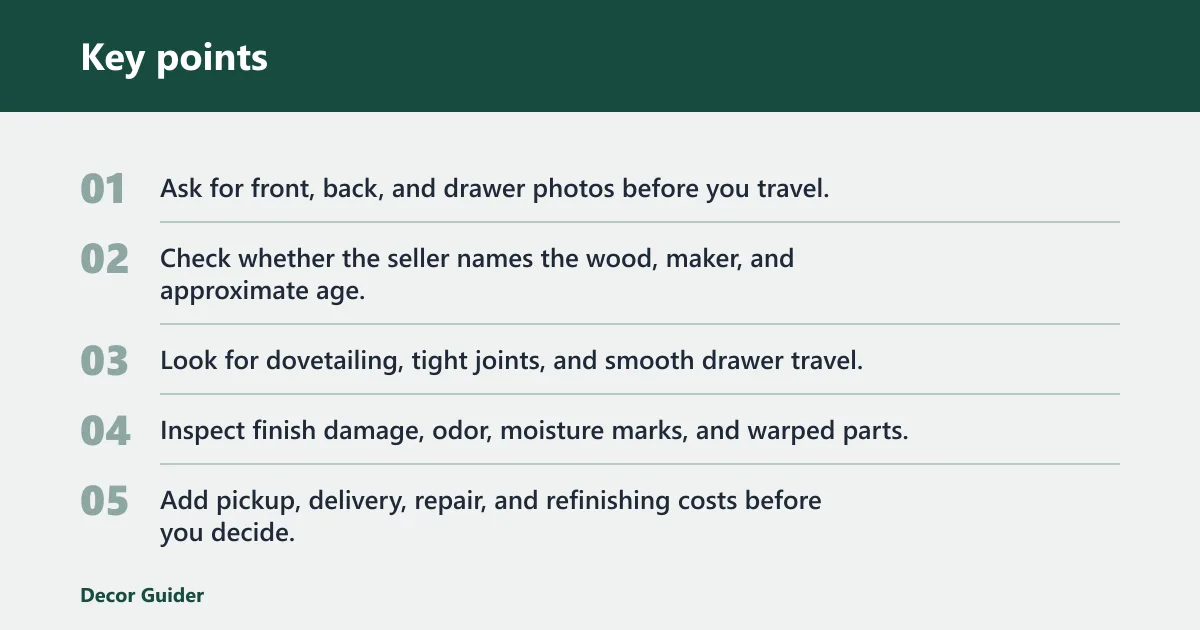
- Ask for front, back, and drawer photos before you travel.
- Check whether the seller names the wood, maker, and approximate age.
- Look for dovetailing, tight joints, and smooth drawer travel.
- Inspect finish damage, odor, moisture marks, and warped parts.
- Add pickup, delivery, repair, and refinishing costs before you decide.
What counts as vintage or antique?
How old does a dresser need to be to count as antique?
Antique dressers are generally 100 years old or more. That 100-year rule is widely used by antique marketplaces and dealers, so a dresser made around 1925 or earlier is commonly considered antique today. Vintage usually means old enough to be useful and interesting, but not old enough to clear that antique line.
Why does the age cutoff matter for price?
Age matters because older pieces can be scarcer, but maker marks, provenance, and condition can matter just as much, and sometimes more. Buyers often pay for authenticity, original details, and period appeal. A verified antique with period hardware can command a better offer than a later dresser with a similar silhouette.
Why era, maker marks, and provenance matter
Maker marks can help separate a generic piece from one tied to a known factory, designer, or regional workshop. Provenance can add value when the history is documented and believable. A dresser with a traceable maker and original hardware often commands more than a similar unmarked piece, especially in better condition.
When old does not mean valuable
Age alone does not make a dresser expensive. A damaged laminate piece from the midcentury period may sell for less than a newer solid-wood dresser with clean lines and strong joints. Buyers pay for usable structure, original details, and the cost of getting the piece into service.
How much does a vintage dresser cost?

What is a realistic used-price range?
Most vintage dressers fall between $150 and $1,200, but asking prices swing widely by condition and construction. Common solid-wood dressers in fair shape often land around $300 to $800. Rare styles, designer labels, original hardware, or a known maker can push the price higher.
How much do common market sources price them for?
Online marketplaces and local resale listings usually show the widest spread: rough pieces at the low end, usable midrange pieces in the middle, and branded or exceptional examples at the top. That spread is why a dresser in good original condition can cost many times more than a similar-sized piece that needs repair or transport.
Typical low, mid, and higher price bands
Low-priced listings usually have obvious wear, missing hardware, or repair needs. Midrange pieces tend to be structurally sound with cosmetic flaws. Higher-priced dressers usually combine strong materials, clean condition, and buyer appeal from the era or maker.
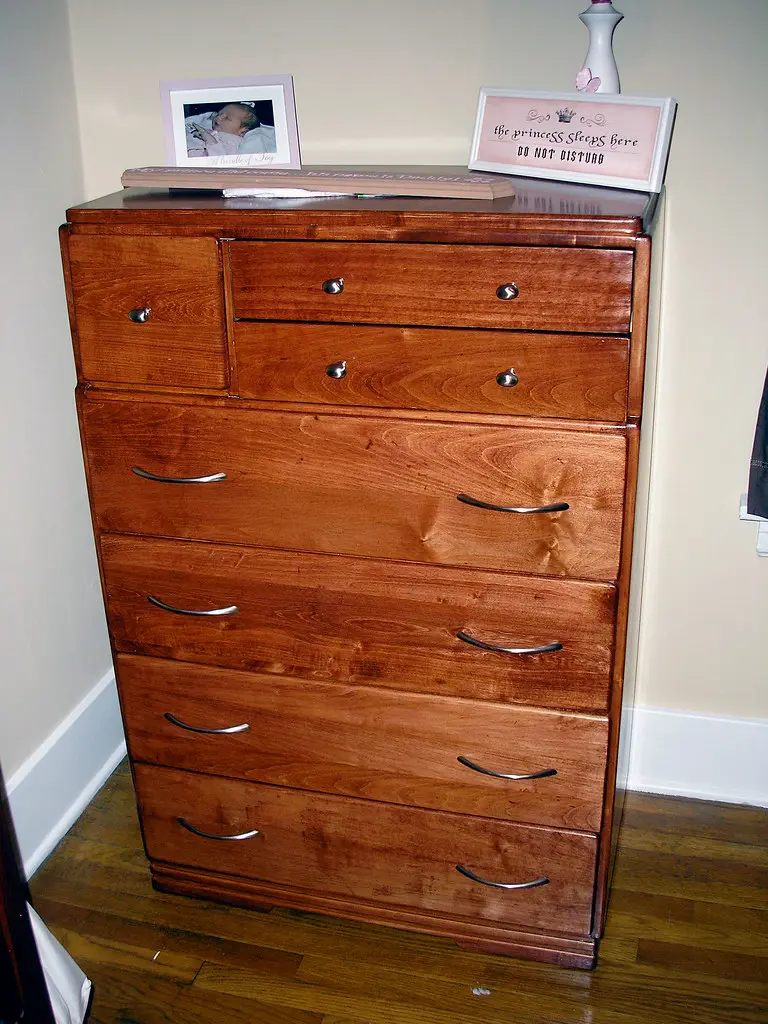
Say your local listing shows a 6-drawer maple dresser with original pulls, but one drawer sticks and the top has water rings. That piece may still be worth a fair offer if the frame is solid. The same dresser with warped sides and a smoke odor belongs in a lower band.
How condition changes the asking price
Condition affects both buying price and resale value. A refinished dresser can sell for less than an original-finish dresser if the refinishing removed patina, softened details, or replaced original hardware. Buyers often pay more for original surfaces when the finish is intact and clean, especially when the piece still has its original finish.
What sellers often leave out of the listing
Listings often omit odor, hidden water damage, missing hardware, drawer wobble, and prior repairs. Sellers may also leave out delivery limits. If the piece is large, heavy, or on an upper floor, the true cost can rise fast once pickup or freight is added.
What makes one dresser cost more?
Why do materials and construction matter so much?
Construction quality, materials, style, era, brand, and originality all move the price. Solid wood usually costs more than low-quality particleboard pieces because it repairs better and lasts longer. A dresser that keeps its original finish and hardware often earns a better offer than one that has been heavily altered.
Solid wood versus veneer, laminate, and MDF
Solid wood is usually the safest value bet because it tolerates sanding, minor repair, and hardware changes better than cheaper panel goods. Veneered wood can still be valuable, but damaged veneer is harder to fix cleanly. Laminate and MDF usually sell for less because repair options are narrower and moisture damage is harder to reverse.
Drawer construction, joints, and hardware quality
Look for dovetail joints, solid drawer bottoms, and runners that do not bind. Tight joints signal better construction and lower repair risk. Original pulls, knobs, and escutcheons can add value, especially when the set matches the piece and does not look swapped in from another dresser.
Style, era, brand, and original finish
Some styles attract more buyers because they fit current rooms or have collectible appeal. Midcentury dressers, Art Deco pieces, and older pine or maple dressers often move well when the proportions are right. A known brand or original finish can raise price, but only if the piece still looks honest and usable.
Why are vintage dressers so expensive? Because buyers are often paying for better wood, sturdier construction, and a style that is harder to find in modern flat-pack furniture. Scarcity matters too. A clean, well-made dresser with original hardware can cost far more than a plain modern piece of similar size.
How much do shipping and repairs add?
How do transport and repair costs change the total?
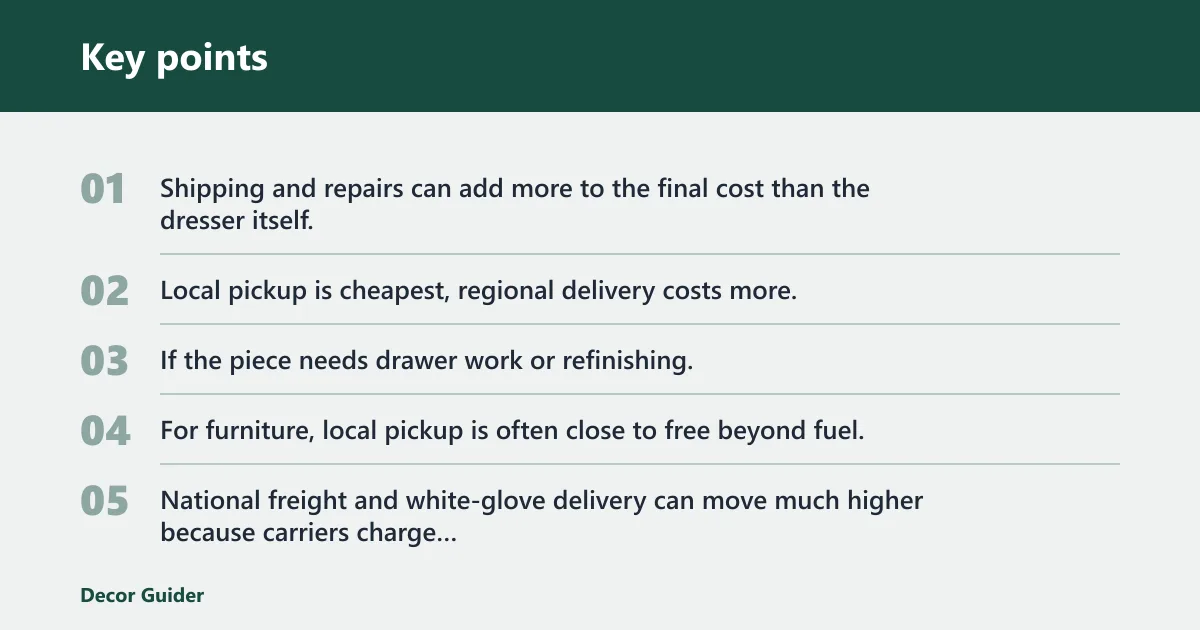
Shipping and repairs can add more to the final cost than the dresser itself. Local pickup is cheapest, regional delivery costs more, and national freight can quickly change the math. If the piece needs drawer work or refinishing, add those estimates before deciding whether the listing is a fair buy.
What are typical delivery and freight ranges?
For furniture, local pickup is often close to free beyond fuel, while regional delivery commonly runs into the low hundreds. National freight and white-glove delivery can move much higher because carriers charge for distance, size, weight, routing, and handling. Consumer moving and shipping quotes for bulky furniture frequently place long-distance transport in the several-hundred-dollar range.
Local pickup versus regional delivery
Local pickup often gives you the best price because the seller does not build in transport labor. Regional delivery is a middle ground, but it depends on route and timing. For heavy dressers, even a short trip can become expensive if the seller uses a delivery service instead of helping load it.
National freight and white-glove delivery
National freight pricing depends on distance, size, weight, handling class, and carrier quote variability. White-glove delivery adds inside placement and extra handling, which raises the bill. Large dressers with mirrors, marble tops, or fragile veneer need more protection, so damage risk and cost both climb.
Drawer repair, refinishing, sanding, and new hardware
The repair bill depends on what is wrong. A drawer that needs a small glue-up is one thing; warped runners or broken corners are another. Refinishing can be especially costly because it may require sanding, stripping, patching, staining, and new hardware, and the final result can still be worth less than the original if key details are lost.
A common first-timer mistake is buying a $200 dresser online and adding $180 for freight, then another $250 for drawer repair and refinishing. The piece may still be a good buy for personal use, but it is no longer a bargain if your goal is resale value.
Two worked pricing scenarios
Example one: a dresser is listed at $325, with $140 in regional delivery and $60 in minor drawer repair. The true cost is about $525, which may still be fair if the piece is solid wood and in good original condition. Example two: a dresser is listed at $475, but freight is $275 and refinishing is estimated at $350, pushing the true cost to roughly $1,100.
Where should you shop for a used dresser?
Which sources usually have the best value?
Thrift stores, estate sales, marketplaces, and Craigslist-style listings can all turn up used dressers, but the price and condition vary by region. Local pickup listings often cost less because sellers want a quick sale. Estate sales may have stronger original pieces, while marketplaces can offer more negotiating room.
Thrift stores, estate sales, and marketplaces
Thrift stores sometimes price dressers low if staff are moving inventory quickly. Estate sales can produce better-built pieces, especially older solid wood furniture, but prices may rise if the dresser is clearly collectible. Marketplaces give you the widest mix of quality, from rough pieces to branded dressers with provenance.
Craigslist-style listings and local pickup deals
Craigslist-style listings often favor buyers who can move quickly and pick up in person. That setup can lower the final price because the seller avoids delivery work. It also lets you inspect drawer fit, joints, finish damage, odor, moisture issues, and old repairs before money changes hands.
Regional price swings and bargaining room
Prices shift by city, suburb, and transport access. A dresser in a dense metro may cost more because demand is higher, but a rural listing may cost less and still become expensive after fuel or delivery. Bargaining room is best when the listing has visible flaws, missing hardware, or a long pickup window.
Suppose a seller in one region asks $425 for a walnut dresser with original pulls, while a similar piece in another region is listed at $275 but requires $150 in delivery. The lower sticker price may not be the better deal once you include the full cost to get it home.
Frequently asked questions
How much is a dresser?
A dresser can cost as little as $50 to $150 for a basic used piece and well over $1,000 for a branded or collectible one. The biggest drivers are condition, construction, size, and whether pickup or shipping is included. Solid wood, original hardware, and a clean finish usually raise the price.
How much does a dresser typically cost?
For a used or vintage dresser, a typical fair range is $150 to $1,200. Most common solid-wood pieces fall around $300 to $800 once you account for age, wear, and size. The same model can price very differently if it needs freight, repair, or refinishing.
Why are vintage dressers so expensive?
Vintage dressers cost more when they combine durable wood, better joinery, original hardware, and a style people want. Collectors also pay for maker marks, documented provenance, and pieces that have not been heavily altered. A clean original dresser can cost more than a refinished one if the original details are stronger.
How old is my antique dresser?
If the dresser is 100 years old or more, it fits the antique threshold. If it is younger, it is usually vintage or simply used. Maker marks, construction style, and hardware can help narrow the date, but provenance is what makes the age claim more persuasive to buyers.
Where can I buy a used dresser?
You can buy a used dresser at thrift stores, estate sales, online marketplaces, and Craigslist-style local listings. Each source has a different price pattern. Thrift stores may be cheapest, estate sales may offer stronger older pieces, and local listings often let you negotiate if the seller wants a quick pickup.
Is it cheaper to buy an old dresser and restore it?
Sometimes, but not always. Restoration is cheaper when the dresser is structurally sound, the finish problems are modest, and missing parts are easy to replace. If you need freight, drawer repair, refinishing, and new hardware, the total can pass the price of a better dresser that needs less work.
What affects the price of a used dresser?
Condition, wood type, drawer construction, style, age, brand, and originality all affect price. Shipping and pickup also matter because a low sticker price can hide a large transport bill. Damage such as odor, water marks, warped drawers, and missing hardware usually pushes the offer down.
Products related to this article
Sponsored / affiliate links. As an Amazon Associate I earn from qualifying purchases. I may earn additional commission from eligible campaigns.