How Much Does a Solid Wood Bookshelf Cost?
A solid wood bookshelf often costs about $150 to $600 store-bought, about $600 to $2,000 semi-custom, and roughly $2,000 or more custom, with larger dimensions and pricier hardwoods often driving the increase. Skip the tier breakdown and you can overpay for veneer or unstable joinery. This guide maps each price tier and the exact features that push a shelf into the next one.
What a solid wood bookshelf costs by type



Open bookcases are the lowest-cost solid wood option, while cabinet-front and library-style units move into premium pricing fast. Built-ins usually cost more than freestanding shelving because they add site fitting, scribing, finish carpentry, and more labor hours. Doors, trim, and a hardwood back panel also push the total up.
Solid wood bookshelf cost ladder
| Tier | Typical width/height | Estimated board feet | Likely species | Labor intensity | Realistic price range |
|---|---|---|---|---|---|
| Store-bought open bookcase | 30-36 in. wide, 60-72 in. tall | 18-28 | Pine or poplar | Low | $600 to $1,200 |
| Semi-custom solid wood bookcase | 36-48 in. wide, 72-84 in. tall | 38-52 | Red oak, hard maple, white oak | Medium | $1,200 to $4,800 |
| Custom or built-in library bookcase | 48-96 in. wide, 84-108 in. tall | 55-90+ | Cherry or walnut | High | $4,500 to $18,000+ |
The table is the cleanest way to read the market. The jump from open shelving to semi-custom is not just more wood, it is better joinery, more finish work, and more labor per unit. The jump from semi-custom to custom often comes from doors, cabinet bases, and built-in fitment.
Price bands by style
A pine or poplar painted bookcase with open shelves and plywood back typically sells for $600 to $1,200. A red oak bookcase with face frame, adjustable shelves, and stain finish typically sells for $1,200 to $2,200. A white oak craftsman bookcase is priced at $2,800 to $4,800.
A cherry bookcase with cabinet base and two doors runs $4,500 to $7,500. A walnut bookcase with glass upper doors and drawer base runs $7,000 to $12,000. A walnut library bookcase can cost $10,000 to $18,000 or more.
What drives the price?
The biggest cost drivers are easy to spot: hardwood species, overall size, shelf count, finish type, hardware, doors, and labor. Material cost can stay modest on a smaller open bookcase, while labor climbs quickly once the design adds a face frame, cabinet base, or custom fit around a wall.
Wood species and board-foot cost
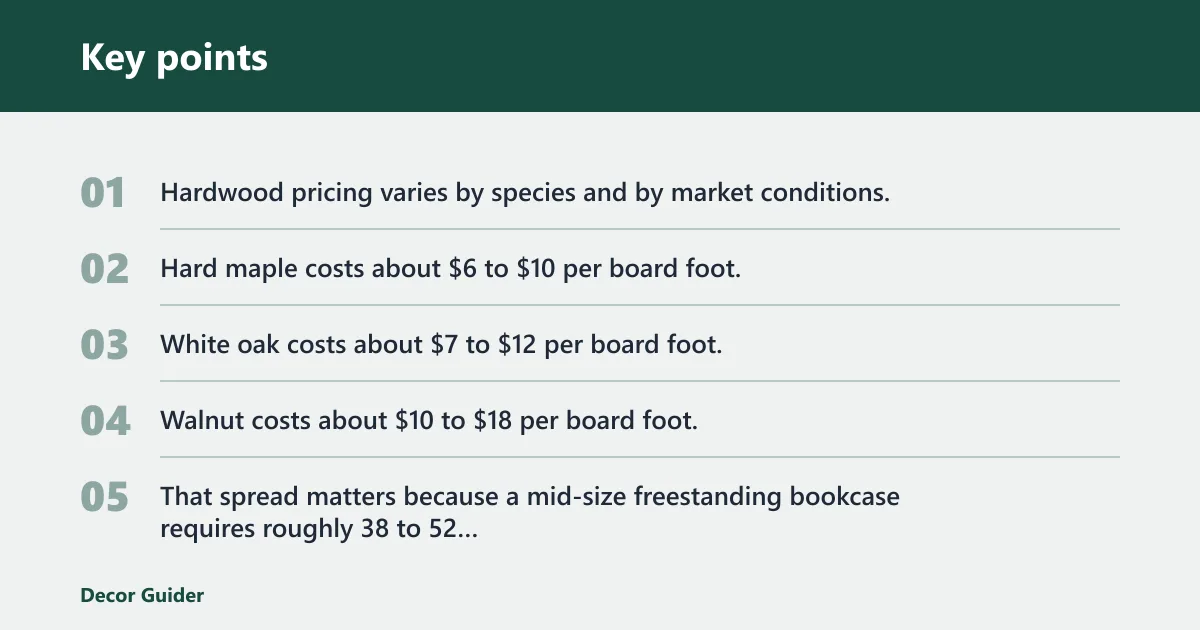
Hardwood pricing varies by species and by market conditions. Pine costs about $2 to $5 per board foot. Poplar costs about $3 to $6 per board foot. Red oak costs about $4 to $8 per board foot. Hard maple costs about $6 to $10 per board foot. White oak costs about $7 to $12 per board foot. Cherry costs about $7 to $11 per board foot. Walnut costs about $10 to $18 per board foot.
That spread matters because a mid-size freestanding bookcase requires roughly 38 to 52 board feet of hardwood including waste. On that basis, lumber alone can move from a few hundred dollars to well over $1,000 before labor, hardware, and finish are added.
Size, shelf count, and waste allowance
More width and height mean more board feet, more joinery, and more finishing surface. Extra shelves add material and labor, even when the design stays open. Waste allowance also matters because solid wood parts must be milled, trimmed, and sometimes remade if a board moves or defects appear.
Say your goal is a 36-inch-wide, 72-inch-tall open bookcase in red oak. The material bill is driven by a modest board-foot count, but the price still rises if you want extra adjustable shelves or a thicker top that looks more substantial.
Finish, hardware, and labor hours
Paint is often cheaper than a stain-grade clear finish, but the labor picture is more nuanced. Paint can require more prep and primer, while stain-grade work demands better wood selection and more care in sanding and matching. Adjustable shelf pins, hinges, pulls, door hardware, and a hardwood back all add cost.
For custom work, labor is often the largest line item. A common custom pricing structure includes direct materials, shop labor, overhead, and profit margin. A shop may price the job by estimating labor hours, then adding overhead and profit on top of wood, hardware, and finish materials.
| Upgrade | Cost impact | Why it adds money |
|---|---|---|
| Doors | High | Requires extra wood, hinges, pulls, fitment, and more labor |
| Crown molding | Medium to high | Adds material, cutting time, and finish work |
| Adjustable shelves | Medium | Needs shelf pins, drilling, and careful layout |
| Hardwood back | High | Uses more lumber than plywood and takes more time to install |
| Stain or painted finish | Medium | Prep, sanding, primer, topcoat, and drying time add labor |
Freestanding vs built-in bookshelves
A freestanding bookcase is usually cheaper than built-in shelving because it avoids site-specific carpentry. A built-in has to fit the wall, floor, and trim condition of the room, which often means scribing, shimming, casing work, and a cleaner finish at the edges. That extra labor is why built-ins usually sit in a higher price tier.
Why built-ins cost more
Built-ins often need custom dimensions, painted trim returns, a secured base, and a finish that blends into the room. If the unit includes cabinets at the bottom, glass doors above, or pilasters and crown molding, the labor hours rise again. The same material can cost far more once it becomes a built-in package.
When a freestanding unit is the better buy
Choose freestanding shelving when you want to move it later, keep the budget tighter, or avoid carpentry charges. It is the better buy when the room does not need a wall-to-wall fit and you can live with a standard width and height. For renters, it is usually the practical choice.
Suppose a buyer needs a 72-inch bookcase for a living room and may move in two years. A freestanding red oak unit keeps resale and relocation simple. A built-in would add cost that is hard to recover unless the home value justifies the upgrade.
Wood species and finish costs
Species choice changes both appearance and price. Pine and poplar sit at the low end. Red oak and hard maple land in the middle. White oak, cherry, and walnut move the project into premium pricing, especially once the design asks for book-matched faces, wide boards, or a stain that brings out the grain.
Painted versus stained finishes
Painted finishes are common on pine and poplar bookcases. Stain is more common on red oak, white oak, cherry, and walnut because it lets the wood read as wood. Stain-grade work usually costs more when the species has to look clean across large visible panels and shelf edges.
Back panels, doors, and trim upgrades
An open bookcase with a plywood back stays cheaper than one with a hardwood back or cabinet doors. A hardwood back adds both board feet and labor. Doors, crown molding, pilasters, and a drawer or cabinet base are the features that move a shelf into the library-style tier.
DIY solid wood bookshelf budget
A DIY bookshelf is not free, and it is rarely just the lumber. Budget for boards, screws, brackets, primer, paint or stain, clamps, sandpaper, and a mistakes buffer for cutoffs or boards that warp. Tools and safety gear can cost almost as much as the first project’s material list.
- Buy boards in the chosen species, plus extra for waste.
- Add screws, brackets, shelf pins, glue, and back-panel material.
- Include primer, paint or stain, and topcoat supplies.
- Set aside money for saw blades, sandpaper, and small tools.
- Buy safety gear such as eye protection, hearing protection, and a dust mask.
- Reserve a mistakes buffer for one or two wasted boards.
A simple DIY open bookcase can often be built on a materials budget that starts in the low hundreds if you already own the main tools. Once you factor in a saw, drill, clamps, finish supplies, and hardware, the true cash outlay can move much closer to the retail price of a basic store-bought unit.
What to buy at each budget
Use budget as a filter, then match it to the finish level you want. The cheapest path is open shelving in pine or poplar. The middle path is solid wood with a face frame, adjustable shelves, and a stain finish. The premium path is a custom or built-in library piece with doors, crown molding, and a cabinet base.
Lowest-cost open shelving
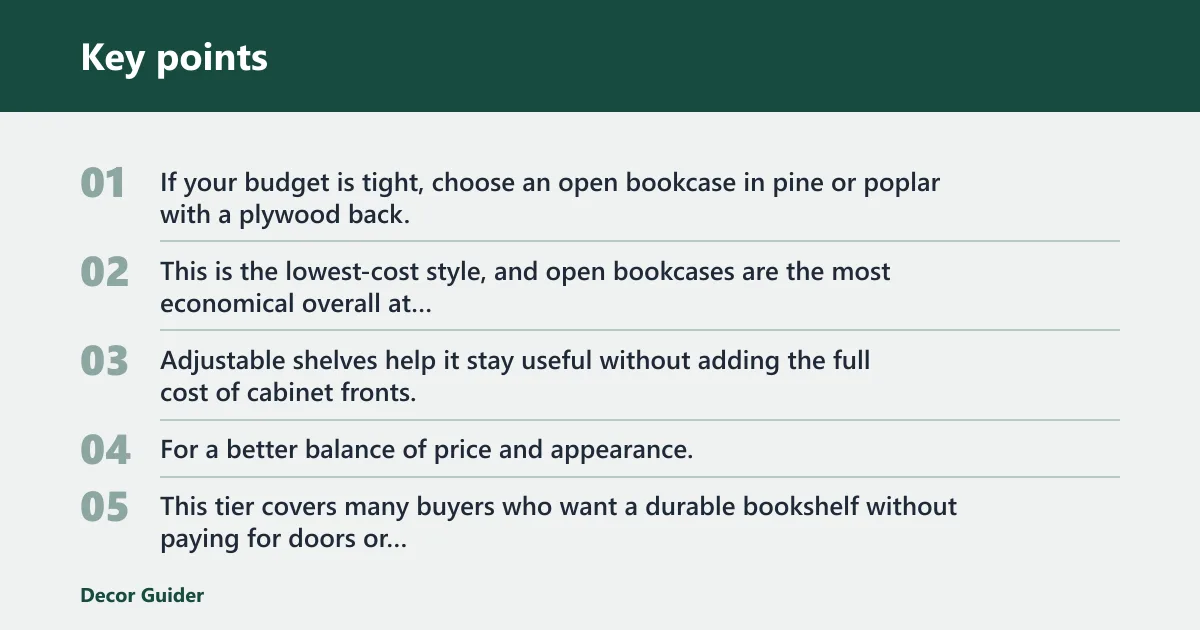
If your budget is tight, choose an open bookcase in pine or poplar with a plywood back. This is the lowest-cost style, and open bookcases are the most economical overall at $600 to $3,500. Adjustable shelves help it stay useful without adding the full cost of cabinet fronts.
Midrange solid wood options
For a better balance of price and appearance, look at red oak or hard maple with adjustable shelves and a simple face frame. This tier covers many buyers who want a durable bookshelf without paying for doors or built-in carpentry. It is also where material and labor start to separate more clearly.
Premium library-style choices
Choose a premium library-style bookcase when you want doors, crown molding, pilasters, and a drawer or cabinet base. That feature set belongs in the custom tier. Walnut and cherry are common species in that bracket because their board-foot cost and finish demands fit the higher price range.
What makes a solid wood bookshelf more expensive is usually not one thing. It is the stack: more board feet, a pricier species, tighter joinery, a better finish, and more labor. If two shelves look similar from across a room, the one with doors and a built-in fit can still cost several thousand dollars more.
Frequently asked questions
How much does a solid wood bookshelf cost?
The biggest jumps come from species, size, finish work, and whether the piece is freestanding or built in. Open shelving stays on the lower end.
How much is a bookshelf?
A bookshelf can be as low as a few hundred dollars for a basic open unit and climb into the five-figure range for a custom library piece. Solid wood, doors, cabinet bases, and built-in installation raise the price quickly. The cheapest solid wood style is usually open shelving.
What is the average cost of built-in bookshelves?
Built-in bookshelves often land above freestanding units because they need custom fitment, trim work, and more labor. For solid wood versions, the common range starts in the low thousands and can move well past that with doors, crown molding, and premium species. A walnut library bookcase can cost $10,000 to $18,000 or more.
How much does a custom bookcase cost in 2026?
A custom bookcase in 2026 commonly starts around $2,000 and can reach $18,000 or more for a walnut library-style build. Pricing reflects labor hours, overhead, profit margin, species choice, and finish complexity. Cabinet bases and glass doors push the total higher.
What makes a solid wood bookshelf more expensive?
Price rises with larger dimensions, more shelves, better species, doors, a hardwood back, trim, and a higher labor bill. Stain-grade finishing and built-in installation also add cost. A simple open pine or poplar unit stays cheaper than a white oak or walnut piece with cabinetry.
Is a freestanding bookcase cheaper than built-in shelving?
Yes. A freestanding bookcase is usually cheaper because it avoids custom carpentry, wall fitting, and trim work. Built-ins need more labor and often more finish detail. If your room does not need wall-to-wall coverage, freestanding shelving is usually the better value.
Products related to this article
Sponsored / affiliate links. As an Amazon Associate I earn from qualifying purchases. I may earn additional commission from eligible campaigns.