Balcony Rug Size Chart
For most apartment balconies, choose a rug that leaves 12 to 18 inches of bare floor around the edges, and keep at least 2 inches clear of the door swing so the rug lies flat and safe. Skip that margin and the rug can curl, hold water, block a sliding door, or make a narrow balcony feel tighter. This balcony rug size chart breaks down common balcony depths, furniture footprints, and clearance rules so you can pick a size that fits.
Balcony rug size basics
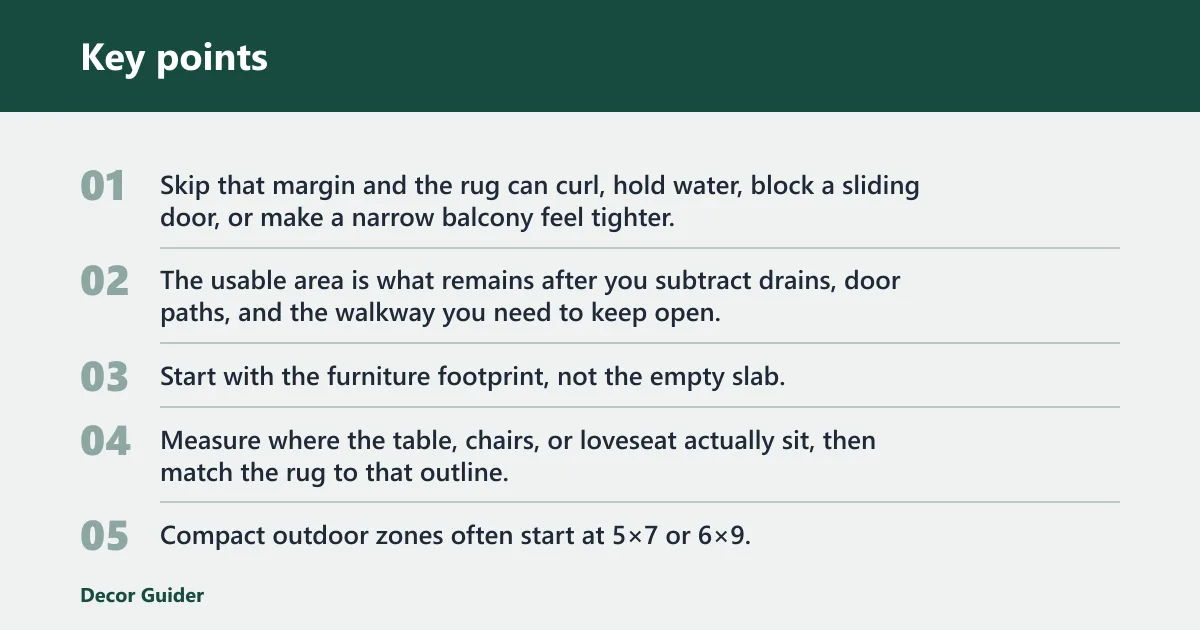


Balcony depth matters more than floor area. A wide-but-shallow balcony may fit a small table, but a deeper balcony can still fail if the door opens into the rug, the drain sits under the pile, or chairs need room to pull back. The usable area is what remains after you subtract drains, door paths, and the walkway you need to keep open.
Start with the furniture footprint, not the empty slab. Measure where the table, chairs, or loveseat actually sit, then match the rug to that outline. Compact outdoor zones often start at 5×7 or 6×9. Larger dining tables or sectionals often need 9×12 or 10×14, but balconies usually run out of depth before they run out of width. A 5×7 can also fail when the balcony seems large enough on paper but the chair pull-back zone, door swing, or drain takes away the usable depth.
Front-legs-on placement is a common compromise for outdoor seating groups. It keeps the furniture visually connected while leaving more exposed floor for drainage and walking space. For dining, the rule changes: chairs need more rug overhang so they stay on the rug when pulled out, which is why a dining layout usually needs more depth than a casual seating group of the same overall size.
How do you measure a balcony for a rug?
Measure the usable width and depth, then subtract anything that changes how the space works: door swing, drain access, rail cutouts, and a safe path along the railing. For a small balcony, the best rug size is the one that preserves circulation and still supports the furniture footprint you plan to use.
-
Measure usable width. Record the clear inside width from wall to wall, then subtract any jut-outs, rail posts, HVAC covers, or door trim that narrow the real walking area. Use the tightest point, because that is what controls rug fit.
-
Measure usable depth. Measure from the balcony door line to the railing, then subtract any drain strip, threshold bump, or step-down area that should stay exposed. The usable depth often decides whether a rectangle works or a runner is safer.
-
Map the furniture footprint. Place the table, chairs, or loveseat in their working position on paper or with tape. Include pulled-back chairs, chaise overhang, and side tables so the rug supports the actual layout instead of the closed-up version. A bistro table may look small in storage mode but need a much deeper footprint once two chairs are pulled out.
-
Mark clearance zones. Keep at least 2 inches clear of the door swing, leave a safe railing path, and preserve drain access. If the rug would cross any of those zones, reduce the size or switch to a runner.
-
Tape the outline. Use painter’s tape to mark the rug footprint on the floor before you buy. Walk the space, open the door, and pull chairs out to check for trip-edge avoidance and blocked circulation.
Suppose a balcony is 5 feet deep and 9 feet wide, with a sliding door that opens inward and a floor drain near one corner. A 6×9 rug may cover too much depth, but a 5×7 or runner can leave the drain open and keep the door track clear.
Balcony rug sizing matrix
This chart uses balcony depth, furniture footprint, and clearance needs first. It also shows when a runner is safer than a rectangle on a tight balcony.
| Balcony width × depth | Recommended rug size | Typical furniture pairing | Narrow balcony note | Door-swing risk | Runner safer? |
|---|---|---|---|---|---|
| Under 4 ft deep | Runner, 3×5, or 4×6 | Single chair, slim bistro stool, plant zone | Use only if the layout is mostly circulation; even a 5×7 usually overwhelms this depth | High if the door opens across the rug, especially on a hinged door | Yes, especially for long walkways |
| 4 to 5 ft deep | 5×7 | Two-seat bistro set or compact seating | Works only if the table footprint stays tight and chairs do not need a wide pull-back | Medium near hinged doors; lower with a sliding door if the track stays clear | Yes if width is long and depth is tight |
| 5 to 6 ft deep | 6×9 | Loveseat plus two chairs | Good balance for small conversation zones, but a 5×7 may feel undersized if the chairs need room to move | Medium if chairs sit close to the door line or if the rug reaches the threshold | Sometimes, if the balcony is very narrow |
| 6 to 8 ft deep | 8×10 | Four-seat conversation area or small dining set | Usually the first size that feels grounded; works best when the balcony can keep a walkway along the railing | Lower if the rug stays off the threshold and the door path remains open | Only if the balcony is long and slim |
| 8 ft deep or more | 9×12 | Larger dining table or sectional layout | Best when the balcony can hold a true room zone and still preserve walking room around the furniture | Lower if drains and paths stay open; higher if a hinged door swings into the layout | Usually no, unless the shape is a long corridor |
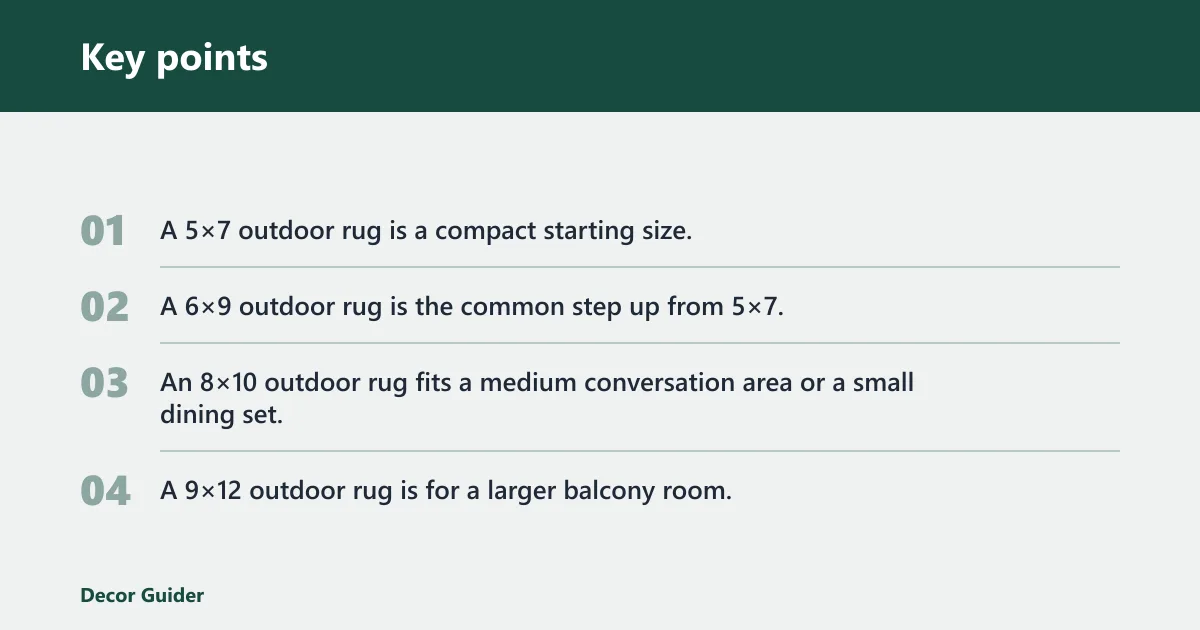
A 5×7 outdoor rug is a compact starting size. It works for a two-seat bistro setup or a small balcony seating zone, but it can be too large if the balcony is shallow, the door swing is tight, or the rug would block drain access. On a very narrow balcony, a runner may fit better than any rectangle, and a 5×7 can fail even when the total floor area sounds generous because the furniture, walkway, and door path all compete for the same depth.
A 6×9 outdoor rug is the common step up from 5×7. It fits a loveseat plus two chairs in many compact conversation layouts and gives enough surface to keep the group visually tied together. It still needs clearance at the door and enough exposed floor for water runoff, so it is a better choice when the balcony is deeper than it is wide or when the seating needs a more settled footprint.
An 8×10 outdoor rug fits a medium conversation area or a small dining set. It is a common size under four-seat conversation areas and often works for a four-seat rectangular table. On balconies, though, the depth has to be there first; otherwise the rug can crowd the railing path or push too close to the door line.
A 9×12 outdoor rug is for a larger balcony room. It can support a bigger sectional or a six-seat dining setup when the balcony has enough depth for chair pull-back and walking clearance. It is rarely the right first choice for a compact apartment balcony, and it is usually too much rug for a shallow layout even if the width looks generous.
What size rug works under a balcony bistro set?
A 5×7 rug is usually the starting point for a balcony bistro set, especially when the table is small and the chairs stay tucked in. If you need more chair clearance or the table is larger, a 6×9 can work better. On a tight, narrow balcony, a runner may solve the layout more cleanly than a rectangle.
5×7 for a tight bistro zone
A 5×7 outdoor rug fits the chart’s two-seat bistro starting size. It works when the table is compact, the chairs do not need a wide pull-back, and the rug can stay clear of the door path. Use it when you want the seating area anchored without covering the whole balcony.
When a 6×9 gives better chair clearance
Choose 6×9 when the bistro chairs need more room to move or when the table sits farther from the wall. This size gives more visual balance and more floor under the seats, which helps in a balcony that doubles as a pass-through. It is also a better fit when the table footprint feels small but the pulled-out chairs make the usable zone much larger.
When to skip a rectangle and use a runner
If the balcony is long and tight, a runner may be safer than a standard rectangle. A 2.5×8 or 3×10 can define the walkway without stealing the full depth, and it can leave the railing side open for traffic, drainage, and door clearance. This is especially useful when a hinged door opens into the space or when the balcony needs to keep a clear walking lane from the door to the railing.
Should balcony chair legs sit on the rug?
For small balcony seating groups, front-legs-on placement is usually the best compromise. It keeps the group connected, prevents the rug from feeling like a floating island, and preserves some exposed floor for drainage. All legs can sit on the rug only when the rug is large enough to hold the furniture in working position.
Front-legs-on placement for small seating groups
Use this rule for a loveseat, two chairs, or a compact conversation set. Place the front legs of the seating on the rug and leave the back legs off if the rug would otherwise crowd the walkway. This works well with 5×7 or 6×9 sizes on balconies.
A common first-timer mistake is choosing a rug that looks right under a tiny bistro set but ends up too small to extend beyond the balcony door swing. The rug seems large enough until one chair slides out and the back legs catch the edge. That is when the balcony feels cramped and the rug starts to shift.
When all legs can fit on the rug
All legs can sit on the rug when the balcony has enough depth for the furniture footprint plus chair pull-back. That is more realistic with 8×10 or 9×12 rugs on deeper balconies. If the rug still leaves clearance at the door and drain, the layout can feel more settled.
How much exposed floor to leave around the edges
Leave about 12 to 18 inches of bare floor around the edges when possible, and keep at least 2 inches clear of the door swing. That margin helps the rug lie flat, keeps the edge out of the traffic line, and leaves room for runoff near the railing and drains. It also gives you a little tolerance for product size variance, which can matter when a rug arrives slightly smaller or larger than the label suggests.
Which rug size fits a narrow balcony?
Runners are often the best answer for a narrow balcony. A standard rectangle can crowd circulation, block a door path, or sit over a drain, while a runner defines the space without consuming the full depth. Common runner sizes like 2.5×8 and 3×10 suit long, tight layouts better than oversized squares or rectangles.
Why runners fit long, tight layouts
Runners work when the balcony is more like a corridor than a room. They keep the center path open, let you preserve safe railing clearance, and reduce the chance that a chair leg catches a rug edge. They are especially useful when the usable depth is limited after subtracting drains and door swing, or when the balcony needs a continuous walking lane between the door and the railing.
2.5×8 and 3×10 as common runner sizes
These sizes are long enough to define a walkway and narrow enough to avoid blocking movement. Use 2.5×8 for slimmer balconies and 3×10 when you need a little more coverage across a longer run. Check actual product dimensions, since labeled sizes can vary by brand and the finished footprint may not match the listed size exactly.
When a standard rectangle crowds circulation
If a rectangle leaves less than a comfortable walking lane, it is too large for the balcony. That is true even if the furniture fits on paper. A rug that forces you to step around edges, dodge the door swing, cover a drain, or squeeze past a chair is the wrong shape for the space.
Frequently asked questions
What size rug for apartment balcony
For most apartment balconies, start with 5×7 or 6×9 for compact seating, 8×10 for a small dining set or four-seat conversation area, and 9×12 for a larger room-like layout. Use the furniture footprint and the usable depth after subtracting drains and paths to decide which size actually fits.
What size rug should I use on a small balcony?
A small balcony may be better served by a 3×5, 4×6, 5×7, or a runner instead of an oversized rectangle. Choose the size that leaves clear door swing space, protects the drain, and keeps at least some bare floor around the edge so the balcony does not feel blocked. If the layout needs a walkway more than a seating zone, a runner is often the better choice.
Is a 5×7 rug too big for a balcony?
Not always. A 5×7 is a compact starting size and can work well for a two-seat bistro set or a small seating zone. It is too big when the balcony is shallow, the rug blocks drain access, the door swing leaves less than the needed clearance, or a chair pull-back would push the furniture off the rug. In those cases, a runner or smaller rectangle is the safer fit.
Can I use a runner on a balcony?
Yes. A runner is often the safest choice on a long, narrow balcony because it defines the space without blocking circulation. Sizes like 2.5×8 and 3×10 work well when a standard rectangle would crowd the door path, cover a drain, or make the balcony feel tighter. It is also the better option when the usable depth is barely enough for a walkway and a small furniture footprint.
Products related to this article
Sponsored / affiliate links. As an Amazon Associate I earn from qualifying purchases. I may earn additional commission from eligible campaigns.