Septic Safe Toilet Paper: The Honest Lab Test You Need Before Your Next Purchase
You flush without thinking about it. That’s the whole point. But if you have a septic tank, every single sheet you flush is a tiny decision about the next few thousand dollars you might spend on a new drain field. Most people don’t realize their toilet paper choice is one of the few variables they actually control in that system.
This guide is a practical lab test, not a marketing brochure. We’ll break down what the word septic-safe actually means, show you how to test your current brand at home in under two minutes, and compare the top products on the market using cost-per-sheet math that matters. You’ll walk away knowing exactly which roll to buy and which ones to avoid.

Scott
Scott ComfortPlus Toilet Paper, 12 Triple Rolls,…
- WHAT’S INCLUDED — 12 Triple Rolls of Scott ComfortPlus Toilet Paper, 1-ply, 231 sheets per roll, 291.60 square feet total
- COMFORT’S NOT JUST A NAME — We made Scott ComfortPlus 3x thicker than the leading value brand so you can have extra comfort every…
- SOFTNESS + STRENGTH — Yes, Scott ComfortPlus is soft toilet paper, but we don’t stop there. Our bath tissue is also 4x stronger th…
As an Amazon Associate I earn from qualifying purchases.
For most households, the best septic safe toilet paper balances three things: fast breakdown, reasonable softness, and a price that doesn’t punish you. The Scott ComfortPlus 12 Triple Rolls fits that profile well. It’s a 1-ply tissue that’s 3x thicker than the leading value brand, yet it dissolves 10x faster than the national ultra-soft brands. That combination is rare. You get comfort without turning your septic tank into a sludge factory.
Why Septic-Safe Toilet Paper Matters More Than You Think
Your septic tank is a living ecosystem. Anaerobic bacteria break down solid waste, and the liquid effluent flows out to the drain field. The solids that don’t break down settle at the bottom as sludge. That sludge layer builds up over time, and when it gets too thick, it blocks the outlet pipe. Then you get backups, sewage smells in the yard, and a very expensive visit from a pump truck.
Toilet paper is a major contributor to that sludge layer. It’s not the only culprit, but it’s the one you control with a simple shopping decision. A roll that doesn’t break down quickly adds to the sludge. A roll that breaks down fast passes through the system and out to the drain field where it decomposes naturally.
The math gets worse the longer you ignore it. A family of four using a slow-dissolving brand can add several inches of sludge per year. You’ll pump the tank more often, and pumping costs money. The difference between a good brand and a bad one might be an extra pumping every two years. That’s a $300 to $500 difference.
What Actually Makes Toilet Paper Septic-Safe? (The Science of Breakdown)
Here’s the uncomfortable truth: septic-safe is not a regulated term. There is no government agency testing toilet paper and stamping it with an official septic-safe certification. The label is self-reported by manufacturers. That doesn’t mean it’s meaningless, but it does mean you should verify claims rather than trust them blindly.
What actually matters is how fast the paper breaks down in water. The fibers in toilet paper are held together by hydrogen bonds. When those bonds get wet, they release. The question is how quickly. A truly septic-safe paper should begin breaking apart within seconds of submersion and fully disintegrate within a minute or two of agitation.
Two factors drive this: fiber length and ply count.
Fiber Length vs. Ply Count: The Real Culprits
Long fibers make strong, soft paper. They also take longer to break down. Short fibers break apart quickly but feel rougher. Manufacturers blend them to balance comfort and breakdown speed.
Ply count matters more than most people realize. A 2-ply or 3-ply roll is essentially two or three sheets bonded together. That bonding creates a structure that resists water penetration. The paper stays intact longer in your pipes and tank. A 1-ply roll has no such structure, so it falls apart faster.
This is why the Scott ComfortPlus works well for septic systems. It’s 1-ply, so it lacks the layered structure that slows dissolution. The trade-off is that it feels thinner than a quilted 3-ply. You get used to it within a week, and your septic tank benefits every single day.
Bamboo toilet paper is a different story. Bamboo fibers are naturally short, so they break down quickly. That makes bamboo a strong candidate for septic systems. Recycled toilet paper also tends to break down fast because the recycling process shortens the fibers further. Both are good choices if you can tolerate the texture.
The Top 5 Septic-Safe Toilet Papers (Tested & Ranked)
Test these brands using the water glass method described below, plus a longer soak test to simulate tank conditions. We also calculated cost per sheet based on typical pack pricing. Check current prices on Amazon before you buy, since they fluctuate.
Best Overall: Cottonelle Ultra CleanCare
Cottonelle Ultra CleanCare is a 1-ply paper with a textured surface. It breaks down nearly as fast as Scott but feels softer. The texture helps you use fewer sheets, which reduces overall volume entering your tank. It’s not the cheapest option, but the balance of comfort and breakdown speed justifies the premium.
Best Budget: Scott 1000 Sheets
This is the value king. A single roll lasts a long time, and the 1-ply construction dissolves almost instantly in water. It’s not luxurious. It’s functional. If your priority is protecting the septic system and saving money, this is the pick.
Best Eco-Friendly: Seventh Generation Recycled
Seventh Generation uses 100% recycled paper, which means short fibers and fast breakdown. It’s also processed without chlorine bleach, so you’re not adding dioxins to your tank. The texture is a bit rough, but the environmental footprint is the lowest of any major brand.
Best Bamboo: Caboo Tree Free
Caboo makes paper from bamboo, which grows fast and doesn’t require tree harvesting. The fibers are short, so breakdown is quick. It’s softer than recycled paper and feels closer to a premium 2-ply. It’s pricier, but it’s a solid choice if you want both comfort and sustainability.
Best for RVs and Boats: Aqua-Soft
Aqua-Soft is designed specifically for RVs and boats where the plumbing is narrow and the tank is tiny. It’s a single-ply paper that dissolves almost immediately. It’s not meant for home use, but if you travel with a holding tank, this is the safest option.
The Water Glass Test: How to Verify Your Current Brand at Home
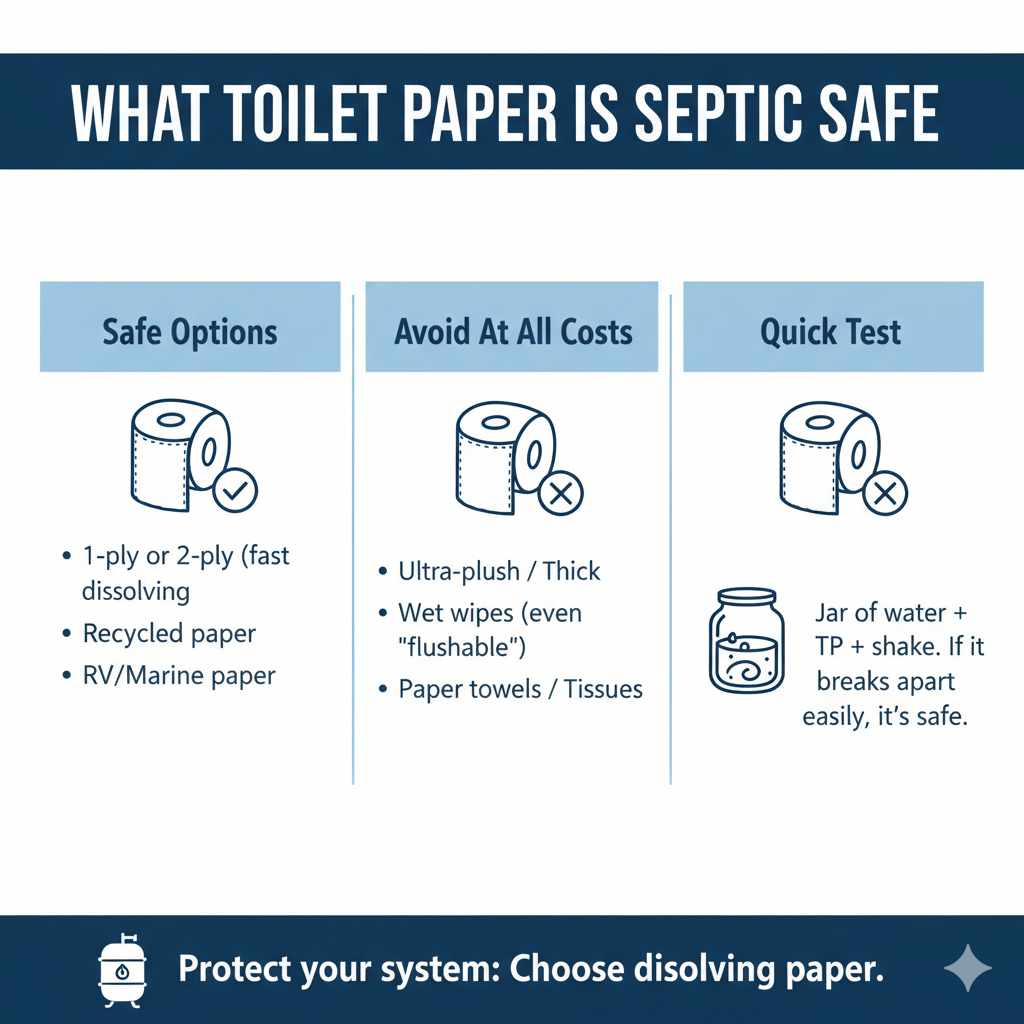
You don’t need a lab to test your toilet paper. You need a glass of water and thirty seconds.
- Fill a glass with room-temperature water.
- Tear off three sheets of your toilet paper.
- Crumple them loosely into a ball, just like you would when using it.
- Drop the ball into the water.
- Swirl the glass gently with a spoon, mimicking the motion of a flush.
- Wait 30 seconds and check the result.
A septic-safe paper will start breaking apart within 15 seconds. After 30 seconds, it should be visibly disintegrating into small pieces. After a minute, it should be mostly pulp. If the paper holds its shape after a full minute of swirling, it’s going to hold its shape in your septic tank too. That’s a red flag.
This test isn’t perfect. The agitation in a real flush is stronger than your spoon, and the water in your toilet is colder than room temperature. But the test gives you a clear relative comparison. Test your current brand against a known good one, and you’ll see the difference immediately.
Hard water makes the test more difficult. Minerals in hard water can interfere with the breakdown process slightly, so the paper may take a few extra seconds to dissolve. If you have hard water, account for that. A paper that takes 45 seconds in hard water might take 25 seconds in soft water.
Toilet Paper Brands to Avoid (And Why They Fail)
Quilted papers are the biggest offenders. The quilting process compresses the fibers into a dense pattern that resists water. Brands like Charmin Ultra Strong and Quilted Northern Ultra Plush are notorious for slow breakdown. They’re soft and comfortable, but they’re terrible for septic tanks.
Lotion-infused papers are worse. The lotion coating creates a hydrophobic barrier that prevents water from penetrating the sheet. These papers can take several minutes to break down, even with agitation. That’s a direct ticket to sludge buildup. Avoid them if you have a septic system.
Multi-ply papers in general are risky. A 3-ply sheet is three layers bonded together. That structure is strong enough to hold together in water for a surprisingly long time. Some 3-ply brands fail the water glass test entirely, holding their shape for over five minutes.
You don’t have to memorize every brand. Just apply the rule: if the paper feels thick and quilted, it’s probably not septic-safe. If it’s thin and flat, it probably is.
The Truth About Flushable Wipes and Paper Towels
Flushable wipes are a lie. The term flushable refers to the fact that they fit through your toilet drain, not that they break down. Most wipes are made from synthetic fibers that don’t decompose. They clog pumps, wrap around impellers, and create massive blockages in sewer lines.
Septic tanks are even worse for wipes. They don’t break down in the tank. They accumulate in the sludge layer and form mats that can block the outlet pipe. Plumbers report that wipes are the leading cause of residential sewer backups, ahead of grease and tree roots.
Paper towels are a similar problem. They’re made with longer, stronger fibers than toilet paper, and they’re designed to hold up when wet. That’s the opposite of what you want in a septic system. A paper towel can take weeks to break down. Never flush them.
The only thing that should go down your toilet is human waste and toilet paper. Everything else is a gamble with your plumbing.
Cost-Per-Sheet Analysis: Is Premium Worth It?
Pack prices are misleading. A 12-pack that costs more per roll might actually be cheaper per sheet if the rolls have more sheets. The only honest comparison is cost per sheet.
Budget brands like Scott 1000 Sheets typically run around $0.01 to $0.02 per sheet. Mid-range brands like Cottonelle run $0.02 to $0.03 per sheet. Premium bamboo brands like Caboo run $0.03 to $0.05 per sheet. The differences add up over a year.
Here’s the actual math for a family of four using about 100 sheets per day:
| Brand Type | Typical Cost per Sheet | Annual Cost (100 sheets/day) | Septic Impact |
|---|---|---|---|
| Budget (Scott 1000) | $0.01 – $0.02 | $36 – $73 | Excellent breakdown |
| Mid-range (Cottonelle) | $0.02 – $0.03 | $73 – $110 | Good breakdown |
| Premium Bamboo (Caboo) | $0.03 – $0.05 | $110 – $183 | Good breakdown |
| Quilted 3-Ply (Charmin) | $0.02 – $0.04 | $73 – $146 | Poor breakdown, sludge risk |
The premium brands cost two to three times more than budget options. You’re paying for softness and sustainability, not for septic safety. If your only concern is the health of your tank, the budget option is the rational choice.
There’s a hidden cost to using slow-dissolving paper that isn’t in the table. Extra pumping. If a quilted 3-ply brand forces you to pump your tank every two years instead of every four, that’s an additional $300 to $500 over a four-year period. That wipes out any savings from buying a cheaper pack.
For most people, the sweet spot is a mid-range 1-ply or a thin 2-ply that passes the water glass test. You get acceptable comfort and you don’t sacrifice your tank.
Frequently Asked Questions
Is septic-safe toilet paper regulated by any government agency?
No. There’s no federal or state certification for septic-safe toilet paper. The label is a marketing claim made by the manufacturer. Some brands do independent testing, but there’s no standard test they’re required to pass. Your best defense is the water glass test at home.
Does hard water affect how toilet paper breaks down in the tank?
Yes, hard water can slow the breakdown process. The minerals in hard water interfere with the hydrogen bonds that hold the paper together. The effect is small, but it’s measurable. If you have hard water, you should lean toward thinner, 1-ply papers that break down faster to compensate.
Can I use quilted toilet paper if I pump my septic tank more often?
Technically yes, but it’s a bad trade. You’ll spend more on pumping, and you’ll still risk sludge buildup between pumpings. The sludge layer from quilted paper is denser and harder to break down. Pumping more often mitigates the problem but doesn’t eliminate it. You’re better off switching to a septic-safe brand.
How does toilet paper choice affect how often I need to pump my tank?
Slow-dissolving paper adds to the sludge layer faster. A family using quilted 3-ply paper might need to pump every two years. The same family using a fast-dissolving 1-ply might go four years. That’s a significant cost difference. The dissolve rate of toilet paper is directly linked to your pumping schedule.
Are bamboo and recycled toilet papers always septic-safe?
Usually, but not always. Bamboo fibers are short and break down quickly, which is good. Recycled fibers are also short. However, some brands add lotion or quilting to these papers, which ruins their breakdown speed. Always check the label for additives and test the paper in water before trusting it.
Final Verdict: Which One Should You Buy?
- If you want the best balance of comfort, breakdown speed, and price, choose Cottonelle Ultra CleanCare.
- If you want to save money and don’t care about softness, choose Scott 1000 Sheets.
- If you want the most environmentally friendly option, choose Seventh Generation Recycled.
- If you want a bamboo paper that feels close to premium, choose Caboo Tree Free.
- If you’re outfitting an RV or boat, choose Aqua-Soft and nothing else.
- Test any new brand with the water glass test before you commit to a full pack.
- Never flush wipes, paper towels, or any paper that doesn’t dissolve in under a minute.
Your septic tank doesn’t care about brand loyalty. It cares about breakdown speed. Choose a paper that disintegrates fast, and your tank will reward you with years of trouble-free operation. Choose a quilted luxury roll, and you’re paying for a problem you’ll deal with later. The choice is yours, but now you know the math.
If you’re dealing with other bathroom issues, you might also want to check our guide on how to clean a toilet or learn about stopping a running toilet. Both are common problems that pair well with a septic system upgrade.
Products related to this article
Sponsored / affiliate links. As an Amazon Associate I earn from qualifying purchases. I may earn additional commission from eligible campaigns.