Can You Turn a Dresser Into a Bookshelf?
Yes, if the dresser is solid, stable, and at least as deep as the books you want to store, you can turn it into a bookshelf. A weak frame, loose joints, or a top-heavy layout can tip, sag, or split under book weight. This guide shows how to judge the dresser you have, choose the right conversion method, and build it safely.
Choosing the right dresser for book storage
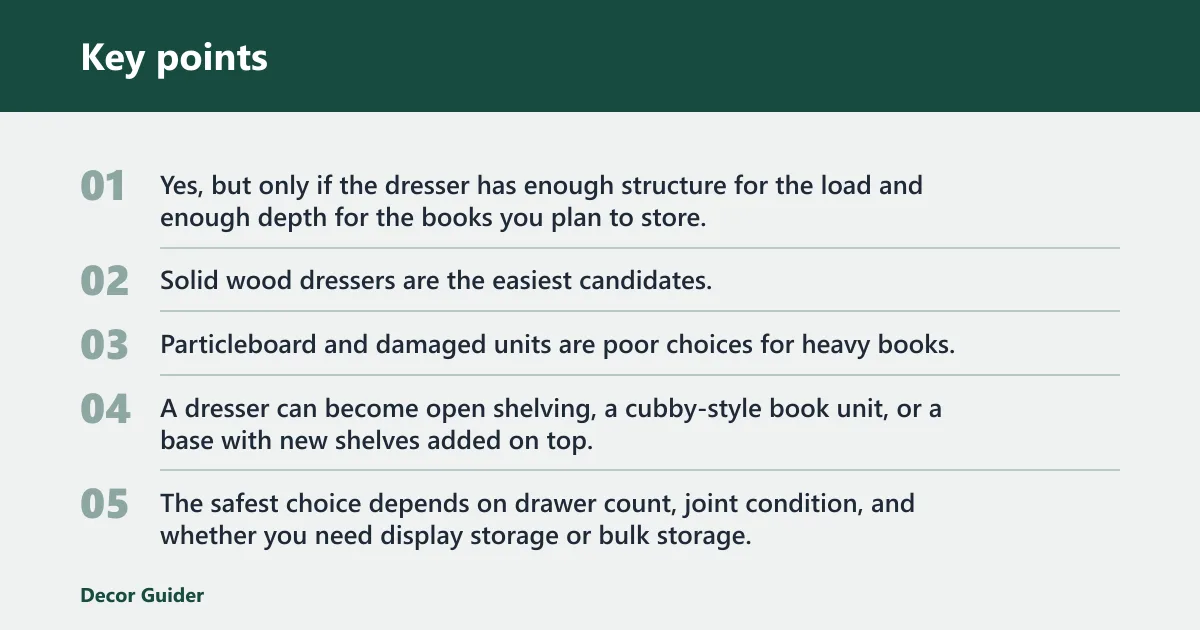


Yes, but only if the dresser has enough structure for the load and enough depth for the books you plan to store. Solid wood dressers are the easiest candidates. Veneer can work with careful prep. Particleboard and damaged units are poor choices for heavy books.
A dresser can become open shelving, a cubby-style book unit, or a base with new shelves added on top. The safest choice depends on drawer count, joint condition, and whether you need display storage or bulk storage.
When a dresser is a good candidate
Choose a dresser with straight sides, tight joints, and a back panel that is firmly attached. Drawer units with full-width fronts often work well for cubbies after the drawers are removed or reused. A deeper top also helps if you want large art books or hardcovers.
When to skip the project
Skip any dresser with swollen particleboard, warped drawer runners, split corners, or a loose back. If the unit already rocks on a flat floor, it is not a good base for books. Tall, narrow dressers with shallow footprints should also be wall anchored before they hold much weight.
Open shelving, cubbies, or a top shelf
Open shelving is best when you want visible books and easy access. Keeping drawers as cubbies works better for paperbacks, small board books, and mixed storage. Adding shelves on top suits a low dresser that can carry a few rows of books without losing drawer function below.
Dresser bookshelf decision matrix
Use this table to match the dresser you already have to the safest conversion path, the tools you will need, and a practical book load. The load figures below are use-case targets, not guarantees. If the dresser is damaged or unstable, reduce the load and anchor it to the wall.
| Dresser type | Best conversion path | Required tools | Stability risk | Recommended book load |
|---|---|---|---|---|
| Solid wood | Remove drawers or add top shelves | Drill, screws, sandpaper, primer, wood glue, air nailer, wall anchor kit | Low to moderate, depending on height | Heavy use: hardcovers on lower shelves, about 15 to 25 lb per shelf if the span is short and anchored. |
| Veneer | Keep drawers as cubbies or add a light top shelf | Sandpaper, filler, primer, screws, backing panel, wall anchor kit | Moderate, with edge-chip risk | Light to medium use: paperbacks and decor, about 10 to 15 lb per shelf |
| Particleboard | Keep drawers as cubbies only, if intact | Drill, screws, backing panel, edge banding, wall anchor kit | High | Light use only: paperbacks or collectibles, about 5 to 10 lb per section |
| Chest of drawers | Remove drawers for open shelving or use drawers as cubbies | Drill, screws, wood glue, air nailer, backing panel, wall anchor kit, optional casters | Moderate to high because of height | Medium use: mixed books on lower levels, keep heavy books low |
What you’ll need
- Measuring tape
- Level
- Drill and driver bits
- Screws for joinery and wall anchoring
- Wood glue for drawer assembly and joints
- Clamps for glued parts
- Air nailer with nails or staples, if you are rebuilding drawer boxes
- Sandpaper in medium and fine grits
- Primer for bare wood, especially latex primer for paint prep
- Paint or other finish
- Knobs and pulls for hardware replacement
- Backing panel or replacement hardboard
- Casters with locks, if you want rolling storage
- Bracket or strap wall anchor kit
How do you turn a dresser into a bookshelf?
Measure the dresser first, remove or reuse the drawers, and reinforce any parts that will carry books. Check width, depth, and height before you cut or drill. Sand the finish, repair worn spots, and paint or prime before you put parts back together. Then add shelves, cubbies, or a top surface sized for the books you plan to store.
-
Measure the unit.
Record width, depth, and height before you cut anything. Measure the tallest book, the deepest book, and the space between shelf points, so you know which volumes fit without crowding. -
Empty and remove drawers.
Take out every drawer and label the runners if you plan to reuse them. Keep the hardware if it still lines up, or replace it later with new knobs and pulls. -
Inspect the frame.
Look for loose joints, split corners, and a back panel that flexes. If the back is thin, replacement panels are available and can improve stiffness when fastened well. -
Sand and clean surfaces.
Use sandpaper to smooth rough spots and give paint something to grip. This matters most on veneer edges and glossy finishes. -
Prime bare wood.
Apply latex primer by brush or spray to exposed wood and repairs. Let it dry fully before paint, or the finish can peel at the corners. -
Build the storage layout.
Remove internal dividers for open shelves, or join old drawers into cubbies with wood glue and clamps. If you rebuild drawer boxes, add bottom reinforcement with 3/8-inch luan plywood where needed. -
Fasten the new parts.
Use screws for structure and an air nailer for speed on drawer assemblies. Glue alone is not enough for book weight. -
Finish and install.
Paint, replace knobs or pulls, and add casters only if the height change still leaves the piece stable. Locking casters matter when the unit will move across a room or under a bed.
Suppose you have a 48-inch-wide dresser with three wide drawers and a solid top. Removing the drawers and adding fixed shelves can work for hardcovers, but only if the back stays square and the unit is anchored. The same dresser with loose veneer and a cracked back should stay a light-duty storage piece.
How do you secure a dresser bookshelf?
A dresser bookshelf should be anchored to the wall anytime it is tall, narrow, or loaded with hardcovers. Books are dense, and the weight moves forward each time a drawer or shelf is opened. Wall anchoring is commonly recommended as the main defense against tip-over.
Wall anchoring basics
Use a strap or bracket made for furniture anchoring. Fasten it into a wall stud whenever possible. If the unit sits on casters, lock them before loading books, and expect the rolling height to change the center of gravity.
Reinforcing shelves and backs
Add a backing panel if the original back is flimsy or missing. A well-fit back panel reduces racking and helps the frame stay square. For shelves longer than about 24 inches, add a center support or reduce the book load to help prevent sag.
Caster and height tradeoffs
Casters can help in tight rooms or under-bed storage, but they raise the piece and make it easier to roll if unlocked. Choose locking casters only, and keep heavy books on the lowest level. If height becomes a problem, remove the casters and mount the dresser lower.
What mistakes should you avoid?
The most common mistake is treating every dresser like a ready-made bookcase. A dresser that looks sturdy can still fail if it is particleboard, warped, or missing its back. Heavy books on shallow shelves create the next problem: sag, split fasteners, or forward tipping.
- Do not load damaged particleboard with hardcovers.
- Do not skip wall anchoring on tall units.
- Do not use loose drawers as shelves without reinforcement.
- Do not leave long shelf spans unsupported.
- Do not paint over dirty, glossy, or un-sanded surfaces.
- Do not rely on knobs, pulls, or trim for strength.
A common first-timer mistake is keeping the dresser’s original drawer fronts in place and stacking books on top of them. That can look finished, but it does nothing for structure. If the drawers stay, use them as cubbies with bottoms that can support the load, or remove them entirely.
Prevention: Check the back panel, the joints, and the wall anchor before loading the first row of books. That sequence prevents most tip-over and sag problems.
How do you style a dresser bookshelf?
Style should follow structure. Use lower, deeper sections for heavier books and upper sections for lighter decor or paperbacks. A dresser bookshelf works best when the shelf spacing fits the tallest item in that section instead of forcing every opening to do the same job.
Book size and shelf spacing
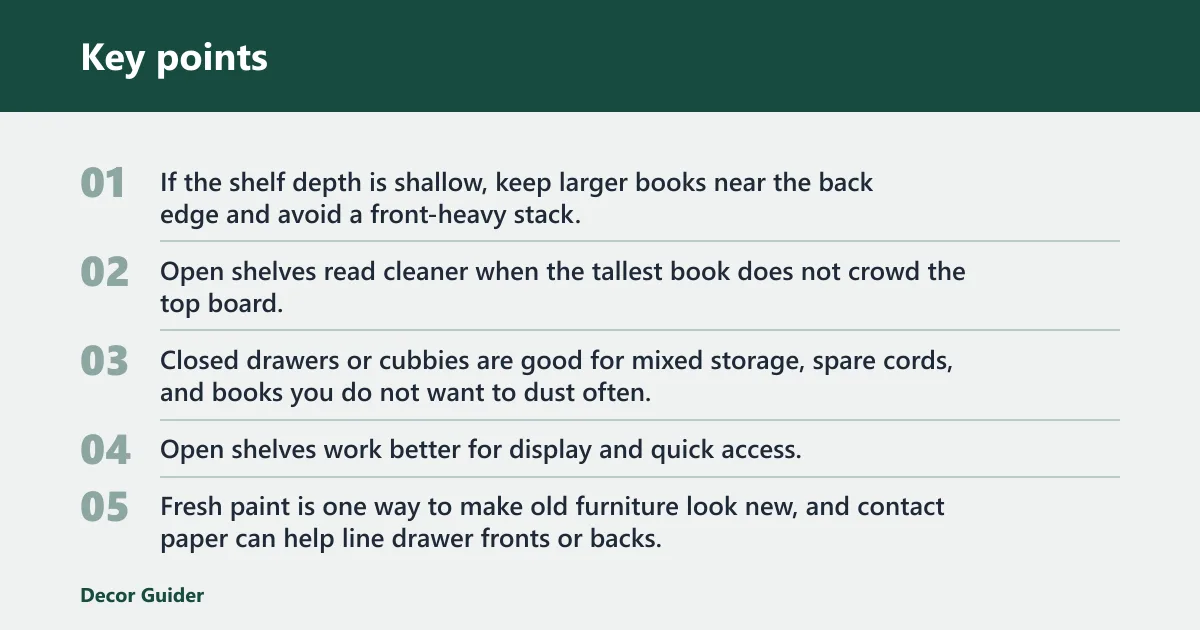
Paperbacks need less height than hardcovers, so use tighter spacing for small books and wider bays for art books or binders. If the shelf depth is shallow, keep larger books near the back edge and avoid a front-heavy stack. Open shelves read cleaner when the tallest book does not crowd the top board.
Closed storage versus display
Closed drawers or cubbies are good for mixed storage, spare cords, and books you do not want to dust often. Open shelves work better for display and quick access. If the room is tight, a shallow layout can suit a hallway or narrow walkway, while deeper storage belongs in a bedroom or office.
Hardware and finish choices
Fresh paint is one way to make old furniture look new, and contact paper can help line drawer fronts or backs. Swap mismatched knobs and pulls for hardware that lines up cleanly. Keep finishes simple if the piece will hold heavy books, because ornate trim can hide cracks and loose joints.
Frequently asked questions
Can you turn a dresser into a bookshelf?
Yes, if the dresser is solid and stable enough for books. Solid wood is the best starting point, while particleboard and damaged units need a lighter load. Anchor the finished piece to the wall and keep heavy books low.
What kind of dresser works best for a bookshelf makeover?
A solid wood dresser with straight sides, a firm back, and tight joints is the safest choice. A chest of drawers can work if you keep the height under control and anchor it. Veneer is workable with light to medium storage.
Can you use dresser drawers to make a bookshelf?
Yes. Old drawers can be joined together to make a small bookshelf, or reused as cubbies for small books and collectibles. Reinforce the bottoms, square the joints with glue and clamps, and fasten the assembly with screws or an air nailer.
How much weight can a dresser bookshelf hold?
There is no universal number. A short, anchored solid-wood shelf can usually handle more than a long span of particleboard. A practical approach is to keep heavier books on lower sections and limit long shelves to about 15 to 25 lb if the span is short and the supports are strong.
How do you secure a dresser bookshelf so it doesn’t tip over?
Use a furniture anchor into a wall stud, especially on tall or narrow units. Lock any casters before loading books. If the back panel is weak, replace it with a fitted panel so the frame stays square and resists racking.
Products related to this article
Sponsored / affiliate links. As an Amazon Associate I earn from qualifying purchases. I may earn additional commission from eligible campaigns.
 BATODA - 8" Floating Shelf Bracket Heavy Duty (16 pcs)–Solid Steel Blind Shelf Supports - Hidden Brackets for Floating Wood Shelves - Blind Shelf Support Shelving Mounting Hardware Included (Pack 16)
 4 Pack Shelf Brackets 12 Inch Floating Shelf Bracket 1/5 inch Thick Heavy Duty Hidden Shelf Brackets Iron Metal Brackets for Shelf Support with Screw Included