You stare at a closet full of clothes and still have nothing to wear. Sound familiar? You’ve got pieces you bought on sale with tags still attached, a few things you rotate on repeat, and a nagging feeling you spend too much on outfits you barely use. Clothing rental services promise a fix, but choosing between the two biggest names—Rent the Runway and Armoire—feels like a gamble. Both sound similar on paper: monthly subscription, designer clothes, free shipping both ways. The reality is they serve different kinds of people, and the right pick depends on how you actually dress.
This guide breaks down the real differences with numbers, not vibes. You’ll see a transparent cost-per-wear analysis for casual and heavy users, a look at how each service handles shipping, damage, and customer service, and a straight answer on which one matches your lifestyle. By the end, you’ll know exactly which box to check at checkout.

As an Amazon Associate I earn from qualifying purchases.
If you’re thinking about starting your own rental service after seeing how these models work, the business planning side matters too. A detailed template like Progressive Business Plan for a Subscription Clothing Rental Company walks through industry analysis and financial projections—useful if you’re exploring this space as an entrepreneur rather than a customer. It’s currently out of stock on Amazon, but worth checking back for.
The Core Difference: Unlimited vs. Curated
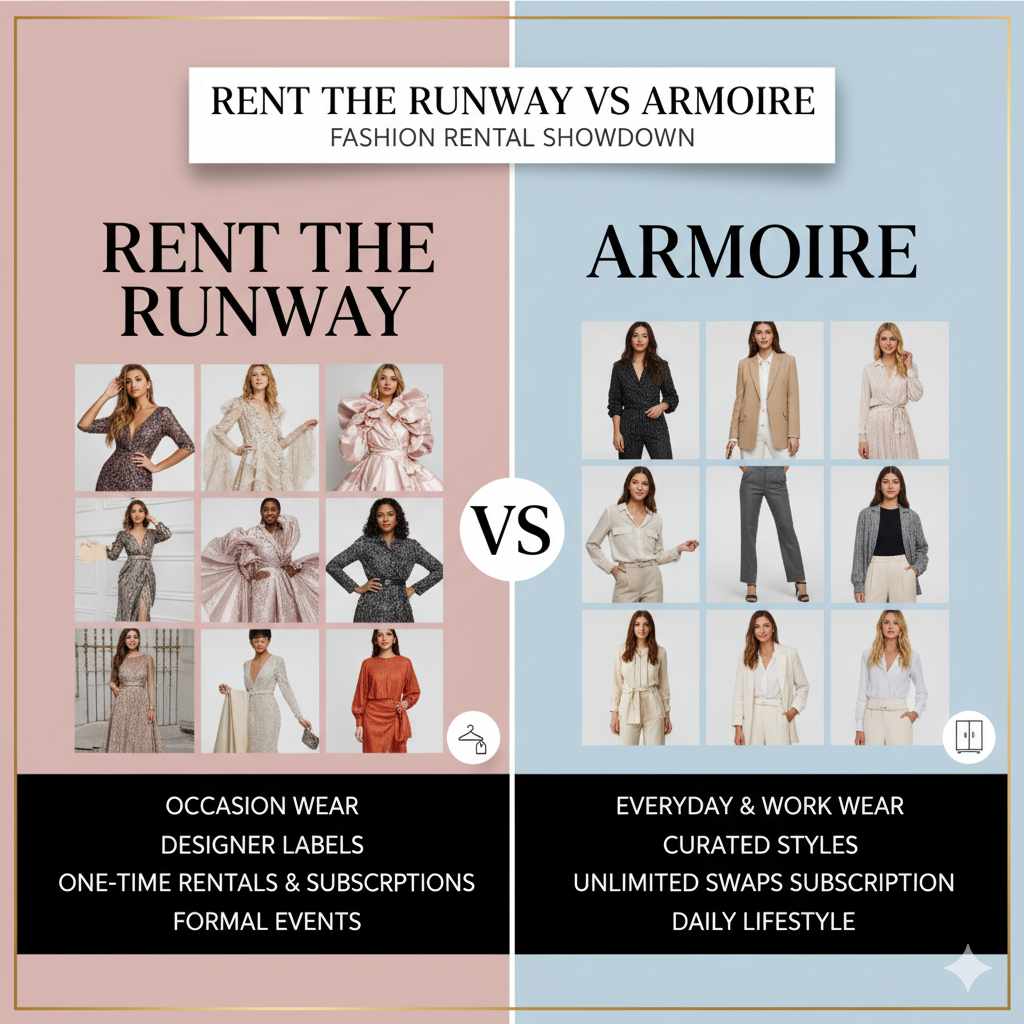
Rent the Runway operates on an unlimited model. You pick a plan tier, grab a set number of items at a time, and swap them as often as you want. The catalog is massive—hundreds of brands, thousands of styles, everything from workwear to formal gowns. You’re the one in charge. You browse, you pick, you wear, you return.
Armoire works differently. Instead of an open catalog, you get a stylist who curates a selection for you. You fill out a style profile covering sizes, colors, patterns, and brands you like. A human (with some algorithm help) picks pieces and sends them to you. You can swap items in your queue, but the starting point is someone else’s taste, not your own scrolling.
That distinction matters more than any price difference. Rent the Runway suits people who know exactly what they want and enjoy the hunt. Armoire suits people who want a wardrobe rotation without the decision fatigue. Neither is objectively better—it’s about whether you trust your own eye or prefer a second opinion.
One thing both services share: they’re not for people who need a single outfit for one event. They’re subscription models built for ongoing use, not one-off rentals. If you have a wedding next month and nothing else, a traditional rental site makes more sense than either of these.
Pricing Showdown: Which Plan Actually Saves You Money?
Let’s talk dollars. Rent the Runway’s plans start around $89 per month for four items at a time, with higher tiers for eight or ten items. Armoire’s pricing starts near $99 per month for three items at a time, scaling up to six or nine items depending on the plan. Those numbers shift with promotions and new member deals, so check current rates before committing.
The real question isn’t the sticker price—it’s cost per wear. Here’s how that breaks down for different usage patterns.
Cost-per-wear analysis for casual users
Say you’re a casual user: you rent two items per month and wear each one twice. That’s four wears total. At $89 per month for Rent the Runway, you’re paying roughly $22 per wear. Armoire at $99 per month gives you about $25 per wear. Neither is cheap, but compare that to buying a $120 dress you wear twice—that’s $60 per wear. Rental wins on paper.
The math flips if you’re a slow wearer. If you rent two items and wear each once, you’re paying $44 to $50 per wear. At that point, buying a sale item and donating it after one event starts to look smarter. Rental services only make sense when you wear pieces multiple times or swap frequently enough to drive the per-use cost down.
Cost-per-wear analysis for power users
Power users change the equation entirely. With Rent the Runway’s unlimited plan, you can cycle through items as fast as shipping allows. If you wear each item once and return it immediately, you might get 12 to 16 wears per month. At $89 per month, that’s $5.50 to $7.50 per wear. Armoire’s unlimited tier works similarly—you can swap as often as you like, so heavy users get exceptional value.
The catch is effort. Power users spend real time browsing, coordinating returns, and planning outfits around shipping windows. It’s a part-time hobby, not a passive service. If you love the process, the cost per wear gets absurdly low. If you hate logistics, you’ll burn out in a month.
One more thing: both services charge extra for premium brands or special occasion pieces. A gown from a top designer might require an additional fee on top of your subscription. That’s not hidden—it’s in the fine print—but it surprises people who assume everything’s included.
The Inventory Deep Dive: Brands, Styles, and Sizing
Rent the Runway’s catalog is the industry heavyweight. They carry over 700 brands, including names like Alice + Olivia, Vince, and Khaite. The selection spans workwear, weekend casual, and red carpet glam. New arrivals drop weekly, and the volume means you can almost always find something in your size.
Armoire’s inventory is smaller but more curated. They focus on contemporary brands like ASTR the Label, French Connection, and Sanctuary. The selection leans toward everyday wear—blouses, trousers, dresses you can wear to the office or dinner. You won’t find a ball gown here, but you’ll find a solid capsule wardrobe rotation.
Sizing is where things get tricky. Rent the Runway offers a wider range, including plus size up to 3X on many items. Armoire also carries plus sizes, but the selection is thinner. If you’re above a size 14, you’ll have more options with Rent the Runway, though neither service matches the size inclusivity of a dedicated plus-size retailer.
Maternity wear is another differentiator. Rent the Runway has a dedicated maternity section with bump-friendly styles from brands like Hatch and Ingrid & Isabel. Armoire doesn’t offer a specific maternity line, though some stretchy pieces might work. Expecting mothers should lean toward Rent the Runway unless they’re willing to dig through Armoire’s general inventory.
The Styling Experience: Human Touch vs. Algorithm
Armoire’s core pitch is personal styling. You get a dedicated stylist who reviews your profile, picks items, and adjusts based on your feedback. You can message them directly, request specific brands, and veto pieces you don’t like. The algorithm learns from your ratings, but a human makes the final call. That’s a genuine advantage if you want guidance or don’t trust your own shopping instincts.
Rent the Runway uses an algorithm-driven recommendation system. It tracks what you rent, what you rate, and what you search for, then suggests similar items. There’s no human stylist on call. You’re browsing a massive catalog on your own, which is great for control but overwhelming for indecisive shoppers.
In practice, Armoire’s stylists are responsive but not mind readers. They’ll nail your taste after a few rounds of feedback, but the first shipment might miss the mark. Rent the Runway’s algorithm is surprisingly good at surfacing pieces you’ll like, but it can’t ask clarifying questions. If you hate a color or need something for a specific event, you’re on your own.
There’s also the brand recognition factor. Rent the Runway’s larger catalog includes more recognizable designer names, which matters if you want labels that impress. Armoire’s brands are contemporary and stylish but less flashy. Neither is wrong—it depends on whether you dress for yourself or for the room.
Logistics: Shipping, Returns, and the Fine Print
Shipping speed differs noticeably. Rent the Runway offers standard shipping that takes 2-3 business days, with expedited options for an extra fee. Armoire ships via standard carriers with similar timelines, but their processing time feels slower because items are hand-picked by stylists rather than pulled from a warehouse. Expect 3-5 business days from order to doorstep with Armoire.
Return windows are where people get burned. Rent the Runway gives you unlimited time with items as long as you keep swapping. There’s no hard deadline—you return items when you’re ready to receive new ones. Armoire works the same way: hold items as long as you want, but you can’t receive new pieces until you send old ones back. The pressure is on the swap cycle, not a calendar date.
Geographic coverage is broader with Rent the Runway. They ship to all 50 states, while Armoire also ships nationwide but with slightly longer delivery times to rural areas. Neither service offers same-day delivery, so plan ahead for events. If you live in a major metro area, you might get next-day options with Rent the Runway, but that’s not guaranteed.
Shipping costs are baked into your membership fee—no surprise charges at checkout. But you’re responsible for returning items in the prepaid packaging provided. Lost packages are your problem until the carrier confirms delivery, so use the drop-off labels and keep tracking numbers.
Damage, Loss, and Customer Service: The Real-World Test
Accidents happen. You spill wine on a white blouse, a seam rips, or a necklace snaps. Both services have policies, but they differ in tolerance.
Rent the Runway charges for damaged items, but the amount depends on the severity. Minor stains that can be cleaned are usually waived. Significant damage—rips, burns, permanent stains—triggers a replacement fee that can range from $50 to the full retail price. The key is reporting damage immediately. If you wait until the return window closes, you’re liable for the full cost.
Armoire takes a similar approach but with more lenient language in their policy. They acknowledge normal wear and tear, and their customer service team evaluates each case individually. In practice, users report Armoire is more forgiving with minor damage, but the process is slower because each claim goes through a human review.
Lost items are different. If you lose something entirely, both services charge the full retail price. That’s steep, but it’s standard across the industry. The smart move is to keep rental items in a dedicated spot and double-check before returning.
Customer service response times vary. Rent the Runway offers 24/7 chat and phone support, with most users reporting responses within minutes. Armoire’s support is email and chat-based, with responses typically within a few hours during business days. Neither is bad, but Rent the Runway’s round-the-clock availability is a real advantage for night owls or last-minute issues.
Sustainability: Which Service is Greener?
Both services position themselves as sustainable fashion alternatives, and the logic holds: renting extends the life of garments and reduces the demand for new production. But the environmental footprint isn’t zero.
Rent the Runway uses dry cleaning for every item between rentals. That’s a chemical-heavy process with significant water and energy use. They’ve invested in eco-friendly cleaning methods, including wet cleaning and CO2-based systems, but the sheer volume of items means the impact adds up. Armoire also dry cleans every piece, though their smaller scale means fewer total garments processed.
Packaging is another factor. Rent the Runway ships items in reusable garment bags and poly mailers, with a return label included. Armoire uses similar packaging but with more cardboard inserts for structure. Neither service uses single-use plastic wrap, which is a plus.
The honest answer: renting is greener than buying new if you would have purchased those items anyway. But it’s not as green as wearing what you already own or buying secondhand. If sustainability is your primary motivation, a capsule wardrobe with a few high-quality pieces beats either subscription.
One more consideration: shipping emissions. Both services ship items back and forth constantly, which adds up. A power user who swaps 12 times per month generates more shipping emissions than someone who buys a few items per season. The environmental math gets murky at high usage levels.
The Verdict: Choosing Based on Your Lifestyle
Think of this as a lifestyle match quiz, not a winner-take-all battle. Answer these questions honestly:
- Do you love browsing and picking your own clothes? Rent the Runway’s massive catalog will feel like a playground.
- Do you dread deciding what to wear and want someone else to handle it? Armoire’s stylists take that weight off you.
- Do you need maternity wear or a wide range of plus sizes? Rent the Runway has the edge.
- Do you want recognizable designer labels? Rent the Runway wins on brand recognition.
- Do you prefer a smaller, more intentional selection? Armoire’s curated inventory reduces choice overload.
- Do you need customer support at 2 a.m.? Rent the Runway’s 24/7 chat is the safer bet.
- Are you a power user who wants maximum swaps? Both work, but Rent the Runway’s faster shipping gives you more rotations.
For most people, Rent the Runway is the safer default. The larger catalog, broader sizing, and faster logistics make it more versatile. Armoire is the better pick if you value human styling and want a more guided experience, even if it means a smaller selection and slower shipping.
Neither service is perfect. Both have had complaints about sizing inconsistencies and occasional shipping delays. But as subscription models go, they’re the two most reliable options in the clothing rental space. Start with a one-month plan, track your cost per wear, and decide based on your own numbers.
Frequently Asked Questions (FAQ)
Can I pause or cancel my subscription anytime?
Yes, both services let you pause or cancel your monthly subscription from your account dashboard. Rent the Runway allows pauses for up to three months, while Armoire lets you pause indefinitely. Cancellations take effect at the end of your current billing cycle, so you’ll get the full month you paid for.
What happens if an item doesn’t fit?
You return it and request a different size, free of charge. Both services include prepaid return labels, and your next shipment can include an exchange. The key is to return the ill-fitting item before requesting new ones—otherwise, you’re stuck waiting.
Are there any items that cost extra?
Yes. Both services charge additional fees for certain premium pieces, like formal gowns or items from luxury designers. The extra fee is shown at checkout before you add the item to your queue. You’ll never be surprised at billing, but you need to read the item details carefully.
Do I have to return items after a certain number of days?
No, there’s no fixed rental period. You can hold items as long as you want, but you can’t receive new ones until you send the old ones back. This is the core swap mechanic—your membership fee covers unlimited swaps, not a set number of items per month.
Can I buy items I rent?
Both services offer a buy option for many items. Rent the Runway has a “Buy It” button on product pages, and Armoire lets you purchase pieces at a discounted member rate. The price varies by item and condition, but it’s a nice option if you fall in love with something.
What to Do Next
- Start with a one-month plan on either service to test the experience without a long commitment.
- Track your cost per wear for the first month—divide your membership fee by the number of times you actually wore each item.
- Read the damage policy before your first shipment so you know what happens if something spills or tears.
- Take photos of items when they arrive, especially any pre-existing damage, to protect yourself from false claims.
- Use the swap cycle to your advantage: return items early if you’re not wearing them, and request new ones immediately.
- Compare current pricing on both sites before choosing—promotions change often, and a new member discount can tip the scales.
- If you’re still torn, go with Rent the Runway for its larger catalog and faster shipping, or Armoire if you want a stylist’s guidance.