How to Remove Mothball Smell From a Dresser
Air out the dresser first, then clean it, then absorb odor with baking soda or activated charcoal. If the smell still lingers after a few days of ventilation and absorber treatment, remove the liner and treat the bare wood. Ignoring the source lets mothball odor settle deeper into the wood and can keep clothing smelling stale. This guide shows how to tell surface odor from wood-grain odor and drawer-liner contamination, then fix each one in the right order.
What you’ll need


- White vinegar
- Water
- Baking soda
- Activated charcoal pellets or sachets
- Cedar chips
- Soft cloths
- Small bowls or open containers
- Gloves
- Trash bags for leftover mothballs or residue
Safety first
Mothballs are made with naphthalene or paradichlorobenzene, which are toxic substances that can release harmful vapor and should be handled with ventilation and gloves. Keep children and pets away from the dresser while you work, do not vacuum loose residue into living areas, and avoid adding heat until the odor is gone and all surfaces are dry. See the CDC/NIOSH chemical safety guidance and the EPA indoor air quality guidance for general ventilation and exposure precautions.
How do you remove mothball smell from a dresser?
Start by removing the source, opening the drawers, and wiping lightly. Mothballs contain naphthalene or paradichlorobenzene, and their odor can linger in drawers and closet interiors long after use. On a dresser, the first job is to remove every ball, pellet, packet, or residue before any deodorizer goes in.
Remove the source first
- Open every drawer and check corners, backing, underside edges, and any hidden compartment.
- Remove leftover mothballs, residue, and old sachets with gloves.
- Seal removed material in a bag before disposal.
- Leave the drawers open and move the dresser to strong fresh air if possible.
Air out before wiping
- Open windows or set the dresser in a dry, shaded outdoor area.
- Keep drawers open for several hours so trapped vapor can dissipate.
- Do not close the furniture up again until it is fully dry.
Say your dresser is in a bedroom and only the top drawer smells faintly when opened. The right move is still the same: remove the source, air the piece out, then treat the drawer interior. A scent that seems mild on the surface can still sit inside enclosed drawer cavities.
Drawers need a more enclosed-space approach than the outer frame. Open-air airing helps, but drawer interiors usually improve fastest with a vinegar wipe, followed by baking soda or activated charcoal left inside the drawer for a few days. That combination addresses both surface residue and trapped odor.
Use a drawer-specific sequence
- Empty the drawer completely.
- Wipe the inside with a diluted vinegar cloth and dry it.
- Place an open dish of baking soda or a charcoal sachet inside.
- Recheck after 48 to 72 hours and repeat once if needed.
For a deeper drawer smell, use a second round rather than adding more liquid. One extra dry absorber cycle often works better than another wet wipe because drawer boards and joints can hold odor without needing more moisture.
Why does the odor keep coming back?
The smell returns when the odor is in more than one place. A surface odor wipes away faster, but wood grain, drawer liners, and sealed corners can keep releasing odor after the first cleaning. Mothball vapor can permeate porous materials, and the underlying chemicals may continue off-gassing from unfinished wood or absorbed residues long after the visible source is gone. See the ATSDR toxicological profile for naphthalene and the EPA indoor air quality guidance.
Surface smell versus deep contamination
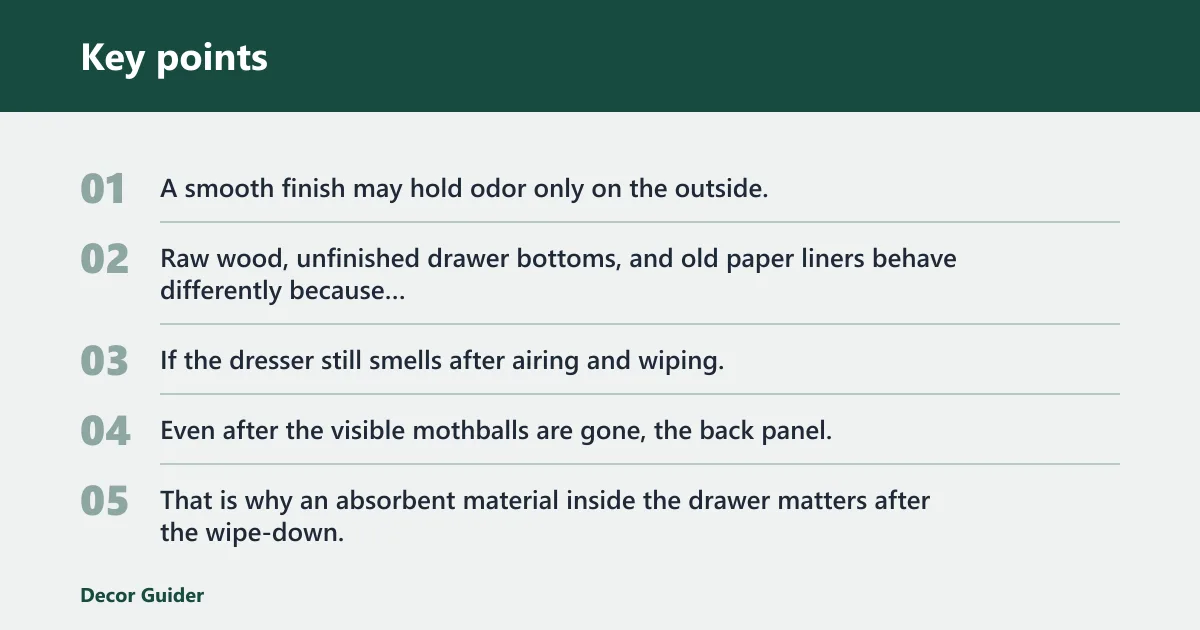
A smooth finish may hold odor only on the outside. Raw wood, unfinished drawer bottoms, and old paper liners behave differently because they can absorb and release scent over time. If the dresser still smells after airing and wiping, the problem has likely moved into the wood or liner.
Sealed cavities trap scent
Closed drawers act like odor boxes. Even after the visible mothballs are gone, the back panel, the underside of drawer bottoms, and the joint corners can keep holding the smell. That is why an absorbent material inside the drawer matters after the wipe-down.
What gets the smell out fastest?
The fastest practical sequence is fresh air, then diluted vinegar on safe surfaces, then an absorber inside the drawers. White vinegar is commonly used to neutralize odor, and activated charcoal can be placed in affected areas to absorb odor. For stubborn dresser odor, the best result usually comes from repeating those steps rather than expecting one pass to finish the job.
Use fresh air first
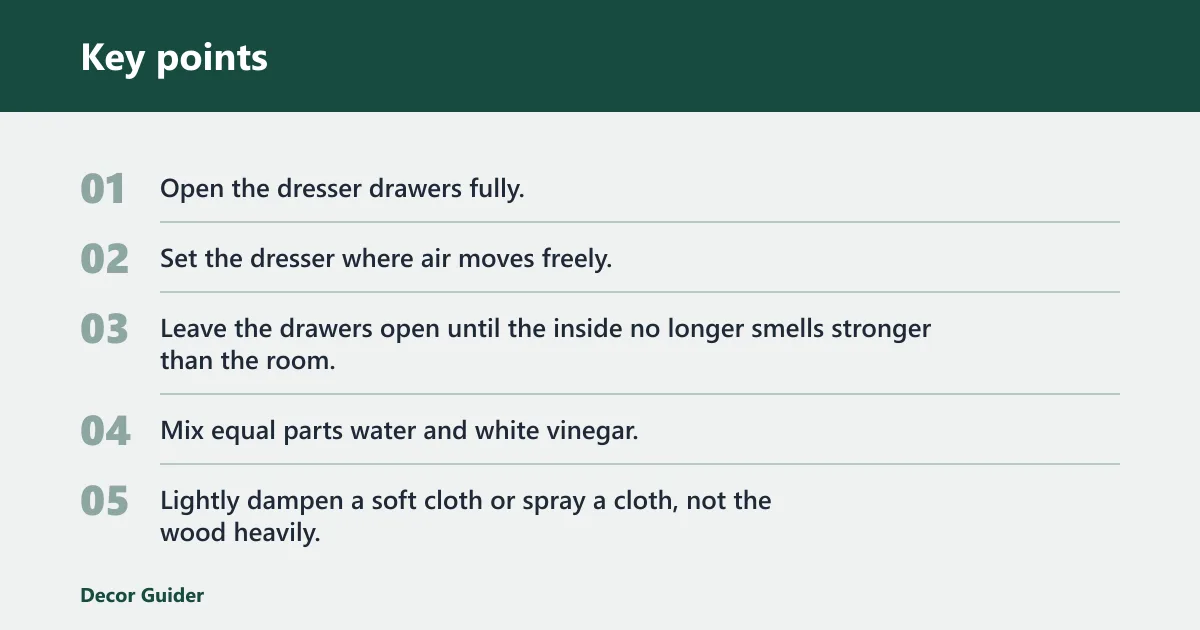
- Open the dresser drawers fully.
- Set the dresser where air moves freely.
- Leave the drawers open until the inside no longer smells stronger than the room.
Wipe with diluted vinegar
- Mix equal parts water and white vinegar.
- Lightly dampen a soft cloth or spray a cloth, not the wood heavily.
- Wipe drawer interiors, sides, and backing; avoid soaking veneer or raw wood.
- Dry the surfaces with a clean cloth right away.
Tips Bulletin says vinegar and water can be sprayed on furniture surfaces. That works best as a light treatment, not a soak. Bob Vila also recommends bowls of vinegar for closets and rooms with stubborn odor, which can help in a dresser room while the furniture itself is being treated.
Absorb what remains inside the drawers
- Place baking soda in an open dish or shallow container inside each drawer.
- Or place activated charcoal sachets in the drawer corners.
- Close the drawers loosely only if the furniture is in a dry room and the wood is already wiped dry.
- Check again after about 48 to 72 hours.
Suppose a six-drawer dresser smells strongest in the bottom drawer after a vinegar wipe. Leave an open dish of baking soda in that drawer for 2 to 3 days, then reassess. If the smell has dropped but not disappeared, repeat the treatment rather than adding heat.
Dresser odor triage table
| What you smell | Likely source | Exact materials to use | Best cleanup sequence | Expected treatment cycles | Wait time before reassessing | Escalation threshold | Repeat or escalate |
|---|---|---|---|---|---|---|---|
| Surface-only smell | Surface finish or exterior wipe residue | Gloves, soft cloth, equal parts water and white vinegar, dry cloth | Remove source, air out, wipe with equal parts water and vinegar, dry fully | 1 to 2 cycles | 24 to 48 hours | Escalate if the odor is still noticeable after 2 cycles or returns as soon as drawers close | Repeat the wipe once if the odor is lighter but still present |
| Smell in drawer interiors | Hidden cavity, drawer sides, underside edges | Gloves, diluted vinegar cloth, baking soda dish or activated charcoal sachets | Air out, wipe, then place baking soda or activated charcoal inside the drawers | 2 to 3 cycles | 48 to 72 hours | Escalate if the smell remains strong after 3 cycles or concentrates in one drawer | Repeat absorber treatment for another cycle if odor still lingers |
| Smell in raw wood or liners | Raw wood, drawer bottoms, or liner material | Gloves, liner remover, vinegar cloth, baking soda or activated charcoal, replacement liner if needed | Remove liners, treat bare wood with vinegar wipe, dry, then use charcoal or baking soda | 3 or more cycles | 1 to 2 weeks | Escalate if raw wood still smells after repeated drying cycles or if liner adhesive keeps reintroducing odor | Escalate to liner replacement, sanding, or refinishing if the smell remains |
What if the smell is in raw wood or liners?
That is the point where deeper treatment matters. Faint surface odor can be handled with airflow and a wipe, but raw wood and old liners may hold mothball residue for much longer. Naphthalene and related mothball chemicals can continue to off-gas from porous materials, especially when they have soaked into unfinished surfaces or old adhesive layers. See the NIH/NIEHS naphthalene overview and the ATSDR toxicological profile for naphthalene.
Remove liners and treat the bare wood
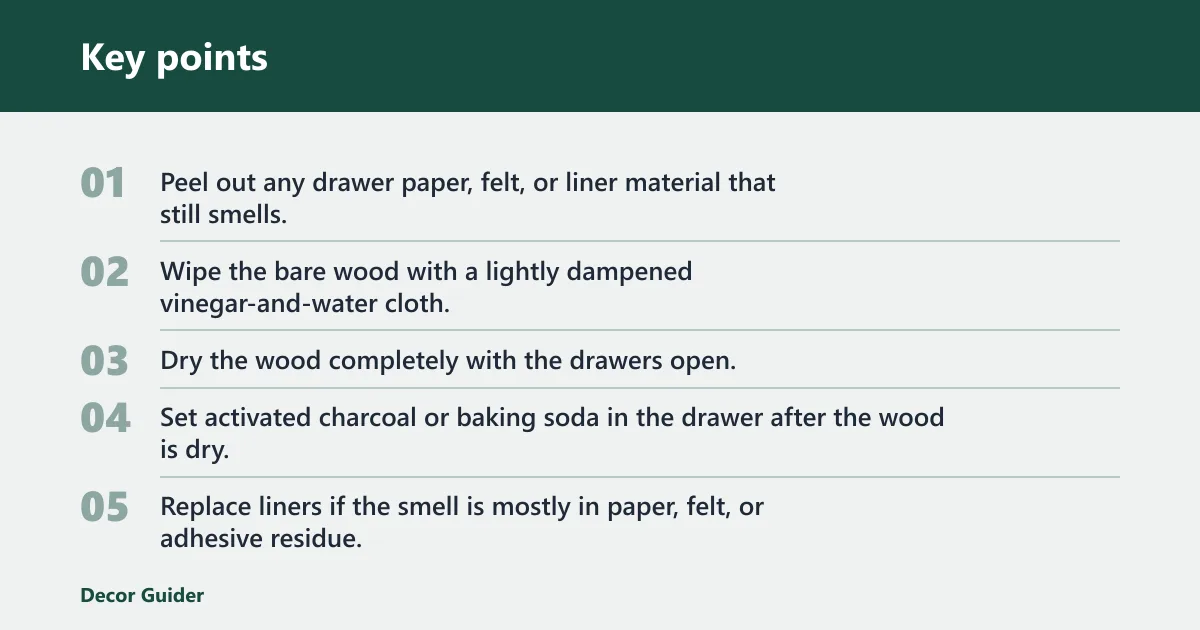
Peel out any drawer paper, felt, or liner material that still smells. If needed, use the internal drawer liners guide to choose a replacement only after the odor source is removed. Wipe the bare wood with a lightly dampened vinegar-and-water cloth, dry the wood completely with the drawers open, and set activated charcoal or baking soda in the drawer after the wood is dry.
- Peel out any drawer paper, felt, or liner material that still smells.
- Wipe the bare wood with a lightly dampened vinegar-and-water cloth.
- Dry the wood completely with the drawers open.
- Set activated charcoal or baking soda in the drawer after the wood is dry.
When to escalate beyond DIY
If the odor keeps returning after several dry cycles, the issue is usually below the finish or trapped in liner adhesive and seams. At that point, replacement materials or refinishing make more sense than repeating the same wipe. Sanding is a last step for unfinished wood only, because it removes the contaminated top layer and exposes fresh wood for a final deodorizing cycle.
- Replace liners if the smell is mostly in paper, felt, or adhesive residue.
- Sand and refinish if unfinished wood still smells after repeated drying cycles.
- Stop deodorizing and seek a different piece if odor keeps returning after several rounds.
Common mistakes
The biggest errors are easy to avoid. Heat too soon can lock in odor, moisture left behind can invite more trouble, and a single pass often leaves smell in the grain. Skipping the drawer bottoms or backing is another common miss because those spots trap odor out of sight.
- Using heat too soon: Do not use a dryer, warm storage, or heated drying until the smell is gone.
- Sealing in moisture: Dry every wiped surface before closing drawers.
- Skipping liners or backing: Treat the hidden surfaces, not only the visible fronts.
- Stopping after one treatment: Repeat vinegar or absorber steps when the smell is weaker but still present.
A common first-timer mistake is closing a freshly wiped dresser at night because the surface feels dry. The drawers can still hold odor and moisture inside the corners. Leave them open longer, then reassess before putting clothing back.
How to remove mothball smell from a cedar chest
A cedar chest should be treated gently because cedar itself is part of the furniture. Remove the mothballs first, then ventilate the chest with the lid open, then use a light vinegar wipe only on safe finished surfaces. If the odor is still present, use charcoal or baking soda inside the chest after everything is dry.
Use cedar chips as a later step
Cedar chips can mask or reduce odor over time and are often used to deter insects, but they are not the first fix for heavy mothball smell. Place them only after the chest has been cleaned and aired. In a stubborn chest, cedar chips work better as a longer-term aid than as a quick deodorizer.
Frequently asked questions
How long does mothball smell last in wood furniture?
Mothball odor can linger for weeks, and porous wood can hold it longer because the vapor is absorbed into the material and released over time. If bare wood or an unfinished drawer bottom still smells after repeated airing and absorber treatment, remove liners and treat the wood again. A strong odor that survives multiple dry cycles usually needs escalation rather than a longer wait.
Is vinegar safe for removing mothball smell from furniture?
White vinegar is commonly used as a deodorizer on furniture surfaces when it is diluted and applied lightly. Use a cloth dampened with equal parts water and vinegar, then dry the wood right away. Avoid soaking veneer or unfinished wood, and repeat the wipe only after the surface is fully dry. If the finish is fragile, test a hidden spot first and keep the treatment very light.
How to remove mothball smell from a cedar chest: open the chest, remove
Open the chest, remove any leftover mothballs, and air it out before cleaning. Use a light vinegar wipe on finished surfaces, then place activated charcoal or baking soda inside after drying. Cedar chips can help later, but only after the smell is reduced and the chest is fully dry. If the odor sits in an old liner, remove the liner before repeating the treatment.
What gets mothball smell out of wooden drawers fastest
The fastest practical sequence is fresh air, a diluted vinegar wipe, and then activated charcoal or baking soda inside the drawer. If the smell is faint, that often works within a few days. If it is strong in raw wood or liners, expect repeated treatment and more time before storage. Drawer bottoms and back corners are usually the first places to check when one drawer keeps smelling.
How to get rid of mothball smell in furniture
Use the same order every time: remove the source, ventilate, wipe with diluted vinegar, then place an absorber inside enclosed spaces. For furniture with drawers, treat the cavity and the liners, not only the outer frame. Do not use heat until the smell is fully gone, and keep the piece open until all surfaces are dry. If odor returns after several cycles, escalate to liner replacement or refinishing.
How to remove moth ball smell from cedar chest
Remove any remaining mothballs, ventilate the chest, and clean the finished surfaces with a diluted vinegar cloth. After drying, place cedar chips or activated charcoal inside. If the odor stays in the wood or liner after repeated drying cycles, strip the liner and treat the exposed wood again. Cedar chips help most after the contamination source has already been removed.
Products related to this article
Sponsored / affiliate links. As an Amazon Associate I earn from qualifying purchases. I may earn additional commission from eligible campaigns.