How To Date A Globe Wernicke Bookcase
The allure of a classic Globe Wernicke bookcase lies not only in its elegant, modular design but also in its storied past. These sectional bookcases, first introduced in the late 19th century, have become prized collectibles for bibliophiles, antique lovers, and interior designers alike. However, accurately dating a Globe Wernicke bookcase can be a challenging task, one that requires attention to detail, historical knowledge, and a keen eye for subtle differences in hardware, wood, and construction.
Understanding when your Globe Wernicke bookcase was made is more than just satisfying curiosity. It can reveal the rich history behind your piece, affect its market value, and guide restoration or preservation efforts. Whether you’ve inherited a family heirloom, discovered a treasure at an estate sale, or are simply fascinated by antique furniture, this comprehensive guide will walk you through every facet of dating a Globe Wernicke bookcase with confidence and precision.
Key Takeaways
- Globe Wernicke bookcases were produced from 1899 through the mid-20th century, with subtle design changes marking different eras.
- Key dating clues include labels, hardware types, wood species, glass styles, and construction methods.
- Understanding patent numbers, company history, and regional manufacturing differences is crucial for accurate dating.
- Real-world case studies help illustrate how to piece together evidence and avoid common pitfalls.
- Comparison tables and expert tips provide clear, actionable ways to distinguish Globe Wernicke bookcases from similar units.
- Authenticity and condition significantly influence both historical and market value.
Credit: www.antiquers.com
The History And Evolution Of Globe Wernicke Bookcases
Dating a Globe Wernicke bookcase begins with understanding the company’s origins and the evolution of its products. This section provides a brief history and outlines major milestones that help anchor your bookcase in time.
Globe Wernicke: From Inception To Icon
The Globe Wernicke Company was formed in 1899 in Cincinnati, Ohio, through the merger of Globe Files Company and Wernicke Company. Their new modular, stackable bookcase design, often called a “barrister bookcase”, revolutionized office and home storage. These bookcases became synonymous with durability, practicality, and craftsmanship.
Key Production Periods And Styles
Globe Wernicke produced bookcases over several distinct periods, each with unique characteristics:
- Early Period (1899, 1910): Marked by patent-pending hardware, hand-cut dovetails, and oak or mahogany construction.
- Middle Period (1910, 1930): Standardized parts, expanded wood choices, and the introduction of leaded glass.
- Late Period (1930s, 1950s): Use of birch and walnut, simplified hardware, and mass production methods.
Global Expansion And Imitations
The popularity of the design led Globe Wernicke to establish factories in Canada, the UK, and Europe. This international presence introduced regional variations. Furthermore, many companies produced similar “barrister bookcases” (notably Gunn, Macey, and Weis), making accurate identification even more important.
Pro Tip: Comparing your bookcase’s features to known production periods can immediately narrow down the date range.
Identifying Key Dating Features
To accurately date a Globe Wernicke bookcase, focus on specific physical features that changed over time. Each clue provides a piece of the historical puzzle.
Labels And Company Marks
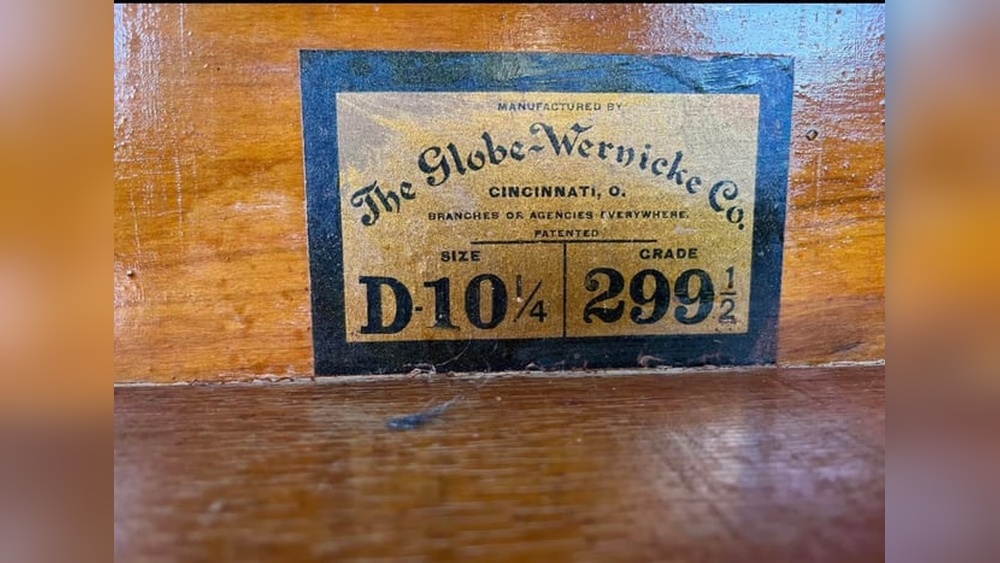
Original labels are one of the most reliable dating tools. Globe Wernicke used several types of labels, often located inside the sectional units or on the back panel.
- Paper labels (1899, 1915): Early labels feature ornate fonts and patent information.
- Metal tags (1915, 1930): Brass or copper tags stamped with company name, city, and sometimes patent numbers.
- Printed logos (1930s, 1950s): Simpler logos, occasionally including “Made in USA” or country of manufacture for export models.
Example: A collector found a Globe Wernicke with a faded paper label reading “Pat. Applied For,” immediately identifying it as pre-1915.
Hardware And Construction Details
The design of the bookcase’s hardware offers crucial dating clues.
- Hinges: Early bookcases use large, visible bronze or brass hinges. Later models switched to smaller, steel mechanisms.
- Door pulls: Initial designs feature elaborate, cast-metal pulls, while later ones use streamlined, machined pulls.
- Joinery: Hand-cut dovetail joints are typical in early pieces; machine-cut or simplified joints appear after 1910.
Wood Types And Finishes
Globe Wernicke bookcases were produced in a range of wood species, each popular in different eras.
| Wood Type | Common Years | Appearance |
|---|---|---|
| Oak | 1899, 1920 | Light to medium brown, pronounced grain |
| Mahogany | 1905, 1930 | Reddish-brown, fine grain |
| Birch | 1930, 1950s | Pale, uniform texture |
| Walnut | 1930, 1950s | Dark brown, straight grain |
Example: In my experience, identifying the wood species on a Globe Wernicke is often the fastest way to exclude certain time periods.
Glass Styles
Globe Wernicke bookcases are known for their unique, up-and-over glass doors. The type of glass used also changed over time.
- Single-pane clear glass (1899, 1920): Early units often used thick, clear glass.
- Leaded or beveled glass (1910, 1930): Decorative glass introduced during the peak of the Arts & Crafts movement.
- Plain, thinner glass (1930s, 1950s): Cost-saving measures led to simpler glass after the Great Depression.
Warning: Replacement glass can mislead dating. Always look for signs of newer glass (e.g., modern edges or incorrect thickness).
Decoding Serial Numbers, Patents, And Model Codes
Beyond physical features, Globe Wernicke bookcases often have serial numbers, patent dates, and model codes that can unlock precise dating information.
Patent Dates And Numbers
Globe Wernicke frequently stamped patent dates or numbers on their labels or metal tags. These refer to the design or mechanism patents granted during production.
- Pat. Applied For: Indicates the piece was made before the patent was granted, often pre-1915.
- Specific Patent Numbers: Referencing the US Patent and Trademark Office database allows you to date the unit to the patent’s issue year.
Example: A bookcase with US Patent No. 814,028 was produced after 1906, the year that patent was granted (patent reference).
Model Codes And Section Numbers
Each unit section (top, base, shelf) typically has a model or series number stamped inside or on the bottom. These codes provide information about the height, depth, and sometimes the wood type.
| Code Example | Meaning | Era |
|---|---|---|
| C299 | 12″ tall, 9″ deep, oak | Early (1899, 1920) |
| D12 | 12″ tall, mahogany | Middle (1910, 1930) |
| 299N | 12″ tall, walnut | Late (1930, 1950s) |
Serial Numbers And Factory Marks
Some Globe Wernicke units bear serial numbers or factory stamps. Cross-referencing these with manufacturing records (where available) can sometimes pinpoint the production year.
Pro Tip: When serial numbers are present, compare them with available collector databases or company archives for more precise dating.
Distinguishing Globe Wernicke From Similar Bookcases
Imitation and competition were rife during the heyday of sectional bookcases. Gunn, Macey, and Weis all produced similar modular units. Knowing how to distinguish a Globe Wernicke bookcase is vital for accurate dating and valuation.
Label And Logo Comparisons
Genuine Globe Wernicke pieces feature distinctive label designs and consistent branding. Macey used a script logo, Gunn incorporated a shield, and Weis labels often included “Sectional Bookcase. ”
Hardware Differences
While all barrister bookcases use an up-and-over door, the mechanisms vary:
- Globe Wernicke: Smooth, counterbalanced mechanism with visible or concealed side tracks.
- Macey: Spring-loaded mechanism and more angular door edges.
- Gunn: Sliding, non-counterbalanced mechanism.
Wood And Construction
Globe Wernicke typically used higher-grade woods and more refined finishes than many competitors. Their joinery and craftsmanship are usually more robust, with tighter tolerances and better fit.
| Feature | Globe Wernicke | Macey | Gunn |
|---|---|---|---|
| Label Location | Inside section or back | Back or inside door | Back panel |
| Door Mechanism | Counterbalanced | Spring-loaded | Sliding |
| Wood Types | Oak, mahogany, walnut, birch | Oak, birch, quartered oak | Oak, birch |
Example: A case study from a 2020 auction highlighted a mislabeled “Globe Wernicke” that was actually a Macey, the giveaway was a spring mechanism and stylized “M” logo.
Avoiding Misidentification
Always cross-reference at least three features: label, hardware, and wood type. If in doubt, consult collector forums or reference books, such as “The Barrister Bookcase” by John W. McPherson.
Assessing Condition, Authenticity, And Restoration
The state of your Globe Wernicke bookcase affects both its historical significance and value. Understanding how restoration and repairs impact dating is essential for collectors and sellers.
Evaluating Condition
Assess the following:
- Finish: Original finishes are more valuable; refinishing can impact value and obscure dating clues.
- Glass: Original glass may have bubbles or waves; modern replacements are smooth and flawless.
- Hardware: Missing or replaced hardware can be sourced from reputable dealers but should be noted.
Pro Tip: Use a UV light to detect modern glues or finishes that may reveal recent repairs.
Authenticity And Modifications
Common modifications include:
- Replaced sections: Mixing and matching sections from different eras can confuse dating.
- Added labels: Fake or reproduction labels are a known issue in high-value markets.
If possible, trace the provenance, who owned the bookcase, where it came from, to add another layer of authenticity.
Restoration Best Practices
If restoration is necessary:
- Preserve original finishes whenever possible.
- Use period-appropriate hardware and techniques.
- Document any changes for future collectors.
Example: A 1910 oak Globe Wernicke with a sympathetic restoration (matching stain, period glass) fetched 30% more than a heavily refinished counterpart at a recent collector’s sale.
Impact On Value
Condition and originality can mean the difference between a $500 and a $5,000 bookcase. For a detailed discussion of value factors in antique furniture, visit the Antique Trader guide.
Real-world Case Studies: Dating Globe Wernicke Bookcases
Examining actual examples clarifies the process and highlights the detective work involved.
Case Study 1: The Inherited Family Bookcase
A reader inherited a three-section Globe Wernicke bookcase from their grandfather. The label was a paper type with “Pat. Applied For. ” The hardware was ornate, and the wood was identified as oak. Based on these clues, it was dated to between 1900 and 1910, a true early model.
Case Study 2: The Auction Find
A collector purchased a unit at auction labeled as “1930s Globe Wernicke. ” Upon inspection, it had a metal tag with “Made in England” and walnut construction. Research revealed it was produced in Globe Wernicke’s Liverpool factory between 1935 and 1950, confirming the auction description.
Case Study 3: The Mixed-section Bookcase
An enthusiast found a bookcase with mismatched sections, some with mahogany veneer, others birch, and a mix of label types. Investigation showed the top and base were from different eras, likely replaced over the years, complicating accurate dating. The solution: date each section individually and value the piece as a “married” unit.
Expert Tips For Accurate Dating
Dating a Globe Wernicke bookcase is as much art as science. These best practices will help you avoid common mistakes and make confident assessments.
Use Multiple Dating Methods
Don’t rely on one feature alone. Combine:
- Label type and placement
- Hardware style
- Wood species and finish
- Model/serial codes
- Patent information
Consult Reference Materials
Valuable resources include:
- Collector forums and online communities
- Antique furniture books (e.g., “The Barrister Bookcase”)
- Company records and patent databases
Beware Of Common Pitfalls
- Replacement sections can create false impressions.
- Reproduction hardware may look authentic but lacks the patina of age.
- Modern finishes obscure grain and original tool marks.
Pro Tip: When in doubt, seek a second opinion from a qualified antiques appraiser or experienced collector.
Document Your Findings
Keep detailed notes and photographs of all identifying marks, labels, and features. This record will serve as proof for future buyers or restorers.
Consider Professional Appraisal
If your bookcase appears particularly rare or valuable, invest in a professional appraisal. This adds credibility and can significantly increase resale value.
Frequently Asked Questions
How Do Globe Wernicke Bookcases Differ From Other Sectional Bookcases?
While many companies produced similar modular bookcases, Globe Wernicke models are distinguished by their patented up-and-over door mechanism, premium hardwood construction, and distinctive branding. Their doors typically glide smoothly on counterbalanced tracks, a feature less common in competitors’ models. The company’s labels, model codes, and wood options also set them apart.
Can I Find A Production Date On Every Globe Wernicke Bookcase?
Not every Globe Wernicke bookcase includes a visible production date. While some have patent dates or serial numbers, many rely on labels, hardware, and construction details for dating. If these features are missing or have been replaced, accurate dating may require expert analysis or comparison with well-documented examples.
Is It Possible To Restore A Globe Wernicke Bookcase Without Affecting Its Value?
Careful restoration that respects the original materials, finish, and craftsmanship can maintain or even enhance value. However, over-restoration, such as aggressive refinishing, replacing original glass, or swapping out period hardware, may reduce both historic and market value. Always document any changes and use reversible methods when possible.
How Should I Clean And Preserve An Antique Globe Wernicke Bookcase?
To clean, use a soft, dry cloth to remove dust. For deeper cleaning, a mild wood cleaner is preferable, avoid water or harsh chemicals. Maintain humidity around 40-50% to prevent wood warping, and keep the bookcase out of direct sunlight to avoid fading.
If storing, disassemble the sections to reduce stress on the joints.
Are Globe Wernicke Bookcases A Good Investment?
Globe Wernicke bookcases have shown steady demand among collectors and decorators, particularly early models in original condition. Their modularity, design appeal, and historical significance contribute to lasting value. However, prices can fluctuate based on trends, condition, and provenance, so consult a specialist before making a major purchase.
Owning and dating a Globe Wernicke bookcase is a journey through history, craftsmanship, and design innovation. By carefully examining labels, hardware, wood species, and construction details, you can confidently place your bookcase within its correct era. Whether you’re a collector, restorer, or simply an admirer, these iconic bookcases continue to captivate and inspire, serving as enduring reminders of quality and ingenuity in furniture making. For those interested in preserving other household treasures, exploring topics like choosing the right canning jar or understanding the differences in preservation salts can provide additional insight into the world of collectible and practical antiques.
Products related to this article
Sponsored / affiliate links. As an Amazon Associate I earn from qualifying purchases. I may earn additional commission from eligible campaigns.