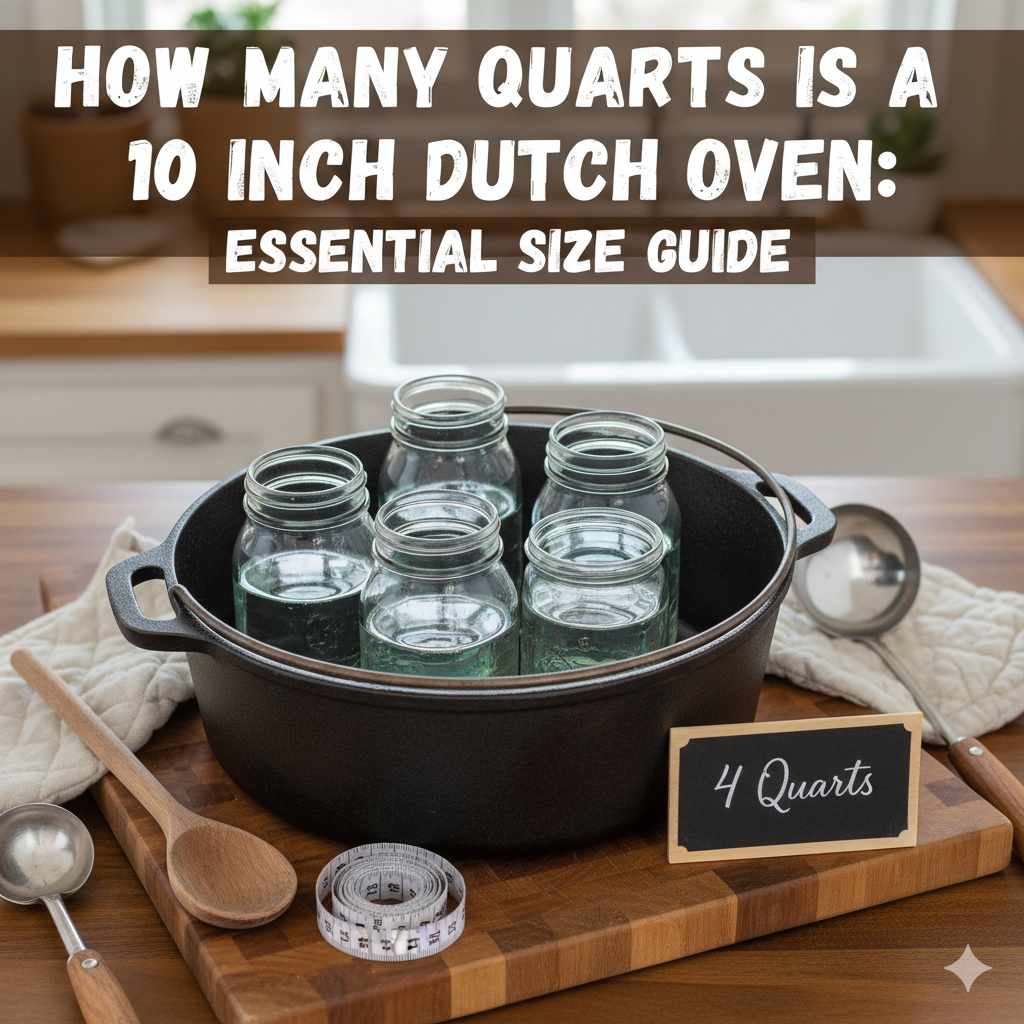
A standard 10-inch Dutch oven typically holds between 5 and 7 quarts of liquid or food. The exact quart size depends on the pot’s depth and lid design. Always check the manufacturer’s specifications, as volume can vary slightly even for the same diameter, but 6 quarts is the most common volume for this size.
When you’re cruising through the cooking aisles, seeing all those Dutch ovens, it’s easy to feel like you’re looking at car specifications—lots of numbers! If you have a standard 10-inch Dutch oven, you might be wondering exactly how big that is in cooking terms. Knowing the quart capacity is super important for cooking recipes correctly, whether you are braising short ribs or baking sourdough.
Don’t sweat it! This can trip up even experienced home cooks. Figuring out the volume of your cookware shouldn’t require a math degree. We are going to break down the quarts in a 10-inch Dutch oven simply and clearly. Think of this as your easy-to-read owner’s manual for cookware sizing. By the end of this guide, you will confidently know what your pot can handle.
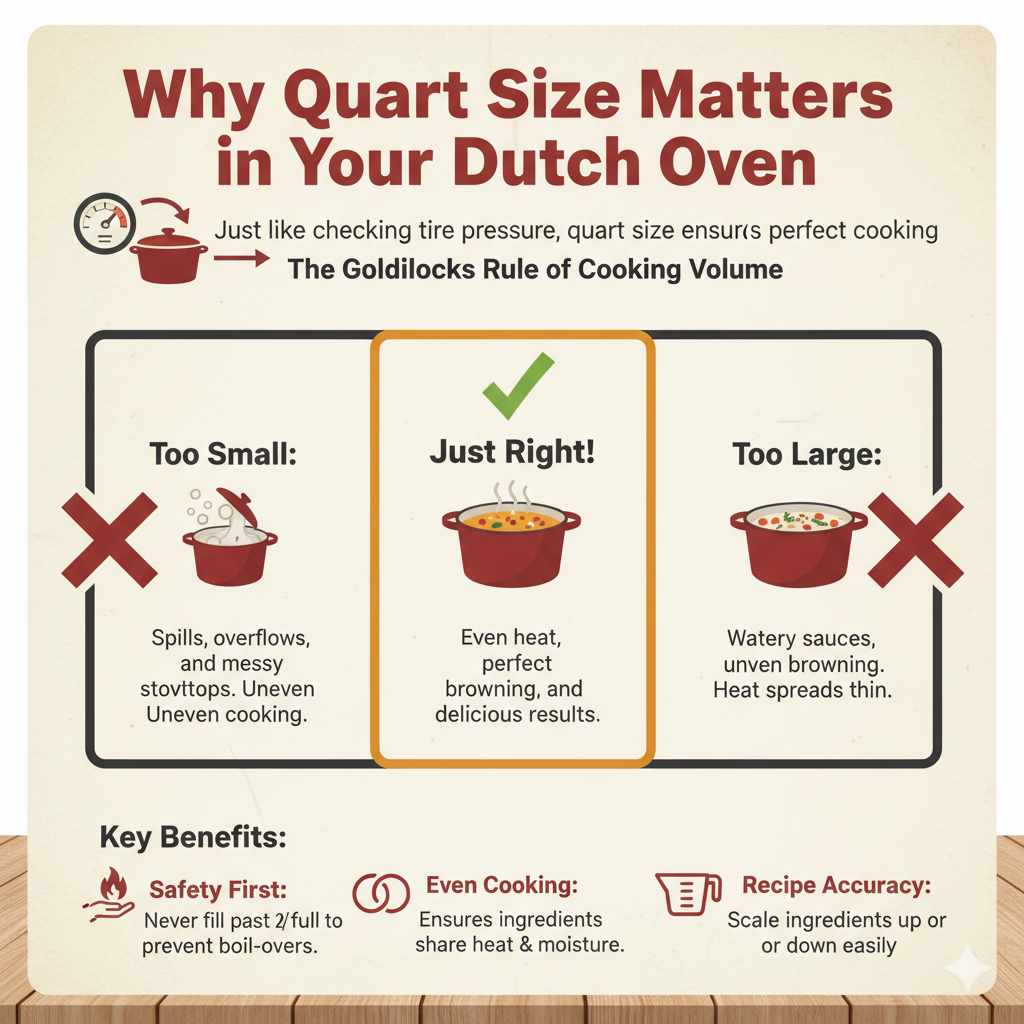
Why Quart Size Matters in Your Dutch Oven
Just like checking your tire pressure ensures a smooth ride, knowing your Dutch oven’s quart size ensures your cooking outcome is perfect. The quart size tells you how much volume the pot holds, which directly impacts how much food you can safely cook.
The Goldilocks Rule of Cooking Volume
Using a pot that is too small for a recipe means spills, overflows, and messy stovetops—nobody wants that extra cleanup! On the flip side, using a pot that is too large means the heat spreads out too thin, leading to watery sauces or uneven browning. You need a pot that’s “just right” for the job.
- Safety First: Never fill cookware past the two-thirds mark, especially when simmering liquids. This prevents boil-overs and dangerous spills on a hot range.
- Even Cooking: Proper volume ensures ingredients are nestled closely enough to share heat and moisture effectively, which is key for stewing and braising.
- Recipe Accuracy: Most recipes list ingredients based on an assumed standard size. Knowing your pot’s size helps you scale ingredients up or down accurately.
The Direct Answer: How Many Quarts Is A 10 Inch Dutch Oven?
When we talk about a “10-inch Dutch oven,” we are almost always referring to the diameter across the top opening of the pot, not the volume it holds.
The Standard Range
For a standard 10-inch Dutch oven—and this is the most common size you’ll find in stores—the capacity usually falls into a tight range. This range accommodates slight variations in depth among different brands (like Le Creuset versus Lodge).
The typical volume for a 10-inch Dutch oven is 5.5 to 7 quarts.
If you look at the box or product description, you will most likely see it listed as a 6-quart or 6.5-quart model. This size is often considered the workhorse of the kitchen because it suits many needs for small families or couples.
Measuring the Variables
Why the range? It comes down to the pot’s shape:
- Depth: A deeper 10-inch pot will hold more quarts than a shallower 10-inch pot.
- Lid Style: Some lids sit snugly inside the rim, while others rest on top, slightly altering the effective cooking capacity.
- Wall Thickness: Heavier enameled cast iron pots have thicker walls, slightly reducing the internal volume compared to thinner aluminum pots of the same external diameter.
| Diameter (Inches) | Typical Quart Capacity | Best Used For |
|---|---|---|
| 8 Inch | 3 to 4 Quarts | Small batches, side dishes, 1–2 people |
| 10 Inch | 5.5 to 7 Quarts | Standard family meals, bread baking |
| 12 Inch | 8 to 10 Quarts | Large gatherings, full roasts, big batches |
How to Figure Out Your Specific 10-Inch Pot’s Volume
If the box disappeared years ago, you don’t need to guess! You can easily measure your pot yourself. This is fantastic knowledge for understanding exactly what kind of recipes you can tackle safely.
Method 1: The Water Measurement Technique (Quick & Easy)
This method is straightforward and gives you a very close approximation. Since we are dealing with volume, water is the easiest thing to measure.
- Prep Your Pot: Ensure your Dutch oven is clean and dry. Place it securely on a counter or sturdy table where it won’t tip over.
- Gather Tools: You will need a standard 1-quart measuring cup (like the ones you use for baking) and a kitchen scale if you want maximum accuracy (though the cup is usually fine).
- Fill Carefully: Slowly pour water into the Dutch oven, filling it right up to the brim where the lid normally sits. Be careful not to overfill past the rim.
- Measure: Empty the Dutch oven into your 1-quart measuring cup, keeping track of how many full cups you pour out.
- Calculate: If you poured out 6 full cups, your Dutch oven is 6 quarts! If you had half a cup left over, it’s 6.5 quarts.
Method 2: Checking Manufacturer Specs (The Professional Way)
The most reliable method is finding the product specifications online. Try these steps if you know the brand:
- Look on the bottom of the pot—sometimes the volume is stamped there.
- Search the brand name (e.g., “Lodge”) and the diameter (“10 inch”) on their official website.
- Check reputable online retailers where you originally purchased it. They usually list capacity in the detailed product description.
When reading manufacturer specs, remember that some brands list the capacity based on the volume with the lid on, which might be slightly more generous than your practical cooking volume. Always aim to keep your food level below the rim for safety.
What Can You Cook in a 10-Inch (5.5–7 Quart) Dutch Oven?
This size is widely considered the sweet spot for everyday cooking. It provides enough surface area for searing and enough depth for simmering. It’s perfect for the average household of two to four people.
Ideal Recipes for a 10-Inch Workhorse
Here is what this versatile size handles best:
- Sourdough Bread: It’s roomy enough for most standard 750g to 900g doughs to expand beautifully without touching the sides.
- Whole Chickens: You can easily fit a standard 3 to 4-pound whole chicken for roasting or braising.
- Stews and Soups: It comfortably holds 4 to 6 servings of hearty recipes like beef stew, chili, or chicken soup.
- Braising Meats: Perfect for bone-in roasts like pork shoulder or Dutch oven pot roast, provided you aren’t trying to cram in an enormous cut.
When the 10-Inch Might Be Too Small
Just like you wouldn’t carry a lot of cargo in a compact car, a 10-inch pot has its limits:
- For Large Crowds:
- If you are cooking for 6 or more adults, especially for a holiday gathering, a 12-inch (8+ quart) pot will save you significant time by eliminating the need to cook in batches.
- Large Cuts of Meat:
- A large bone-in ham or a rack of ribs that needs to lie flat will likely overpower a 10-inch vessel.
- Big Batch Freezing:
- If you like to meal prep and freeze large quantities of chili or sauce, you’ll quickly use up the capacity.
Understanding Dutch Oven Sizing Beyond the Diameter
The diameter (10-inch) only tells half the story. If you are comparing a 10-inch pot from one brand to a 10-inch pot from another, you need to look at the overall dimensions. This relates closely to how much space you need in your kitchen. Knowing these dimensions helps ensure your pot fits comfortably in your oven.
Comparing Diameter to External Size
When shopping or simply comparing cookware, the stated diameter is helpful, but the external size matters for storage and oven racks. Always check the measurements provided by the manufacturer, as these often include the handles.
| Measurement Aspect | Typical Range for 10-Inch Pot | Why It Matters |
|---|---|---|
| Internal Diameter (Cooking Surface) | 9.5 to 10 Inches | Determines how wide your meat or loaf of bread can be. |
| External Diameter (Including Handles) | 12 to 13.5 Inches | Ensures it fits on your stovetop burner and oven rack. |
| Height (Side Wall Depth) | 5 to 6 Inches | Impacts filling capacity (quarts) and liquid retention. |
If you are concerned about fitting your pot into a smaller oven, especially in older homes or RV setups, the external width (with handles) is your critical number. For example, many standard ovens can accommodate a pot up to 12 inches wide easily. If your model is closer to 13.5 inches with handles, double-check your oven clearance before buying.
The Relationship Between Quartz and Weight (A Quick Aside)
While not directly related to volume, the weight of your Dutch oven often correlates with its size and material. A heavier pot usually means thicker cast iron walls, which holds heat more consistently—a huge plus for cooking!
For context:
- A standard 10-inch 6-quart enameled cast iron pot will weigh significantly more than a 10-inch aluminum stockpot of the same volume.
- Heavier pots tend to distribute heat more evenly, reducing hotspots on your stovetop. This is a key feature of quality cast iron cookware.
If you are upgrading from a lighter pot, take care when moving the filled 10-inch model. Lifting a full 6-quart pot takes some muscle! For safety, always lift with both hands using the main handles, not just one side handle.
Tips for Safe and Efficient Cooking Based on Size
Now that you know your 10-inch Dutch oven is likely around 6 quarts, here are actionable tips to ensure your cooking goes smoothly every time, just like checking your vehicle’s fluid levels before a long trip.
1. Searing Technique
If you are searing meat (like getting that beautiful brown crust on pot roast), you need enough space between the pieces so they steam instead of boil. For a 10-inch pot:
- Limit searing to two or three medium-sized pieces of meat at a time.
- Ensure the bottom of the pot is covered by no more than two layers of food.
2. The Halfway Rule for Braises
When you add liquid for braising (covering the meat), you should never fill the pot more than two-thirds full. For a 6-quart pot, this means keeping the total liquid and food volume under 4 quarts. This leaves necessary headspace for simmering and bubbling without eruption.
3. Perfect Bread Baking
When baking artisan bread, the oven spring (the rapid rise when dough hits the heat) can be dramatic. For a 10-inch diameter:
If your dough ball is larger than about 4.5 inches across before baking, it risks sticking to the sides of the pot. For doughs requiring very high oven spring, consider setting the temperature slightly lower if you notice the top crust touching the lid prematurely.
How Dutch Oven Size Impacts Heat Transfer
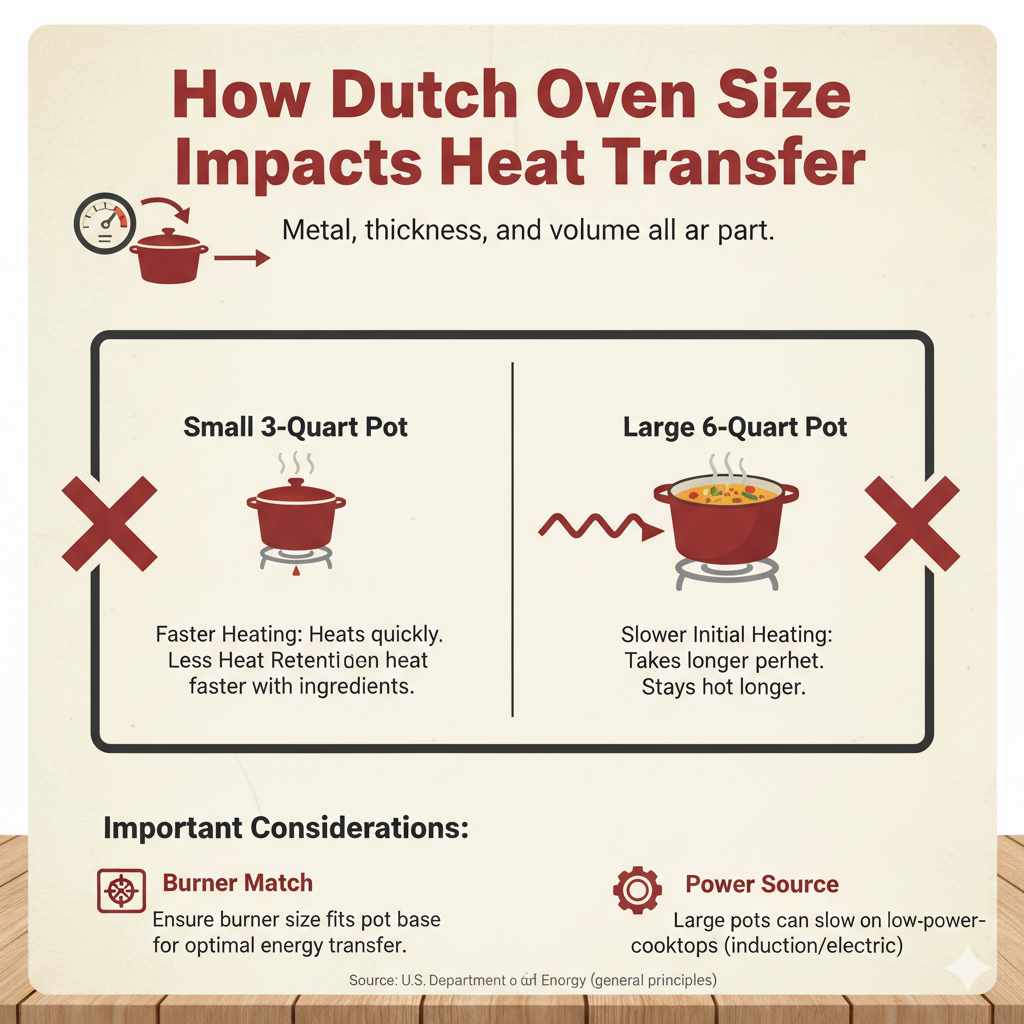
Heat transfer is more than just the temperature on your knob! The metal material, the thickness of the walls, and the volume all play a part. When you use a 6-quart pot versus a very small 3-quart pot on the same burner set to medium, the heat dynamics change.
The larger, heavier 10-inch pot (around 6 quarts) tends to absorb and retain heat better once fully preheated. This means:
- Better Heat Retention: It does not lose temperature as quickly when you add cold ingredients.
- Slower Initial Heating: It takes slightly longer to get the whole mass of iron up to temperature, but once there, it stays there reliably.
If you are cooking on low-power induction or a weak residential electric coil, a larger, heavy pot can sometimes be slow to respond to large temperature changes. Always ensure your burner size is appropriate for the pot’s base diameter for optimal energy transfer. You can find useful guides on maximizing cooktop efficiency from organizations like the U.S. Department of Energy, which covers general principles applicable to all cooking vessels.
FAQ: Beginner Questions About Your 10-Inch Cookware
Q1: If I only cook for one person, is a 10-inch Dutch oven too big?
It can be, but it’s still usable! For single servings, a 10-inch pot might struggle to maintain consistent heat around small amounts of food, leading to scorching. You might get watery results when simmering small batches. For one person, an 8-inch or 3-quart pot is generally better, but you can use the 10-inch if you increase the recipe volume slightly or cook a large batch for leftovers.
Q2: Does the lid count in the official quart measurement?
No, generally, the quart measurement refers to the usable volume inside the bottom pot, up to the rim. Some manufacturers might include the volume of the lid if it’s designed to sit inside the rim, but it’s safest to calculate capacity based on the pot body itself.
Q3: Can I use my 10-inch Dutch oven on a glass stovetop?
Yes, absolutely, provided the bottom is flat and smooth. Cast iron can scratch glass tops if dragged. Always lift the pot straight up, never slide it across the surface. Also, make sure the bottom diameter of the pot isn’t drastically larger than the burner size, or the heat won’t transfer efficiently across the base.
Q4: If a recipe calls for a 7-quart pot, can I use my 6-quart 10-inch pot?
You can, but you must reduce the amount of ingredients by about 15%. If the recipe doesn’t explicitly say “do not fill past two-thirds,” assume it needs that space. For a 7-quart recipe, aim to cook only about 5 to 5.5 quarts of food in your 6-quart pot to prevent boil-overs.
Q5: What is the difference between enameled and bare cast iron in terms of volume?
The difference is often negligible but exists due to wall thickness. Enameled cast iron tends to have slightly thicker walls for durability, meaning the internal volume might be a fraction smaller than a bare cast iron pot of the exact same external dimensions.
Q6: How deep is a “deep” 10-inch Dutch oven?
While there’s no official standard, a “deep” 10-inch model capable of reaching 7 quarts usually has interior side walls around 6 inches high. A “shallower” 10-inch model holding around 5 quarts might only be 5 to 5.5 inches deep.
Conclusion: Trusting Your Cookware’s Capacity
You’ve now got the full rundown on your 10-inch Dutch oven. Most likely, you are holding a fantastic, versatile 6-quart piece of equipment—the perfect companion for weeknight dinners and weekend baking projects.
Don’t let confusing numbers hold you back in the kitchen. If you are ever unsure about a specific pot, the simple water measurement test is your most reliable tool. When you know your pot’s true capacity, you can confidently follow any recipe, ensuring perfectly simmered sauces, beautifully browned meats, and risen bread every single time. This small piece of knowledge builds huge confidence in your cooking skills. Get out there, fill that