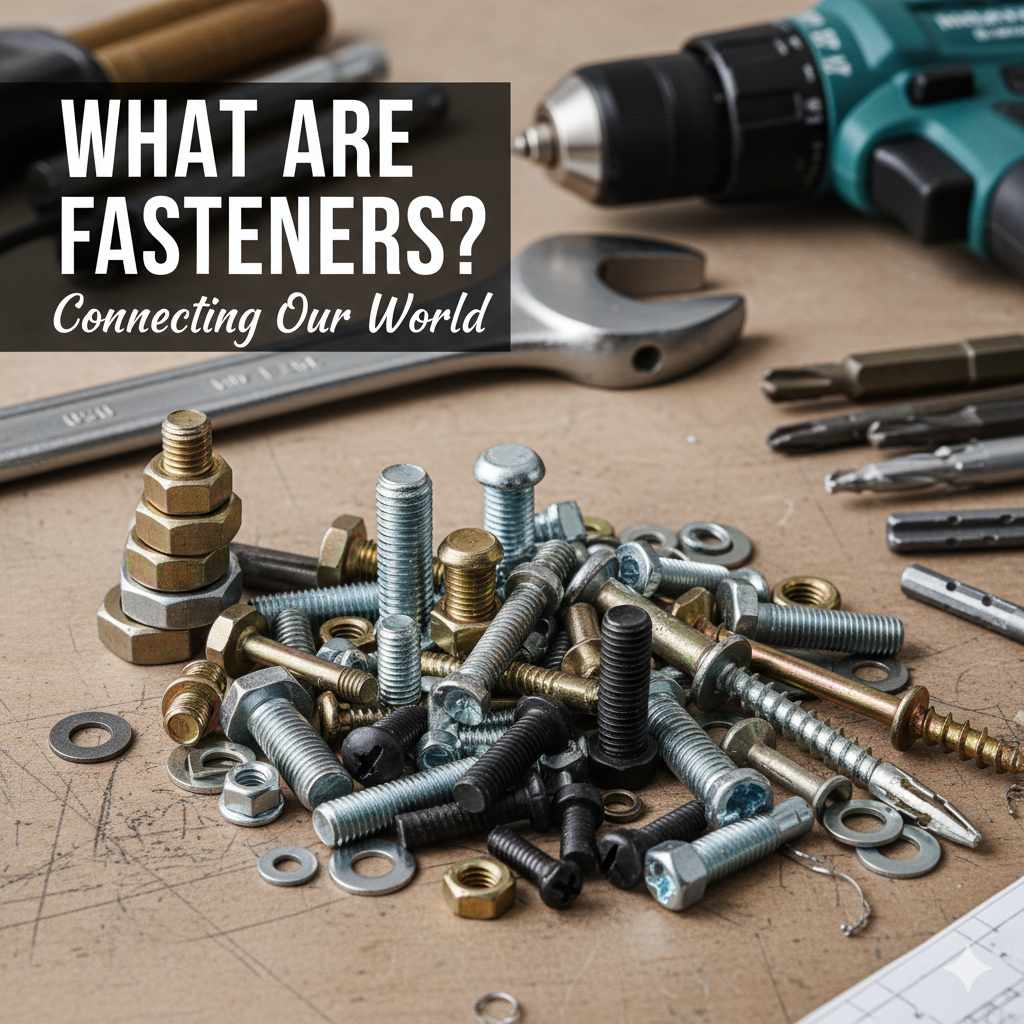
What Are Fasteners? A Practical Guide to Choosing the Right One
You’re mid-project, holding two pieces of metal that need to join, and suddenly the hardware drawer looks like alphabet soup. M6, #10-24, 304 stainless, grade 8 — what do these mean, and which one won’t fail in a year? That’s the moment you realize fasteners aren’t just ‘screws and bolts.’ They’re the quiet load-bearing backbone of everything you build.
This guide walks through what fasteners actually are, how they’re classified, and — more importantly — how to pick the right one for your specific job. You’ll leave with a practical 4-step selection framework, a comparison table, and a few hard-won lessons about what happens when you get it wrong.

Vifmy
Vifmy SAE & Metric Rivet Nut Assortment…
- Rivet Nut Assortment Kit: 2 in 1 Rivet nuts Kit contains 172 metric rivet nuts, 128 Sae rivet nuts, for a total of 300 rivet nuts
- Metric rivet nuts: There are 172 pcs metric rivet nuts, they are m3-0.5(60 pcs),m4-0.7(40 pcs),m5-0.8(30 pcs),m6-1(20 pcs),m8-1.25…
- Sae rivet nuts: There are 128 pcs sae rivet nuts, they are #8-32(40 pcs),#10-24(40 pcs),1/4"-20(30 pcs),5/16"-18(10 pcs),3/8"-16(8…
As an Amazon Associate I earn from qualifying purchases.
If you’re working with thin sheet metal or need to add threads where none exist, a rivet nut assortment kit like the Vifmy 300-piece set (SAE and metric, 304 stainless) lets you install strong threads in seconds, without welding. It’s a smart workaround for a lot of repair and fabrication scenarios.
What is a Fastener? (Simple Definition)
A fastener is any hardware device that mechanically joins or affixes two or more objects together. That’s the broad definition. In practice, fasteners range from a tiny #2 machine screw in a toy to a 2-inch diameter bolt holding a bridge flange.
Fasteners create either a permanent or temporary joint. The key distinction is whether you can disassemble it without damaging the parts. A nail is semi-permanent — you can pull it, but the wood may splinter. A bolt with a nut is fully reversible. A rivet is permanent; you’re drilling it out if you need to separate the pieces.
Fasteners also transfer load. A bolted joint doesn’t just hold parts together — it clamps them, creating friction that resists shear and tension forces. That’s why fastener selection is an engineering decision, not just a hardware store guess.
How Fasteners Are Classified (Temporary vs. Permanent)
The most useful classification is by whether the joint can be disassembled without destroying the fastener or the parts.
Temporary Fasteners
- Threaded fasteners — bolts, screws, studs, and nuts. These are the workhorses of assembly. You can tighten, loosen, and retighten them many times.
- Quick-release pins — clevis pins, cotter pins, hitch pins. Used where you need fast, tool-free disassembly.
- Clamps and latches — not always called fasteners, but they perform the same function.
Permanent Fasteners
- Rivets — solid, blind, and tubular. Once installed, the rivet deforms and locks in place. Removal means drilling.
- Nails — technically removable, but the wood around them usually suffers.
- Adhesives and welds — not fasteners in the hardware sense, but they create permanent bonds that compete with mechanical fastening.
Some fasteners blur the line. A self-tapping screw forms threads in the material, so removing it leaves a hole that’s still threaded — semi-permanent. A threaded insert (like a rivet nut) is permanent in the base material but accepts a removable bolt.
The 12 Most Common Types of Fasteners (With Uses)
Walk into any hardware store and you’ll see dozens of bins. Here are the 12 you’ll actually use, grouped by category.
Threaded Fasteners (Bolts, Screws, Studs, Nuts)
Bolts are threaded fasteners that require a nut to clamp parts. They’re designed for through-hole applications. A bolt has a head on one end and threads on the other. The nut provides the clamping force. Bolts are measured by diameter, thread pitch, and length.
Screws differ from bolts in that they don’t need a nut. They cut or form their own mating threads in the material. Wood screws, sheet metal screws, and self-tapping screws are all examples. The distinction is practical, not absolute — some screws can be used with nuts, and some bolts are used in tapped holes.
Studs are threaded on both ends, with no head. You screw one end into a tapped hole, then attach a nut to the other. Common in engine manifolds and pipe flanges where you need to align components before tightening.
Nuts are the female counterpart to bolts. Hex nuts are the standard, but you’ll also find lock nuts (nylon insert or distorted thread), flange nuts (built-in washer), and cap nuts (closed end for aesthetics and safety).
Threaded inserts are a special case. They’re installed into a base material to provide a durable thread. Rivet nuts — like the ones in that Vifmy kit — are a type of blind insert. You install them from one side, and they form a flange on the back. This is a lifesaver when you can’t access the back side of a panel.
Non-Threaded Fasteners (Rivets, Pins, Nails, Keys)
Rivets are permanent mechanical fasteners. A solid rivet is a cylinder with a head; you deform the tail to lock it. Blind rivets (pop rivets) are installed with a tool that pulls a mandrel through the body, expanding the tail. They’re fast, cheap, and don’t require access to the back side.
Pins — dowel pins for alignment, roll pins for hinged joints, and cotter pins for locking nuts in place. Each has a specific job, but all are non-threaded.
Nails are the oldest fastener on this list. They work by friction and displacement of the material. Common in construction, but not for any load-bearing metal joint.
Keys and keyways — these transmit torque between a shaft and a hub (like a gear or pulley). A square or rectangular piece of metal fits into matching grooves. It’s a mechanical fastener in the truest sense, though not one you’ll find in a hardware bin.
Support Fasteners (Washers, Anchors, Inserts, Retaining Rings)
Washers do three things: distribute load, reduce friction, and prevent loosening. Flat washers spread clamping force over a larger area. Lock washers (split or toothed) add spring tension to resist vibration. But honestly, lock washers under a properly torqued bolt are often redundant — a clean, correctly torqued joint rarely loosens.
Anchors are for attaching to materials that have no threads — concrete, drywall, masonry. Sleeve anchors, wedge anchors, and toggle bolts expand behind the wall to grip. The load rating depends on the base material, not just the anchor.
Inserts — like helical coils (Heli-Coil) or key-locking inserts — repair stripped threads or provide a stronger thread in soft materials. A rivet nut is a type of insert.
Retaining rings (snap rings) hold components on a shaft or inside a bore. They fit into a groove and provide a shoulder. Inexpensive, reliable, and essential in rotating machinery.
Materials and Strength Grades (Steel, Stainless, Titanium, etc.)
The fastener material dictates its strength, corrosion resistance, and cost. You can’t just pick ‘steel’ and move on.
Carbon steel is the baseline. It’s strong and cheap, but it rusts. Plated steel (zinc, phosphate, or chrome) resists corrosion better but not indefinitely. Grade 5 and grade 8 bolts are carbon steel with different heat treatments and strength levels. Grade 8 has a higher tensile strength (150,000 psi) than grade 5 (120,000 psi). For most DIY projects, grade 5 is plenty.
Stainless steel adds chromium and nickel to resist corrosion. The common grades are 18-8 (304) and 316 (marine grade). 316 has added molybdenum for chloride resistance. Stainless is softer than grade 8, so it’s not for high-torque structural joints. But for outdoor, moist, or food-contact environments, it’s the right call.
Titanium is the premium choice — high strength, light weight, and excellent corrosion resistance. It costs 10-20 times more than steel and is mostly used in aerospace, racing, and medical implants. For a bike rack, it’s overkill.
Brass and bronze are for electrical conductivity, low friction, and decorative uses. They’re non-magnetic and won’t spark, which matters in some industrial settings.
Here’s a quick reference table comparing the most common fastener materials:
| Material | Tensile Strength (psi) | Corrosion Resistance | Relative Cost | Best Use |
|---|---|---|---|---|
| Low-carbon steel | 60,000 | Poor (must be plated) | $ | Indoor furniture, light fixtures |
| Grade 5 steel | 120,000 | Fair (zinc plated) | $$ | Automotive, structural steel |
| Grade 8 steel | 150,000 | Fair (zinc plated) | $$$ | Heavy machinery, suspension parts |
| 304 stainless (18-8) | 90,000 | Good | $$$ | Outdoor, marine, food equipment |
| 316 stainless | 85,000 | Excellent (chloride resistant) | $$$$ | Coastal, chemical, medical |
| Titanium | 120,000-140,000 | Excellent | $$$$$ | Aerospace, racing, high-end bikes |
Don’t forget the coating. A zinc-plated bolt is not the same as a hot-dip galvanized bolt. The latter has a thicker zinc layer for outdoor exposure. And never mix dissimilar metals in a wet environment — you’ll get galvanic corrosion. More on that in the failure section.
How to Choose the Right Fastener (A Practical 4-Step Framework)
Here’s the decision process I use when I’m not sure what to reach for. It’s not a flowchart — it’s four questions.
Step 1: What load will this joint carry?
Estimate the force, both in tension (pulling apart) and shear (sliding sideways). A simple rule: for a structural joint, use a bolt that can handle at least 4 times the expected load. For a shelf bracket holding 50 pounds, a 1/4-inch grade 5 bolt (which holds about 2,000 pounds in shear) is overkill — but it’s cheap insurance. For a trailer hitch, you need a proper engineering calculation, not a guess.
Step 2: Do you need to disassemble it later?
If yes, use a bolt or screw. If no, a rivet or weld might be faster and cheaper. But remember: rivets are permanent. If you think you might need to service the joint, go threaded.
Step 3: What environment will it live in?
Indoor dry air? Plain steel is fine. Outdoor with rain? You need stainless or zinc-plated. Coastal salt air? 316 stainless or a marine-grade coating. Chemical exposure? Check the compatibility chart — not all stainless is immune to all acids.
Step 4: What’s the cost and availability?
Standard bolts and nuts are cheap and available at any hardware store. Custom or oversized fasteners require ordering ahead and cost more. A rivet nut assortment kit like the Vifmy set gives you 12 common sizes in one case, which is cost-effective if you use them regularly. But if you need a single 10-32 x 2-inch bolt, just buy a few individually — it’s a 50-cent part.
This framework isn’t perfect, but it covers 90% of everyday decisions. For high-risk applications, always consult a licensed engineer.
Common Fastener Failures and How to Avoid Them
Fasteners fail in predictable ways. Here are the three I’ve seen most often, plus how to prevent each.
Vibration Loosening
You’ve seen it: a bolt backs out after a week of use. The cause is lateral vibration, which makes the nut rotate slightly with each cycle. The fix isn’t a lock washer — it’s proper tension. A correctly torqued bolt stretches slightly and holds tension, creating friction that resists rotation. If you can’t torque it (like a blind fastener), use a thread-locking compound or a nylon-insert lock nut.
Galvanic Corrosion
When two dissimilar metals touch in the presence of an electrolyte (water), the more active metal corrodes. I once saw a stainless steel bolt in an aluminum bracket. After a winter of road salt, the aluminum around the bolt had turned to white powder. The bolt was fine, but the joint was useless. The fix is to isolate the metals with a non-conductive washer or use a compatible material pair, like zinc-plated steel on aluminum.
Fatigue Failure
Cyclic loading — even far below the fastener’s static strength — can cause cracks that grow until the bolt snaps. This is why aircraft fasteners are replaced on a schedule, not when they break. In your projects, avoid sharp thread roots and don’t reuse bolts that have been over-torqued. If a joint vibrates, consider a larger diameter bolt or a higher grade.
Fastener Selection for Sustainability and Repairability
Your choice of fastener affects how easy a product is to repair, recycle, and reuse. That’s a bigger deal than it used to be.
If you use permanent fasteners (rivets, welds), you’re committing to a product that can’t be serviced. If a motor fails on a mower deck that’s riveted together, you’re replacing the whole deck. If it’s bolted, you’re replacing the motor. That’s a huge difference in cost and waste.
For a circular economy, choose threaded fasteners that can be removed with standard tools. Use common sizes (metric or SAE) so replacement parts are easy to find. Avoid thread-locking compounds that make disassembly difficult. And mark the torque spec on the product so the next person knows what to use.
Also consider the fastener material’s recyclability. Steel and aluminum are readily recycled. Some coatings (like hexavalent chromium) are hazardous. Stainless steel is also recyclable, though it’s more valuable to a scrap yard, which gives it an incentive to be recovered.
It’s not just about the environment — it’s about your time. I’ve spent far too long drilling out a rivet to replace a $5 part. A bolt would have taken 30 seconds.
Frequently Asked Questions (FAQs)
What’s the difference between a bolt and a screw?
A bolt is a threaded fastener with a head that’s designed to be used with a nut. A screw is designed to mate with pre-formed threads or to cut its own. In practice, the line blurs. A hex cap screw can be used with a nut, and a bolt can be threaded into a tapped hole. The real distinction is the intended use, not the shape.
Why does my fastener keep loosening?
Vibration is the usual culprit. The joint isn’t clamped tightly enough, so the nut rotates. Fix it by checking the torque spec and using a lock nut or threadlocker. Also, make sure the surfaces are clean and flat — a soft gasket between parts can compress and reduce clamp load.
What is torque-to-tension?
Torque is the twisting force you apply to a fastener. Tension is the clamping force it creates. They’re not the same. Friction under the head and on the threads eats up a lot of the torque — sometimes 50% or more. That’s why lubrication matters: a lubricated bolt will achieve more tension at the same torque. Always follow the manufacturer’s torque spec, and if you’re critical, use a torque wrench.
Can I reuse a fastener after removing it?
It depends. A standard bolt can be reused if it’s not stretched, corroded, or damaged. Check the threads and the shank for signs of necking (a thinned area). If it’s a torque-to-yield bolt (often in engine heads), it’s designed to stretch permanently — never reuse those. For safety-critical joints, always use new fasteners.
What does the ‘grade’ on a bolt mean?
It’s a measure of strength. Grade 2 is low-carbon, grade 5 is medium-carbon, and grade 8 is medium-carbon with additional heat treatment. The higher the grade, the higher the tensile strength. For most projects, grade 5 is sufficient. But if you’re building anything that could hurt someone if it fails, go higher or consult an engineer.
Final Thoughts on Getting Fasteners Right
Fasteners are the quiet heroes of every assembly. They’re also the first thing to fail when you ignore the basics. Here’s what to remember:
- Know whether you need a permanent or temporary joint before you buy anything.
- Match the material to the environment — stainless for wet, zinc for dry, and never mix aluminum and stainless without isolation.
- Use the 4-step framework: load, disassembly, environment, cost.
- Torque matters more than you think. A loose bolt is worse than a missing one.
- When in doubt, go one size up. The weight penalty is small; the safety margin is big.
- Invest in a rivet nut assortment kit if you work with sheet metal — it’s a game-changer for adding threads where you need them.
- For anything that carries a human load, talk to a professional. Fasteners are not the place to guess.
Next time you’re staring at a hardware bin, you’ll know exactly what to reach for. That’s the whole point.
Products related to this article
Sponsored / affiliate links. As an Amazon Associate I earn from qualifying purchases. I may earn additional commission from eligible campaigns.