How Much Is It To Mail A Box: Essential Costs
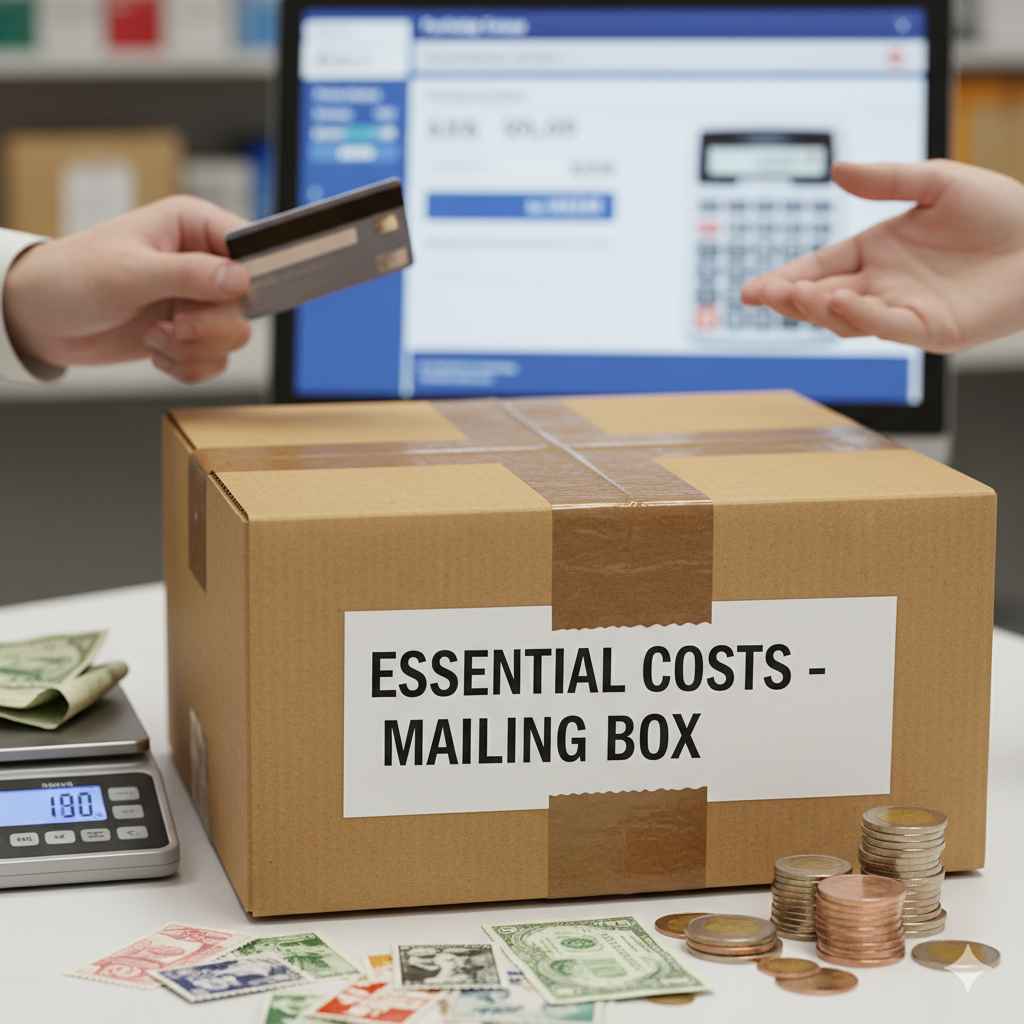
The cost to mail a box depends on four main things: its weight, size, where it’s going (distance), and how fast you need it there. For a standard 1-pound package sent across the country via USPS Ground Advantage, expect to spend around $10-$15. Always measure and weigh your box first for the best estimate.

Mail Boss
Mail Boss Mail Manager Modern Locking Post…
- SECURE YOUR DELIVERIES: USPS approved locking mailbox defends against mail theft; keeps mail, checks, and small packages locked aw…
- QUALITY: 14- and 16-gauge galvanized welded steel construction with stainless steel hinges defends against vandalism
- SECURITY: Innovative baffle door accepts small parcels, packages, and a box of checks and also deters fishing. Does not include or…
As an Amazon Associate I earn from qualifying purchases.
For a related kitchen decision, How To Hide Box Spring On Platform Bed adds another practical detail to check.
Hey there! Dustin here. Sending a box might seem simple, but when the price tag shows up, it can feel like taking your car to the mechanic without knowing what the labor charge might be. You need to get something important from Point A to Point B, and figuring out the shipping cost is often the most confusing part. Does it cost five dollars or fifty?
Don’t worry! We are going to break down exactly how the postal services figure out the price. Just like checking your oil or tire pressure, understanding shipping costs is an easy skill you can master. We will look at the main carriers, the hidden fees, and how you can easily save money. Let’s get your package moving without emptying your wallet!
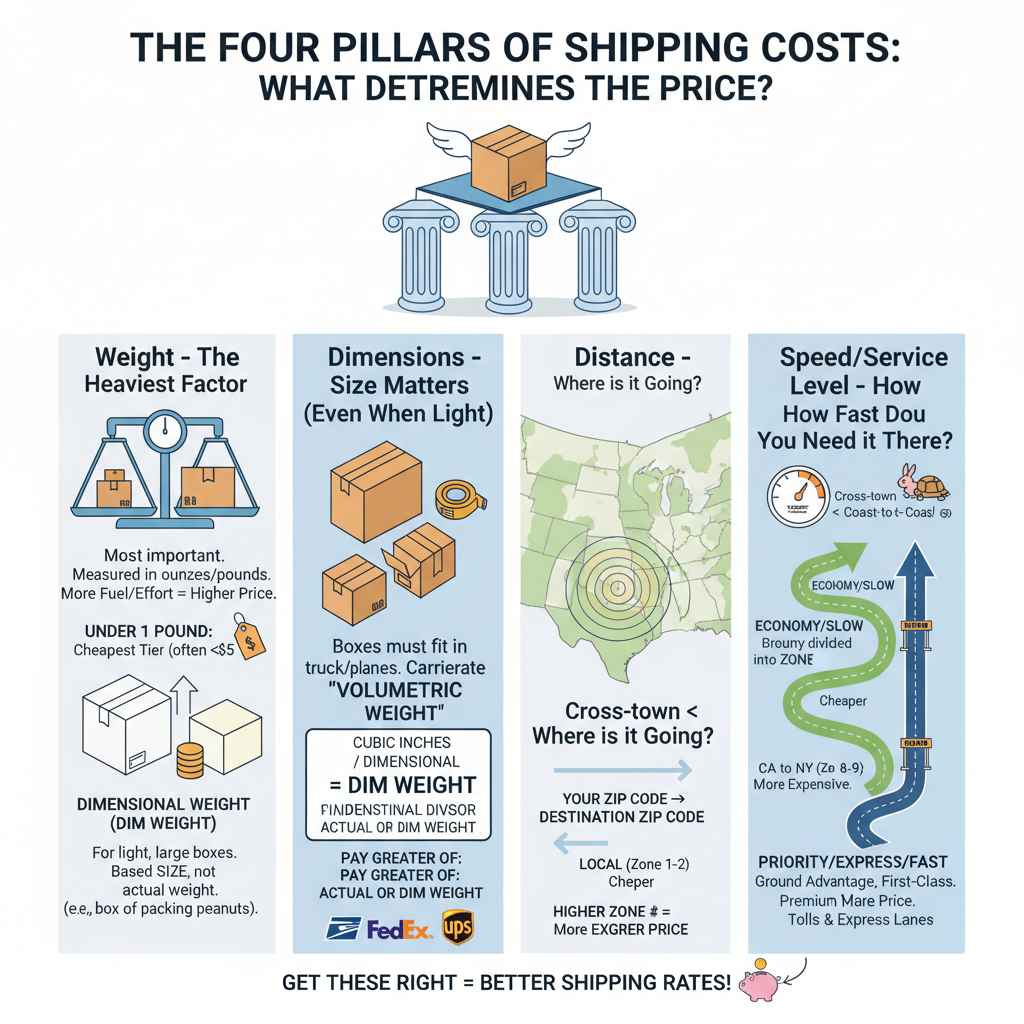
The Four Pillars of Shipping Costs: What Determines the Price?
Before you even walk up to the counter or click “print label,” you need to know that every mailing service uses the same basic formula to calculate “how much is it to mail a box.” Think of these four factors as the essential engine components—if one is off, the whole price changes. Get these right, and you’re halfway to a great shipping rate.
Pillar 1: Weight – The Heaviest Factor
This is the most important part. Shipping services measure your box in ounces or pounds. The heavier the package, the more fuel and effort it takes to move it, so the price goes up significantly. Most basic, affordable services (like USPS Ground Advantage) only cover up to 1 pound for their absolute lowest price tier.
- Under 1 Pound: Often the cheapest tier, sometimes under $5, depending on the service.
- 1 Pound and Up: The price increases with every ounce or pound added thereafter.
- Dimensional Weight (DIM Weight): This is crucial for light but large boxes. If your box is huge but mostly air (like shipping a box full of packing peanuts), the carrier might charge you based on its size instead of its actual weight, ensuring they aren’t losing money on bulky air freight.
Pillar 2: Dimensions – Size Matters (Even When Light)
Carriers need to fit your box onto trucks, planes, and sorting machines efficiently. A long, skinny box takes up valuable real estate, even if it weighs very little. This is where the DIM weight concept comes into play. Carriers use a specific formula based on length x width x height to determine a “volumetric weight.”
For example, USPS, FedEx, and UPS divide the calculated cubic inches by a “dimensional divisor” (which changes frequently, so always check the latest published number on their official sites) to see which weight—actual or dimensional—is greater. You pay for the greater of the two.
Pillar 3: Distance – Where is it Going?
Shipping across town is almost always cheaper than shipping coast-to-coast. Carriers divide the country into zones. The further your package travels from your zip code to the destination zip code, the higher the zone number, and thus, the higher the price.
For example, shipping between two addresses in the same local area might be Zone 1 or 2. Shipping from California to New York might push you toward Zone 8 or 9. Understanding zones helps you predict cost differences when shipping domestically.
Pillar 4: Speed/Service Level – How Fast Do You Need It There?
This is speed vs. savings. If you can wait a few days, economy services are cheap. If you need it there tomorrow morning, you are paying a premium for priority handling and direct routes.
Think of regular mail like taking the scenic route in your car; Ground Advantage or First-Class package service is efficient but sticks to the standard roadmap. Priority Mail or Express services are like paying tolls and taking express lanes—guaranteed quicker arrival via the fastest means available.
Comparing the Big Three: USPS, FedEx, and UPS Costs
When you need to ship a box, you generally have three major options in the United States. Each has its sweet spot. Since this is beginner-focused, we’ll look at what each is best for.
United States Postal Service (USPS)
USPS is often the most budget-friendly choice for lighter items and packages going to PO boxes or rural addresses where the other carriers might charge surcharges.
Key USPS Services Explained
- USPS Ground Advantage: This is the workhorse for non-urgent packages, replacing the older First Class Package Service (for items under 1 lb) and Parcel Select Ground. It’s the go-to for small businesses and general personal shipping. Delivery usually takes 2–5 business days.
- USPS Priority Mail: Faster than Ground Advantage, typically delivered in 1–3 business days. This service includes $100 of insurance automatically, which is a big plus for valuable items.
- USPS Priority Mail Express: The fastest service, often overnight delivery. It’s the most expensive but comes with robust tracking and guarantees.
Tip: USPS offers free Priority Mail boxes and envelopes—if you use their Priority services, you can skip buying your own boxes. Just make sure the contents fit securely!
FedEx and UPS
UPS and FedEx generally excel when you need reliable, fast service (especially for business-to-business shipping) or when shipping heavy items over long distances. They often have better tracking visibility than USPS for commercial routes.
FedEx Service Tiers Sample
| Service Level | Typical Speed Range | Best For |
|---|---|---|
| FedEx Ground/Home Delivery | 2–5 business days | Cost-effective, non-urgent home deliveries. |
| FedEx Express Saver | 3 business days | A good middle ground for moderate urgency. |
| FedEx 2Day | 2 business days | Medium urgency without the overnight cost. |
| FedEx First Overnight | Next morning | Urgent deadlines. |
UPS operates similarly to FedEx, using services like UPS Ground, UPS 2nd Day Air, and UPS Next Day Air. They are known for robust tracking capabilities. For everyday drivers needing to mail a typical box, USPS often has the edge on price for smaller packages, while UPS/FedEx can sometimes offer better rates for very heavy items (over 50 lbs) when commercial discounts are applied.
The Real Cost Breakdown: Weights and Price Examples
To truly understand “how much is it to mail a box,” let’s look at some real-world examples. Remember, these are estimates based on shipping from one coast to the other (higher zones) using standard, non-discounted retail rates as of early 2024. Prices change, so always verify with the carrier’s online calculator!
Estimated Cost to Mail a Standard 12″ x 12″ x 12″ Box (Cross-Country Shipping)
| Weight of Box | USPS Ground Advantage | USPS Priority Mail | FedEx/UPS Ground |
|---|---|---|---|
| 1 Pound | $10.50 – $12.50 | $14.00 – $16.00 | $16.00 – $19.00 |
| 5 Pounds | $15.00 – $18.00 | $22.00 – $26.00 | $24.00 – $30.00 |
| 15 Pounds | $28.00 – $33.00 | $45.00 – $55.00 | $40.00 – $50.00 |
Notice how the gap narrows for heavier items. For a 15-pound box, USPS Ground Advantage remains the clear budget winner, but UPS Ground starts to look competitive with Priority Mail. This variance is why you must weigh and measure before deciding.
Step-by-Step Guide: Calculating and Saving on Your Shipment
You don’t need a degree in logistics to figure this out! Follow these simple steps to ensure you get the best rate every time you mail a box.
Step 1: Pack Smartly and Accurately
Before anything else, prepare the box. Use the right sized box—don’t use a huge box for a small item. Over-packaging adds unnecessary dimensional weight costs.
- Securely fill all empty space with cushioning (bubble wrap, packing peanuts, or crumpled paper).
- Seal the box completely with strong packing tape on all seams.
- Weigh the final, sealed box using a kitchen or bathroom scale. Be as accurate as possible; a pound difference can push you into a higher price bracket.
- Measure the Length, Width, and Height (L x W x H) in inches.
Step 2: Determine Your Required Speed
Be honest with yourself. Does Aunt Martha really need that birthday gift tomorrow, or can she wait until the end of next week? This decision immediately narrows down your carrier options.
- If delay is acceptable (3+ days): Focus on Ground or Advantage services.
- If speed is necessary (1-3 days): Focus on Priority or Express tiers.
Step 3: Use the Online Calculators
This is a non-negotiable step for saving money. Never guess the price at the counter. Visit the website of your preferred carrier (USPS, UPS, or FedEx) and use their rate calculator.
You will input:
- Origin Zip Code and Destination Zip Code.
- Your exact package weight and dimensions.
- The service level you require (e.g., Ground Advantage).
The calculator will instantly show you the retail price. Many services, including the USPS, allow you to print the label online. If you compare the USPS online rate with the in-store rate, you often find online savings! For more in-depth zone mapping information, review the official USPS Domestic Service Standards documentation from the United States Postal Service (USPS Official Site).
Step 4: Check for Surcharges and Extra Fees
This is where the price quote can creep up unexpectedly. These are mandatory fees added onto the base shipping cost, regardless of the service you pick.
Common Surcharges to Watch For:
- Fuel Surcharge: Nearly all carriers add this dynamic fee to cover fluctuating gas/fuel costs. It’s built into the quoted price but changes often.
- Residential Surcharge: If you are shipping to a home address versus a commercial business address, packages sent via FedEx or UPS often have a small fee added.
- Signature Confirmation: If you request proof that someone physically signed for the package, this adds a fee (usually $2-$5).
- Oversize/Irregular Handling: If your box exceeds standard dimensions or is oddly shaped, this fee can be steep.
Hidden Costs: Boxes, Tape, and Insurance
The actual shipping label is only part of “how much is it to mail a box.” You also need supplies. If you aren’t careful, buying these can add $10 or $15 to your total shipment cost.
The Cost of the Container
You have two paths when it comes to the box itself:
- Free Boxes (USPS): If you use Priority Mail, Priority Mail Express, or Flat Rate services, USPS provides the boxes for free, provided they are used for that service. This is almost always the cheapest way to ship heavier items if Priority speed works for you.
- Purchased Boxes: If you use USPS Ground Advantage, FedEx, or UPS, you need to buy your own boxes. A sturdy, medium-sized shipping box from a supply store can cost between $2.50 and $5.00. Don’t reuse old cereal boxes—they rarely meet carrier strength requirements for heavy items.
Insurance: Protecting Your Investment
If you are shipping something valuable (anything you couldn’t easily replace), you need shipping insurance. If the box gets lost or damaged, the insurance refunds you.
USPS Ground Advantage includes $100 coverage for free. For higher values, you buy additional coverage. FedEx and UPS include minimal coverage (often $50) standard, but you must purchase extra insurance for substantial value protection.
| Carrier/Service Feature | Included Coverage | Cost to Add Coverage (Approximate) |
|---|---|---|
| USPS Ground Advantage | $100 | $1.85 per $100 extra value |
| USPS Priority Mail | $100 | $1.85 per $100 extra value |
| FedEx/UPS Standard Parcel | $50 – $100 (Varies) | Varies widely; often $1-$2 per $100 |
Mastering Regional and Flat Rate Shipping
If you want to nail down the cost, use the flat rate options whenever possible. These services ditch zone calculations entirely, relying solely on the box size and the service speed.
USPS Flat Rate Options
The Flat Rate system is fantastic because the price is the same whether shipping 1 pound or 70 pounds (as long as it fits and closes). You must use the specific boxes provided by USPS for these services.
- Flat Rate Envelope: Best for documents or very thin, flexible items.
- Flat Rate Box (Small/Medium/Large): Ideal for mailing heavy, dense items that fit snugly into the box. If you have 10 pounds of metal parts, putting them in a Flat Rate Box might be half the cost of using Ground Advantage based on weight alone.
The “If It Fits, It Ships” Advantage
Always check the weight limit for Flat Rate services. For example, if you use a USPS Medium Flat Rate Box, you can send up to 70 lbs to Hawaii or Alaska for the same price as sending it across the street. If your item weighs 30 pounds, this is a massive saving over paying by weight.
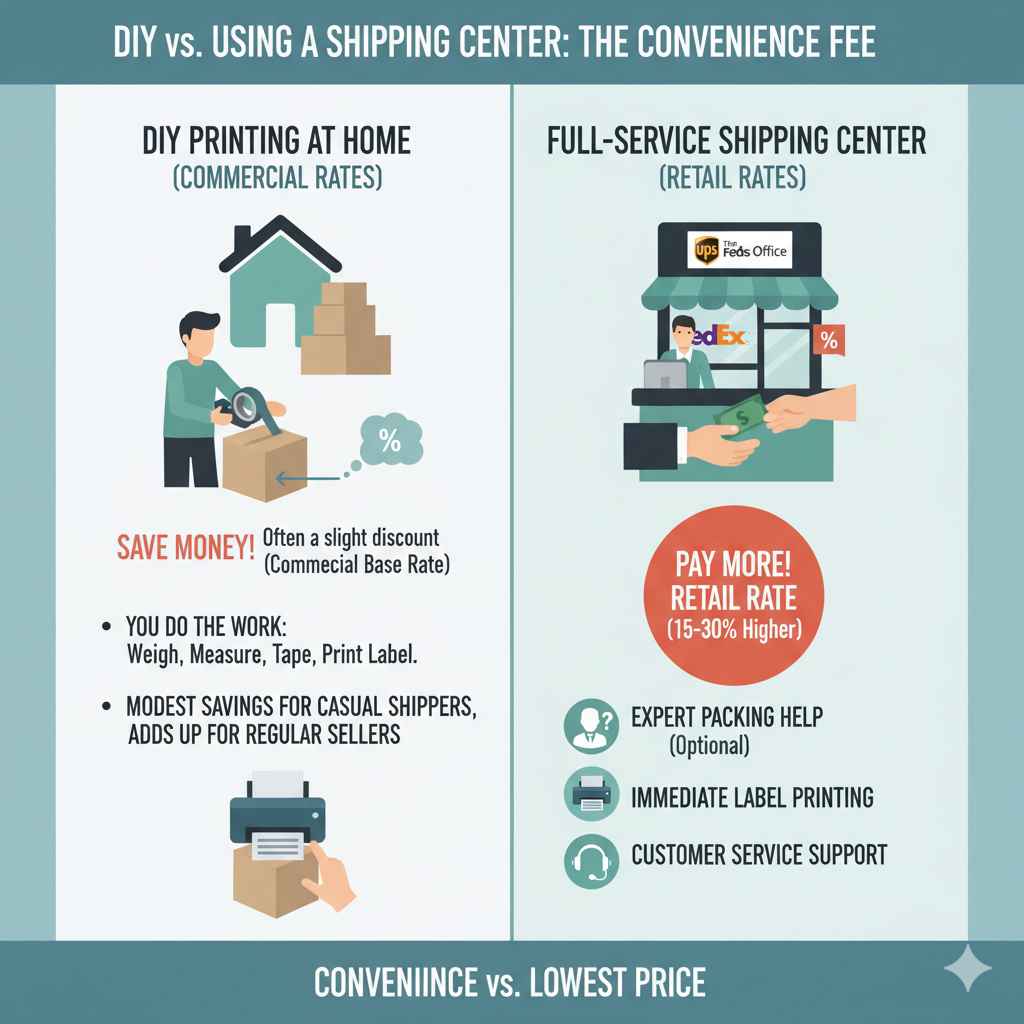
DIY vs. Using a Shipping Center (The Convenience Fee)
When trying to answer “how much is it to mail a box,” you must decide if you want convenience or the absolute lowest price. Shipping centers like The UPS Store or FedEx Office offer services that cost extra but save you time.
Shipping Centers (Retail Rates)
When you walk into a staffed center, you are paying the RETAIL rate. This rate is the highest possible price because you are paying for:
- Expert packing help (if needed).
- Immediate printing of the label.
- Customer service support if something goes wrong.
The convenience fee can sometimes add 15% to 30% more than what you would pay printing the label at home online.
Printing at Home (Commercial Rates)
If you weigh, measure, tape, and print your label yourself from your home printer, you often receive a slight discount, called a commercial base rate. For most casual shippers, the savings are modest, but for those sending packages regularly, these savings add up significantly.
Frequently Asked Questions (FAQ) for Beginner Shippers
Q1: What is the cheapest way to mail a lightweight box domestically?
The cheapest way is usually USPS Ground Advantage for anything under 1 pound. If you can use one of the free USPS Priority Mail boxes and your item weighs less than 70 pounds, Priority Mail Flat Rate can sometimes beat Ground Advantage prices if you are shipping something heavy (over 5 or 6 pounds) across long distances.
Q2: Do FedEx and UPS charge extra if I drop the box off at their location?
Generally, no—if your package already has a prepaid label, you can drop it off at an official location without extra cost. However, if you go to a retail partner (like a staffed shipping store) and ask them to print the label, pack the item, or process the shipment, they may charge service or handling fees. Always check whether you’re at a corporate location or a third-party store.
Q3: Is it cheaper to ship online or at the post office?
It’s almost always cheaper to ship online through United States Postal Service, FedEx, or UPS websites. Online rates often include commercial discounts, while in-store purchases are charged at retail rates, which can be 10–30% higher. Printing your label at home and dropping off the package is one of the easiest ways to save money.
Q4: How can I reduce the cost of mailing a box?
Here are some proven ways to cut shipping costs:
- Use the smallest box possible to avoid dimensional weight charges
- Compare carriers online before choosing (USPS vs UPS vs FedEx)
- Choose slower shipping if time allows (Ground vs Express)
- Take advantage of flat-rate boxes for heavy items
- Reuse sturdy boxes when possible (as long as they meet standards)
- Avoid unnecessary add-ons like signature confirmation unless needed
Even small changes—like trimming box size—can save several dollars per shipment.
Q5: What happens if my package is lost or damaged?
If your package is lost or arrives damaged, you can file a claim with the carrier:
- United States Postal Service includes up to $100 insurance with many services
- FedEx and UPS typically include $50–$100 coverage
To file a claim, you’ll need:
- Your tracking number
- Proof of value (receipt or invoice)
- Photos (for damage claims)
If the declared value exceeds the included coverage, it’s worth purchasing additional insurance before shipping.
Conclusion: Ship Smart, Save More
Mailing a box doesn’t have to feel like guessing a mystery bill. Once you understand the four key factors—weight, size, distance, and speed—you’re in control of the cost. For most everyday shipments, USPS Ground Advantage is the cheapest option, while FedEx and UPS shine for heavier or time-sensitive deliveries.
The real secret? Preparation and comparison. Measure your box, check rates online, and choose the service that fits your needs—not just the fastest one available.
With these tips, you’ll ship confidently, avoid surprise fees, and keep more money in your pocket every time you send a package.
Related pick: Check today's price on Amazon
Products related to this article
Sponsored / affiliate links. As an Amazon Associate I earn from qualifying purchases. I may earn additional commission from eligible campaigns.