Where to Put Tarps in Bookkeeping: A Contractor’s Decision Tree
You bought a heavy-duty tarp to cover a client’s roof during a storm. Then another one to protect a pile of lumber on a job site. Then a bulk pack of smaller tarps for general site cleanup. When you sit down to code those receipts, the cursor blinks in QuickBooks. Is this a supply? Is it an asset? Is it inventory?
This confusion costs small contractors and farmers real money at tax time. Misclassified tarps either inflate your taxable income or trigger an audit flag. This guide walks you through a simple decision tree so you can assign every tarp purchase to the correct account. You’ll know the dollar thresholds, the account names that work, and how to handle the tarps that get ruined or stolen. If you’re also trying to get your overall financial habits in order, the book Where to Put Your Cookies covers saving and investing basics in plain language.

As an Amazon Associate I earn from qualifying purchases.
Clarifying ‘Tarps’ in a Bookkeeping Context
Before we dive into accounts, let’s clear up a common search confusion. Most people searching this topic mean physical tarpaulins. But sometimes ‘tarp’ is a typo for ‘target’ as in a target budget or target sales figure. If you are budgeting, that is a different process entirely. This article assumes you buy and use physical tarps for construction, farming, or landscaping work.
The second clarification: expense categorization depends on how you use the tarp. A tarp that covers a roof during a repair is a job supply. A tarp you keep in your truck for years of general use is a small tool. A stack of tarps you sell to customers is inventory. The same physical item lands in three different accounts based on intent.
The Core Rule: Supplies vs. Fixed Assets
The IRS does not have a specific line for tarps. You classify them under general bookkeeping principles. The main question: does the tarp get consumed within a year, or does it last longer?
The $2,500 Threshold Rule
Most small businesses use the de minimis safe harbor. This rule lets you deduct tangible property that costs $2,500 or less per item as an immediate expense. So a $150 tarp, even a heavy-duty one, gets expensed right away. You do not need to depreciate it.
But watch the per-item rule. If you buy a single invoice for ten tarps at $300 each, the invoice total is $3,000. The IRS looks at the invoice. If the invoice total exceeds $2,500, some accountants prefer to capitalize the whole purchase. The safer route: ask the supplier to issue separate invoices for each tarp over $2,500. That keeps each item under the threshold.
Depreciation for Heavy-Duty Tarps
Occasionally a tarp is a serious piece of equipment. Think of a massive industrial tarpaulin used as a temporary warehouse wall or a custom-made cover for expensive machinery. If a single tarp costs over $2,500, treat it as a fixed asset. Depreciate it over five years using the Modified Accelerated Cost Recovery System (MACRS).
This is rare for most readers. Most tarps cost $50 to $500. Just know the rule exists so you do not accidentally expense a $4,000 tarp and trigger a tax deduction issue.
Setting Up Your Chart of Accounts for Tarps
Generic advice says ‘put it in supplies.’ That is not good enough. Your chart of accounts should reflect how you actually work. Here is a practical mapping for contractors and farmers.
Best Account Names (Job Supplies, Small Tools, COGS)
Use Job Supplies for tarps bought for a specific project. This account tracks direct costs linked to a customer contract. It flows into your cost of goods sold (COGS) on the profit and loss statement. When you estimate future jobs, you can see exactly what you spent on tarps and adjust your bids.
Use Small Tools and Equipment for tarps you keep for general use. These are not tied to a single job. They get expensed immediately but tracked in a separate category. This helps you monitor replacement costs.
Use Inventory: Resale if you sell tarps. This only applies to supply yards or farm stores. You log the purchase as inventory. When you sell a tarp, you move the cost to COGS. If you buy a bulk pack and use some for your own jobs and sell the rest, split the invoice. Allocate the percentage to each account.
Here is a quick reference table for the most common scenarios:
| Scenario | Account Name | Expense Type | Example |
|---|---|---|---|
| Rented tarp for one job | Equipment Rental | Operating Expense | $75 rental fee for a weekend |
| Bought tarp for a specific client project | Job Supplies | COGS | $120 tarp for roof repair |
| Bought tarp for general truck use | Small Tools | Operating Expense | $90 tarp kept in work vehicle |
| Bought 50 tarps to resell | Inventory | Asset until sold | $1,500 bulk purchase |
| Single tarp over $2,500 | Fixed Assets | Depreciable Asset | $3,000 industrial cover |
How to Track Tarp Purchases (Rental vs. Purchase)
Renting a tarp is straightforward. The rental fee is a current operating expense. Code it to Equipment Rental. You do not track the tarp itself on your books. Keep the receipt with the job file.
Purchasing a tarp requires a bit more thought. Here is the step-by-step process:
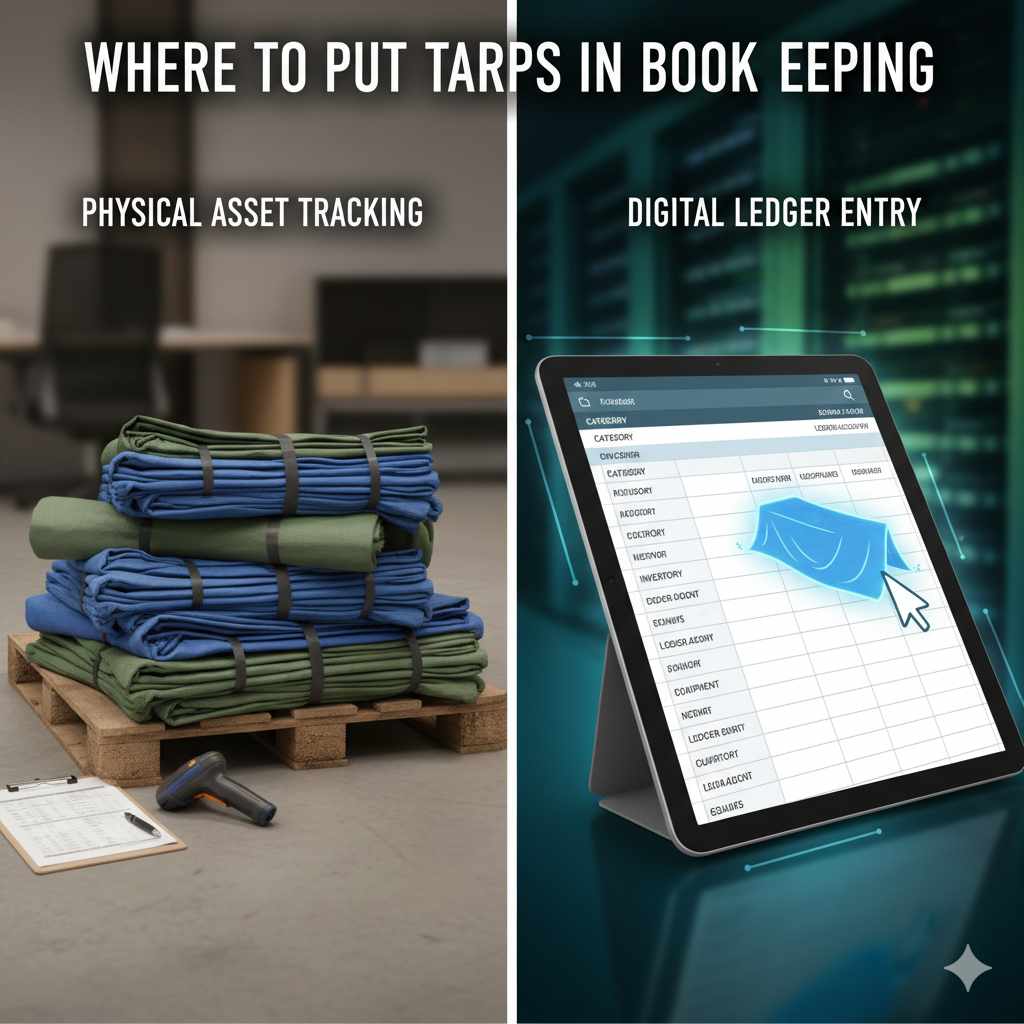
- Look at the invoice. Is the total over $2,500? If yes, treat it as a fixed asset and set up a depreciation schedule.
- If under $2,500, ask: did I buy this for a specific customer contract? If yes, code to Job Supplies.
- If it is for general site use, code to Small Tools.
- If you plan to sell it, code to Inventory.
- Attach a digital copy of the receipt to the transaction in your accounting software. Note the job name if applicable.
Pro tip: take a photo of the tarp in use. Attach it to the receipt in your accounting software. This gives you visual proof if the IRS ever questions whether the tarp was a business expense or a personal purchase for camping.
Recording Tarp Transactions in QuickBooks
QuickBooks makes this easy once your chart of accounts is set up. When you enter the bill or expense, select the correct account from the dropdown. Use the Memo field to note the job name or project code. This keeps your job costing reports accurate.
For cash basis accounting, record the expense when you pay. For accrual basis, record it when you receive the tarp, even if you have not paid the invoice yet. Most small contractors use cash basis because it is simpler and matches their bank account.
One warning: do not use the generic Supplies account that QuickBooks creates by default. That account is a dumping ground. Creating a specific Job Supplies account takes five minutes and saves hours at year-end. You can also set up a rule in QuickBooks that automatically categorizes purchases from your regular tarp supplier to Job Supplies. This saves time on recurring purchases.
Handling Lost, Damaged, or Stolen Tarps
Tarps take a beating. They get torn by wind, stolen from job sites, or simply wear out. The accounting treatment depends on how the tarp was classified.
If you expensed the tarp as Job Supplies or Small Tools, there is nothing to write off. The expense already hit your books. A damaged tarp just means you buy a new one. You do not record a loss.
If you capitalized the tarp as a fixed asset, you have a bookkeeping event. Suppose you bought a $3,000 industrial tarp and depreciated it for two years. Its net book value is now $1,800. If a storm destroys it, you write off the remaining $1,800 as a casualty loss. This reduces your taxable income. You need documentation: photos of the damage, a police report for theft, or an insurance claim.
For inventory, a stolen or damaged tarp is shrinkage. You adjust the inventory account down and record the loss as Shrinkage Expense. This is a normal part of running a retail business.
Common Tarp Categorization Mistakes to Avoid
Three mistakes show up repeatedly in my reviews of contractor books.
Mistake 1: Coding all tarps to COGS. Not every tarp is tied to a job. If you buy a tarp to cover your own equipment in the yard, that is an overhead expense, not a project cost. Putting it in COGS inflates your project margins and makes your estimates look better than they are.
Mistake 2: Ignoring the rental vs. purchase distinction. Rental fees are simple operating expenses. Some bookkeepers try to capitalize rental fees because they feel ‘significant.’ Do not do this. A rental has no ownership, so it is always an expense.
Mistake 3: Forgetting the inventory rule. If you buy tarps in bulk and sell them, you must track them as inventory. You cannot expense the whole purchase immediately. The IRS requires you to match revenue with the cost of goods sold. Expensing the entire bulk purchase upfront distorts your profit for that period.
Frequently Asked Questions
Can I deduct a tarp purchase as a business expense?
Yes, if the tarp is used for your business. A tarp to cover a client’s roof or protect job site materials is deductible. A tarp for your personal boat is not. Keep the business use clear and documented.
What if I buy a tarp for a job and later use it on another job?
Code it to Job Supplies on the first job. You do not need to transfer the cost. The expense is recognized when incurred. Just note in the memo that it may be used on multiple sites. This is standard practice.
Is a tarp considered a capital expense or an operating expense?
It depends on the cost. Under $2,500 per item, it is an operating expense. Over $2,500, it is a capital expense and must be depreciated. The $2,500 threshold is the IRS de minimis safe harbor limit.
How do I handle a tarp that was stolen from my job site?
If the tarp was expensed, no adjustment is needed. If it was capitalized as a fixed asset, write off the remaining book value as a theft loss. File a police report and keep a copy for your tax records.
Do I need to track tarps as inventory if I buy them in bulk?
Only if you sell them. If you buy a bulk pack and use all of them in your own operations, treat the entire purchase as a supply expense. If you sell a portion, allocate the cost between inventory and supplies based on the number of tarps.
Final Checklist for Tarp Bookkeeping
- Classify each tarp purchase based on intent: job-specific, general use, or resale.
- Apply the $2,500 threshold rule to every single tarp or invoice.
- Set up specific accounts: Job Supplies, Small Tools, Equipment Rental, and Inventory.
- Attach receipts and photos to every transaction in your accounting software.
- Depreciate any tarp over $2,500 over five years.
- Write off damaged or stolen capitalized tarps with proper documentation.
- Review your chart of accounts quarterly to make sure tarps are not landing in the generic Supplies account.
Products related to this article
Sponsored / affiliate links. As an Amazon Associate I earn from qualifying purchases. I may earn additional commission from eligible campaigns.