How Does The Periodic Table Work? Simple Explained
The periodic table is a chart that lists all known elements. It organizes them by their atomic structure and properties. This helps scientists understand and predict how elements will behave. It’s a fundamental tool in chemistry.
For another table or room-layout decision, How Does Pivot Table Work gives readers a useful follow-up.
What is the Periodic Table?
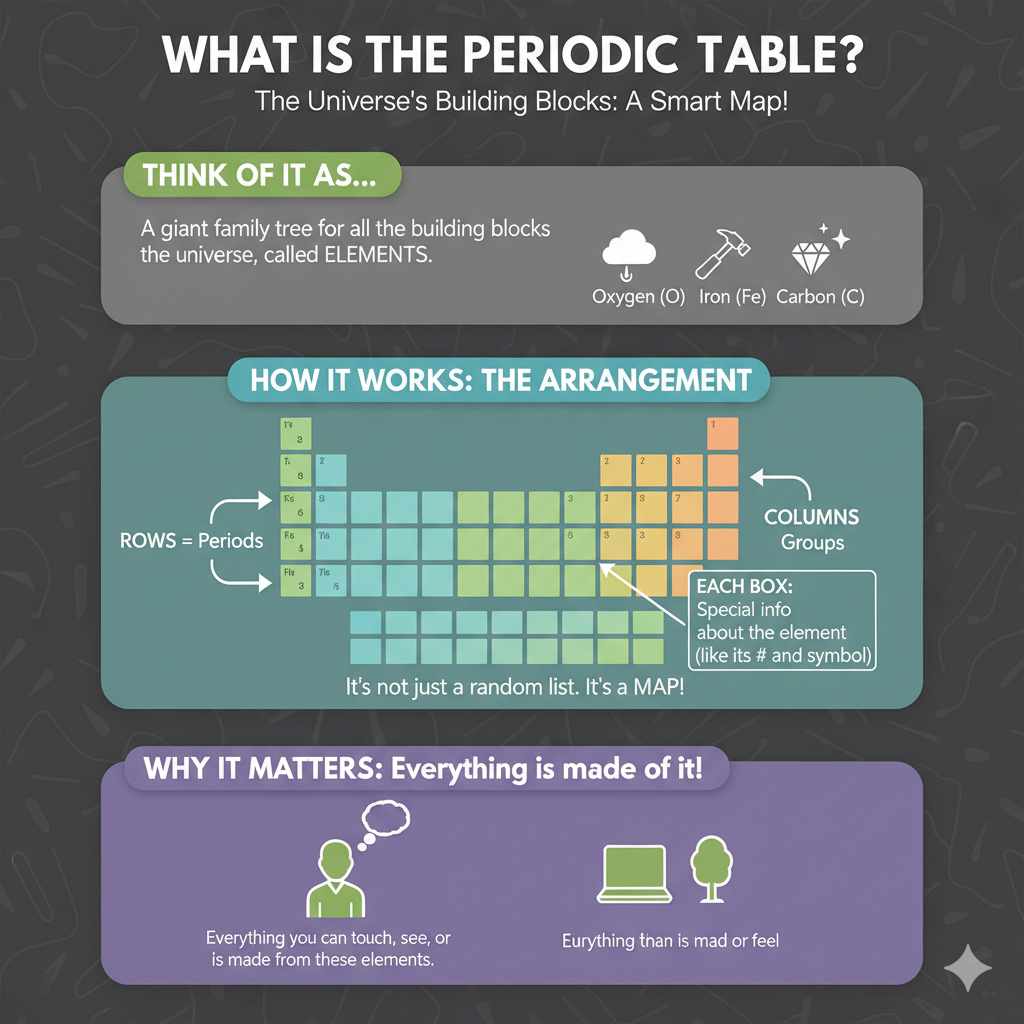
Think of the periodic table as a giant family tree for all the building blocks of the universe. These building blocks are called elements. You know, like oxygen that we breathe, or iron that makes up some tools.
Everything you can touch, see, or even feel is made from these elements.
The table arranges these elements in a very smart way. It puts them into rows and columns. Each element has its own special box.
This box tells you important things about that element. It’s not just a random list. It’s a map.
Why Does the Periodic Table Matter?
This chart is super important for scientists. It helps them understand how different elements connect. They can see which elements might react with each other.
They can guess what new things they might create. It’s like knowing how different LEGO bricks fit together. You can build amazing things!
For people like me who love explaining science, it’s exciting to see how this chart unlocks so many secrets. It makes chemistry less scary and more like a fascinating puzzle. Understanding the periodic table means you’re starting to understand the world itself.
The Building Blocks: Elements
At its heart, the periodic table is all about elements. An element is a pure substance. It cannot be broken down into simpler substances by normal chemical means.
Think of it as something fundamental. It’s like a single type of LEGO brick, not a whole structure made of many bricks.
Right now, we know of 118 elements. Some are very common, like carbon in all living things. Others are very rare.
Some exist only for a tiny moment before changing into something else. The chart lists all of them, from the lightest to the heaviest.
Atomic Number: The Element’s ID Card
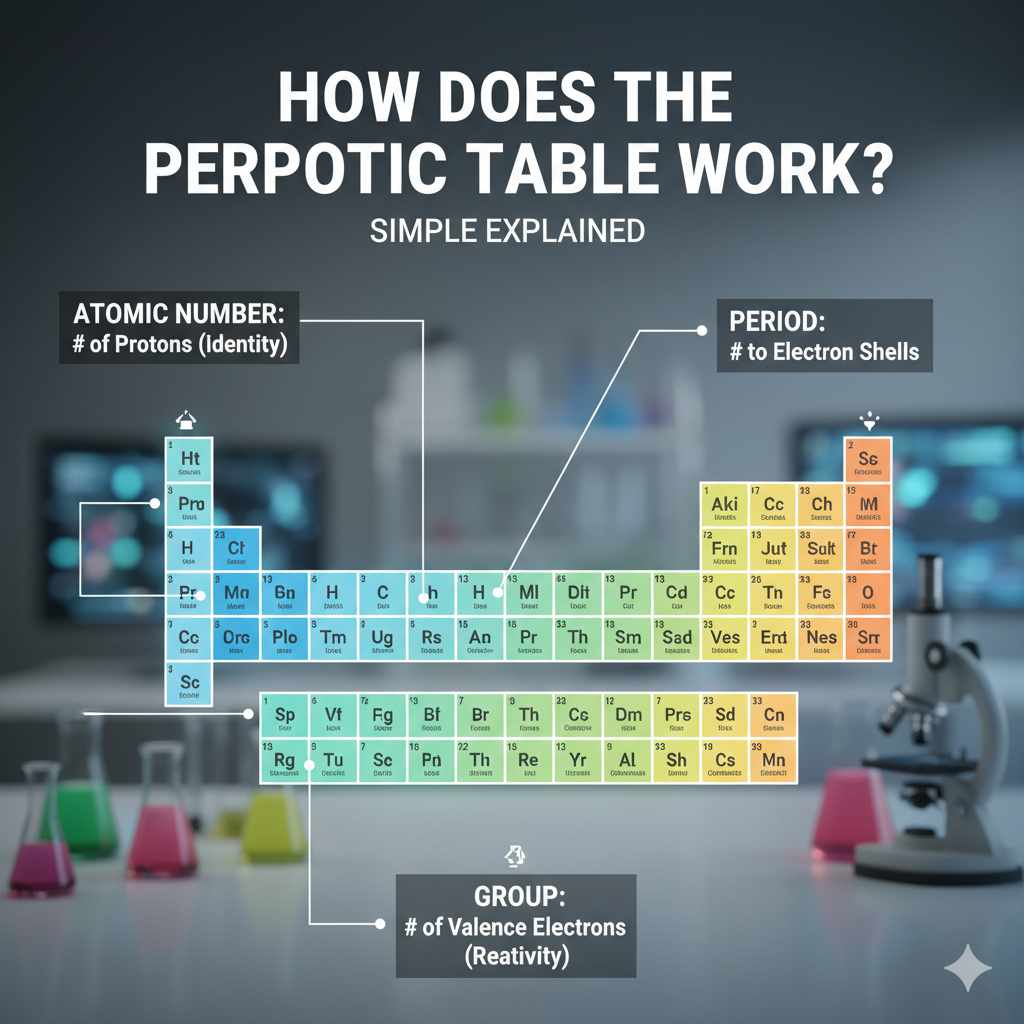
Every element on the table has a unique number. This is called the atomic number. It’s like an element’s personal ID number.
The atomic number tells us how many protons are inside the center of an atom of that element. Protons are tiny particles found in the middle part of an atom, called the nucleus.
Hydrogen is the simplest element. It has one proton. So, its atomic number is 1.
Helium has two protons. Its atomic number is 2. As you go down the table, the atomic numbers get bigger.
This means the elements have more protons. This is a key way the table is organized.
Atomic Number = Number of Protons
Atoms: The Tiny World
To really get the periodic table, we need to think small. Really small. Everything, all matter, is made of atoms.
Atoms are the smallest unit of an element that still has the properties of that element. They are incredibly tiny.
An atom has a center, the nucleus. This nucleus holds protons (which have a positive electric charge) and neutrons (which have no charge). Tiny particles called electrons orbit around the nucleus.
Electrons have a negative electric charge. The number of protons usually equals the number of electrons in a neutral atom. This is why elements behave the way they do.
The number of protons defines the element. If you change the number of protons, you change the element itself. It’s like changing the core ingredient in a recipe.
The whole dish changes.
Groups: The Vertical Columns (Families)
Look at the periodic table. You’ll see long columns going up and down. These are called groups.
Elements in the same group are like family members. They share similar traits and often behave in similar ways. This is one of the most powerful things about the table.
Why do they act alike? Because they have the same number of electrons in their outermost shell. These outer electrons are called valence electrons.
They are the ones that do most of the “talking” or reacting between atoms. So, if atoms have the same number of these outer electrons, they tend to do similar “talking.”
Elements in the Same Group: Shared Traits
Group 1: Alkali Metals
These are shiny, soft metals. They react very strongly with water. Think sodium, which is in salt.
Group 17: Halogens
These are reactive non-metals. They often form salts. Chlorine and fluorine are examples.
Group 18: Noble Gases
These are very unreactive gases. They are stable. Helium and neon are noble gases.
Periods: The Horizontal Rows (Timelines)
Now, look at the rows going across the table. These are called periods. As you move from left to right across a period, the elements change.
Their properties change in a predictable way. It’s like a timeline showing how things transform.
What’s changing? The number of electron shells around the atom’s nucleus. In each period, atoms are adding electrons to a new, outer shell.
This gradual change in electron arrangement leads to the step-by-step shift in properties you see across the row.
The first period is short. It only has two elements: Hydrogen and Helium. This is because atoms in the first period are filling their first and only electron shell.
As you go to longer periods, atoms have more electron shells to fill. This gives them more complex behavior.
Metals, Nonmetals, and Metalloids
The periodic table also divides elements into three main categories. This helps us quickly see their general behavior.
Metals: Most elements are metals. You find them mostly on the left and in the middle of the table. Metals are usually shiny.
They are good at conducting heat and electricity. They can be bent or shaped without breaking. Think of copper wires or a gold ring.
Nonmetals: These are found on the right side of the table. They are not good conductors of heat or electricity. They can be gases, liquids, or brittle solids.
Oxygen, carbon, and sulfur are nonmetals. These are crucial for life.
Metalloids: These elements sit on the “staircase” line between metals and nonmetals. They have properties of both. Silicon, used in computer chips, is a metalloid.
They are often used in electronics because their conductivity can be controlled.
Element Categories at a Glance
Metals
- Shiny
- Good conductors
- Malleable (can be shaped)
- Found left & middle
Nonmetals
- Dull
- Poor conductors
- Brittle (if solid)
- Found right
Metalloids
- Mix of metal & nonmetal traits
- Semi-conductors
- On the staircase line
The Element Box: What’s Inside?
Let’s take a closer look at a single element’s box on the periodic table. It’s packed with information.
Usually, the largest number you see is the atomic number. This is the number of protons. It’s unique for each element.
Below the atomic number, you’ll often see the element’s symbol. This is a one or two-letter abbreviation. For example, H for Hydrogen, O for Oxygen, Fe for Iron (from the Latin word ‘ferrum’).
Underneath the symbol is the element name itself. Like “Helium” or “Carbon.”
There might also be a relative atomic mass (or atomic weight). This is like the average weight of an atom of that element. It’s usually a decimal number.
It’s based on the number of protons and neutrons in the atom’s nucleus. The number of neutrons can sometimes vary, which is why it’s an average.
Inside an Element’s Box
Atomic Number: Unique ID (number of protons)
Symbol: Short code (e.g., Au for Gold)
Name: Full name of the element
Atomic Mass: Average weight (protons + neutrons)
I Was Staring at a Periodic Table…
I remember in my first chemistry class, the professor pointed to the periodic table. He said, “This is your roadmap.” I just saw a bunch of colored squares and numbers. It felt overwhelming.
My first homework assignment was to identify elements based on their properties. I had no idea where to start.
I spent hours flipping through pages. I tried to memorize what each number meant. It was like trying to learn a new language without a dictionary.
Then, during a study group, a classmate pulled out a different periodic table. This one had the groups and periods clearly labeled. She explained that elements in the same column acted alike.
She showed me how the rows changed things bit by bit.
Suddenly, it clicked. It wasn’t just random data. It was a system.
A beautiful, organized system. That feeling of understanding, of seeing the pattern, was amazing. It turned a frustrating chore into a moment of real discovery.
That’s when I knew I loved chemistry. It’s all about finding those patterns.
Electron Shells and Electron Configuration
The real magic behind the periodic table’s organization is how electrons are arranged. Electrons don’t just float randomly around the nucleus. They live in specific energy levels or “shells.” Think of them like floors in a building.
The first floor is closest to the nucleus and has the lowest energy.
Each shell can hold a certain number of electrons. The first shell can hold 2. The second can hold 8.
The third can hold up to 18, and so on. The elements are arranged so that their electron shells get filled up as you move across and down the table.
The elements in the same group (column) have the same number of electrons in their outermost shell. This is why they behave so similarly. For example, all alkali metals (Group 1) have one electron in their outer shell.
This single outer electron is very eager to join with other atoms. This makes them very reactive.
Electron Shells: Where Electrons Live
Shell 1 (Innermost): Max 2 electrons. Filled by Hydrogen and Helium.
Shell 2: Max 8 electrons. Filled by elements Lithium through Neon.
Shell 3: Max 18 electrons. Filled by elements Sodium through Argon.
Outer Shell Electrons: These are the “valence” electrons. They determine an element’s chemical behavior.
The Importance of Valence Electrons
Valence electrons are the key players in chemical reactions. They are the electrons in the outermost shell of an atom. When atoms interact, it’s these valence electrons that make contact and form bonds.
Elements “want” to have a full outer shell of electrons. This makes them stable, like the noble gases. So, atoms will gain, lose, or share their valence electrons to achieve this stable state.
How an element does this is predictable based on how many valence electrons it has.
For example, elements with one valence electron (like Sodium, Na) tend to lose that electron easily to become stable. Elements with seven valence electrons (like Chlorine, Cl) tend to gain one electron to complete their outer shell. This dance of electrons is what creates compounds and drives all chemical processes.
Blocks of the Periodic Table: s, p, d, f
You might notice that the periodic table has different shapes or blocks. These blocks correspond to the type of electron orbital being filled. This is a more advanced way to look at it, but it’s another layer of organization.
The s-block is on the far left. It includes Group 1 and Group 2 elements. These elements fill their ‘s’ orbitals.
The p-block is on the right side. It includes Groups 13 through 18. These elements fill their ‘p’ orbitals.
The d-block is in the middle. These are the transition metals. They fill their ‘d’ orbitals.
The f-block is usually shown at the bottom. These are the lanthanides and actinides. They fill their ‘f’ orbitals.
This block structure is a direct result of how electron shells are filled according to quantum mechanics. It’s a complex idea, but it explains the shapes and patterns you see on the table.
Periodic Table Blocks Explained
s-block (Groups 1-2): Filling s-orbitals. Alkali metals and alkaline earth metals.
p-block (Groups 13-18): Filling p-orbitals. Includes nonmetals, metalloids, and some metals.
d-block (Groups 3-12): Filling d-orbitals. Transition metals.
f-block (Lanthanides & Actinides): Filling f-orbitals. Inner transition metals.
Trends in the Periodic Table: Predictable Patterns
Besides having similar properties within groups, elements also show trends as you move across periods or down groups. These trends allow scientists to predict properties of elements they haven’t even made yet!
Atomic Radius: This is the size of an atom. It generally gets smaller as you move from left to right across a period. This is because more protons pull on the electrons.
It also gets larger as you move down a group. This is because new electron shells are added.
Ionization Energy: This is the energy needed to remove an electron. It generally increases as you move from left to right across a period. It also decreases as you move down a group.
Elements that want to hold onto their electrons tightly have high ionization energy.
Electronegativity: This is an atom’s ability to attract electrons in a chemical bond. It generally increases as you move from left to right across a period. It also decreases as you move down a group.
Fluorine is the most electronegative element.
Key Periodic Trends
| Property | Across a Period (Left to Right) | Down a Group (Top to Bottom) |
|---|---|---|
| Atomic Radius | Decreases | Increases |
| Ionization Energy | Increases | Decreases |
| Electronegativity | Increases | Decreases |
Real-World Context: Where We See Elements
The periodic table isn’t just for science labs. Its elements are everywhere. They make up our homes, our food, and even ourselves.
In Your Home: Copper in your wiring (a metal). Aluminum in your soda cans (a metal). Silicon in your computer chips (a metalloid).
Oxygen and Nitrogen in the air you breathe (nonmetals).
In Your Food: Carbon is the backbone of all organic molecules, so it’s in all food. Calcium in milk for bones (an alkaline earth metal). Iron in red meat for blood (a transition metal).
In Nature: Helium in balloons. Gold and silver in jewelry. Uranium in nuclear power.
Even exotic elements are studied in places like CERN.
Understanding the table helps us appreciate the complex, yet ordered, world around us. It shows how simple building blocks combine in countless ways to create everything we experience.
What This Means For You
So, why should you care about the periodic table? It’s not just for chemists. Knowing how it works gives you a better grasp of the world.
When it’s Normal: Seeing elements listed with their numbers and symbols is completely normal. The arrangement in groups and periods is logical. Metals on one side, nonmetals on the other, with metalloids bridging the gap, is how it’s designed.
When to Worry (Less about the table itself, more about applications): If you see claims about elements that sound too good to be true, or if someone is selling “miracle cures” based on specific elements without scientific backing, be cautious. Always look for reliable sources.
Simple Checks: If you’re curious about what something is made of, you might look up its chemical composition. You’ll often see element symbols listed. This is where the periodic table comes in handy!
Quick Tips for Understanding the Periodic Table
Here are a few simple ways to make the periodic table less intimidating:
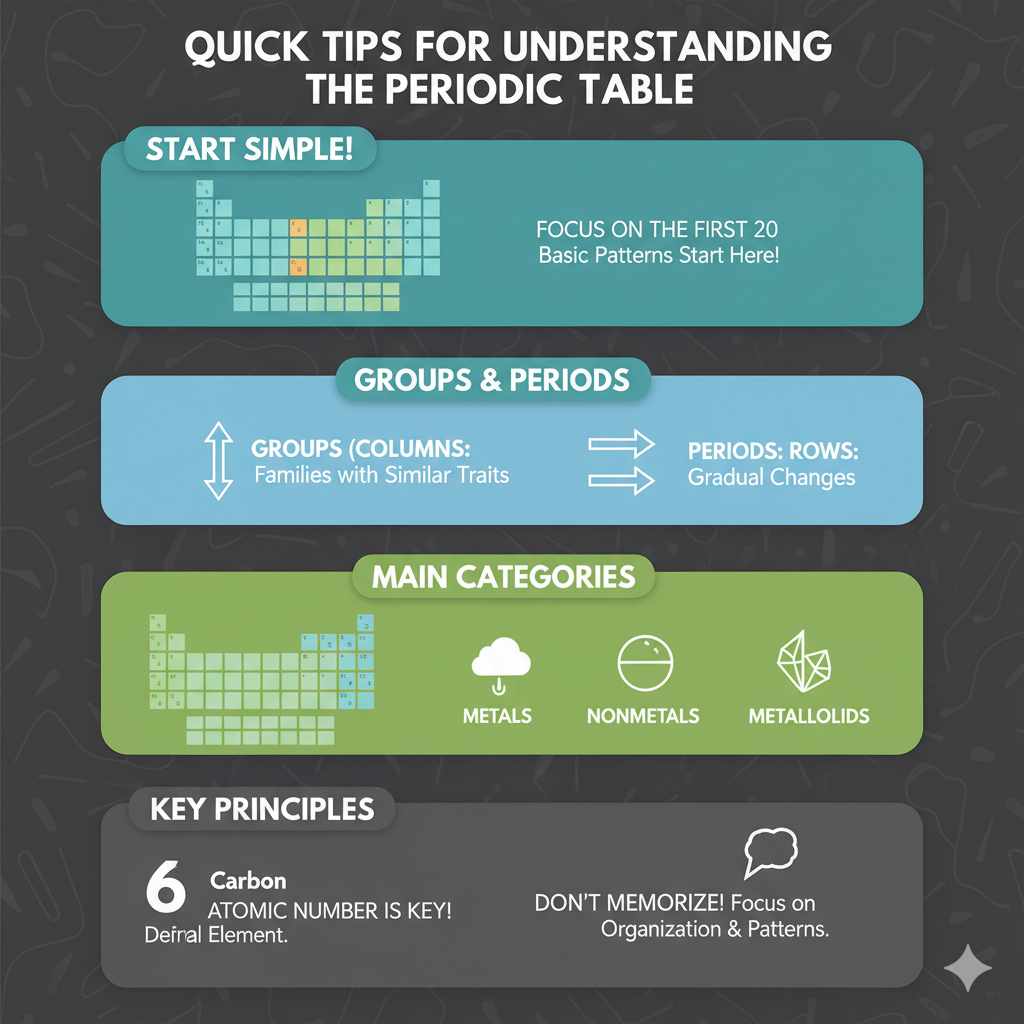
- Focus on the first 20 elements first. They show many of the basic patterns.
- Understand the difference between groups and periods. Groups are families with similar traits. Periods show gradual changes.
- Learn the main categories: metals, nonmetals, metalloids. This gives you a broad idea of behavior.
- Remember that the atomic number is key. It defines the element.
- Don’t try to memorize everything at once. Focus on understanding the organization.
Frequently Asked Questions About How the Periodic Table Works
What is the main purpose of the periodic table?
The main purpose of the periodic table is to organize all the known chemical elements. It arranges them in a way that shows their properties and how they relate to each other. This helps scientists predict how elements will behave and discover new ones.
How are elements arranged in the periodic table?
Elements are arranged by their atomic number, which is the number of protons in their nucleus. They are organized into horizontal rows called periods and vertical columns called groups. Elements in the same group generally have similar chemical properties.
What is an atomic number and why is it important?
An atomic number is the number of protons in an atom’s nucleus. It’s like an element’s unique ID card. Every atom of a specific element always has the same number of protons.
This number determines which element it is.
Why do elements in the same group behave similarly?
Elements in the same group have the same number of electrons in their outermost shell, called valence electrons. These valence electrons are involved in chemical reactions. Because they have the same number of valence electrons, they tend to react in similar ways.
What are the three main categories of elements?
The three main categories are metals, nonmetals, and metalloids. Metals are usually shiny and good conductors. Nonmetals are typically dull and poor conductors.
Metalloids have properties of both and are often found on the “staircase” line separating metals and nonmetals.
How does the periodic table help predict element properties?
The periodic table shows trends. For example, you can predict how reactive an element might be or how large its atoms are based on its position. Elements in the same group have similar properties, and properties change in predictable ways across periods.
Putting It All Together
The periodic table is a beautiful tool. It’s a masterpiece of scientific organization. It helps us understand the fundamental stuff that makes up everything.
By looking at its structure, we can learn about atoms, electrons, and how elements interact.
It’s a map that guides us through the vast landscape of chemistry. The more you explore it, the more you’ll see the brilliant logic behind it. It’s a testament to human curiosity and our quest to understand the universe.
Products related to this article
Sponsored / affiliate links. As an Amazon Associate I earn from qualifying purchases. I may earn additional commission from eligible campaigns.