Floating Nightstand Review: Worth It for Small Bedrooms?
A floating nightstand is worth it in a small bedroom when you need floor space, can anchor it into studs, and only need light storage. If you need drawers or cannot drill, a slim freestanding table is the better pick. Skip that tradeoff and you can lose storage, damage walls, or end up with a bedside surface that feels too high, too low, or too shallow for daily use. This guide compares space saved, install risk, storage needs, and bedside habits so you can choose the right option for your room.
This guide is part of our Bedroom design ideas series.
Verdict
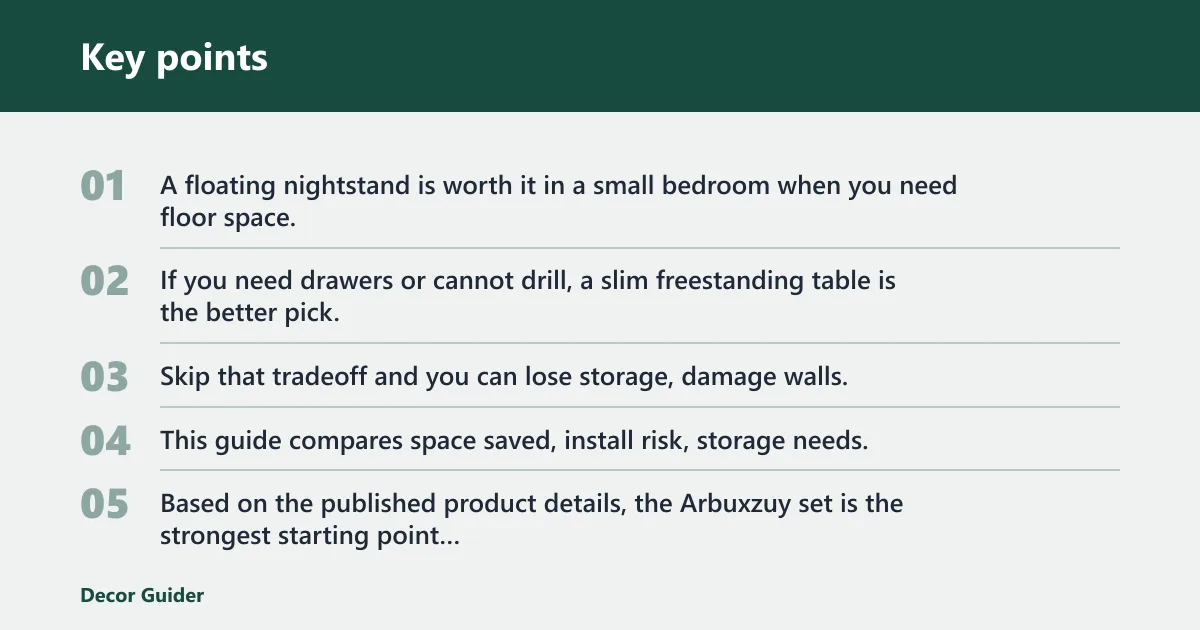

Based on the published product details, the Arbuxzuy set is the strongest starting point here because it is sold as a set of 2, includes 2 AC outlets and 2 USB ports per nightstand, and combines a drawer plus an open shelf. That said, its value depends on wall type and installation quality, not style alone.
Specs at a glance
| Spec | Floating nightstand | Arbuxzuy set |
|---|---|---|
| Form | Wall-mounted bedside table | Wall-mounted bedside table |
| Usable depth | 7 to 12 inches | Not stated in the product data |
| Storage | Often open shelf, drawer, or both | Drawer plus open shelf |
| Charging | May include a built-in charging station | 2 AC outlets and 2 USB ports per nightstand |
| Installation support | Requires secure wall mounting | Wall-mounted; hidden support not specified in the listing |
| Best use | Small rooms that need floor clearance | Small spaces with modest bedside storage needs |
| Included quantity | Usually sold individually or in pairs | Set of 2 |
Who it
Floating nightstands suit you when the bedside load is light: a lamp, a phone, a book, maybe a water glass. They fit readers who want the surface close to mattress height, minimalists who want fewer items on view, and homeowners who can fasten into studs or another secure support system.
They are less appealing if you keep meds, chargers, glasses, and a stack of books at the bed. In that case, a slim freestanding table usually gives you easier storage and fewer install variables.
When a slim freestanding nightstand is the better choice
Choose a slim freestanding nightstand when the wall is uncertain, the room is rented, or you want to move the piece later. It is also the safer choice if the bed height changes often, because you can shift the table without reworking wall placement.
Say your bedroom has one usable wall and a bedside lamp, a phone charger, and a paperback. A floating unit can work well if the mount lands on studs and the depth stays within about 7 to 12 inches. Add a tall reading lamp, and the reach problem shows up fast.
Floating nightstand decision matrix
This matrix compares floating nightstands with slim freestanding nightstands on the five factors that matter most in a small bedroom. Higher scores mean a stronger fit for that factor, not a universal ranking.
| Factor | Floating nightstand | Slim freestanding nightstand |
|---|---|---|
| Floor space saved | 5 | 2 |
| Install difficulty | 2 | 5 |
| Storage capacity | 2 | 4 |
| Renter-friendliness | 1 | 4 |
| Long-term durability | 3 | 4 |
| Bedroom type | Wall condition | Recommendation |
|---|---|---|
| Minimalist | Stud-backed drywall | Yes |
| Reader | Stud-backed drywall | Yes, if the shelf or drawer fits the bedside load |
| Couple | Secure wall and enough reach on both sides | Maybe, if each side has clear access and separate storage is not needed |
| Renter | Hollow drywall or uncertain wall type | No |
| Adjustable-bed setup | Any wall type | Maybe, only after checking height and mattress travel |
What works well
Floating nightstands reclaim floor space in a small bedroom, and that matters most when the bed already dominates the room. The open floor under the unit can make a tight layout feel less crowded, and it also helps with sweeping or vacuuming.
The other real advantage is bedside access. A built-in charging station, cable pass-through, or both can reduce cord clutter around the pillow area. That matters more than style if the bed is used for reading, charging, or late-night device access.
Drawer plus open shelf storage is the most useful combination in compact rooms. The drawer can hide meds, spare earbuds, or a sleep mask, while the open shelf keeps a book, remote, or glasses within easy reach.
Hardware that makes a difference
For hidden support, the guide points to a French cleat or a full-width steel bracket. Those are stronger choices than flimsy anchors because they spread load across more of the mount and help the unit stay aligned.
Wall studs remain the preferred anchoring point. Drywall anchors can work in some hollow walls, but they carry compatibility and loosening risks over time, especially if the unit gets tugged nightly.
Suppose a 10-inch-deep nightstand sits beside a bed with a thick mattress and a phone charger. If the mounting point is too high, the top feels awkward; if it is too low, books and glasses dip below easy reach. Small errors matter here.
What does not work well?
Floating nightstands are a poor fit when the wall cannot support secure fastening. Hollow drywall without studs, tiled walls, and lightweight walls all narrow the install options, and some wall types are not recommended for one model at all. That is a real limitation, not a minor one.
Storage can also be too limited for some users. If you need a lamp, a water glass, several books, a charger, and a clutter catch-all, a wall-mounted shelf may feel cramped. A floating unit can save space and still fail the bedside test if it is too shallow or too small.
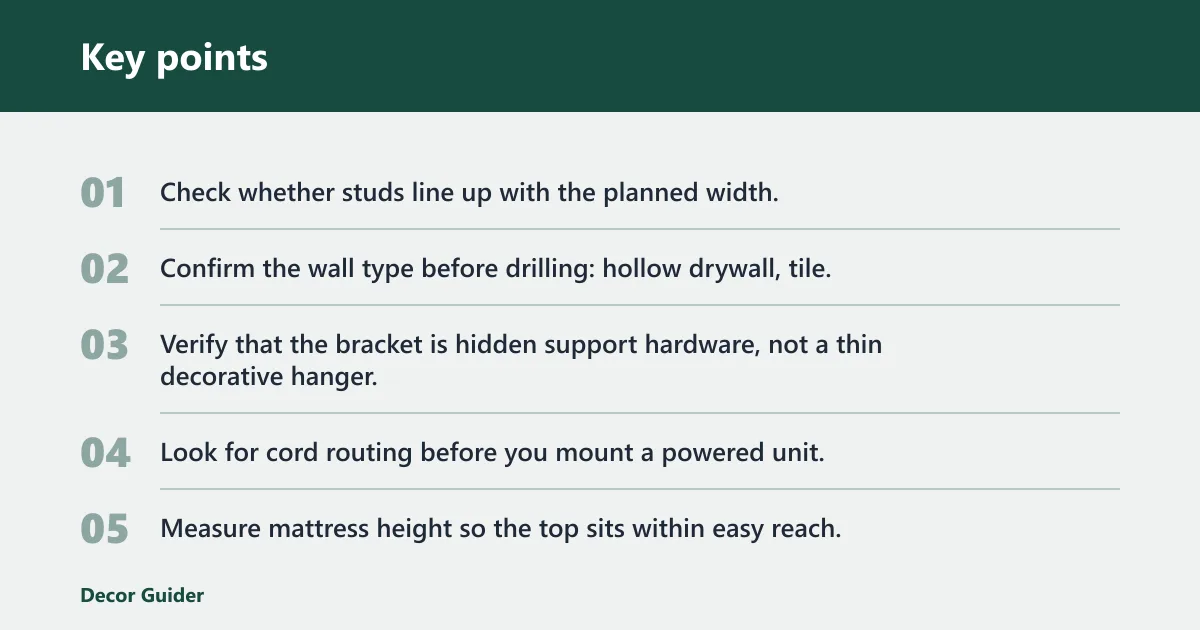
Failure-case checklist for wall mounting
- Check whether studs line up with the planned width.
- Confirm the wall type before drilling: hollow drywall, tile, or lightweight construction can change the hardware choice.
- Verify that the bracket is hidden support hardware, not a thin decorative hanger.
- Look for cord routing before you mount a powered unit.
- Measure mattress height so the top sits within easy reach.
- Skip the install if the wall finish or anchor choice feels uncertain.
A common first-timer mistake is mounting for looks instead of reach. A nightstand that looks centered on the wall can still sit awkwardly relative to a taller mattress, especially on an adjustable base that changes the bed height during use.
Alternatives
The Arbuxzuy set is the more direct floating-nightstand choice here because it combines wall mounting, a drawer, an open shelf, and built-in charging in one package. Based on the manufacturer’s specs and published details, that makes it a practical option for two sides of a bed, but it still needs secure anchoring and enough wall strength.

The Someteth bedside caddy is not a floating nightstand, but it is the low-risk fallback when drilling is off the table. Its hooks make it useful for phones, tablets, books, and glasses, though it does not offer the flat, furniture-like surface or the long-term stability of a wall-mounted or freestanding bedside table.
If you only need a place for a phone, glasses, and a paperback, a wall shelf or hanging caddy can be enough. If you need a lamp base, a water glass, and a drawer, stay with a compact nightstand of some kind.
Should you buy it?
Buy a floating nightstand if the bedroom is tight, the wall can take secure mounting, and your bedside load stays light. Skip it if the room is rented, the wall type is uncertain, or you need deeper storage than a 7 to 12 inch surface can reasonably provide.
For most small bedrooms, the best buying logic is simple: save floor space only when the mount, height, and storage all work together. If even one of those fails, a slim freestanding nightstand usually gives better day-to-day results.
Buyer checklist
- Confirm stud location or another secure mounting plan.
- Measure mattress height and compare it with the planned mount height.
- Decide whether you need a drawer, an open shelf, or both.
- Check for cable pass-through or a built-in charging station if cord clutter is a problem.
- Review the wall type before buying hardware for drywall, tile, or lightweight construction.
- Choose freestanding storage if you cannot answer the first two checks confidently.
Frequently asked questions
Are floating nightstands worth it for small bedrooms?
Yes, when floor space matters more than storage volume. A floating nightstand works best in small bedrooms if you can mount it securely and only need a lamp, phone, and a book. If you need deeper storage or cannot drill, a slim freestanding nightstand is usually the better buy.
How much weight can a floating nightstand hold?
There is no universal weight limit, because load depends on the bracket, fasteners, wall type, and span. The safest approach is to match the hardware to the wall and keep the mount on studs whenever possible. A full-width steel bracket or French cleat is generally stronger than light-duty anchors.
Can you install a floating nightstand without a stud?
Sometimes, but it is limited and wall-dependent. Drywall anchors can work for light loads in hollow walls, yet they bring compatibility and loosening risks over time. For a bedside unit, stud attachment is the preferred option because it gives far better support and reduces the chance of movement.
What height should a floating nightstand be mounted at?
Mount it so the top lands near mattress height and within easy arm reach. The exact height depends on your bed frame, mattress thickness, and whether you sit up to read. Adjustable beds need extra care because the mattress position changes, which can make a fixed mount feel too high or too low.
Do floating nightstands work with adjustable beds?
They can, but only if you check the full range of mattress movement before drilling. An adjustable bed changes bedside reach, so a mount that feels fine in one position may become awkward in another. Leave enough clearance for movement and make sure the top remains easy to reach.
Will a floating nightstand damage my wall?
It can leave holes, and poor installation can cause bigger damage if the mount loosens. Secure anchoring into studs lowers that risk. Tile, hollow drywall, and lightweight walls need extra caution because the wrong fastener can crack the finish or pull out over time.
What storage features matter most in a floating nightstand?
For most small bedrooms, the most useful features are a drawer for private items, an open shelf for books or decor, and a cable pass-through for charging cords. A built-in charging station can help, but only if outlet location and cord management make sense for the bed layout.
Products related to this article
Sponsored / affiliate links. As an Amazon Associate I earn from qualifying purchases. I may earn additional commission from eligible campaigns.