End Table Vs Side Table: Key Differences Explained
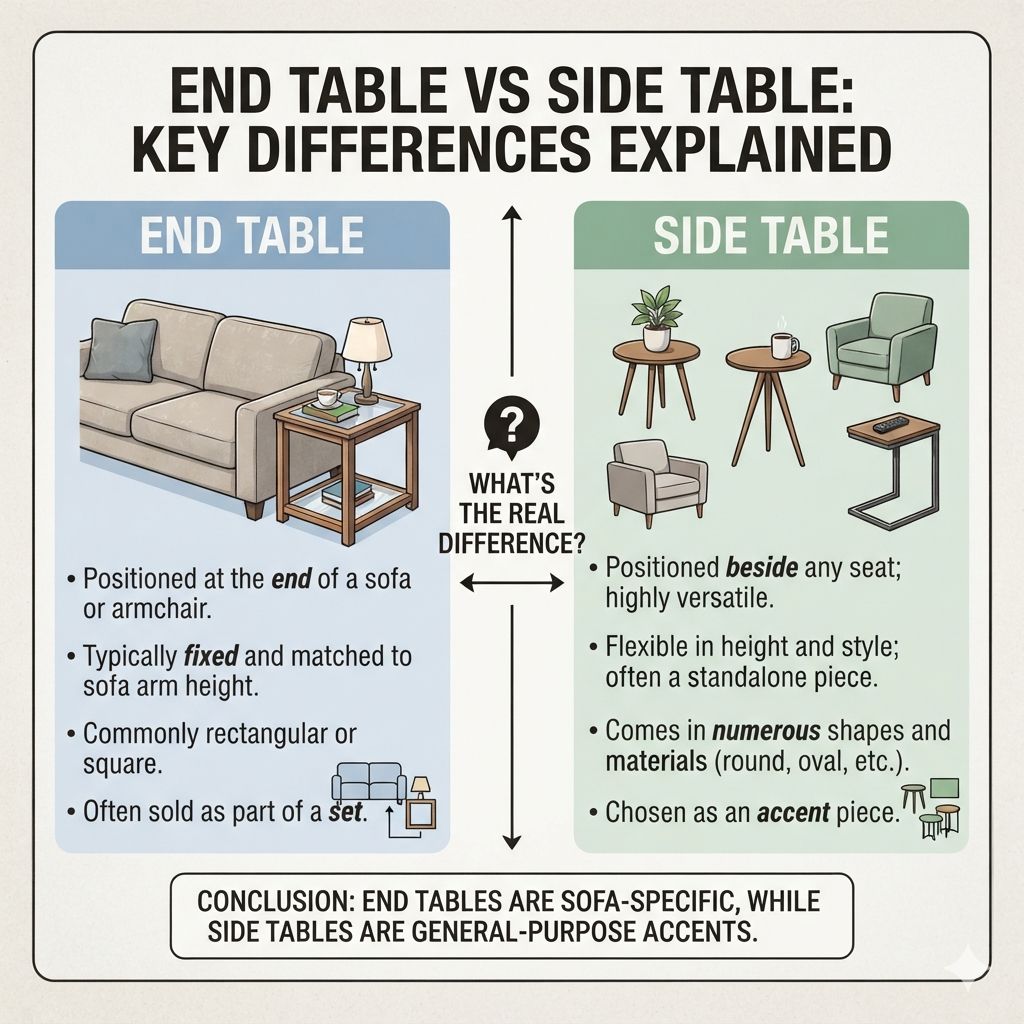
The main difference between an end table and a side table is their typical placement and size. End tables usually go at the end of a sofa. They are often a bit taller and wider than side tables. Side tables are more versatile and can be placed next to chairs or even beds. They tend to be smaller.
End Table vs. Side Table: What’s the Real Story?
So, you’re looking at your living room or bedroom and thinking about adding a table. You want something handy for a lamp, your book, or a drink. The terms “end table” and “side table” pop up everywhere.
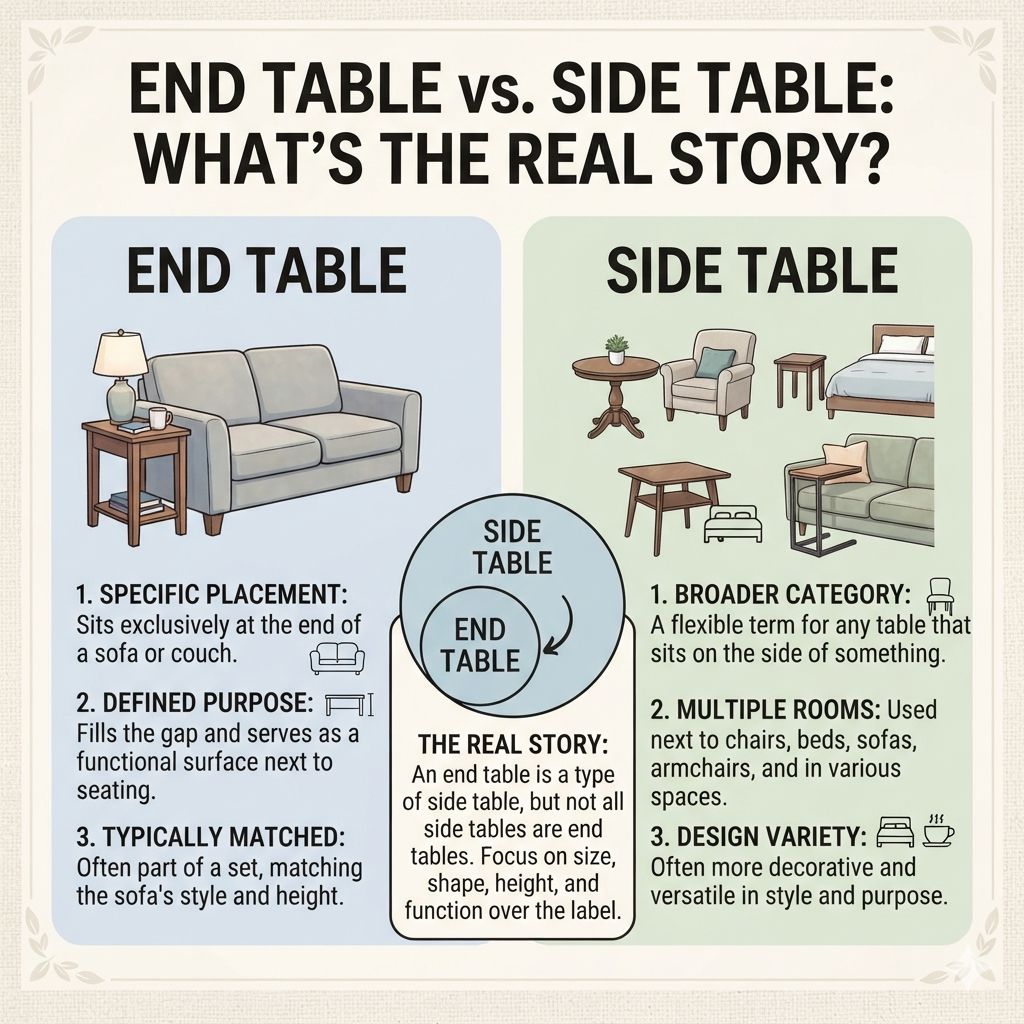
But what’s truly the difference between them? Let’s break it down. Think of it like this: most end tables are side tables, but not all side tables are end tables.
This might sound a bit like a riddle, but it makes sense when you look at how we use them. An end table is a specific type of side table. Its job is usually very clear: to sit at the end of a sofa or couch.
It fills that gap and provides a surface right where you need it when you’re lounging.
A side table, on the other hand, is a broader category. It just means a table that sits on the side of something. This could be a chair, a bed, a sofa, or even an armchair.
They are often more flexible in their design and purpose. People use them in many different rooms too.
The key takeaway here is that the terms are often used interchangeably. Many stores might label a table as a “side table” when it functions perfectly as an “end table.” Don’t get too hung up on the label. Focus on the table’s size, shape, height, and where you plan to put it.
My Own Table Tale
I remember when I first moved into my own apartment. I had this comfy but slightly too big sectional couch. There was this awkward gap at one end, and I wanted a place to put my phone and a coaster.
I went shopping and saw so many “end tables.” They all seemed to be about the same height as the armrest of my couch. That felt right.
Then, I looked at the “side tables.” Some were tiny little things, barely big enough for a single mug. Others were taller, like small pedestals. I got a little confused.
Was the taller one an “end table” in disguise? Or was the shorter one a “side table” for my armchair?
I ended up buying a table that was labeled as an “end table.” It fit the space next to my couch perfectly. It was about 24 inches tall. Later, I bought a smaller, matching one for next to my reading chair.
The store called that one a “side table.” But honestly, they looked very similar in style and function, just different sizes.
What I learned was that the names are often just suggestions. The style and dimensions are what really matter. It’s less about the official title and more about how it helps you in your home.
That awkward gap next to the couch? It needed a surface. The space by my chair?
It also needed a little surface. Both were filled by tables that did their job.
Quick Comparison: End vs. Side Table
End Table:
- Usually placed at the end of a sofa.
- Often matches sofa height.
- Typically a bit larger.
- Provides a surface for lamps, drinks, remotes.
Side Table:
- More versatile placement.
- Can go next to chairs, beds, sofas.
- Often smaller or more varied in size.
- Serves as a handy spot for essentials.
Understanding Placement and Size
Let’s dive deeper into what makes an end table distinct from a general side table. The primary cue is its intended location. An end table is almost always found flanking a sofa.
It tucks neatly into that little bit of space between the sofa’s arm and the end cushion. This placement is strategic.
Think about sitting on your couch. You have your drink, your book, maybe your phone. You want these things within easy reach without having to lean too far or put them on the floor.
An end table bridges that gap perfectly. Its height is usually designed to be roughly level with the armrest of your sofa. This creates a seamless surface.
A typical end table might be around 20 to 26 inches tall. Width can vary, but they are often square or rectangular, maybe 18 to 24 inches wide. This size is enough to hold a table lamp, a few books, and your essential items.
It’s a functional piece that blends into the seating arrangement.
Side tables, however, have more freedom. Because they aren’t tied to the specific “end of the sofa” spot, their design can be more diverse. You might see a small, round side table next to an armchair.
This one might only be 18 inches tall. It’s perfect for a cup of tea and a small book.
Or, you could have a taller, more slender side table next to a bed. This one might be 28 inches tall, accommodating a bedside lamp and alarm clock. They can be used in hallways, entryways, or even as a decorative piece with a plant.
The key difference is the context. If a table’s main role is to sit at the end of a couch and match its height, it’s leaning towards being an end table. If it’s more about general utility on the side of furniture, or in a more varied location, it’s a side table.
Style Spotlight: Common Designs
End Table Styles
Classic Square: Simple, functional, fits most decor.
With Drawer: Extra storage for remotes, coasters.
C-Table: Slides under the sofa for closer reach.
Side Table Styles
Round Pedestal: Elegant, often used in living rooms.
Nesting Tables: Space-saving, can pull out when needed.
Console Table (Narrow): Can act as a side table behind a sofa or against a wall.
Beyond the Living Room: Where Else Do They Fit?
While the living room is the most common place for these tables, their roles can extend. Think about your bedroom. A bedside table is essentially a side table.
Its purpose is to hold your essentials for nighttime and morning: a lamp, your phone charger, a glass of water, perhaps a book you’re reading.
The height of a bedside table is often dictated by the height of your bed. You want to be able to reach your lamp or water without straining. So, while it’s serving the function of a side table, its specific design is tailored to the bedroom environment.
In a hallway, a small, decorative side table can add a touch of elegance. It might hold a vase of flowers, a small sculpture, or a stack of mail. Here, its function is less about immediate utility and more about aesthetics and filling an empty space.
Entryways also benefit from side tables. You can place one near the door to drop your keys, mail, or purse when you come in. Some may even have a drawer for small items.
This makes it a practical landing spot.
Even in a dining room or kitchen, small side tables can be useful. A baker’s rack might have small side tables built into it. Or, a small decorative table could hold serving dishes during a gathering.
The term “side table” truly covers a wide range of applications.
An end table, in its purest form, is most at home next to a sofa. It’s part of a seating arrangement. If you take that same “end table” and put it next to your bed, it becomes a bedside table, which is a type of side table.
The function dictates the name more than the name dictates the function.
Material Matters: Choosing Your Table’s Vibe
Wood: Offers warmth and durability. Oak, maple, and walnut are popular. Can be stained or painted to match your decor.
Metal: Modern, industrial, or sleek. Iron, brass, or stainless steel. Can be forged, cast, or tubular.
Glass: Creates a sense of openness and light. Often paired with metal or wood frames. Shows dust easily.
Stone/Marble: Luxurious and heavy. Adds a sophisticated touch. Can be cold to the touch.
Composite/Engineered Wood: More budget-friendly. Can mimic the look of solid wood.
Factors to Consider When Choosing
When you’re out shopping or browsing online, keep these points in mind. They will help you decide if a table is right for your needs, regardless of what it’s called.
Height is Crucial: This is perhaps the most important factor, especially for end tables. You want the tabletop to be about the same height as the seating it’s next to. For a sofa, aim for the armrest height.
For a chair, match the chair’s armrest. For a bed, align with the mattress top.
Size and Scale: Consider the space you have. A huge end table can overwhelm a small sofa. A tiny side table might get lost next to a large armchair.
Measure the area where you plan to put the table. Leave enough room for people to walk around it comfortably.
Functionality: What do you need the table for? Just a place to set a drink? Or do you need storage for books, remotes, or charging cables?
Look for tables with drawers, shelves, or compartments if you need extra space.
Style and Material: The table should complement your existing decor. Do you have a modern, farmhouse, or bohemian style? Choose materials and finishes that fit.
Wood can add warmth, metal a contemporary feel, and glass lightness.
Stability: You don’t want a table that wobbles every time you touch it. Check if the legs are sturdy and well-attached. If you have children or pets, a more stable table is essential.
Your Budget: Tables come in all price ranges. Decide how much you’re willing to spend before you start shopping. You can find great options at various price points.
Myth vs. Reality: Table Talk
Myth
End tables and side tables are always different.
Side tables are always small.
You must buy a matching set.
Reality
They are often used interchangeably, with end tables being a type of side table.
Side tables come in many sizes, some are quite large.
Mixing and matching can create a more unique look.
When a Side Table Acts as an End Table
It’s common to see a table labeled “side table” placed at the end of a sofa. Why does this happen? Often, it’s because the dimensions are just right.
The height might perfectly align with the sofa armrest, and the width and depth offer enough surface area.
For example, a round pedestal side table could look fantastic next to a sofa. It offers a softer look than a sharp-cornered end table. If its height is appropriate, it functions exactly like an end table.
The decorative element is a bonus.
Nesting tables are another example. While primarily a space-saving solution, the largest table in a nesting set can often serve as an end table. You might use the smaller ones for drinks or snacks when needed.
The key is that the function is the same. If a table is providing that convenient surface right next to your seating, it’s fulfilling the role of an end table, regardless of its official product name. Don’t let a label limit your options.
If it fits, it sits!
When an End Table Might Be Too Much
Conversely, sometimes a table sold as an “end table” might be a bit too large or bulky for a particular spot. If you have a smaller sofa or a more compact living room, a standard end table might feel out of proportion. In these cases, a more slender or smaller side table would be a better fit.
Imagine a sofa with very low, slim arms. A tall, wide end table next to it could look awkward. It might overpower the sofa.
A lower, more delicate side table would offer better balance. This is where understanding scale becomes very important.
Also, if your sofa doesn’t have much space at the ends, a bulky end table might even be a tripping hazard or make it difficult to get in and out of the sofa. A C-table, which slides under the sofa, is a clever solution here. It acts like an end table but takes up minimal floor space when not in use.
Quick Fixes and Tips for Table Placement
Here are a few simple tips to help you get the most out of your tables:
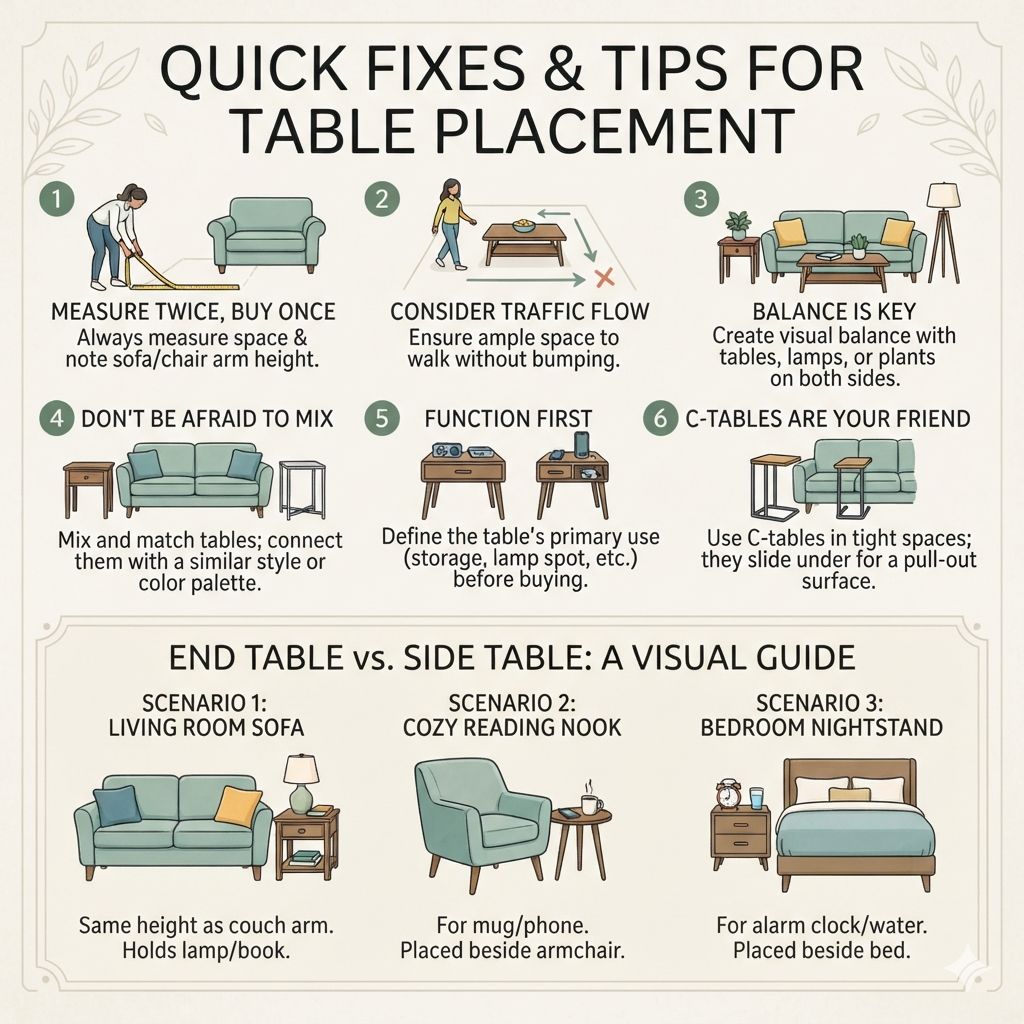
- Measure Twice, Buy Once: Always measure the space where you intend to place the table. Note the height of your sofa arms or chair.
- Consider Traffic Flow: Make sure there’s enough space to walk around the table without bumping into it.
- Balance is Key: If one side of your sofa has an end table, consider if you need something on the other side. It could be another end table, a floor lamp, or even a decorative plant stand.
- Don’t Be Afraid to Mix: You don’t need matching end tables. One might be a solid wood piece, and the other a metal and glass design, as long as they share a similar style or color palette.
- Function First: Think about what you need the table for. Extra storage? A spot for a lamp? This will guide your choice of style and features.
- C-Tables Are Your Friend: If space is tight, C-tables are brilliant. They slide right under your sofa and pull out a tabletop when you need it.
End Table vs. Side Table: A Visual Guide
Imagine this:
Scenario 1: Living Room Sofa
You have a couch. At the end of the couch, you place a table. This table is roughly the same height as the couch arm.
It holds your lamp and a book. This is an end table.
Scenario 2: Cozy Reading Nook
You have an armchair. Next to the armchair, you place a small, round table. It’s just tall enough for a mug of coffee and your phone.
This is a side table.
Scenario 3: Bedroom Nightstand
You have a bed. Next to your bed, you have a table holding your alarm clock and a glass of water. This is a bedside table, a type of side table.
Frequently Asked Questions About End and Side Tables
Are end tables and side tables the same thing?
They are very similar and often used interchangeably. An end table is a specific type of side table, usually placed at the end of a sofa. Side tables are more general and can be used in various locations next to furniture.
What is the ideal height for an end table?
For an end table, the ideal height is usually about the same as the armrest of the sofa it’s next to. This typically falls between 20 to 26 inches, but it can vary based on your furniture.
Can I use a side table as an end table?
Yes, absolutely! If a side table is the right height and size to fit next to your sofa, it will function perfectly as an end table. The key is how you use it.
How do I choose between an end table and a side table?
Consider where you need the table most. For the end of a sofa, an end table is designed for that spot. For other areas like chairs or beds, or if you need more flexibility, a side table is a great choice.
Also, think about the size and style that fits your room.
Do end tables and side tables have to match my coffee table?
No, they don’t have to match perfectly. While a coordinating set can look nice, it’s also very stylish to mix and match. Aim for pieces that share a similar material, color, or general style to create a cohesive look.
What are nesting tables and how can they be used?
Nesting tables are a set of tables where smaller tables slide neatly under a larger one. They are great for saving space. The largest table can function as a side table or even an end table, and you can pull out the smaller ones when you need extra surface area for guests or drinks.
Putting It All Together
Navigating the world of home furnishings can sometimes feel a bit confusing. But when it comes to end tables and side tables, the core idea is simple: they are both about adding helpful surfaces to your living spaces. An end table has a very specific job next to a sofa.
A side table is more of a general helper, found wherever you need a little extra space.
Don’t stress too much about the exact label. Focus on what you need. Measure your space, consider your style, and think about how you’ll use the table.
Whether it’s called an end table or a side table, the right one will make your home more comfortable and functional. Happy decorating!
Products related to this article
Sponsored / affiliate links. As an Amazon Associate I earn from qualifying purchases. I may earn additional commission from eligible campaigns.