
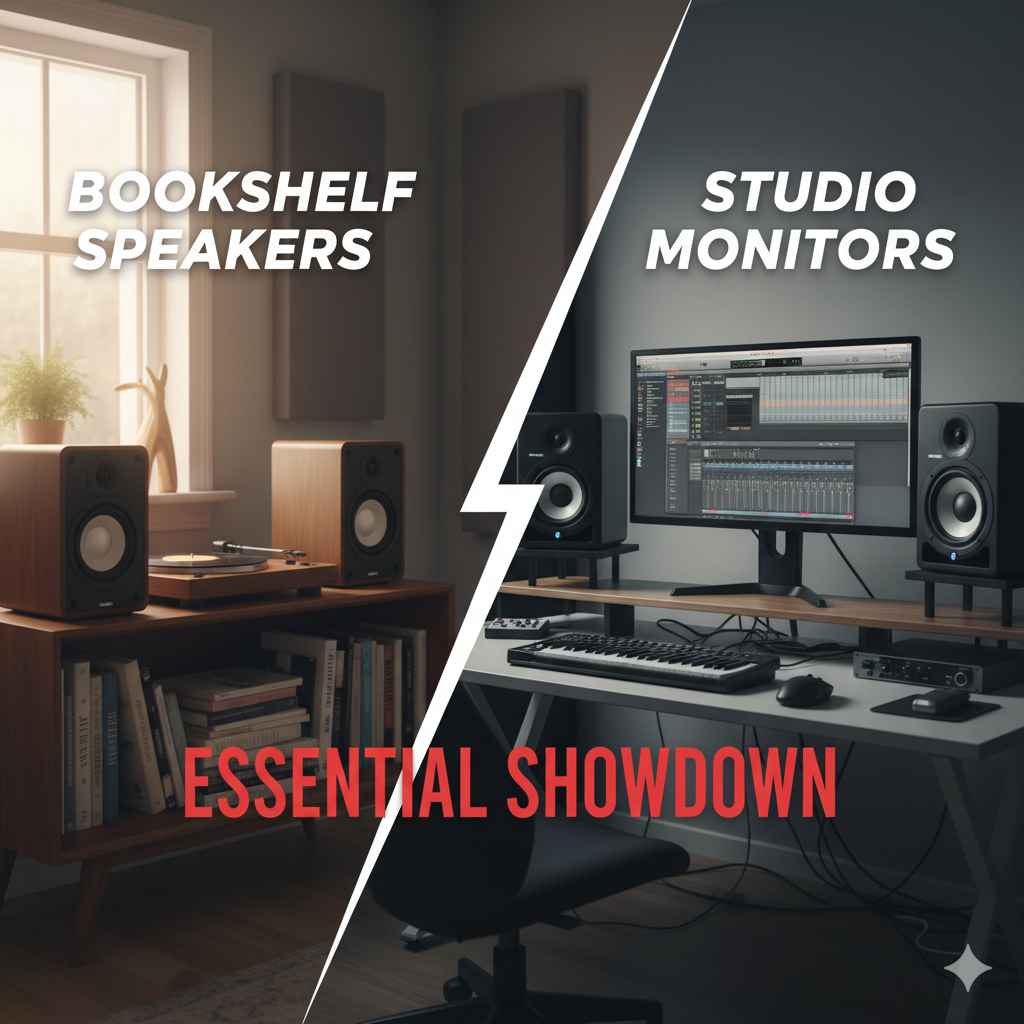
Bookshelf speakers are great for great-sounding home stereo systems or casual listening, offering a warm sound. Studio monitors are precision tools designed for accurate playback in recording and mixing, prioritizing flat, truthful audio reproduction. Choose based on whether you prioritize enjoyment or detailed accuracy.
Picking new speakers for your TV, turntable, or computer can feel overwhelming. You see “Bookshelf Speakers” and “Studio Monitors” everywhere, and honestly, they often look similar! It’s confusing to know which one is right for your living room or if one is simply “better” than the other. Don’t worry, this isn’t a complicated repair job; we’re just figuring out the right tool for the job.
The main difference boils down to what they are built to do: enjoyment versus accuracy. We’ll break down what these speakers are, how they sound different, and help you decide which pair belongs in your setup. Let’s get your audio clear and simple!
Understanding the Core Difference: Sound Philosophy
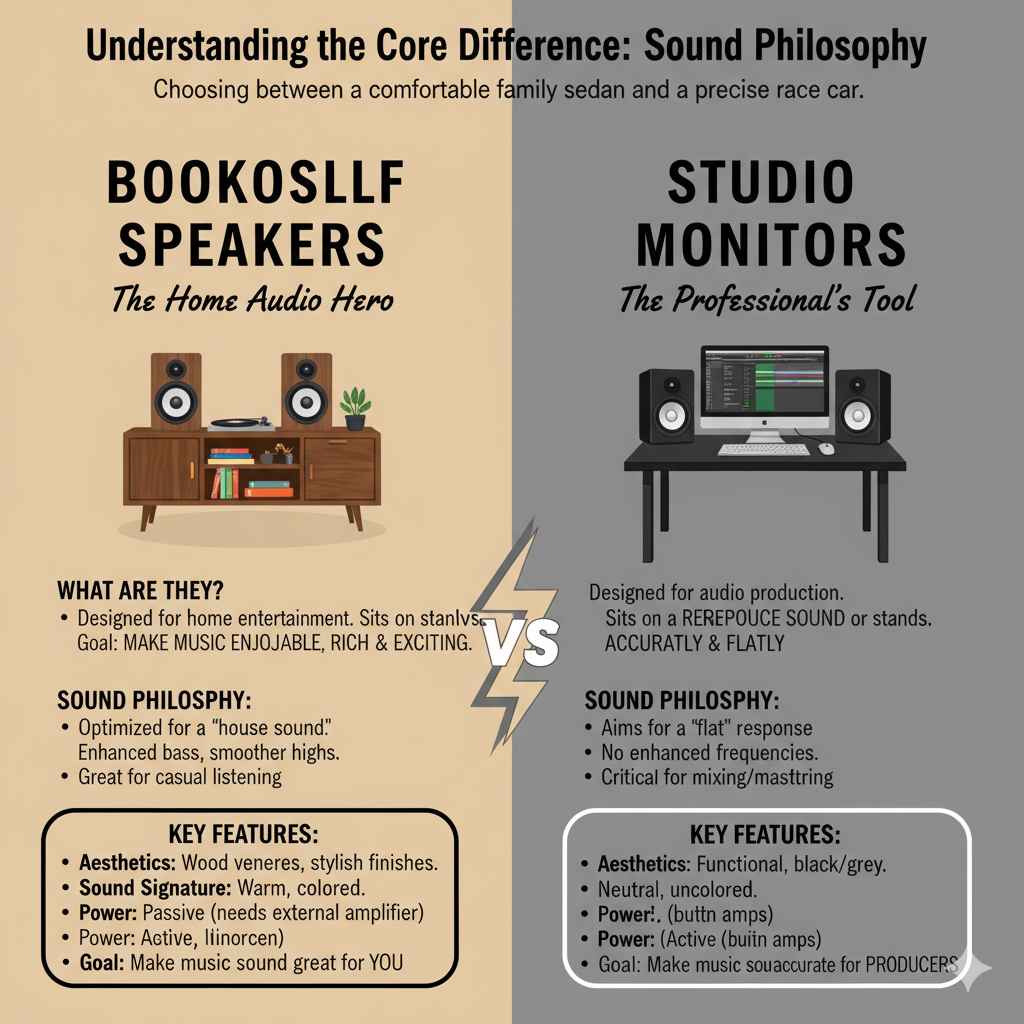
When we talk about speakers, we are really talking about their design philosophy. Think of it like choosing between a comfortable family sedan and a precise race car. Both get you moving, but they handle very differently.
What Are Bookshelf Speakers? (The Home Audio Hero)
Bookshelf speakers are designed primarily for home entertainment. They are meant to sit on stands or shelves in your living room, office, or den. Their main goal is to make music sound enjoyable, rich, and exciting to the average listener.
They are often optimized for a specific “house sound.” This usually means they enhance the lower bass frequencies slightly or make the highs sound a little smoother. This makes pop, rock, or movie soundtracks sound fuller and more powerful without any extra effort from you.
Key Features of Bookshelf Speakers:
- Aesthetics: Usually designed to look good in a home environment, often coming in nice wood veneers or stylish finishes.
- Sound Signature: Often slightly “colored” or warm. Great for casual listening.
- Power: Usually passive, meaning they require a separate amplifier or receiver—the same kind you’d use for a full stereo system.
- Goal: Make music sound great for you.
What Are Studio Monitors? (The Truth Tellers)
Studio monitors are the workhorses of recording studios, broadcast facilities, and podcast editing bays. If a bookshelf speaker aims for enjoyment, a monitor aims for absolute, unvarnished truth. They are designed to reproduce sound as flatly and accurately as possible.
This means they don’t boost the bass or smooth out the sharp edges. If a recording has a slight hiss or an uneven midrange, the monitor will tell you immediately. This precision is necessary when mixing music or dialogue because you need to hear exactly what is happening in the recording, not what the speaker wants you to hear.
Key Features of Studio Monitors:
- Aesthetics: Often boxy, plain, and function-focused (usually black or dark gray vinyl wraps).
- Sound Signature: Very “flat” or neutral. They reveal flaws in recordings.
- Power: Most modern ones are “active,” meaning they have a built-in amplifier. This is often called ‘powered’ speakers.
- Goal: Reveal the unbiased truth of the recording.
The Showdown: Key Comparison Points
To make the choice easier, let’s compare them side-by-side across the areas that matter most to a home user.
1. Sound Accuracy vs. Enjoyment
This is the biggest hurdle. Imagine you are looking at a picture. A bookshelf speaker might put a slight, warm filter over the photo. A monitor shows you every single pixel, sharp and clear, quirks and all.
Bookshelf Speakers (The Warm Sound)
They sound good right out of the box. If you listen to Spotify while cleaning the garage, you want a speaker that makes the music feel full. Bookshelf speakers are expertly tuned by their manufacturers to sound pleasing to most ears in a typical room setting.
Studio Monitors (The Flat Sound)
Monitors are designed to be unforgiving. If you can mix a song on studio monitors and it sounds great in your car, on earbuds, and on a cheap portable speaker, it’s because the monitors told you the mix was balanced. For casual listening, this accuracy can sometimes sound a little “boring” or analytical compared to a dedicated hi-fi speaker.
2. Power Requirements (Active vs. Passive)
How the speaker gets its power significantly affects setup complexity and required components.
Passive Speakers (Common for Bookshelf):
- You need a separate Amplifier or Receiver to power them.
- Speaker wire runs from the amplifier to the back of the two speakers.
- Pros: Allows flexibility to upgrade the amplifier later.
- Cons: More components, more wires, higher initial cost.
Active Speakers (Common for Monitors):
- The amplifier is built right inside the speaker cabinet (hence “powered”).
- You plug each speaker directly into the wall outlet (or sometimes one powers the other).
- Pros: Simple setup, less clutter, perfect pairing of amp and speaker.
- Cons: Less flexibility to swap out the amplifier later.
Note: While most monitors are active, many modern bookshelf speakers are now sold as “Active Bookshelf Speakers” (often called powered speakers), blurring this line. Always check the specifications!
3. Acoustic Tuning and Room Correction
In professional settings, sound needs to be perfect for the room. Monitors often come with features to help you correct for your specific space.
Monitor Tuning Features:
- Boundary EQ: Switches or dials to reduce booming bass if the speaker is placed too close to a wall (a common issue at home desks).
- High/Low Trim: Small adjusters to slightly tweak the treble or the bass response to better match a room’s acoustics.
- Acoustic Space Controls: Settings based on whether you are sitting near a wall or in the middle of a room.
Most standard bookshelf speakers do not include these intricate tuning features, relying instead on the listener to place them optimally or use external receivers for modification.
4. Connection Options
Entry-level bookshelf speakers often rely on standard RCA inputs or spring clips for bare speaker wire connection to a receiver. Monitors, however, are often designed to plug straight into professional gear or computers.
Look for monitors that offer balanced connections like XLR or TRS, which reduce noise over long cable runs. While home users rarely need true balanced connections, many modern powered bookshelf speakers now offer USB or optical inputs perfect for direct connection to a computer or a modern TV.
Placement Matters: Where Do These Speakers Go?
Where you place the speaker dictates how it sounds. This is true for both types, but monitors often demand more careful positioning.
Setting Up Bookshelf Speakers for Home Use
For the best movie or music experience, bookshelf speakers should ideally follow the “golden triangle” rule:
- Place the speakers roughly equidistant from each other and your main listening spot (where your head will be).
- Tweeters (the small drivers handling high notes) should generally be aimed right at ear level when you are seated.
- Avoid putting them flush against a wall, which can make the bass sound muddy. A few inches of space works wonders.
Setting Up Studio Monitors for Accuracy
Monitors require very precise placement, often referred to as the “near-field setup,” meaning you sit close to them (within 3–5 feet).
- Equilateral Triangle: The distance between the two monitors should be the same as the distance from each monitor to your ears.
- Toe-in: The speakers should be aimed inward so that the sound waves cross slightly behind your head, not directly at your ears.
- Height: The tweeter must be exactly at ear level. If they are too low or too high, the accurate sound they produce will be distorted because you are hearing less of the tweeter and more of the woofer.
If you are setting up monitors on a desk for computer use, you might need sturdy isolation pads (like Sorbothane) or dedicated stands to decouple them from the desk, stopping desk vibrations from coloring the sound. You can learn more about the importance of proper speaker placement from acoustic engineering resources like those found in university audio programs, which emphasize minimizing boundary interference.
Bookshelf Speakers vs Monitors: A Comparison Table
Here is a quick reference guide summarizing the main differences in features and function:
| Feature | Bookshelf Speakers (Hi-Fi/Home) | Studio Monitors (Pro Audio) |
|---|---|---|
| Primary Goal | Enjoyable, warm home listening | Accurate, flat, truthful reproduction |
| Typical Power Setup | Passive (Requires separate receiver/amp) | Active/Powered (Amplifier built-in) |
| Sound Profile | Slightly enhanced bass/treble | Neutral, clinical, uncolored |
| Aesthetics | Designed to blend with home decor | Utilitarian, function-over-form |
| Best For | Music enjoyment, TV/Home Theater systems | Mixing, Mastering, Critical Listening, Podcasting |
| Tuning Controls | Minimal or none | Extensive EQ, Boundary, and Acoustic controls |
When Should You Choose Bookshelf Speakers?
Bookshelf speakers are the clear winners when your primary focus is relaxed, satisfying audio playback in a comfortable setting.
Choose Bookshelf Speakers If:
- You love music enjoyment first. You want your favorite songs to sound rich and full, even if it means slightly coloring the sound signature.
- You are building a traditional stereo system. You already have or plan to buy an AV receiver to power surround sound or your turntable setup.
- You need simple plug-and-play. If you opt for powered bookshelf speakers, the setup is incredibly easy—just connect the source and you are ready.
- Aesthetics are important. You want speakers that look beautiful next to your bookshelves or on your mantelpiece.
Many high-quality bookshelf speakers, especially those categorized as high-fidelity (Hi-Fi), offer fantastic performance that easily rivals entry-level monitors while being far more pleasing for daily background music.
When Should You Choose Studio Monitors?
Monitors shine when precision and hearing exactly what is on the recording file are crucial.
Choose Studio Monitors If:
- You create audio professionally or as a serious hobbyist. If you edit vocals, produce beats, or mix videos, accuracy is non-negotiable.
- You work near-field. You sit within 3 or 4 feet of your speakers at a computer desk. This is where monitors perform optimally.
- You need simplicity in powered setup. Active monitors mean you don’t need a bulky receiver taking up space under your desk.
- You want to hear flaws. If you struggle to figure out why something sounds bad on your car stereo, monitors will instantly reveal the problem area (too much bass, harsh vocals, etc.).
Remember, the clarity provided by monitors can be extremely revealing. When you first switch from warm bookshelf speakers to flat monitors, the music you love might sound thin or strange for a few days until your ears adjust to hearing the true mix. It’s an adjustment, but a valuable one for audio creators.
Powering Up: Explaining Active vs. Passive Again
As a beginner, the active/passive distinction is critical because it dictates your shopping list.
Active Monitor Setup (Simpler Connection)
This is like buying a computer that already has its own speakers inside its case. You need:
- The two active studio monitors.
- Source device (computer, audio interface).
- Cables (e.g., RCA to TRS, or USB).
This is usually less expensive upfront for a comparable power level than buying separate components, and it saves significant shelf space.
Passive Bookshelf Speaker Setup (More Flexibility)
This requires three main parts for a basic stereo setup:
- The two passive bookshelf speakers.
- An integrated amplifier or AV receiver.
- Speaker wire (to connect the amp to the speakers).
The benefit here is future-proofing. If you buy a great set of bookshelf speakers, you can later upgrade to a much more powerful amplifier without buying new speakers. This separation allows for component-level upgrades, which is key in serious home theater systems.
Size Matters: Drivers and Bass Response
Speakers are defined by their drivers—the cone-shaped parts that move air to make sound. Both bookshelf speakers and monitors come in different sizes, usually defined by the woofer (the larger driver handling bass and midrange) diameter.
Common Driver Sizes
You often see drivers measured in inches (e.g., 4-inch, 5.25-inch, 8-inch).
- 4-inch to 5.25-inch: Very common in compact bookshelf speakers and smaller near-field monitors. They are excellent for clear midrange and vocals but will struggle to produce deep, rattling bass.
- 6.5-inch to 8-inch: Found in larger bookshelf speakers and mid-sized monitors. These move more air and provide a satisfying, full sound, often needing less help from a subwoofer.
The Bass Caveat: No matter which type you choose, if you are trying to shake the room with deep bass (like 30Hz or below), you will likely need a separate subwoofer. Monitors and bookshelf speakers generally reach their limit in the 50Hz to 60Hz range comfortably before distortion creeps in.
A Note on Cost and Value
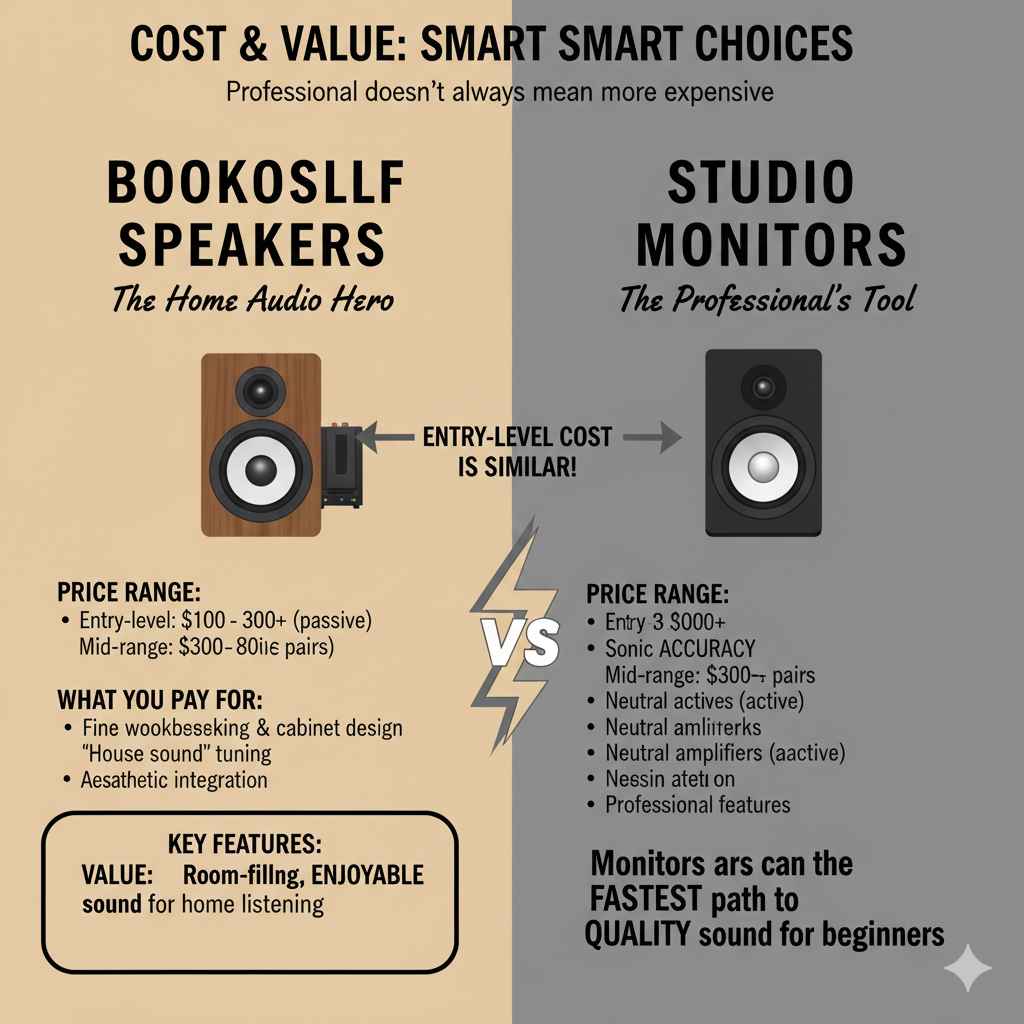
It’s easy to assume that because monitors are used in professional settings, they must be vastly more expensive. This isn’t always true, especially at the beginner level.
You can find excellent entry-level active studio monitors (like those from brands like PreSonus or KRK) for the same price as a decent pair of passive bookshelf speakers and a budget amplifier. The value proposition shifts:
- For Monitors: You are paying for sonic accuracy and an internal amp.
- For Bookshelf Speakers: You are paying for woodworking, cabinet design, and the expected “house sound” tuning.
If you are purchasing your first setup, pairing a pair of quality active monitors with your computer might be the fastest path to great sound quality without getting bogged down in amplifier matching.
Frequently Asked Questions (FAQ)
Q1: Can I use studio monitors for casual music listening at home?
Yes, absolutely! They will sound very accurate. Many people, once they adjust to the flat sound, prefer the clarity monitors provide, even for just listening to music. They are versatile tools.
Q2: Do I need a subwoofer with bookshelf or monitor speakers?
For most modern 5-inch driver speakers, a subwoofer is highly recommended if you listen to bass-heavy music (EDM, Hip Hop) or watch action movies. For smaller desk monitors, it greatly enhances the depth.
Q3: Are bookshelf speakers better for TV and movies than monitors?
Often, yes. Because bookshelf speakers are usually tuned to have a warmer, fuller sound profile, they make general content—dialogue and predictable sound effects—sound more impactful and less fatiguing over long viewing sessions than clinical monitors.
Q4: What does “passive” mean when talking about speakers?
Passive means the speaker does not have its own internal power source or amplifier. You must connect it via bare speaker wire to an external component (like a stereo receiver) that provides the necessary electrical power to make the speaker cones move.
Q5: If I buy active bookshelf speakers, are they basically studio monitors?
They are very similar in power delivery (active), but usually, active bookshelf speakers are still tuned with a more consumer-friendly warm sound signature, whereas dedicated studio monitors are tuned for neutrality. They are closer cousins, though!
Q6: Can I connect passive bookshelf speakers directly to my computer?
No, not safely. A standard computer sound card or headphone jack cannot put out enough clean power to drive passive speakers. You must have an amplifier
Q6: Can I connect passive bookshelf speakers directly to my computer?
No, you should not connect passive bookshelf speakers directly to a computer. A computer’s headphone jack or sound output does not provide enough power to properly drive passive speakers. Doing so will result in very low volume at best, and in some cases, it could strain your computer’s audio output.
Conclusion
Choosing between bookshelf speakers and studio monitors ultimately comes down to how you plan to use them and what kind of listening experience you prefer.
If your goal is to relax, enjoy music, and create a warm, room-filling sound for movies, TV, or casual listening, bookshelf speakers are usually the better fit. They are designed to make audio feel rich and engaging, and they often blend more naturally into home environments. With passive models, you also gain flexibility to upgrade your amplifier later.
On the other hand, if you care about hearing every detail exactly as it was recorded—especially for editing, mixing, producing, or serious critical listening—studio monitors are the smarter choice. Their flat, accurate sound helps reveal imperfections and gives you a true representation of your audio. They also tend to be simpler to set up thanks to their built-in amplifiers.
There isn’t a universal “better” option. Bookshelf speakers prioritize enjoyment. Studio monitors prioritize accuracy. The right pick depends on whether you want your sound shaped to feel exciting or presented exactly as it is.