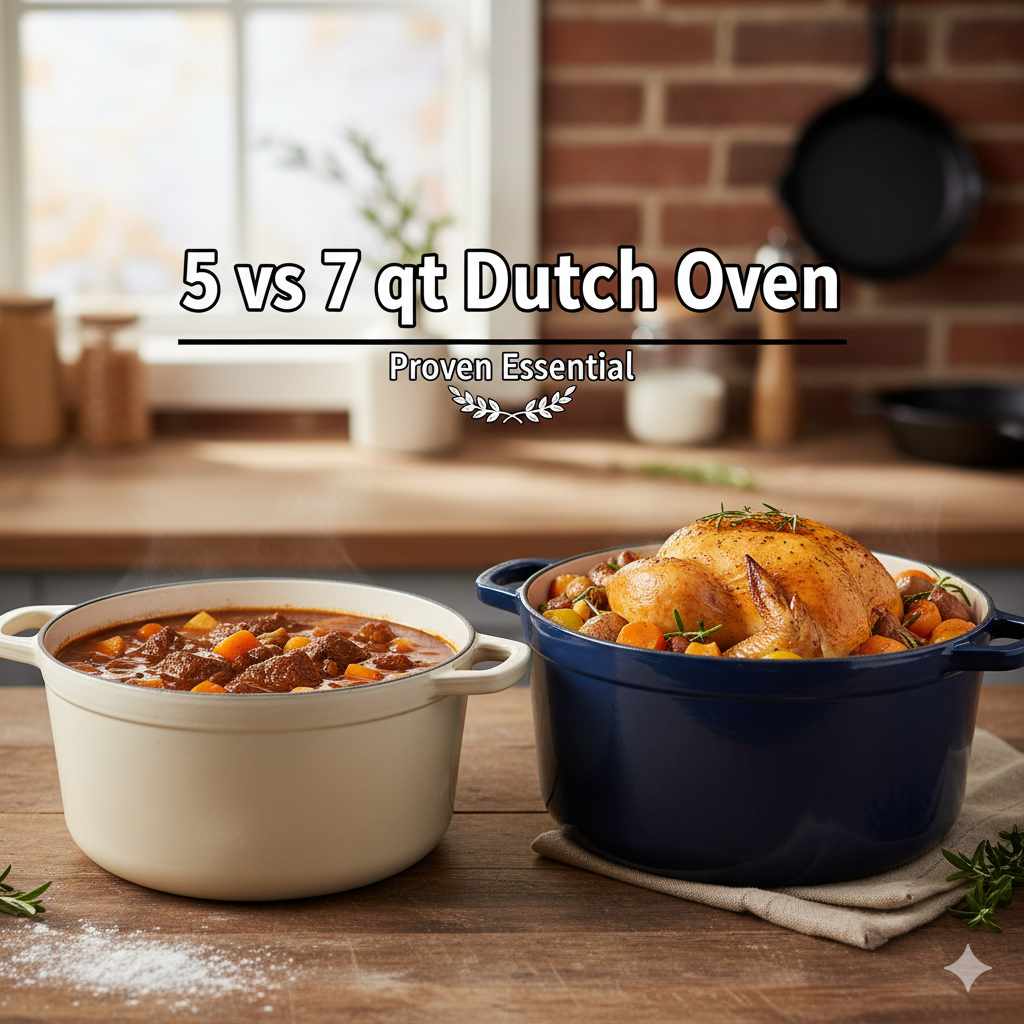
For most home cooks, the 5-quart Dutch oven is the proven essential size, perfectly balancing capacity for family meals (4–5 servings) with manageable weight and storage. The 7-quart is better reserved for larger gatherings or dedicated bread bakers who frequently need extra room.
Choosing the right size for a Dutch oven can feel like a major decision. You want a pot that handles your weekly cooking needs without taking up half your cabinet. This choice often boils down to capacity versus usability. Does the bigger pot offer more flexibility, or just more weight? I’m Dustin Hall, and just like finding the right wrench for a tight spot, picking the correct kitchen tool makes cooking much smoother. We are going to break down the 5-quart versus the 7-quart Dutch oven so you can confidently select the one that becomes your reliable kitchen workhorse. Let’s make sure your investment fits your life perfectly.
Why Dutch Oven Size Really Matters (It’s More Than Just Soup)
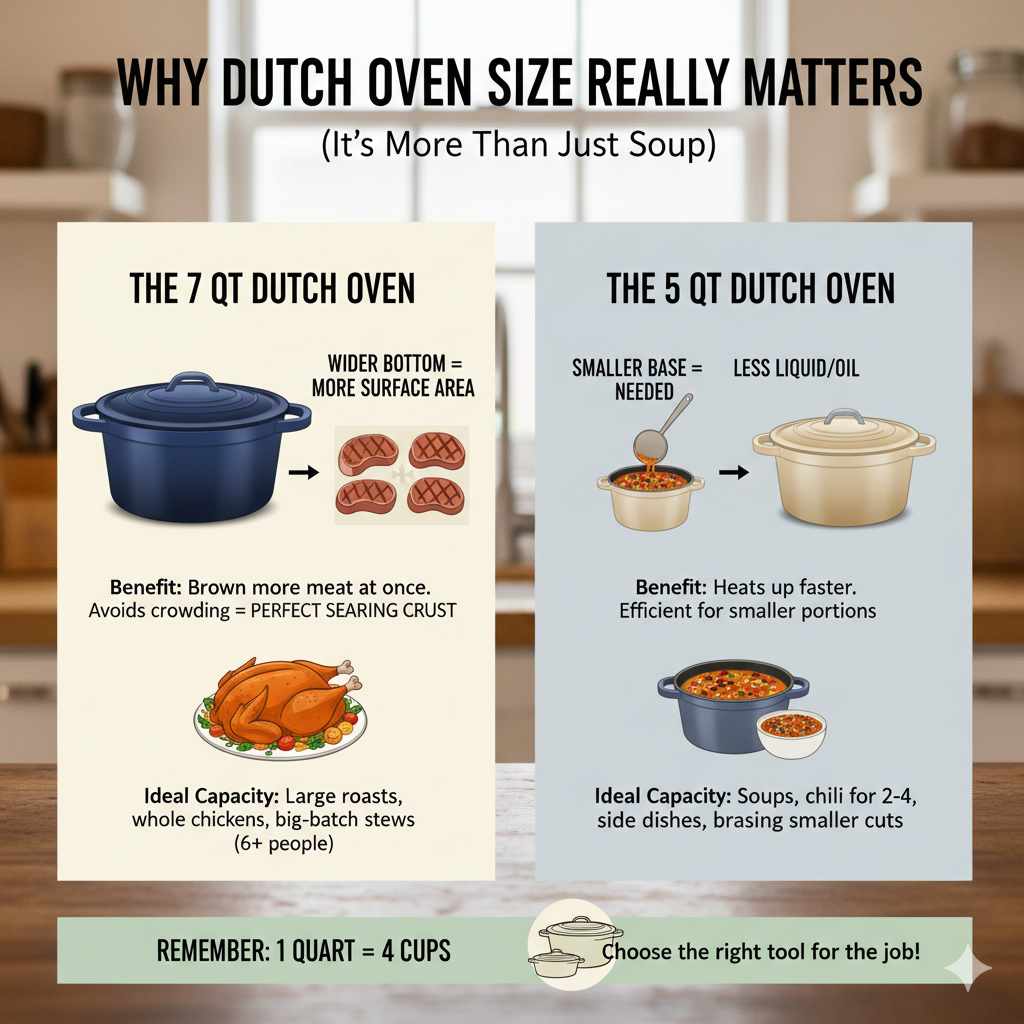
When we talk about the size of a Dutch oven, we are talking about its quarts (qt). One quart equals four cups. This might seem straightforward, but the way you use the pot changes how that volume matters. It is not just about how much liquid it holds; it is about surface area.
A larger Dutch oven (like the 7 qt) has a wider bottom. This wider base lets you brown more meat at once without crowding the pan. Crowding leads to steaming instead of searing, which ruins that beautiful crust you want on roasts or short ribs. Conversely, a smaller pot (like the 5 qt) heats up faster and requires less oil or liquid.
Think about everyday cooking. If you are making chili for two people, a giant 7-quart pot seems wasteful and awkward to store. If you are preparing a whole chicken plus vegetables for six people, the 5-quart might overflow. Understanding ideal capacities helps you select the right tool for the job.
The Contenders: 5 Quart vs. 7 Quart Head-to-Head
Let’s look closely at what each size generally offers in terms of real-world cooking capacity. These measurements are based on standard round Dutch ovens, which are the most common type.
| Feature | 5-Quart Dutch Oven | 7-Quart Dutch Oven |
|---|---|---|
| Weight (Empty) | Lighter, easier to lift and move (often 10–12 lbs) | Significantly heavier (often 14–17 lbs) |
| Ideal Servings | 3 to 5 people comfortably | 5 to 8 people comfortably |
| Best For | Daily cooking, smaller households, baking smaller artisan loaves | Large batches, whole poultry, large roasts, frequent entertaining |
| Storage Footprint | Easier to find cabinet space for | Requires deeper or wider cabinet space |
The 5-Quart Dutch Oven: The Everyday Companion
The 5-quart size is often hailed as the Goldilocks option—it’s just right for the typical American family or couple who cooks regularly.
Who is the 5-Quart Perfect For?
- Couples or small families (3–4 people).
- People with limited kitchen storage space.
- Bakers who prefer a slightly smaller loaf that cooks evenly without too much empty space.
- Those who prefer easier handling, especially when carrying a heavy pot full of hot liquid.
Pros of the 5-Quart Size
- Maneuverability: It is much easier to lift when full of hot stew or soup, which is a big safety advantage in the kitchen.
- Faster Heating: The smaller volume means the heat transfers quicker, making it excellent for fast braises or one-pot meals.
- Surface Area Balance: It usually provides enough surface area to sear two medium chicken breasts or three large pork chops without overcrowding.
Cons of the 5-Quart Size
- It struggles when cooking for guests or meal-prepping large quantities.
- You can rarely fit a standard whole chicken (over 5 lbs) comfortably alongside many root vegetables.
The 7-Quart Dutch Oven: The Entertainer’s Choice
When space isn’t an issue, the 7-quart gives you superior capacity for volume cooking. It is built for large batches and those recipes that demand ample space.
Who is the 7-Quart Perfect For?
- Larger families (5+ people).
- People who frequently host parties or potlucks.
- Home cooks focused on making huge batches of stock or chili for freezing.
- Bakers needing maximum oven spring for very large artisan sourdough loaves.
Pros of the 7-Quart Size
- Volume Capacity: Perfect for simmering large quantities of bone broth or making double batches of sauce.
- Superior Searing: The wider base allows you to sear a full-sized roast or a large quantity of meat cuts without trapping steam, setting you up for better flavor.
- Room for Expansion: Great when you add lots of potatoes, carrots, and liquid to a stew—you won’t be spilling over the sides.
Cons of the 7-Quart Size
- Heavy Lifting: Even empty, these weigh considerably more, making them harder on the wrists and back when moving from the stovetop to the oven.
- Heating Time: Takes longer to preheat and longer to recover heat if you remove the lid frequently.
- Storage Demands: It requires a sizeable, sturdy shelf in your pantry or cabinet.
Practical Test: How Size Affects Your Favorite Recipes
Let’s move from abstract numbers to practical kitchen scenarios. How does the size change the way you execute essential cooking tasks?
1. Searing Meat for Deep Flavor
This is where size really shows its worth. To get a good sear, the meat needs direct contact with the hot bottom of the pot without pieces touching each other. If the pieces touch, moisture gets released, and the meat steams rather than browns. Look up reliable food safety and cooking guides, like those provided by the USDA Food Safety and Inspection Service, which stress proper internal temperatures, but remember that surface browning is flavor building.
- 5-Quart: Can comfortably sear 2 large chicken breasts or 3–4 medium-sized steak cuts.
- 7-Quart: Can comfortably sear 4 large chicken breasts or manage a 4–5 lb pork shoulder.
If your primary goal is achieving a deep, rich mahogany crust on meats before braising, the 7-quart gives you more wiggle room to avoid that steaming problem with bigger cuts.
2. Making Soup and Stew (Liquid Capacity)
When making pot-style meals, you fill the pot closer to the top. Here, the quart size directly reflects the servings saved for later.
- Measure your typical family meal: If your go-to beef stew recipe uses 6 cups of liquid and lots of veggies, it will fill a 5-quart pot about halfway.
- Scaling Up: If you double that recipe to 12 cups of liquid, the 5-quart pot will quickly become too full, forcing you to simmer on the stovetop (where heat isn’t as even) or risking boil-overs. This is where the 7-quart shines, keeping that 12-cup batch comfortably below the rim.
3. Baking Artisan Bread
Dutch ovens are fantastic for baking bread because they trap steam released by the dough, creating a crispy crust similar to a professional steam-injected oven. For bread, the internal diameter matters more than the depth.
- 5-Quart: Perfect for standard-sized dough balls, usually yielding a loaf up to 8 inches wide.
- 7-Quart: Better for very large dough balls or when you want extra clearance between the dough and the lid to allow for maximum oven spring (rise).
Understanding Cast Iron Weights and Handling
This is a crucial, often overlooked factor, especially for those managing mobility or storage challenges. Dutch ovens are heavy because they are made of cast iron, which retains heat exceptionally well.
The added volume in a 7-quart pot necessitates more iron to build the walls and base, creating a substantial weight difference, even when empty.
Handling Checklist (Safety First!)
Safety in the kitchen means being prepared for weight. Ask yourself these questions:
- Can I safely lift the pot full of boiling liquid from the stovetop to the oven rack?
- Do I have a sturdy shelf or cabinet that can safely bear the weight of the empty 7-quart pot (which can approach 20 lbs when full)?
- If I have to pour liquid out, can I smoothly manage the weight without excessive tilting or strain?
For many beginners, the easier handling of a 5-quart pot significantly reduces the chance of slips or spills associated with hot food.
Investment Comparison: Cost and Longevity
While Dutch ovens are an investment meant to last generations (think about the heirloom quality of brands like Le Creuset or Staub), there is a price difference related to the material needed.
| Factor | 5-Quart Dutch Oven | 7-Quart Dutch Oven |
|---|---|---|
| Typical Entry Price Range | $100 – $250 (Mid-range brands) | $150 – $350 (Mid-range brands) |
| Premium Price Range | $300 – $450+ | $400 – $600+ |
| Cost Justification | Lower initial cost, less material used | Higher cost reflects significantly more material and heavier build |
When you buy a quality enameled cast iron piece, you are buying longevity. Brands often tested by culinary experts, such as those reviewed by organizations like Cook’s Illustrated, emphasize durability. If you are looking at budget options, ensure the enamel coating is thick and smooth, regardless of size, to prevent chipping.
When to Consider Both Sizes (The Collector’s Route)
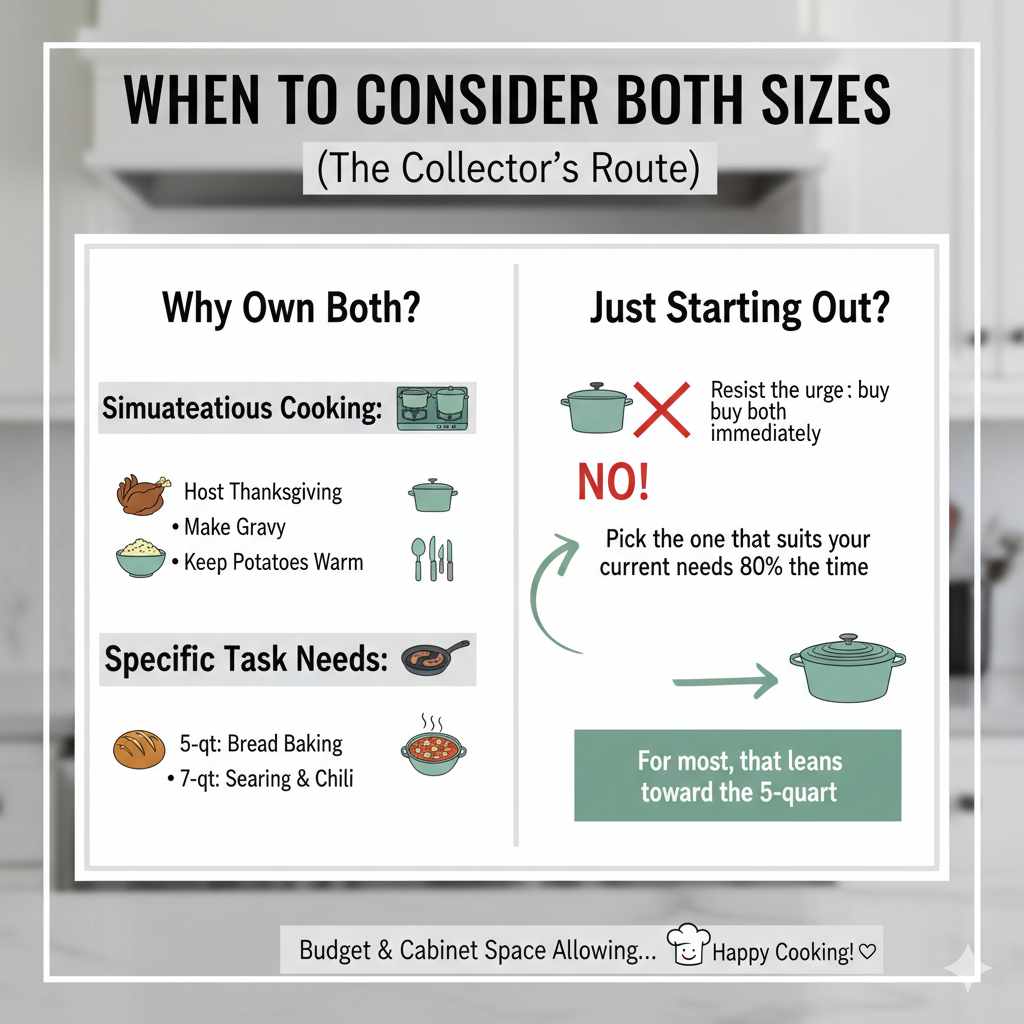
If budget and cabinet space allow, some serious home cooks eventually own both the 5-quart and the 7-quart. Why own two heavy pots?
- Simultaneous Cooking: If you are hosting Thanksgiving and need to make gravy in one pot while keeping mashed potatoes warm in another, having two sizes prevents a stovetop traffic jam.
- Specific Task Needs: The 5-quart might be dedicated solely to bread baking, keeping its bottom pristine, while the 7-quart handles oily searing and messy chilis.
However, if you are just starting out, resist the urge to buy both immediately. Pick the one that suits your current needs 80% of the time. For most, that leans toward the 5-quart.
Frequently Asked Questions (FAQ)
Q1: Is a 6-quart Dutch oven a good compromise between 5 and 7 quarts?
A: Yes, 6-quart sizes are excellent compromises, especially if they are wider rather than taller. They usually offer enough space for 5–6 people without being quite as heavy or bulky as a dedicated 7-quart model. Look for 6-quart options if you fall exactly in the middle of the need spectrum.
Q2: Will a 5-quart Dutch oven fit a standard whole chicken?
A: Generally, yes, a standard 4-pound chicken fits fine, but if you try to add many large potatoes or bulky vegetables alongside it, it will likely overflow. If you usually roast whole chickens, the 7-quart provides better room for aromatics and vegetables.
Q3: Do I need a specific size for making bread?
A: For home baking, 5-quart or 5.5-quart round Dutch ovens are often recommended because they offer the perfect dome clearance for most standard dough recipes, allowing the steam to circulate well around the loaf.
Q4: How do I store these heavy pots safely?
A: Always store them on sturdy lower shelves or in deep base cabinets. Never stack heavy enameled cast iron too high, especially on flimsy racks. If you must stack, place the heaviest pot on the bottom shelf for stability. A good storage solution is often a dedicated cabinet shelf cleared just for your main Dutch oven to prevent strain when pulling it out.
Q5: Do I need to season a new enameled Dutch oven like a raw cast iron pan?
A: No. Enameled cast iron—the kind typically sold in 5 qt and 7 qt sizes by major brands—comes pre-seasoned (glazed). You only need to wash it with soap and water before the first use. Raw cast iron requires seasoning; enameled does not.
Q6: What is the ideal Dutch oven for soup meal prepping for one person?
A: If you are only cooking for one or two people and focusing on meal prep, a 4-quart or even a camp-style cocotte (which is often shallower) is often better than a 5-quart. It reduces the amount of oil or liquid needed for searing and minimizes heat loss when reheated later.
Conclusion: Making the Final Decision
Deciding between a 5-quart and a 7-quart Dutch oven comes down to a simple self-assessment of your cooking habits and kitchen layout. You want a tool that inspires you to cook, not one that frustrates you with storage hassles or constant heavy lifting.
If your regular meals feed four or fewer people, and you value lighter handling and faster heat-up times, the 5-quart Dutch oven is your proven essential starter piece. It is versatile enough for daily soups, braised chicken thighs, and even moderate batches of chili.
If you routinely cook for a crowd of six or more, regularly roast whole turkeys or large cuts of meat, and have ample, sturdy storage, then the 7-quart offers the capacity buffer you need to avoid overcrowding and achieve superior searing results on those larger batches.
Take a good look at your typical weeknight dinner size. That number should guide your initial investment. Either way, you are choosing a reliable tool built to last. Happy cooking!