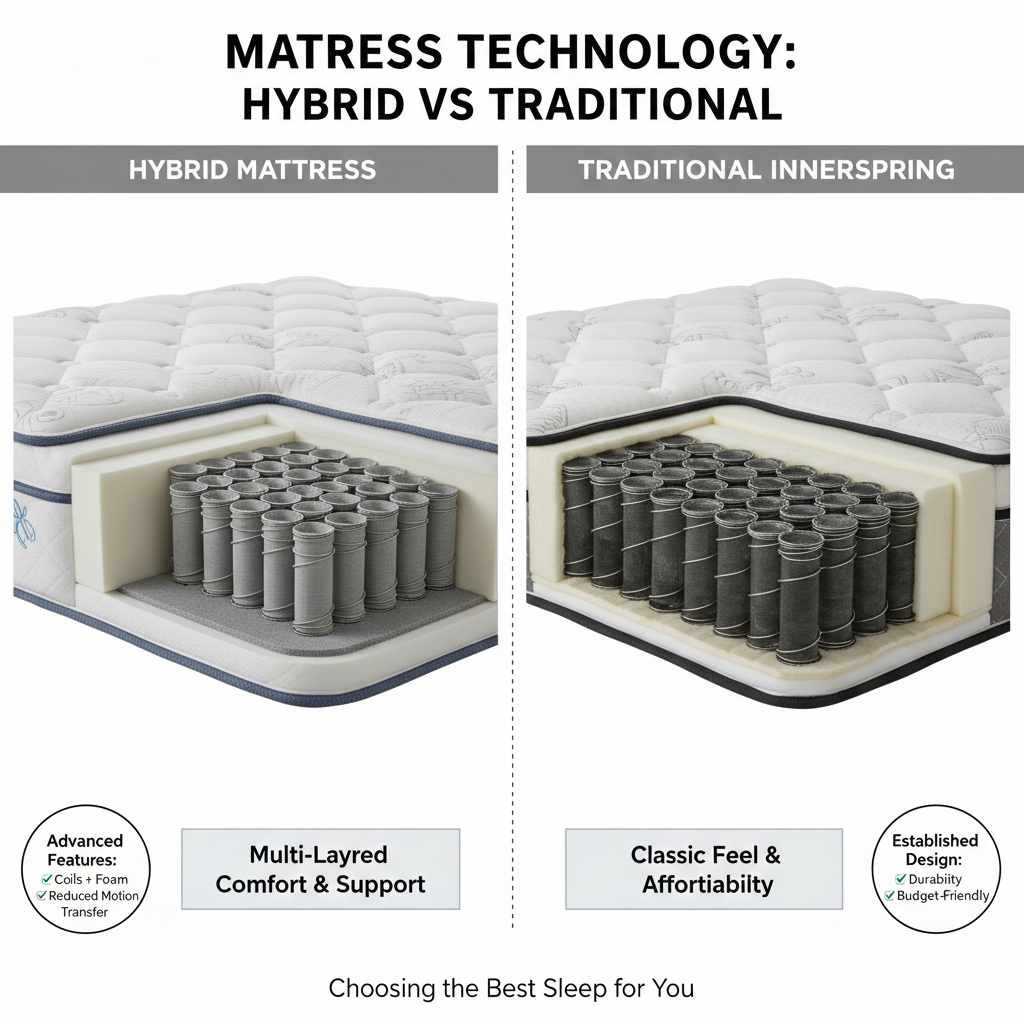
For most beginners, a hybrid mattress offers the best blend of support, comfort, and pressure relief by combining foam and innerspring coils, often delivering superior performance for various sleeping styles compared to purely traditional options.
Choosing a new mattress can feel as tricky as diagnosing a strange engine noise! You hear terms like “hybrid” and “traditional,” and it’s easy to get lost in the jargon. Does one truly offer better sleep than the other? Don’t worry; we’re going to walk through this comparison step-by-step, just like checking your tire pressure. We will break down what each type is, how they feel, and which one is the proven best choice for your bedroom setup. Stick with me, and you’ll know exactly what to ask for on your next shopping trip.
Understanding the Basics: What Makes a Mattress “Traditional”?
When we talk about a “traditional” mattress, we are usually talking about the classic design that most people grew up sleeping on. Think of it as the reliable, standard model of the mattress lineup—it has been around for decades and serves many drivers well!
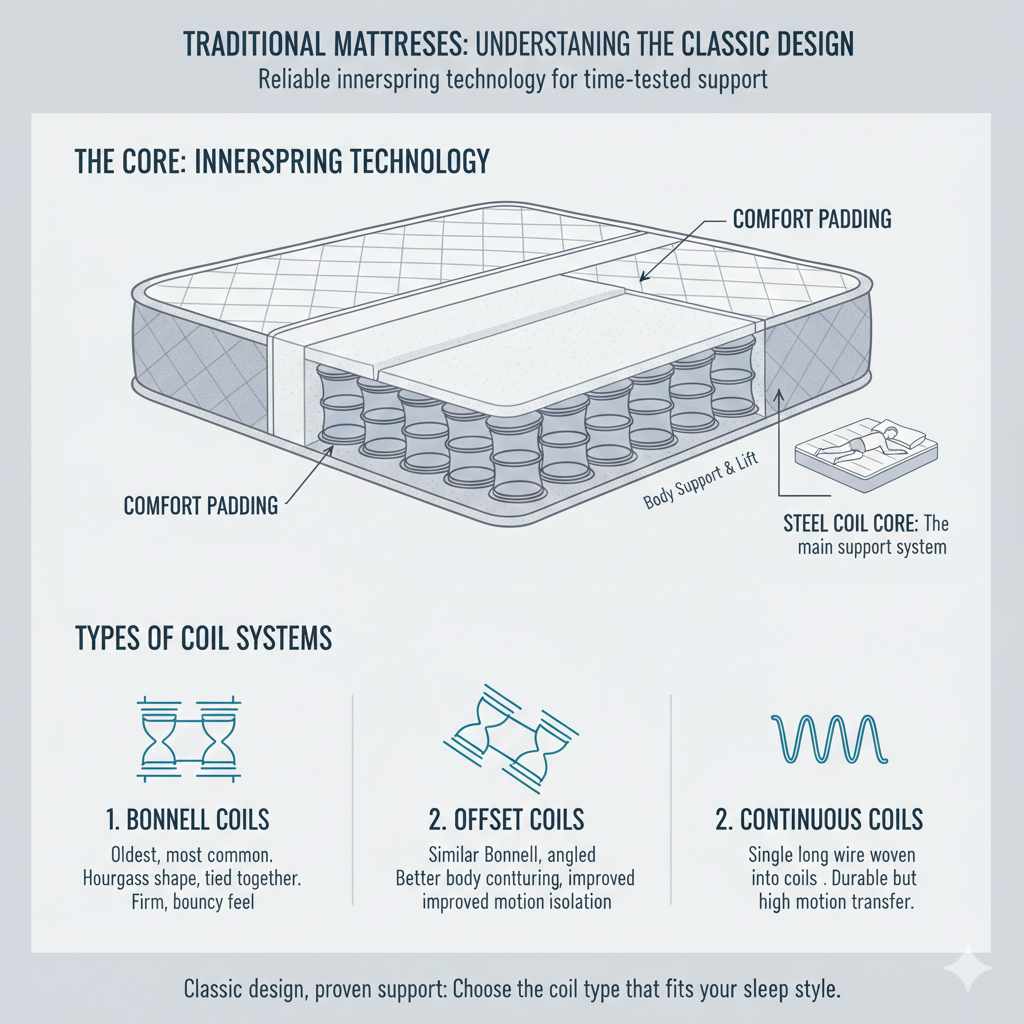
The Core of Traditional Mattresses: Innerspring Technology
Traditional mattresses rely almost entirely on an inner core of steel coils for their support. These coils are the main engine of the bed. They work together to keep your body lifted and prevent you from sinking too far.
Types of Coil Systems in Traditional Beds
Not all coils are created equal, similar to how a four-cylinder engine works differently than a V6. Here are the main types you might encounter:
- Bonnell Coils: These are the oldest and most common. They are shaped like an hourglass and tied together. They often offer a very firm, bouncy feel.
- Offset Coils: These are similar to Bonnell but arranged at an angle. This design helps them conform slightly better to the body’s curves, offering a little more motion isolation than basic Bonnell.
- Continuous Coils: Made from a single long wire woven into coils. These can be quite durable but often transfer motion easily across the bed—if your partner shifts, you’ll feel it!
Comfort Layers: What Sits on Top?
The top part of a traditional mattress, the comfort layer, is usually made thin compared to modern options. It often includes basic padding like cotton fibers or thin layers of polyfoam to soften the initial feel of the coils underneath.
The Feel of a Traditional Mattress
If you like a bed that feels firm, bouncy, and gives you a “sleep-on-top” sensation, a traditional innerspring might be your go-to. They tend to be cooler because the coil structure allows for excellent airflow. However, this structure can also mean less targeted support.
Introducing the Game Changer: What is a Hybrid Mattress?
Now, let’s look at the hybrid. If the traditional mattress is the standard sedan, the hybrid is the modern crossover SUV—it takes the best parts of two different systems and puts them together for better overall performance.
The Definition of a Hybrid Mattress
A hybrid mattress combines the foundational support of innerspring coils with the plush comfort of foam layers. It must have both systems to truly qualify as a hybrid.
Think of it this way: the coils act as the strong chassis and suspension of a rugged vehicle, offering lasting support. The foams are the plush seats and interior padding, focusing on cradling your pressure points.
Understanding the Hybrid Coil Core: Pocketed Coils
The critical difference in virtually all modern hybrid mattresses is the coil system used. They almost exclusively use pocketed coils (also called Marshall or wrapped coils).
- Each coil is wrapped individually in a fabric sleeve.
- This isolation means when you press down on one coil, the surrounding coils don’t move much.
- This leads to fantastic motion isolation (your partner won’t wake you up when they move) and better contouring to your body shape.
The Foam Component of Hybrids
The top layers of a hybrid are where the magic happens for customized comfort. These layers sit directly on top of the pocketed coils.
These layers typically include:
- Memory Foam: Known for deep contouring and pressure relief, hugging your hips and shoulders.
- Latex Foam: A natural or synthetic foam that offers a more buoyant, responsive feel than memory foam.
- High-Density Polyfoam: Used often as a transition layer to add cushion before hitting the coils.
This combination means hybrids offer the bounce lift of springs, paired with the sink-in pressure relief of foam—a true dual-action system!
Hybrid Vs Traditional Mattress: A Head-to-Head Comparison
To make the decision clearer, let’s put these two types side-by-side. We need to look at key performance indicators that impact your nightly rest and long-term satisfaction.
1. Pressure Point Relief and Contouring
This is about how well the mattress cradles your curves—especially shoulders and hips when you sleep on your side.
- Innerspring (Traditional): Offers generalized support. If the top padding is thin, you might feel the coils pushing back, leading to pressure points, especially for side sleepers.
- Hybrid: Excel here. The soft foam top layers absorb the shock and contour around wide parts of your body, while the individually wrapped coils below adjust to your shape. They are often recommended for side sleepers who need deep cushioning.
2. Motion Isolation (Partner Disturbance)
If you share a bed, this factor is huge. It’s about minimizing movement transfer.
- Innerspring (Traditional): Because the coils are usually interconnected (tied together), movement on one side of the bed often causes the coils on the other side to rock slightly. Poor motion isolation is common.
- Hybrid: Superior motion isolation. The pocketed coils move independently, meaning one person tossing and turning has almost no effect on the other side of the bed.
3. Temperature Regulation (Sleeping Cool)
Do you tend to overheat while sleeping? Airflow is key here.
- Innerspring (Traditional): Generally excellent for cooling. The large empty spaces between the coils allow air to move freely throughout the mattress core, naturally dissipating heat.
- Hybrid: Very good. While the foam layers can trap some heat (especially traditional memory foam), being built around a coil core means they have much better airflow than all-foam mattresses. Many modern hybrids even use cooling gel-infused foams.
4. Durability and Lifespan
How long will your investment last before sagging becomes a problem? This often depends on unit quality, but generally:
- Innerspring (Traditional): Can last a long time if the coils are high quality, but sagging can occur where the body sinks most, creating dips where the wires are stressed.
- Hybrid: Often hold up better because you have two robust support systems working together. The coils handle the heavy lifting, and the dense replacement foams resist quick breakdown. Reputable sources suggest good quality pocketed coils can last 8–12 years. The National Institute of Standards and Technology (NIST) provides testing standards that guide manufacturers in creating durable bedding products.
5. Handling Edge Support
Edge support is how sturdy the perimeter of the bed feels when you sit on the edge or sleep right near it.
- Innerspring (Traditional): Edge support varies wildly. Cheaper models often collapse easily at the edges.
- Hybrid: Usually designed with reinforced coils or high-density foam encasement around the perimeter. This means you usually get much stronger edge support, making it easier to get in and out of bed.
Summary Table: Hybrid vs. Traditional at a Glance
Here is a quick cheat sheet to see how the two types stack up on the most important features:
| Feature | Traditional Innerspring | Hybrid Mattress |
|---|---|---|
| Support Core | Interconnected Steel Coils | Individually Pocketed Coils |
| Comfort Feel | Bouncy, Firm, “On Top” Feel | Contouring, Balanced, Customized Feel |
| Motion Isolation | Poor to Fair | Good to Excellent |
| Best For | Hot sleepers who prefer very firm support | Side sleepers, couples, and those needing pressure relief |
| Price Point (Generally) | Lower to Mid-Range | Mid-Range to Premium |
Which Mattress is Proven Best for Different Sleepers?
The “best” mattress isn’t about what the factory says; it’s about what works for your body. As your friendly automotive guide, I always say you need the right tool (or mattress) for the right repair (or rest). Here’s my breakdown based on common sleeping positions.
The Side Sleeper: Prioritizing Pressure Relief
Side sleepers put the most direct pressure on their hips and shoulders. If the mattress is too firm, it creates painful pressure points. If it’s too soft, the hips sink too far, misaligning the spine.
- The Winner: Hybrid. The thick, cushioning top layers (memory foam or latex) conform perfectly to these curves, relieving pressure, while the pocketed coils underneath provide targeted lift so your spine stays straight.
The Back Sleeper: Needing Even Spinal Alignment
Back sleepers need firm support to keep the spine in a neutral position, with just enough give to cushion the lumbar (lower back) area.
- The Verdict: Hybrid OR High-Quality Traditional. A hybrid usually wins because it offers both the firmness needed and the subtle conforming layer to prevent lower back stiffness. However, a very firm, high-coil-count traditional mattress can also work well here.
The Stomach Sleeper: Avoiding Letdown
Stomach sleepers must avoid sinking in the middle, which forces the hips up and arches the back uncomfortably. Firmness is paramount.
- The Verdict: Traditional Innerspring or Firm Hybrid. Stomach sleepers need a consistently firm surface. A standard, high-innerspring mattress often provides this predictable, buoyant feel. If choosing a hybrid, look specifically for one with a very thin top comfort layer and high-density support foam.
Best for Couples: Motion Isolation is King
If sharing a bed, you need a setup that minimizes movement transfer.
- The Winner: Hybrid. The individually wrapped coils are the key technology here. They drastically reduce the sensation of your partner moving compared to interconnected coils found in traditional beds.
Making the Smart Buy: Practical Tips Before You Purchase
Deciding on the type is the first step. The next steps ensure you don’t end up with a lemon! Buying a mattress online or in a store requires some savvy shopping.
1. Know Your Firmness Scale (1 to 10)
Mattress firmness is rated on a 1 (softest) to 10 (firmest) scale. Don’t just rely on what the salesperson says; understand where you sit:
- Soft (3–4): Best for lightweight side sleepers.
- Medium (5–6): The versatile sweet spot for back/stomach sleepers and average-weight side sleepers. This is where most popular hybrids land.
- Firm (7–8): Ideal for heavier individuals or strict stomach sleepers.
2. Check the “Test Drive” Period
Just like you wouldn’t buy a car without a long test drive, never purchase a mattress without a trial period. Your body needs 30 days or more to truly adjust to a new sleeping surface. Look for companies offering at least a 90-night trial period with free returns. This minimizes your risk significantly.
3. Don’t Forget the Foundation
This is crucial maintenance advice! A new mattress requires the right foundation. If you buy a hybrid mattress—which relies on individually pocketed coils—a weak or old box spring just won’t cut it. The foundation needs to be firm and supportive.
For hybrids, you generally need either:
- A solid platform base (no slats, or slats fewer than 3 inches apart).
- A sturdy replacement box spring designed specifically for hybrid or foam mattresses, which usually has a supportive grid pattern rather than large gaps.
Using the wrong base voids warranties and negates the benefits of the hybrid design. Check the manufacturer’s documentation; for example, the Federal Trade Commission (FTC) advises consumers to always check warranty requirements regarding the foundation.
4. Inspect the Materials (Density Matters)
For the foam layers in a hybrid, density is a measure of quality, not just softness. Higher density foam holds its shape longer and is more durable.
- Look for comfort layers (memory foam/latex) that are at least 3–4 lbs per cubic foot for good durability.
- Support layers (the base foam under the coils) should be dense polyfoam to prevent premature failure.
The Long-Term View: Maintenance and Longevity
You maintain your car to keep it running smoothly; you must maintain your mattress too. While hybrids generally win on longevity, a little care goes a long way for both types.
Basic Mattress Care: Simple Steps to Extend Life
These steps apply to both traditional innerspring and hybrid models:
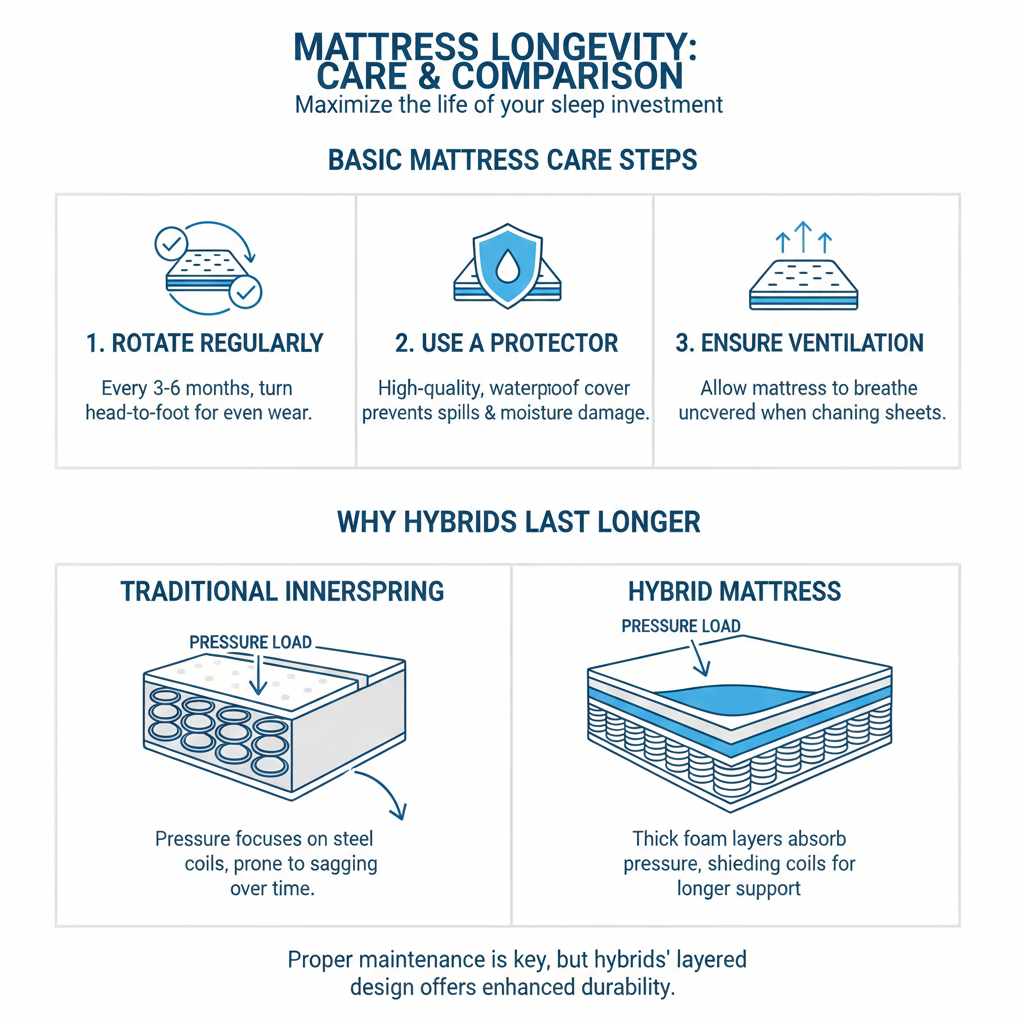
- Rotate Regularly: Every 3 to 6 months, turn your mattress 180 degrees (head-to-foot). This distributes wear evenly across the surface.
- Use a Protector: Always use a high-quality, waterproof mattress protector. Spills, sweat, and allergens break down foam and fabric layers faster than anything else.
- Ensure Proper Ventilation: When changing sheets, allow the mattress to “breathe” uncovered for an hour or two. This allows any trapped moisture to evaporate, which prevents mold or mildew growth inside the core.
Why Hybrids Often Feel “Newer” Longer
The primary reason hybrids maintain their supportive feel longer than traditional innersprings is the way the foam and coils work in tandem. In a traditional bed, the pressure is focused almost entirely on the steel coils, which can eventually sag under consistent load. In a hybrid, the thick foam absorbs much of that immediate pressure, shielding the coils more effectively, thus preserving the spring unit’s intended function for a longer period.
FAQ: Answering Your Beginner Mattress Questions
Q1: Is a hybrid mattress generally more expensive than a traditional one?
A: Yes, typically. Hybrids use more complex, high-quality components, mainly the individually wrapped pocketed coils and the multiple layers of premium comfort foams. This advanced construction usually pushes the price slightly higher than basic, interconnected coil traditional models.
Q2: Can I use my old box spring with a new hybrid mattress?
A: Probably not safely. If your old box spring is the traditional type with wide gaps between the wires or slats, it will likely cause your hybrid support coils to push through or wear out unevenly. Always check the warranty—most hybrid manufacturers require a solid platform or a foundation with slats no more than 3 inches apart for coverage.
Q3: Do traditional innerspring mattresses sleep cooler than hybrids?
A: Traditionally, yes. Innersprings allow maximum airflow. However, modern hybrids are very close contenders because their coil centers offer great air channels, making the difference minimal unless you are someone who sleeps extremely hot and chooses a hybrid with thick memory foam layers.
Q4: If I sleep alone and don’t move much, does the hybrid’s motion isolation matter?
A: Not really for motion isolation, but hybrids still provide superior contouring. Even sleeping alone, if you are a side sleeper, the isolated coil response helps the mattress hug the dips in your body much better than a traditional interconnected coil system.
Q5: Are hybrid mattresses less bouncy than traditional ones?
A: They are less bouncy in the traditional sense, often described as having a more “responsive support” feel. You get a slight lift from the coils, but the foam layers absorb much of the sharp, immediate springiness characteristic of older innerspring designs.
Final Conclusion: The Clear Winner for Most Sleepers
Choosing between a hybrid and a traditional innerspring mattress doesn’t have to feel overwhelming. Once you strip away the jargon, the decision comes down to one simple question:
Do you want basic support — or balanced performance?
Traditional innerspring mattresses are reliable, breathable, and often budget-friendly. They work well for sleepers who prefer a firm, bouncy, no-frills feel — especially stomach sleepers or those who naturally sleep hot. If you love that classic “sleeping on top” sensation, a high-quality traditional model can absolutely do the job.
But for most beginners — and most sleep styles — the hybrid mattress stands out as the smarter long-term investment.