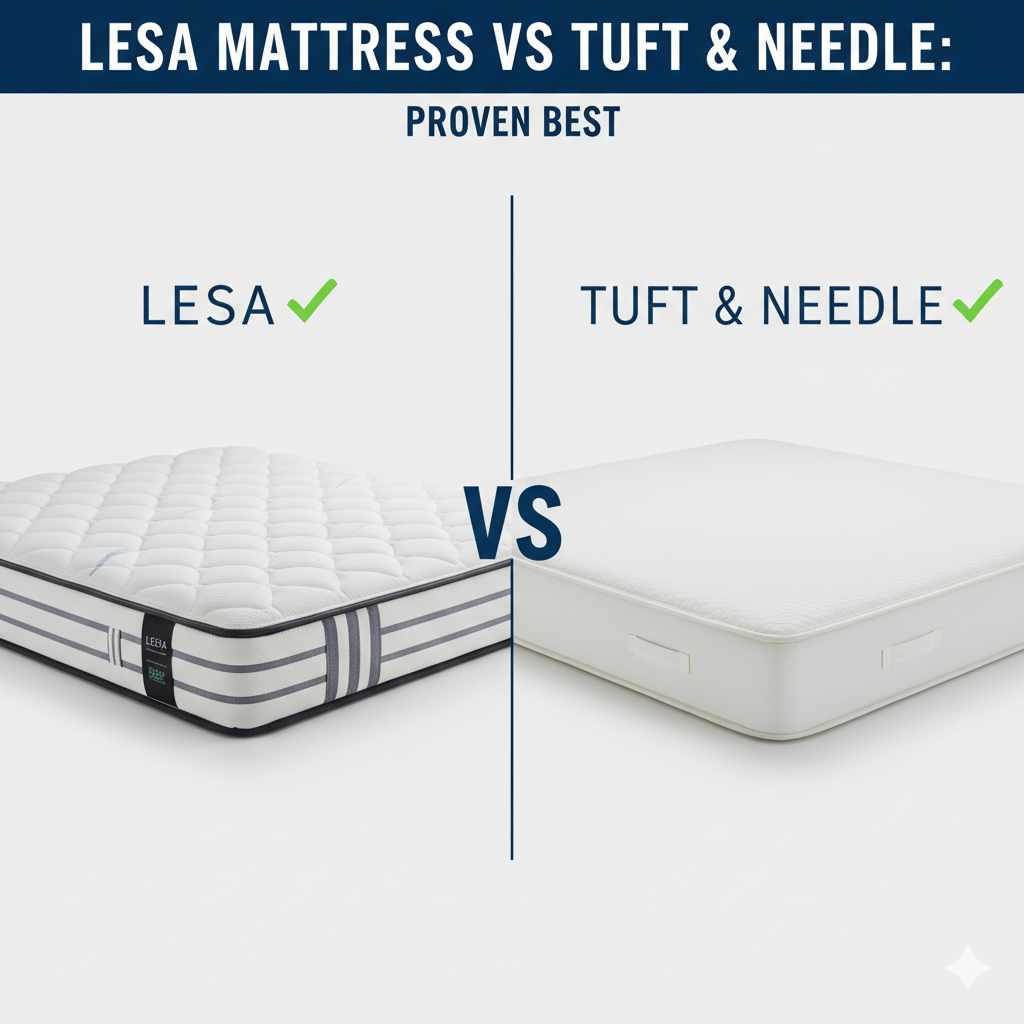
Leesa Mattress vs. Tuft & Needle comparison shows both are great foam options. Leesa often wins for pressure relief and deeper sink, while Tuft & Needle excels in balanced support and cooler sleeping. The “best” choice depends on whether you prioritize contouring softness (Leesa) or consistent, firmer support (Tuft & Needle).

Tuft & Needle
Tuft & Needle Original Hybrid Medium Queen…
- This queen bed mattress comes compressed in a box with both a 100-Night Sleep Trial and 10 Year Limited Warranty and is certified…
- Exceptional Cooling – Queen size mattress topped with a quality cover that includes cooling technology; T&N Original Hybrid mattre…
- Bounce-Back Support – Hybrid mattress with breathable open-cell foam infused with cooling gel and graphite to help wick away heat,…
As an Amazon Associate I earn from qualifying purchases.
For a closely related home or decor topic, Compare Full Size Mattress to Queen Size gives readers a useful next step.
For a related kitchen decision, Remove Blood Stain From A Mattress adds another practical detail to check.
For a closely related home or decor topic, Ikea Foam Vs Latex Mattress: Showdown gives readers a useful next step.
Choosing a new mattress can feel harder than changing your engine oil—so many options, so much jargon! If you’re looking at online mattresses, you’ve likely hit the wall between Leesa and Tuft & Needle. Both are top names, but they feel different. You want the best fit for your sleep, not just the one that’s easiest to buy online. Don’t worry; we’ll break down these two foam giants simply. We’ll look at what makes them unique so you can pick the right one with total confidence. Ready to stop losing sleep over this decision? Let’s dive into the details!
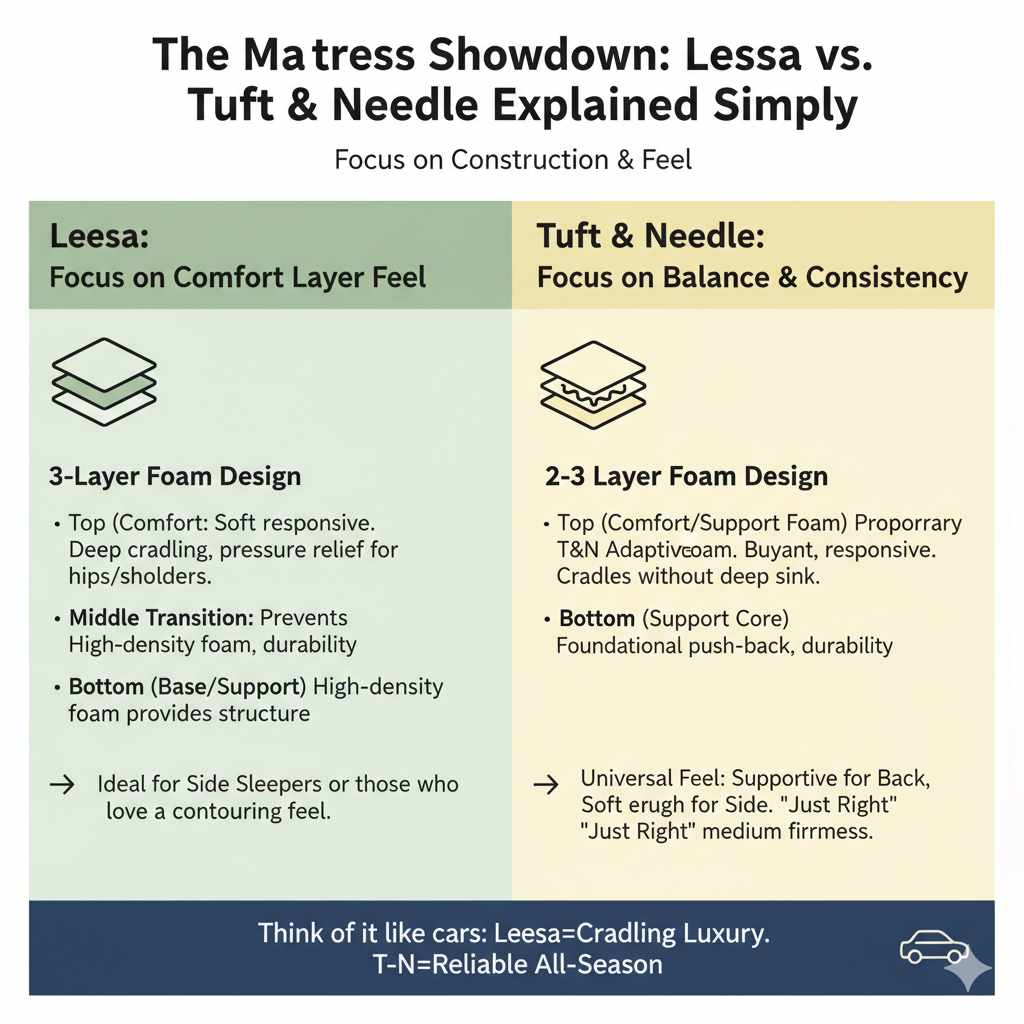
The Mattress Showdown: Leesa vs. Tuft & Needle Explained Simply
When you shop for a mattress online, you’re skipping the showroom floor. That means you have to rely on reviews and specs. Leesa and Tuft & Needle both offer high-quality foam beds delivered right to your door. They are popular because they solve the problem of uncomfortable, saggy beds common with older innerspring models. However, they use slightly different foam recipes to achieve their signature feel.
Think of it this way: both are reliable, entry-level luxury cars, but one might handle corners slightly better, and the other might accelerate faster. Understanding these small differences in construction is key to finding your perfect match.
What Makes Leesa Unique? Focus on Comfort Layer Feel
Leesa built its brand around one core idea: exceptional comfort and pressure relief. When you put your money down on a Leesa, you are generally paying for a feel that cradles your body more deeply. This is often managed through their top comfort layers.
Leesa Construction Snapshot
The original Leesa mattress typically uses a three-layer foam design. This is important because the top layer is where you feel the immediate hug.
Top Layer (Comfort): This layer is usually a soft, responsive foam designed to cushion hips and shoulders. It’s where most of that “sinking in” feeling comes from.
Middle Layer (Transition): This foam works to bridge the gap between the soft top and the firm base. It stops you from feeling like you’re bottoming out.
Bottom Layer (Base/Support): This high-density foam provides the essential structure and keeps the mattress durable over many years.
Leesa often appeals to side sleepers or those who prefer a traditional “contouring” memory foam feel, though they have moved towards more hybrid options recently. It’s designed to conform closely to your body’s curves.
What Makes Tuft & Needle Unique? Focus on Balance and Consistency
Tuft & Needle (T&N) took a slightly different approach. They wanted a simple, universally comfortable bed that didn’t rely heavily on the deep sink of traditional memory foam. Their goal was a “just right” medium firmness that works for almost everyone—stomach, back, and side sleepers alike.
Tuft & Needle Construction Snapshot
Tuft & Needle’s original model is famous for its simplicity, often using just two or three layers. They pride themselves on using proprietary foam blends rather than standard memory foam.
Top Layer (Comfort/Support Foam): T&N often uses their specialized “T&N Adaptive Foam.” This foam is designed to be more buoyant and responsive than traditional memory foam. It cradles, but it resists that feeling of being completely enveloped.
Bottom Layer (Support Core): This layer provides the foundational push-back and durability.
The key takeaway here is balance. T&N aims for a feel that is supportive enough for back sleepers but soft enough for side sleepers, making it a fantastic universal choice, much like choosing a reliable, all-season tire for your vehicle.
Head-to-Head Comparison: Leesa Mattress Vs Tuft & Needle
When you are comparing these two, look at the core performance areas. These areas determine how you will feel the morning after sleeping on the bed.
Firmness Level and Feel
Firmness is subjective, but generally, these two fall on different ends of the “medium” spectrum.
| Feature | Leesa Mattress (Original/Signature) | Tuft & Needle (Original/Core) |
| :— | :— | :— |
| General Feel | Medium-Soft to Medium | Medium to Medium-Firm |
| Pressure Relief | Excellent (Deeper hug) | Very Good (More buoyant feel) |
| Motion Isolation | Excellent (Foam absorbs movement well) | Very Good |
| Responsiveness | Moderate (Slightly slower response) | Quick (Easier to change positions) |
| Ideal For | Side sleepers, pressure relief seekers | Combination sleepers, back/stomach sleepers |
The Sink Factor
If you love that feeling where your shoulder sinks down perfectly when you sleep on your side, Leesa often delivers more of that characteristic “sink.” If you prefer feeling like you are resting on top of the mattress more than sinking into it, T&N’s adaptive foam will feel better suited to you.
Temperature Regulation (Staying Cool While You Sleep)
One major complaint about traditional foam mattresses is heat retention. Both companies have worked hard to engineer coolness into their products.
Leesa often utilizes open-cell foam structures in its comfort layer, which allows for better airflow compared to older, denser memory foams. However, because it allows for a deeper contour, some users still report slight warmth if they sleep very hot.
Tuft & Needle often receives praise for its cooler profile. Their Adaptive Foam is generally designed to be more breathable right out of the box. If overheating is a major concern, T&N often edges out Leesa in this category, though both are significant upgrades from basic foam beds.
Edge Support
Edge support refers to how well the sides of the mattress hold up when you sit on the edge or sleep right near the perimeter. This is especially important if you use the entire surface area of your bed or need support getting in and out.
Since both of these models are primarily all-foam designs (not hybrid with coils), their edge support is generally good but not outstanding compared to a traditional innerspring model.
Leesa: Generally provides solid edge support due to the dense base layer.
Tuft & Needle: Offers comparable edge support, again relying on the density of the core foam.
Neither will feel like you’re sitting on the edge of a park bench, but if true, unwavering edge support is your top priority, you might consider a hybrid model from either brand instead of their original foam versions.
Motion Isolation (The Partner Test)
If you share your bed with a restless partner, motion isolation is crucial. This keeps you from feeling every toss and turn when they shift position in the night.
Both Leesa and Tuft & Needle excel here because they are foam mattresses. Foam naturally dampens movement far better than bouncy innerspring coils.
Winner Here: It’s a near tie. Both are fantastic at isolating motion, making them great choices if one person moves a lot during the night. You can generally move around on one side without disturbing the other sleeper severely.
Durability and Materials Deep Dive
Durability isn’t just about how long the mattress lasts; it’s about how long it maintains that “like new” feel. This boils down to the density and quality of the foam used. Think about the engine block in your car—higher quality materials mean fewer breakdowns over time.
The Role of Foam Density
In the mattress world, higher density usually means better durability, assuming the foam quality is good.
High-Density Foams: These are less likely to sag or develop permanent body impressions quickly.
Lower-Density Foams: These feel softer initially but break down faster, leading to premature sagging.
Both Leesa and Tuft & Needle use high-quality foams that pass rigorous testing, ensuring they meet modern safety and comfort standards. For instance, foam safety standards often align with requirements set by organizations focused on indoor air quality, similar to how the EPA sets standards for vehicle emissions for cleaner air.
Off-Gassing: That “New Mattress Smell”
Foam mattresses, because they are compressed and shipped in a box, release volatile organic compounds (VOCs) when first opened. This smell is called off-gassing.
Leesa: Generally has moderate off-gassing that usually dissipates within 24 to 48 hours if the bedroom is well-ventilated.
Tuft & Needle: Often praised for having minimal off-gassing, partly due to the specific foam chemistries they use.
Quick Tip: Always unwrap your new mattress in a well-ventilated room. Open a window, even if it’s chilly outside for a day or two. This helps the gases clear out faster.
Who Should Buy the Leesa Mattress Most Likely?
You should lean toward the Leesa if you fit these profiles:
1. Side Sleepers Needing Deep Cushion: You carry most of your weight on your hips and shoulders and need significant pressure relief to keep your spine aligned.
2. Those Who Like a Traditional “Hug”: You enjoy the feeling of sinking into your bed slightly for a cozy, enveloping sensation.
3. Shoppers Prioritizing Deep Contouring: You want your mattress to map exactly to your body shape.
Leesa often feels slightly softer overall than the T&N original, making it an excellent choice for those who like a more luxurious, cloud-like initial feel.
Who Should Buy the Tuft & Needle Mattress Most Likely?
You should lean toward the Tuft & Needle if you fit these profiles:
1. Combination Sleepers: You switch positions frequently (side-to-back-to-stomach), and you need a bed that lets you move easily without sticking.
2. Hot Sleepers: You generally run warm and need a very breathable, buoyant foam surface that doesn’t trap much heat.
3. Those Who Prefer Medium Support: You want a feel that is supportive but still cushioned—the universal medium setting done well.
T&N’s proprietary foam prioritizes responsiveness, meaning you don’t have to wait for the mattress to adjust when you shift position. It’s reliable and consistent across different sleeping styles.
Comparing Warranties and Sleep Trials
When buying sight-unseen, the policies you have after the purchase are almost as important as the mattress itself. These are your safety nets!
Sleep Trial Period
This is your chance to “test drive” the mattress at home.
Leesa: Leesa usually offers a 100-night sleep trial. This is standard in the industry. They require you to try it for at least 30 nights to let your body adjust before initiating a return.
Tuft & Needle: Tuft & Needle also typically offers a 100-night trial. Their return process is known for being very straightforward.
Warranty Coverage
Warranties cover manufacturing defects, like significant sagging or broken components, not normal wear and tear or changes in firmness you’ve simply gotten used to.
| Warranty Aspect | Leesa | Tuft & Needle |
| :— | :— | :— |
| Length | 10 Years (Limited) | 10 Years (Limited) |
| Coverage Trigger (Sagging) | Usually covers impressions deeper than 1 inch (check specific model terms) | Usually covers impressions deeper than 1 inch (check specific model terms) |
| What’s Covered? | Manufacturing defects, structural issues | Manufacturing defects, structural issues |
Always read the fine print on both websites regarding what depth of impression voids the warranty. For instance, if you notice a permanent dip in the mattress, you need to measure it against their stated allowance.
The Financial Checkup: Pricing Considerations
For many new buyers, budget is a massive factor. Since both brands frequently run sales, the list price is often less important than the sale price. Generally, both brands are positioned in the mid-to-upper range of direct-to-consumer foam mattresses.
In many head-to-head price checks (for a Queen size), the pricing structures often land very close to each other, usually within a few hundred dollars, depending on ongoing promotions.
Look for Holiday Sales: If you can wait for major holidays (like Memorial Day or Labor Day), both companies significantly drop prices.
Consider the Foundation: Remember that a great mattress needs a great foundation. Verify if your existing box spring is suitable or if you need a solid platform base. As with proper tire rotation ensuring even wear on your tires, a solid foundation ensures your new expensive mattress wears evenly. You can find reliable platform frame information from consumer safety sites to ensure you choose a sturdy base.
Comparing Specific Models (Beyond the Original Foam)
It’s important to note that both Leesa and Tuft & Needle have expanded their lineups well beyond the basic foam mattresses we’ve discussed. They now offer hybrids, luxury lines, and cooling-focused models.
If you are leaning toward one brand but find the original foam model isn’t quite right, here is a quick look at their upgraded offerings:
Leesa’s Hybrid Lineup
Leesa Hybrids incorporate pocketed coils beneath the foam layers. This combination usually provides:
1. Better Support: Coils offer superior push-back.
2. Improved Airflow: Coils create massive air channels.
3. Stronger Edge Support: Coils are usually reinforced around the perimeter.
If you like the soft Leesa comfort layer but need the stable support of coils, their hybrid line is a natural progression.
Tuft & Needle’s Hybrid Lineup (The Mint)
Tuft & Needle’s advancements often focus on temperature control and specialized comfort foams. Their higher-end models often feature advanced cooling fibers woven into the cover and additional, specialized foam layers engineered for targeted pressure relief.
If T&N’s original felt just a little too firm, their upgraded models usually increase the softness of the top layer without sacrificing that signature responsive support.
To simplify this for beginners, if you are comparing a Leesa Hybrid to a Tuft & Needle Hybrid, the general rule still applies: Leesa leans slightly softer/more conforming, and T&N maintains a firmer, more balanced feel.
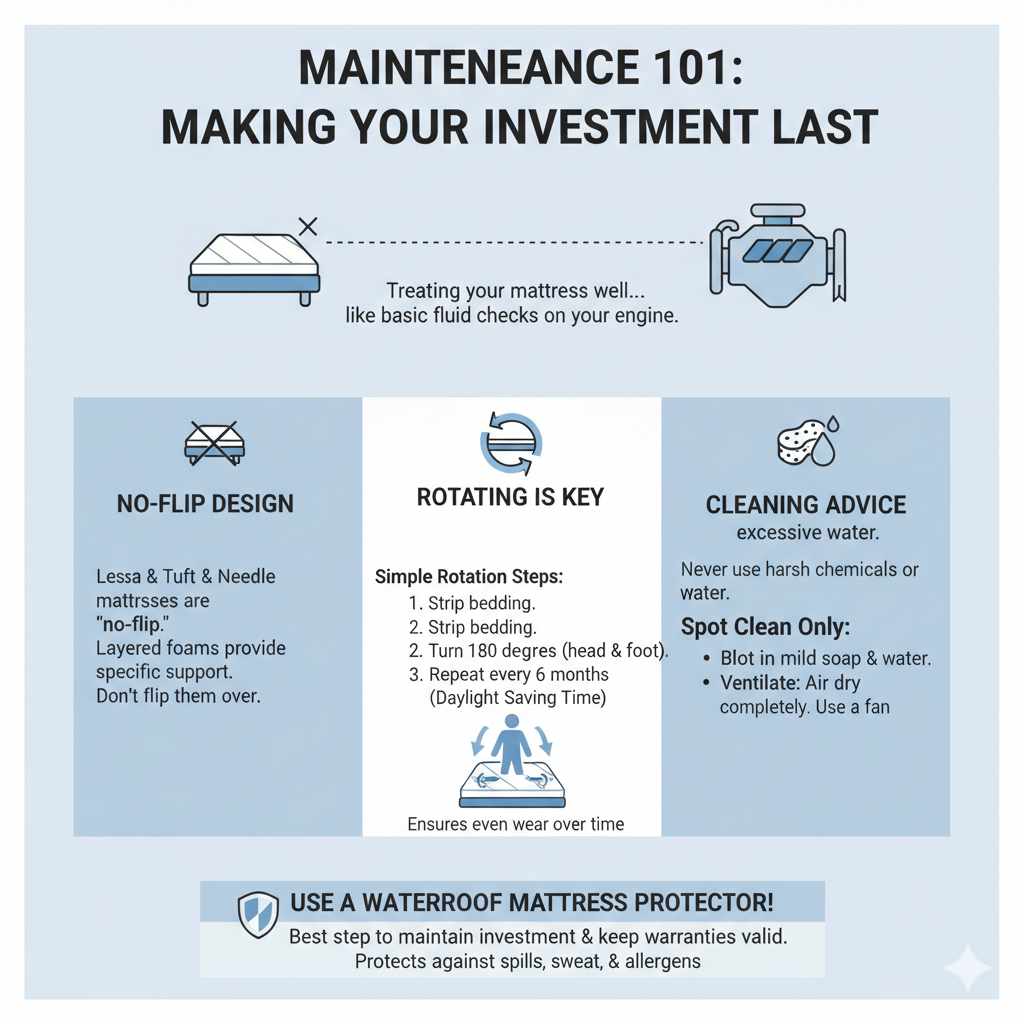
Maintenance 101: Making Your Investment Last
Treating your mattress well ensures it performs reliably for years, much like keeping up with basic fluid checks on your engine keeps your car running smoothly.
No-Flip Design
Both Leesa and Tuft & Needle mattresses are designed to be “no-flip.” You do not need to flip them over head-to-toe. This is because the specific foams used are layered intentionally, and flipping them interferes with the intended support structure.
Rotating is Key
While you don’t flip them, you should rotate them periodically.
Simple Rotation Steps:
1. Strip all the bedding off the mattress.
2. Carefully turn the mattress 180 degrees (rotate head to foot).
3. Repeat this rotation every 6 months (perhaps when you change your clocks for Daylight Saving Time).
Rotating ensures that the heaviest part of your body (your hips and shoulders) rests on different parts of the comfort layer over time, leading to more even wear.
Cleaning Advice
Never use harsh chemicals or excessive water on foam mattresses unless specifically directed by the manufacturer. Water can degrade the foam structure, making it heavier and less supportive.
Spot Clean Only: If you spill something, blot the area immediately with a cloth dampened with mild soap and water.
Ventilate: Allow the spot to air dry completely before putting sheets back on. A fan can speed this up.
Using a high-quality, waterproof mattress protector is the absolute best step you can take to maintain your investment and keep warranties valid. It protects against spills, sweat, and allergens.
Frequently Asked Questions (Beginner Edition)
Q1: Which mattress is better if I sleep on my stomach?
For stomach sleepers, you need consistent support to keep your hips from sinking too far. Generally, the Tuft & Needle (which leans medium-firm) is often recommended over the slightly softer Leesa original because it offers better spinal alignment for this sleeping position.
Q2: Do I need a special frame for these mattresses?
Both Leesa and Tuft & Needle require a sturdy foundation. A traditional box spring is usually too soft. You need a platform bed frame or a foundation with strong, solid slats spaced no more than 2.75 inches apart. Check the manufacturer’s website for the precise slat spacing rule.
Q3: What if the mattress feels too firm or too soft after a month?
This is why the 100-night trial is essential. If you are within the trial period, contact the company. They will arrange a pickup (often donating the bed) and issue a full refund. Don’t worry; returns are easy if the feel just isn’t right for your body.
Q4: Are Leesa and Tuft & Needle “Green” mattresses?
Both brands focus on using CertiPUR-US certified foams. This certification ensures the foams are made without harmful chemicals like heavy metals, certain flame retardants, formaldehyde, and ozone depleters. This is a key indicator that they meet strict health and environmental standards.
Q5: Which one is better for couples with different body weights?
When weights vary greatly, you need something that offers targeted support. The Tuft & Needle’s inherent balance might work better, as it keeps the lighter person from sinking too far into the mattress while still offering support for the heavier person. Motion isolation is excellent for both, which helps couples.
Q6: How fast will my mattress ship?
Online mattress companies pride themselves on fast shipping. Generally, you can expect shipping within 1–2 weeks, though this can vary based on stock levels. Because they ship compressed in a box, transport is efficient, similar
Q6: How fast will my mattress ship?
Online mattress companies pride themselves on fast, convenient delivery. In most cases, both Leesa and Tuft & Needle ship within about 1–2 weeks, depending on your location and product availability. Since the mattresses are compressed and packed in a box, they are easier to transport and often arrive via standard courier services. Once delivered, setup is simple—just unbox, unroll, and allow 24–48 hours for the mattress to fully expand and air out before sleeping on it.
Conclusion
Leesa and Tuft & Needle are both strong contenders in the foam mattress market, but they cater to slightly different comfort preferences. Leesa stands out for its deeper contouring, pressure relief, and softer, more cradling feel—making it a great choice for side sleepers and anyone who enjoys that “hugged” sensation. Tuft & Needle, on the other hand, excels in balanced support, cooler sleep, and responsive comfort that works well for back, stomach, and combination sleepers.
Since both brands offer similar pricing, 100-night trials, and 10-year warranties, the decision ultimately comes down to how you want your mattress to feel. If you prefer sinking in and cushioning around pressure points, Leesa is likely the better fit. If you want a more supportive, buoyant surface that keeps you lifted and cool, Tuft & Needle is the smarter choice. Either way, both are reliable, modern options that deliver comfort, durability, and convenience right to your door.
Related pick: Check today's price on Amazon