How to Fix a Broken Box Spring Slat: A Step-by-Step Repair Guide
You feel it the moment you sit on the edge of the bed: a sickening crunch, followed by your mattress dipping in a way it definitely shouldn’t. You lift the mattress, and there it is — a cracked or snapped slat, the wooden backbone of your box spring. It’s a common problem, and most people assume it means buying a whole new foundation. That’s usually a waste of money.
This guide walks you through the actual repair process, from quick overnight fixes to permanent structural repairs. You’ll learn why slats break, how to tell if the frame itself is damaged, and exactly what tools and materials you need. By the time you finish, you’ll know whether your box spring is worth saving or if it’s time to shop for a replacement.

MAF
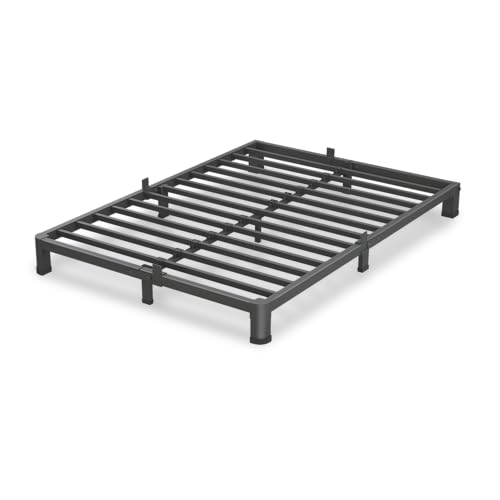
MAF 2 Inch Queen Box Spring with…
- Heavy Duty Queen Box Spring: Box spring queen with high quality soft wooden slats and durable reinforced steel construction for ma…
- Mattress Protection: This queen metal boxsprings is different from other metal box springs. It is equipped with wider wooden slats…
- Low Profile & Round Corner Design: The box spring with four rounded corners design can protect you from injury. Box springs queen…
As an Amazon Associate I earn from qualifying purchases.
If your box spring is too far gone, a solid replacement like the MAF 2 Inch Queen Box Spring with its reinforced steel frame and wider wooden slats can solve the problem without the hassle of constant repairs. But first, let’s see if you can fix what you already own.
Assess the Damage: Slat vs. Frame vs. Springs
Before you buy anything, you need to know what you’re dealing with. Lift the mattress and inspect the foundation. There are three distinct types of box springs, and each requires a different repair approach.
- Wood slat foundation: Individual wooden slats running across the width of the frame, usually spaced 2-3 inches apart. These are the easiest to fix.
- Metal grid foundation: A wire mesh or grid welded to a metal frame. You can’t replace individual slats here — you’re looking at welding or a full replacement.
- Hybrid (wood slats on metal frame): Wooden slats sitting on a steel frame. You can replace the slats, and the metal frame is rarely the problem.
Look for the failure point. A single cracked slat is a simple fix. A split in the outer wooden frame is more serious. And if the springs themselves are poking through the fabric, that’s not a slat problem — that’s a replace-the-whole-thing problem.
Check the center support too. Many box springs have a wooden or metal crossbeam running down the middle. If that’s broken, you’ll need to reinforce it before touching any slats.
Tools and Materials: What You Actually Need (and What to Skip)
For most slat repairs, you don’t need a workshop. Here’s the honest list:
- Replacement wood: A 1×4 or 1×6 board of pine or plywood. Measure your existing slats first — match the thickness exactly.
- Wood glue: Standard PVA wood glue works fine. No need for epoxy unless you’re repairing a split frame.
- Screws: 1.5-inch to 2-inch wood screws. Use coarse threads for softwood.
- Drill: A cordless drill with a screwdriver bit. A drill bit for pilot holes helps prevent splitting.
- Measuring tape and pencil: For marking cuts.
- Hand saw or circular saw: A handsaw works for one or two slats. A circular saw makes cleaner cuts.
- Sandpaper: Medium grit, to smooth cut edges.
Skip the metal brackets, angle braces, and other hardware-store gadgets. They add bulk without adding real strength. A properly glued and screwed wooden slat is stronger than the original.
One more thing: wear safety glasses when cutting wood. Sawdust in the eye ruins a repair session fast.
The Quick Fix: Temporary Support Without Removing the Mattress
Sometimes you need the bed usable tonight, and you don’t have time for a proper repair. Here’s a temporary fix that holds for a few days.
- Slide the mattress off just enough to expose the broken slat. You don’t need to remove it completely — just lift one side.
- Find a piece of plywood, a hardcover book, or a stack of cardboard that fits between the broken slat and the floor.
- Place the support directly under the crack. The goal is to transfer the mattress weight to the floor, bypassing the broken slat.
- Lower the mattress back down and test the spot. If the dip is gone, you’re set for the night.
This is a stopgap, not a solution. The support will shift and compress over time. Schedule the real repair within a week.
Another emergency option: flip the broken slat over if it’s only cracked, not snapped. The crack is often on the tension side, and flipping it can buy you a few nights. It won’t last long, but it works in a pinch.
The Proper Repair: Replacing and Reinforcing Broken Slats
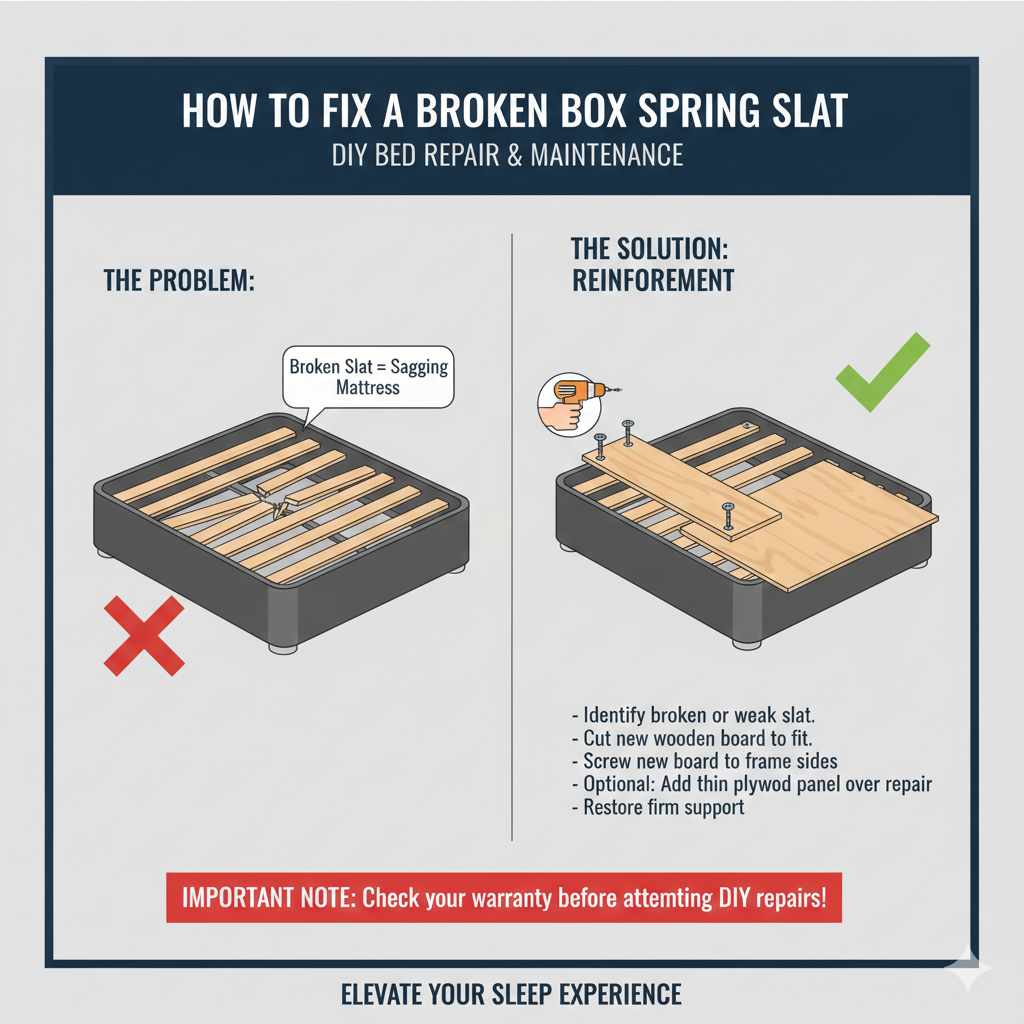
This is the permanent fix. It takes about an hour and costs under $20 if you already have basic tools. Remove the mattress and box spring cover, or just the mattress if the slats are exposed from below.
Cutting and Fitting the New Slat
Measure the old slat’s length and width. The new slat should match exactly — too short and it won’t sit properly on the frame; too long and it’ll bow upward. Transfer the measurements to your replacement wood and mark the cut line.
Cut the slat with your saw. If you’re using a handsaw, go slow and keep the cut straight. Sand the cut edges so they don’t snag the mattress fabric.
Test-fit the new slat. It should lie flat on the lip of the frame with no gaps. If it rocks or twists, trim a hair off one end and try again.
Securing the Slat with Glue and Screws
Apply a thin bead of wood glue along the bottom edge of the new slat where it contacts the frame. Press it into place. The glue adds shear strength and prevents the slat from shifting sideways.
Drill pilot holes through the slat and into the frame. Two screws per end is enough. Countersink the screws slightly so the heads sit flush with the slat surface.
Drive the screws in. Don’t overtighten — you’ll strip the wood and lose the grip. The slat should feel solid when you push on it.
For cracked slats that aren’t fully broken, you can sister the repair: cut a new slat, then glue and screw it directly alongside the cracked one. This doubles the load capacity without removing the original.
Reinforcing the Outer Frame for Maximum Stability
The slats aren’t the only thing that breaks. The outer wooden frame — the rectangle that holds everything together — can crack, especially at the corners or where the center support meets the sides.
If the frame is split, you need more than glue. Here’s the method that actually holds:
- Clean the crack and work wood glue deep into the split. Use a putty knife to force it in.
- Clamp the crack closed. A bar clamp or even a ratchet strap works. Wipe away excess glue that squeezes out.
- Drill pilot holes across the crack, then drive 2.5-inch screws through the frame perpendicular to the split. This pulls the two halves together.
- Add a metal corner brace on the inside of the frame for extra strength. Screw it into both sides of the corner.
- Let the glue dry for 24 hours before putting weight on it.
For a frame that’s cracked in multiple places, consider adding a plywood gusset: a triangular piece of 3/4-inch plywood screwed across the corner. It distributes the load over a wider area and prevents the crack from propagating.
Check the center support beam while you’re in there. If it’s sagging, add a vertical leg made from a 2×4 that runs from the beam down to the floor. This takes enormous stress off the whole structure.
Load Testing and Preventing Future Breaks
After the repair, test it before you trust it. Place your mattress back on the foundation. Sit in the middle, then on each edge. Listen for creaking and watch for any dip. A properly repaired slat should feel identical to the unbroken ones.
Here’s the load math that matters: a single 1×4 pine slat spanning 30 inches can hold roughly 200-300 pounds of distributed weight. A repaired slat with a sistered board or proper glue-and-screw joint can match that. But a slat with just a glue joint and no screws? That’s maybe half the strength. If you’re a heavier person or share the bed, double up on any repaired slat.
Prevention is simpler than repair. Three things cause most slat failures:
- Missing center support: If your box spring doesn’t have a center beam, add one. It cuts the unsupported span in half.
- Overtightened screws: People over-tighten and split the wood. Snug is enough.
- Water damage: A damp mattress or humid room weakens wood over time. Fix leaks and keep the area ventilated.
One more tip: rotate your mattress regularly. It distributes wear more evenly across the slats and prevents one spot from taking all the load.
When to Call It Quits: The Repair vs. Replace Decision
Not every box spring is worth saving. Here’s a practical decision tree:
| Situation | Repair or Replace? | Why |
|---|---|---|
| One or two cracked slats, frame intact | Repair | Simple, cheap, and permanent with proper technique. |
| Multiple slats broken (more than 4) | Replace | Indicates structural fatigue; repairing each one is patchwork. |
| Outer frame cracked or split | Repair (if isolated) | Gluing and bracing works if the crack is in one spot. |
| Frame cracked in several places | Replace | Structural integrity is gone; patches won’t hold. |
| Springs poking through fabric | Replace | That’s a spring failure, not a slat issue. |
| Box spring is over 10 years old | Replace | Wood dries and becomes brittle; other failures are imminent. |
| Water damage or mold present | Replace | Weakened wood can’t be reliably restored. |
If you decide to replace, look for a foundation with a steel frame and wooden slats. That combination avoids the most common failure points. A low-profile option like the MAF bunkie board gives you the support without the height, and the welded steel construction eliminates most squeaking issues.
Common Mistakes to Avoid
Three mistakes ruin more repairs than anything else:
Using the wrong wood. A 1/4-inch plywood strip won’t hold up. Match the original slat’s thickness. If in doubt, go thicker, not thinner.
Skipping the pilot holes. Screwing directly into pine without a pilot hole splits the wood in half. You’ll end up with two broken slats instead of one.
Ignoring the frame. You can replace every slat, but if the frame is flexing, the new slats will break too. Fix the foundation before you fix the surface.
Final Thoughts
Fixing a broken box spring slat is a straightforward DIY job that most people can complete in an afternoon. The key is diagnosing the actual problem — slat, frame, or springs — and matching your repair to the damage.
- Always identify the box spring type before starting; wood slats and metal grids need different approaches.
- For a quick fix, use a temporary floor support under the crack. It buys you time, not permanence.
- A proper repair uses wood glue, pilot holes, and screws. Sistering a cracked slat doubles its strength.
- Reinforce the outer frame with glue, clamps, and corner braces if it’s cracked.
- Add a center support leg if your box spring lacks one — it prevents most future slat breaks.
- Test the repair with your full body weight before trusting it.
- If the frame is damaged in multiple places or the springs are failing, replace the unit rather than patching it.
Your bed is one of the most-used pieces of furniture you own. A few dollars and an hour of work can extend its life by years. And if you’re in the market for a new foundation, understanding how they’re built will help you choose one that lasts. For more on foundation types, check out the difference between box springs and platform beds to see which suits your setup.
Products related to this article
Sponsored / affiliate links. As an Amazon Associate I earn from qualifying purchases. I may earn additional commission from eligible campaigns.