
Can Fibroids Cause Blood in Urine: Key Facts
It can be confusing to figure out if fibroids are the reason for blood in your urine. Many people wonder, Can Fibroids Cause Blood in Urine? Key Facts.
For a closely related home or decor topic, What Causes Glucose in Urine: Warning Signs gives readers a useful next step.
For a closely related home or decor topic, How Long Does Tylenol 3 Stay in: Urine Facts gives readers a useful next step.
For a closely related home or decor topic, Do Fibroids Cause Blood In Urine? gives readers a useful next step.
This topic might seem tricky at first because other things can also cause this. But don’t worry, we’re here to make it super simple. We will walk you through it step by step.
Let’s get to the bottom of this so you know what to look for and what to do next.
Understanding Fibroids and Urinary Symptoms
This part helps you learn what fibroids are and how they might affect your bladder and kidneys. We will explain what fibroids are in simple terms and why they sometimes press on parts of your body that control urination. This can lead to noticing blood when you go to the bathroom.
It’s important to know the basics so you can understand the connection better.
What Are Uterine Fibroids
Uterine fibroids are lumps that grow in a woman’s uterus. They are not cancer. Most of the time, they are not a big problem.
But sometimes, they can grow large enough to cause issues.
These fibroids can be found in different places within or on the uterus. Some grow on the outside wall. Others grow within the uterine wall.
Some can even stick out from the uterus on a stalk. The size can vary a lot, from as small as a pea to as large as a grapefruit.
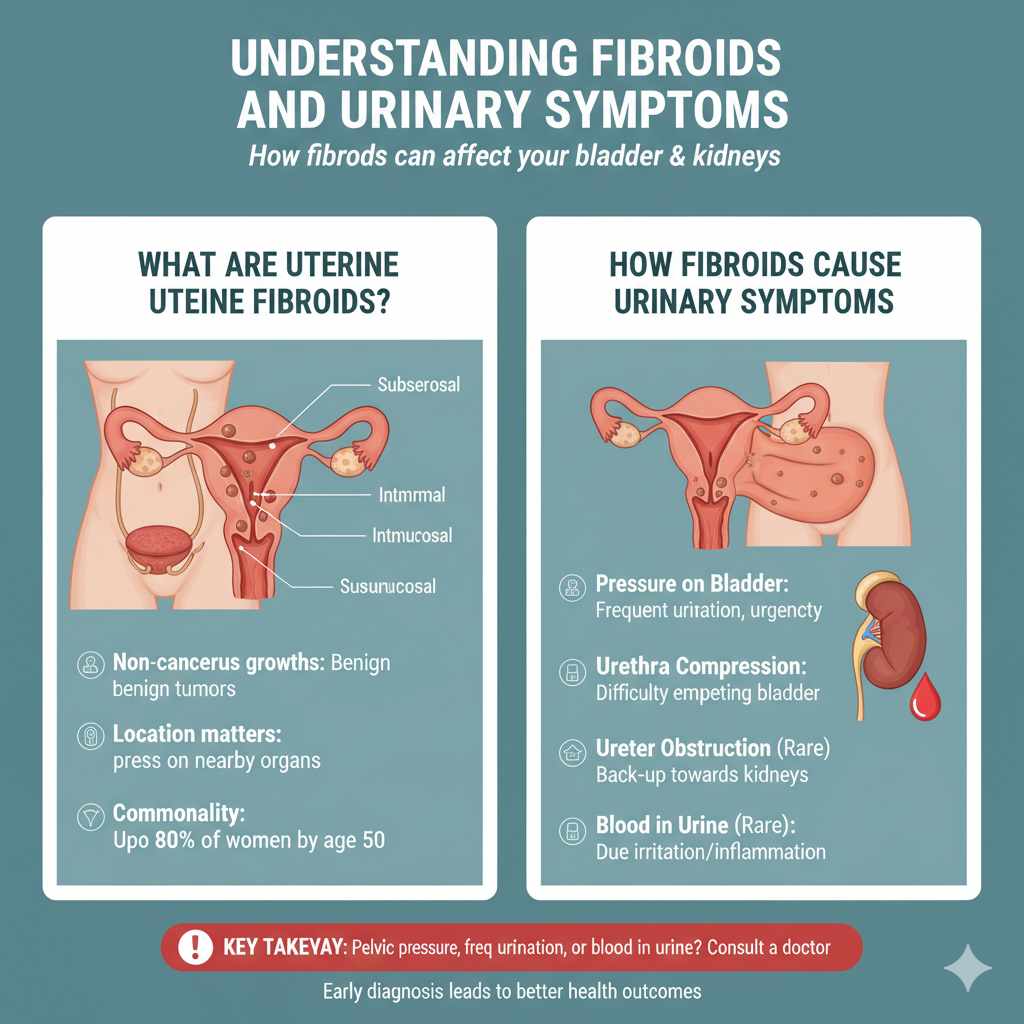
Non-cancerous growthsFibroids are benign tumors. This means they are not cancerous and do not spread to other parts of the body. They are very common, especially for women in their reproductive years.
Location mattersWhere a fibroid is located can greatly affect the symptoms a woman experiences. If a fibroid grows large or is positioned in a certain way, it can press on nearby organs. This includes the bladder, which is located directly in front of the uterus.
CommonalityEstimates suggest that up to 80% of women develop fibroids by the time they reach age 50. Many women never know they have them because they don’t cause any symptoms. However, when they do cause symptoms, they can be significant and impact daily life.
How Fibroids Can Affect the Urinary System
When fibroids grow, they can get quite big. If they are located near your bladder, they can press on it. Think of it like holding a large balloon against a smaller one.
The pressure can make it hard for the bladder to work normally.
This pressure can lead to problems like needing to pee more often. It can also make it feel like you can’t empty your bladder completely. In some cases, the pressure can even affect the tubes that carry urine from the kidneys to the bladder.
These tubes are called ureters.
Bladder pressureA fibroid pressing on the bladder can cause a feeling of fullness even when it’s not full. It can also irritate the bladder lining. This irritation might lead to increased urinary frequency and urgency.Sometimes, it can even cause incontinence, which means leaking urine.
Ureter obstructionIf fibroids are large or located in a specific area, they can press on the ureters. The ureters are tubes that connect the kidneys to the bladder. When a ureter is blocked, urine can back up into the kidney.This can be painful and lead to serious kidney problems if not treated.
Pain and discomfortThe pressure and irritation caused by fibroids can lead to general pelvic pain. This pain might worsen when you press on your abdomen. Sometimes, the pain can radiate to your back or legs, adding to the discomfort.
Identifying Blood in Urine Due to Fibroids
Now, let’s talk about the main question: Can Fibroids Cause Blood in Urine? Key Facts. Seeing blood in your urine, a condition called hematuria, can be concerning.
While fibroids are not the most common cause of blood in urine, they can indeed be a reason. Understanding how this happens is key to knowing if your fibroids might be the culprit.
When fibroids grow and press on the urinary tract, they can cause changes that lead to bleeding. This bleeding can happen in different ways. Sometimes, it’s a direct result of irritation.
Other times, it’s due to more serious blockages.
What is Hematuria
Hematuria is the medical term for blood in the urine. It can be visible to the naked eye, which is called gross hematuria. Or, it can only be seen under a microscope, which is called microscopic hematuria.
Seeing blood, even a small amount, is never normal and should always be checked by a doctor.
There are many reasons why someone might have hematuria. Some are minor, like a simple urinary tract infection (UTI). Others can be more serious, like kidney stones or even kidney disease.
That’s why it’s so important to see a healthcare provider to find out the exact cause.
Visible bloodGross hematuria means you can see the blood in your urine. It can make your urine look pink, red, or even brown, like cola. This is often the first sign that something is wrong and usually prompts a person to seek medical attention right away.
Microscopic bloodMicroscopic hematuria means there are red blood cells in the urine, but they are too small to be seen without a microscope. This can be found during a routine urine test. Even if you don’t see blood, it still needs to be investigated.
Other causesIt’s important to remember that many things can cause blood in the urine. These include infections, kidney stones, strenuous exercise, certain medications, and more serious conditions like bladder or kidney cancer. This is why a proper diagnosis is essential.
When Fibroids Cause Bleeding
Fibroids can lead to blood in the urine through a few main pathways. One is by pressing on the bladder or ureters. This pressure can cause damage or inflammation, which might lead to bleeding.
Another way is if a fibroid grows very large and starts to break down, releasing blood.
If a fibroid is pressing on your ureters, it can cause a backup of urine. This backup can put pressure on the kidneys and potentially cause bleeding from the kidney itself. This is a more serious situation and needs prompt medical attention.
Sometimes, heavy or large fibroids can also affect blood flow in the pelvic region, indirectly contributing to urinary tract irritation and bleeding.
Direct pressure on urinary tractWhen fibroids grow, they can push against the bladder or the ureters. This constant pressure can irritate the delicate lining of these organs. Irritation can cause inflammation and damage, leading to small blood vessels breaking and releasing blood into the urine.
Kidney back-upIf a fibroid blocks a ureter, urine cannot flow freely from the kidney to the bladder. This blockage causes urine to build up in the kidney. This condition, called hydronephrosis, can increase pressure within the kidney and potentially lead to bleeding.It can also cause significant pain.
Vascular changesLarge fibroids can sometimes affect the blood supply to the surrounding tissues, including parts of the urinary tract. Changes in blood flow or increased pressure in the pelvic blood vessels might contribute to minor bleeding or irritation that shows up as blood in the urine.
A study published in the Journal of Urology noted that uterine fibroids were identified as the cause of recurrent gross hematuria in a small percentage of cases. The mechanism often involved extrinsic compression of the ureters by large or pedunculated fibroids.
Diagnosis and When to See a Doctor
If you think your fibroids might be causing blood in your urine, it’s really important to talk to your doctor. They are the best people to figure out what’s going on. They have ways to check and make sure it’s indeed the fibroids and not something else.
Don’t wait if you see blood in your urine. Getting a quick diagnosis means you can get the right treatment sooner. This can help you feel better and prevent any other health problems from developing.
Signs That Could Point to Fibroids
Besides blood in the urine, other signs might suggest that fibroids are causing your urinary issues. These can include a frequent need to urinate, pain when you urinate, or feeling like you can’t empty your bladder. Pelvic pain or pressure is also a common symptom associated with fibroids.
It’s helpful to keep a log of your symptoms. Note down when you notice blood, how much, and any other feelings or pains you experience. This information will be very useful when you talk to your doctor.
Increased urinary frequency and urgencyFeeling like you have to pee all the time, even if you don’t pee much when you go, can be a sign of bladder pressure from fibroids. This urgency can be strong and hard to control, leading to accidents.
Pain or difficulty urinatingSome women experience pain or a burning sensation when they urinate. It might also feel difficult to start urinating or to empty the bladder completely. This could be due to inflammation or pressure affecting the urinary tract.
Pelvic pain and pressureFibroids can cause a feeling of heaviness or pressure in your lower abdomen or pelvis. This pain can range from a dull ache to sharp pains, and it may worsen during your period or with physical activity.
Medical Tests to Confirm the Cause
Doctors use several tests to figure out if fibroids are causing blood in your urine. They will likely start with a urine test to check for infection or other issues. Then, they might use imaging tests like an ultrasound, MRI, or CT scan to get a clear picture of your uterus and see if fibroids are present and how large they are.
These imaging tests are very helpful because they can show the exact size and location of fibroids. They can also show if fibroids are pressing on your bladder or ureters. Sometimes, a procedure called a cystoscopy might be done.
This involves inserting a small camera into the bladder to look for any problems inside.
UrinalysisThis is a standard urine test. It checks for red blood cells, white blood cells, bacteria, and other substances. It helps rule out infections or other common causes of blood in the urine, such as kidney stones.
Pelvic UltrasoundAn ultrasound uses sound waves to create images of your uterus and ovaries. It’s a safe and effective way to detect fibroids, measure their size, and see where they are located. It can also show if they are impacting nearby organs.
MRI (Magnetic Resonance Imaging)An MRI provides more detailed images than an ultrasound. It can give doctors a very clear view of the fibroids and their relationship to other structures, like the bladder and ureters. This helps in planning any necessary treatment.
CT Scan (Computed Tomography)A CT scan uses X-rays to create cross-sectional images. It can also be used to visualize fibroids and assess for any complications, such as urinary tract obstruction.
A recent survey indicated that approximately 60% of women experiencing urinary symptoms possibly related to fibroids reported a delay in diagnosis, often due to attributing symptoms to other common conditions.
Treatment Options for Fibroids Causing Urinary Issues
If fibroids are indeed causing blood in your urine and other urinary problems, there are several treatment options available. The best treatment for you will depend on the size and number of fibroids, your symptoms, and your overall health. Your doctor will discuss these options with you.
The goal of treatment is to relieve your symptoms, reduce the size of the fibroids, or remove them altogether. Some treatments focus on managing symptoms, while others aim to get rid of the fibroids. It’s about finding the right fit for your situation.
Medications to Manage Fibroid Growth and Symptoms
There are medications that can help shrink fibroids or control their growth. Some medications work by lowering the levels of hormones that cause fibroids to grow. These can help reduce symptoms like heavy bleeding and pelvic pain.
Hormonal therapies, such as birth control pills or GnRH agonists, can be used. They temporarily shrink fibroids and reduce bleeding. However, they don’t permanently get rid of fibroids and symptoms often return once treatment stops.
Your doctor will guide you on the best medication approach.
Hormonal treatmentsThese include birth control pills, patches, or vaginal rings, which regulate hormones and can reduce heavy bleeding. GnRH agonists temporarily shut down ovarian hormone production, causing fibroids to shrink. They are usually used for a short time before surgery.
Medications for symptomsPain relievers like NSAIDs (e.g., ibuprofen) can help manage pelvic pain associated with fibroids. Medications to reduce bleeding, like tranexamic acid, can also be prescribed for heavy periods.
Selective progesterone receptor modulators (SPRMs)These drugs can help control bleeding and reduce fibroid size. They work by interfering with the effects of progesterone, a hormone that can stimulate fibroid growth.
Surgical and Non-Surgical Procedures
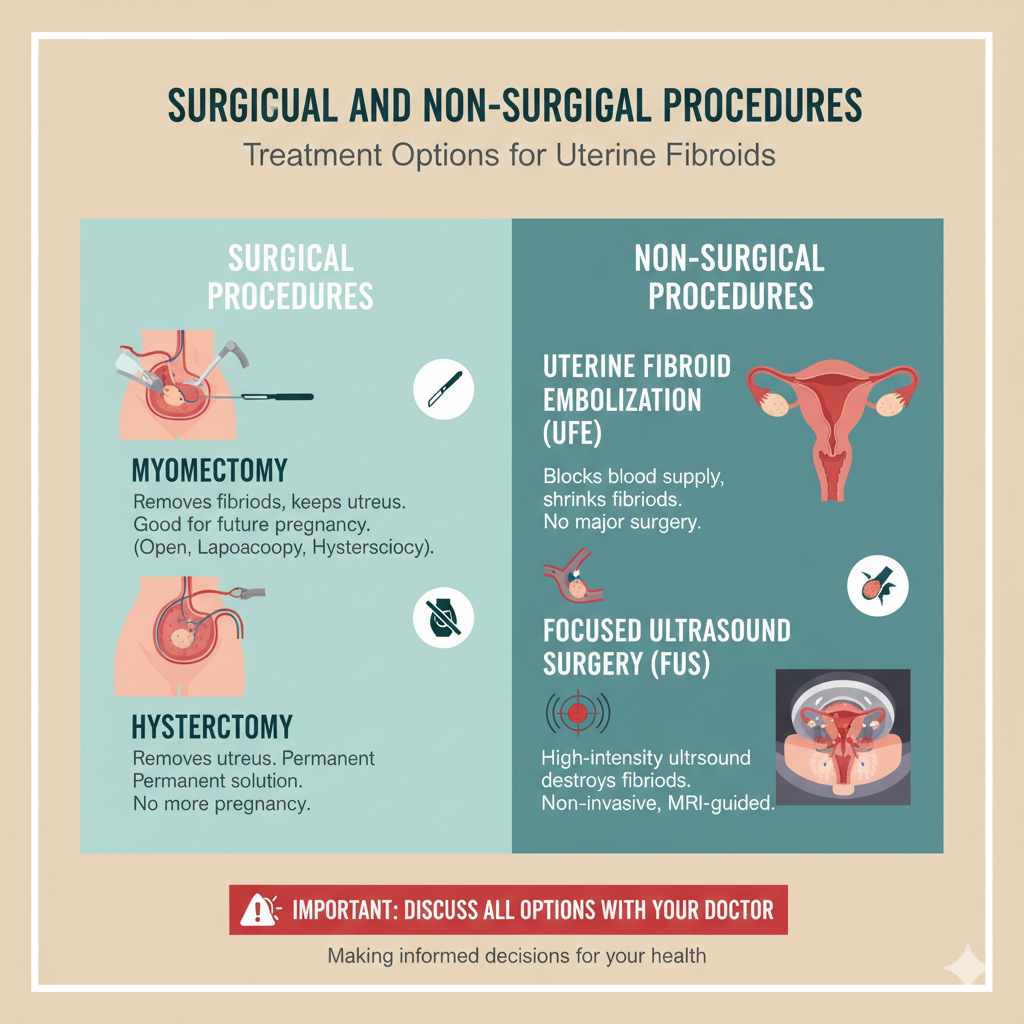
If medication isn’t enough, surgery might be considered. There are different types of surgery. Myomectomy is a procedure to remove fibroids while keeping the uterus intact.
This is often done if you wish to have children in the future.
Hysterectomy is another surgical option, where the uterus is removed. This is a permanent solution for fibroids but means you can no longer get pregnant. There are also minimally invasive procedures like uterine fibroid embolization (UFE) or focused ultrasound surgery, which can treat fibroids without major surgery.
MyomectomyThis surgery removes fibroids from the uterine wall. It can be done through open surgery, laparoscopy (keyhole surgery), or hysteroscopy (using a scope through the cervix). It preserves the uterus, which is important for women planning pregnancy.
HysterectomyThis is the surgical removal of the uterus. It is a definitive treatment for fibroids, as it completely eliminates the possibility of fibroid regrowth. It is usually considered when other treatments have failed or if symptoms are severe.
Uterine Fibroid Embolization (UFE)This is a non-surgical procedure where tiny particles are injected into the blood vessels that supply the fibroids. This cuts off the blood supply, causing the fibroids to shrink. It is performed by an interventional radiologist.
Focused Ultrasound Surgery (FUS)This is a non-invasive treatment that uses high-intensity focused ultrasound waves to heat and destroy fibroid tissue. It is done using MRI guidance to precisely target the fibroids.
FAQ
Question: Can fibroids cause a urinary tract infection
Answer: While fibroids themselves don’t directly cause urinary tract infections (UTIs), they can indirectly increase the risk. Large fibroids can press on the bladder, making it harder to empty completely. This can leave residual urine in the bladder, creating a breeding ground for bacteria and potentially leading to UTIs.
Question: Is blood in urine from fibroids painful
Answer: Blood in the urine itself may not be painful. However, the underlying cause, such as pressure on the bladder or ureters from fibroids, or any resulting inflammation or obstruction, can cause pain. Pelvic pain and discomfort are common symptoms associated with fibroids that can be significant.
Question: How quickly do fibroids need to be treated if they cause blood in urine
Answer: If you notice blood in your urine, it’s important to see a doctor promptly to determine the cause. If fibroids are confirmed as the reason, the urgency of treatment depends on the severity of symptoms, the amount of bleeding, and whether there are signs of kidney damage. Your doctor will advise on the best course of action.
Question: Can small fibroids cause blood in urine
Answer: While larger fibroids are more likely to cause pressure on the urinary tract, even small fibroids, if located in a critical position, could potentially contribute to symptoms. The location and specific positioning of the fibroid are often more important than its size alone in determining if it can cause urinary issues.
Question: Will I always have symptoms if I have fibroids that cause blood in urine
Answer: No, not necessarily. Many women with fibroids have no symptoms at all. However, if fibroids are pressing on your urinary tract or causing other significant issues, you will likely experience symptoms.
Blood in the urine is a notable symptom that requires medical attention.
Summary
Fibroids can sometimes cause blood in your urine, especially if they press on the bladder or urinary tract. However, they are not the most common cause, so it’s important not to assume.
If you notice blood in your urine, always see a doctor to find the exact reason. The good news is that fibroids are treatable, and with the right care, symptoms can be managed effectively.
Early attention is the key to staying safe and healthy.
Products related to this article
Sponsored / affiliate links. As an Amazon Associate I earn from qualifying purchases. I may earn additional commission from eligible campaigns.